Senate Democrats blocked a bill Wednesday night that would make President Trump's new Justice Department fraud unit permanent. Sen. Sheldon Whitehouse objected after calling the division a "perfect vehicle" for weaponization. The House-passed text answers that charge directly: it puts every career employee of the division under the strictest political-activity limits in federal law, the same tier that covers the FBI and the DOJ Criminal Division.
What happened on the Senate floor Wednesday?
On Sept. 30, the Senate's last working day before the midterms, Sen. Eric Schmitt (R-Mo.) asked unanimous consent to pass H.R. 9576, the National Fraud Enforcement Division Act of 2026, exactly as the House sent it over. A unanimous consent request means no vote. One senator's objection kills it on the spot.
That senator was Whitehouse, the Rhode Island Democrat and former U.S. attorney. The Senate Press Gallery's floor log records the exchange at 5:39 p.m.: Schmitt asked, Whitehouse objected and asked that the bill be modified, and Schmitt objected to the modification. Hours later the Senate adjourned. According to the gallery's schedule, it holds only pro forma sessions until it returns for business on Monday, Nov. 9.

Sen. Sheldon Whitehouse (D-R.I.), who objected to passing H.R. 9576 on Sept. 30. (United States Senate Photographic Studio, public domain, via Wikimedia Commons)
The House already passed it 352-72
This was not a party-line bill. Rep. Brad Finstad (R-Minn.) and Rep. Derek Schmidt (R-Kan.) introduced it July 2. It passed the House 352-72 on Sept. 16. That is far more votes than Republicans hold in the House, so a large bloc of Democrats crossed over to support it.
The division already exists on paper inside the executive branch. Colin McDonald was sworn in as its first Assistant Attorney General in April after Senate confirmation. In an Aug. 13 memo, as summarized by Holland and Knight, he set five priorities: public trust and financial integrity, healthcare, internal revenue, global trade, and corporate misconduct. The same memo cites Government Accountability Office estimates that Washington loses between $233 billion and $521 billion a year to fraud.
The catch is that anything one administration builds by reorganization, the next one can tear down by reorganization. "Without this bill codifying it, fraudsters will know that their paydays will soon return because a future administration could disband the division," Schmitt said on the floor, according to the Congressional Record (pages S5215 to S5217).
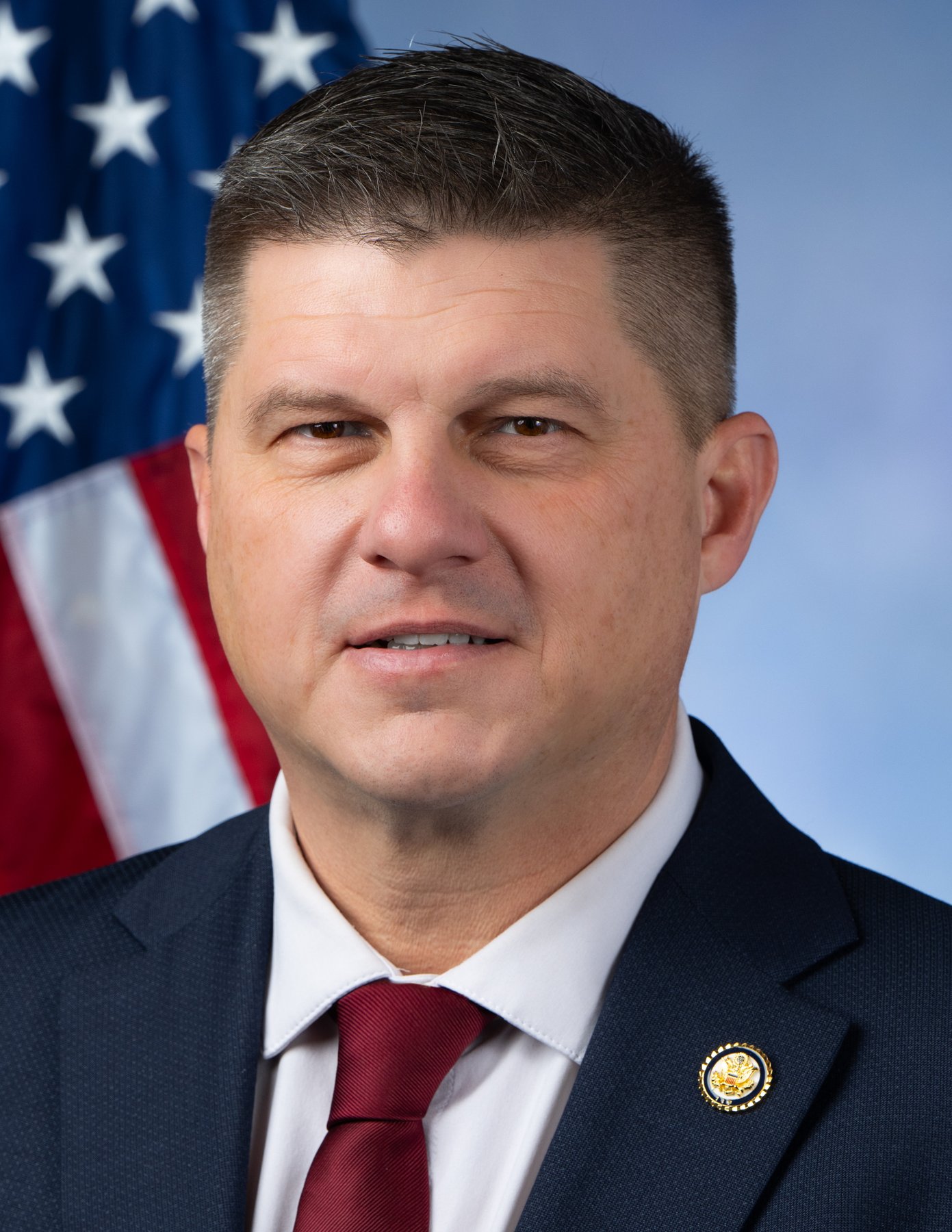
Rep. Brad Finstad (R-Minn.), lead sponsor of H.R. 9576. (House Creative Services, public domain, via Wikimedia Commons)
Whitehouse's case: a "perfect vehicle" for weaponization
Whitehouse did not argue that fraud is a small problem. He argued that this administration can't be trusted with a fraud unit. He told the chamber that weaponizing the Justice Department against Trump's political enemies is the real priority, "and this new component is the perfect vehicle for more of that."
He went after McDonald personally, describing him as a former co-chair of the department's "so-called Weaponization Working Group." He also complained that Judiciary Committee Democrats had asked how the division would be structured and operated and got "No answer."
Then came the counteroffer. Whitehouse asked to swap Schmitt's bill for his own S. 4004, which he said would restore the Organized Crime Drug Enforcement Task Forces, a Reagan-era program he said the Trump administration "eliminated entirely." Schmitt refused. He said the swap "deals with a completely different topic" and would undo the administration's Homeland Security Task Force model for going after cartels. With the swap rejected, Whitehouse objected to the original request and the bill died for the session.
What the bill text actually says about politics
Here is the part neither senator mentioned. Section 2(c) of the House-passed bill is three lines long, and it amends the Hatch Act. It inserts "National Fraud Enforcement Division" into 5 U.S.C. 7323(b)(3).
That subsection is the federal government's strictest political-activity rule. Today it names only two components of the Justice Department, the Criminal Division and the National Security Division. Employees there "may not take an active part in political management or political campaigns." The only exception is for officials confirmed by the Senate. Rank-and-file prosecutors in those divisions can vote and hold opinions, but they cannot work on campaigns the way ordinary federal workers may on their own time.
So the bill Whitehouse called a weaponization vehicle would put every career lawyer and agent in the fraud division behind the same political firewall as the FBI. Because the statute names only those two divisions today, staff in a division created by internal reorganization would not obviously fall under that top tier unless Congress adds them. That is our reading of the statute's plain text, and the Justice Department has not said publicly how it classifies the division's employees right now. Either way, a senator worried about partisan prosecutors could hardly ask for a sharper tool. Whitehouse objected to it anyway.
Official record
H.R. 9576, National Fraud Enforcement Division Act of 2026, as passed by the House on Sept. 16, 2026 (engrossed text, GovInfo). Page 2 shows the new 28 U.S.C. 509C. Page 3 adds the division to the Hatch Act's 5 U.S.C. 7323(b)(3).
"Section 7323(b)(3) of title 5, United States Code, is amended by inserting ', National Fraud Enforcement Division,' after 'Criminal Division'."
H.R. 9576 (EH), Sec. 2(c)
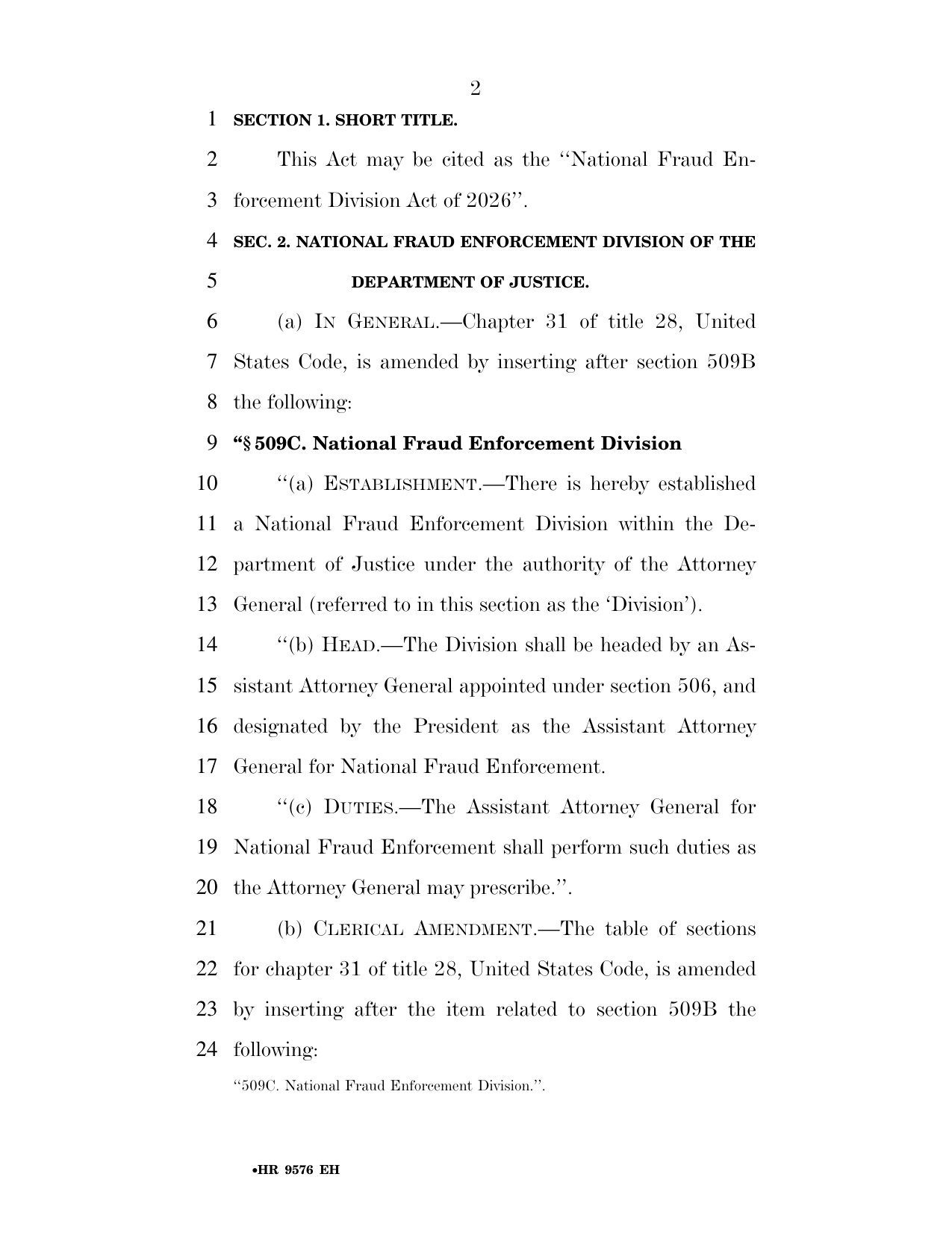
Read or download the full 4-page House-passed bill (PDF) · view the original on GovInfo
The House quietly cut the job description
A second detail cuts the other way, and it partly explains Whitehouse's complaint about structure. The version that passed is not the version most people summarized.
The bill Finstad introduced in July spelled out seven duties for the new Assistant Attorney General. They included leading the department's work against fraud "affecting the Federal Government, Federally funded programs, and citizens of the United States," overseeing multi-district and multi-agency investigations, and setting national enforcement priorities. Before the floor vote, the Rules Committee swapped in a substitute, Rules Committee Print 119-41, under a closed rule. The same report shows the bill was never reported by the Judiciary Committee, so the Rules Committee waived the point of order against that.
The substitute dropped all seven duties. The passed text now says only that the Assistant Attorney General "shall perform such duties as the Attorney General may prescribe." Finstad's own Sept. 16 press release still describes a division "to investigate, prosecute, and prevent fraud within federally funded programs." That wording comes from the introduced version, not the one the House approved.
Official record
H.R. 9576 as introduced July 2, 2026 (GovInfo). Page 2 lists the duties that the House-passed substitute later replaced with "such duties as the Attorney General may prescribe."
"(1) lead the efforts of the Department of Justice to investigate, prosecute, and remedy fraud affecting the Federal Government, Federally funded programs, and citizens of the United States; (2) oversee multi-district and multi-agency fraud investigations..."
H.R. 9576 (IH), Sec. 2(b)
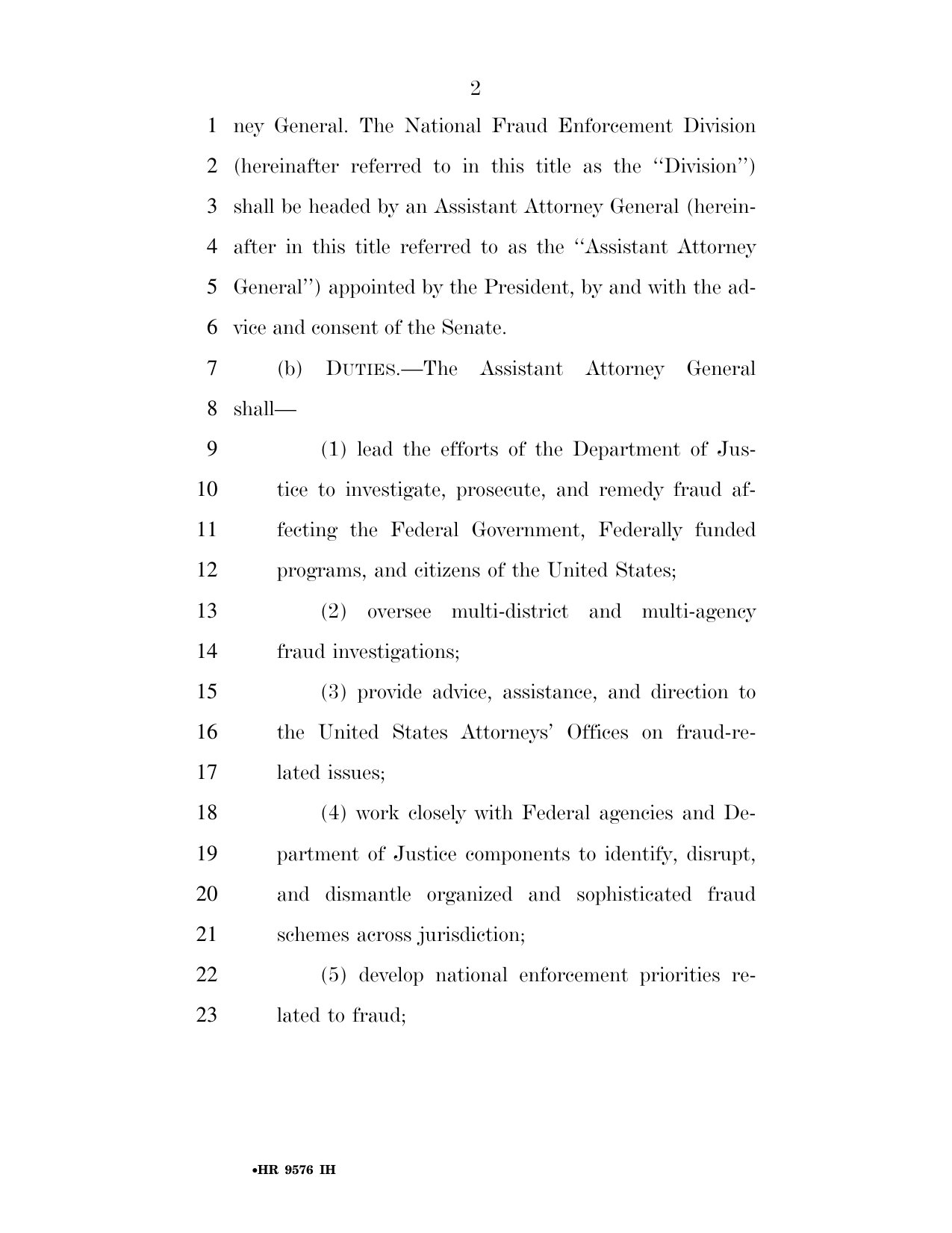
Read or download the full 3-page introduced bill (PDF) · view the original on GovInfo
Why a shorter bill may be the smarter bill
There is a fair argument for the trim. The standard formula, "such duties as the Attorney General may prescribe," is how Congress usually handles assistant attorneys general. It lets the Attorney General, who answers to the President and to Congress, shift resources as fraud schemes change. A seven-point list written into law in 2026 could become a straitjacket by 2030.
What the bill does lock in is the part that is hard to undo. A named division in Title 28 can't be dissolved without an act of Congress. Its head must be one of the assistant attorneys general appointed under 28 U.S.C. 506, which means Senate confirmation. And its staff would be locked out of campaign work. If Whitehouse wanted more detail on structure, the honest move was to amend this bill, not to swap in a different one about drug task forces.
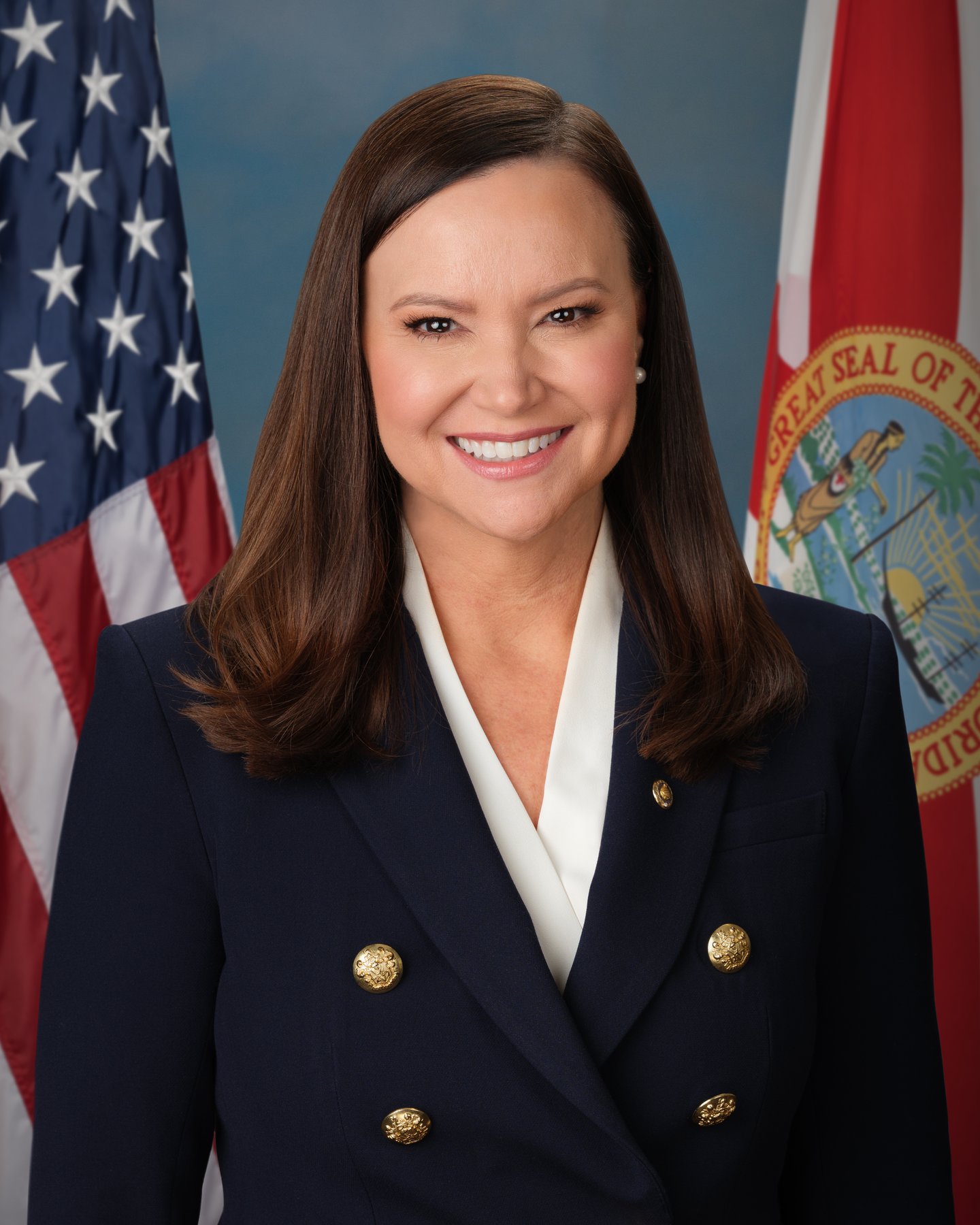
Sen. Ashley Moody (R-Fla.), who filed the Senate companion bill and spoke with Schmitt on Sept. 30. (United States Senate Photography Service, public domain, via Wikimedia Commons)
Was it the only anti-fraud bill blocked that day?
No. Sen. Ashley Moody (R-Fla.), a former Florida attorney general who filed the Senate companion the day after the House vote, told the chamber that Sen. Joni Ernst's anti-fraud package had been blocked earlier the same day. The floor log confirms it: at 2:55 p.m., Ernst asked consent to pass S. 4952, the Protecting American Taxpayers Act, and Sen. Ron Wyden objected.
"Dismantling the fraud economy and going after those who defraud the American taxpayer should be a 100-to-0 issue," Moody said. Finstad put out a statement accusing Senate Democrats of putting "fraudsters above American taxpayers."
What happens next
Nothing until at least Nov. 9. The Senate's first scheduled business when it returns is a cloture vote tied to the permitting reform deal, so the fraud bill would have to compete for floor time in a lame-duck session. Schmitt could try unanimous consent again, and Whitehouse could object again. Getting around him means a cloture vote with 60 senators, which means Democrats.
The bigger stakes come after that. If H.R. 9576 isn't law by the time the 119th Congress ends in January, it dies, and the House has to pass it again from scratch. Until then the National Fraud Enforcement Division runs on an administrative order that any future Attorney General can reverse. That is exactly the outcome Schmitt warned about on the floor, and Wednesday night's objection makes it more likely.