President Trump's Council of Economic Advisers put a price on the Democratic Socialists of America's agenda Wednesday night: $49 trillion over ten years, or about $355,000 per household. Read the 92-page report itself, and one line item carries almost the entire bill. Medicare for All accounts for $47.4 trillion of the $48.9 trillion net total, roughly 97 cents of every dollar.
The White House Scored the Socialist Platform Line by Line
The report, titled "The Real Cost of Socialism in America," went up on WhiteHouse.gov on October 1. The CEA says it "took them at their word, examined their policy proposals," and scored eight pillars of the DSA program: student debt cancellation with free college, open borders and amnesty, abolishing the police and prisons, Medicare for All, universal rent control, the Green New Deal, a 32-hour workweek and a 5 percent annual wealth tax on billionaires.
The White House press release did not soften the message. "Make no mistake, these are the Democrats' policies," it says, adding that "under President Trump's leadership, the United States of America will never be a Communist nation."
This is the second time a Trump CEA has done this. On October 23, 2018, the council released "The Opportunity Costs of Socialism," which estimated that Venezuela-style policies would cut U.S. GDP by at least 40 percent. Eight years later, the target has a name, a membership roll and a mayor in New York City.
Official record
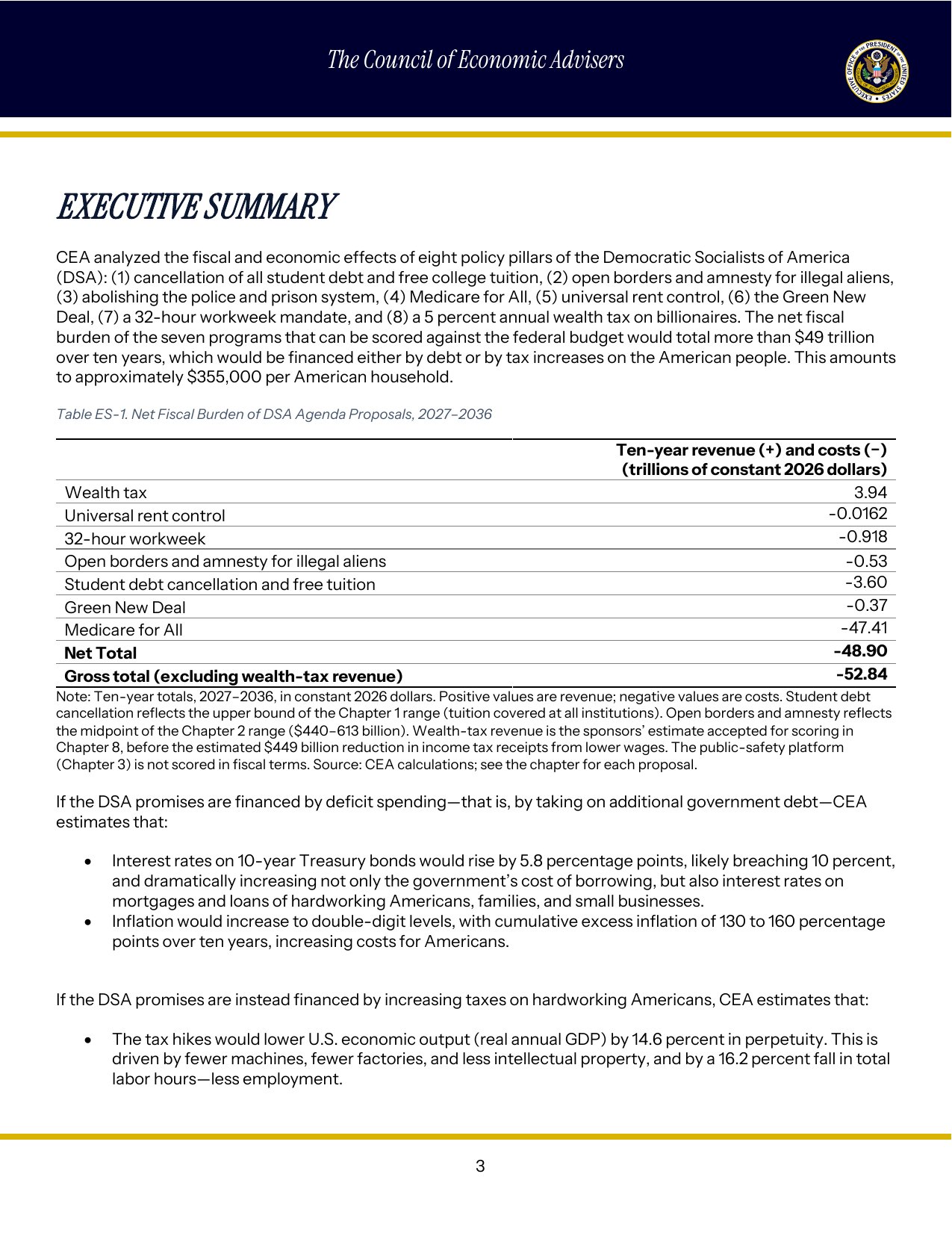
Council of Economic Advisers, The Real Cost of Socialism in America: Scoring the Economic and Fiscal Impact of the DSA Agenda, October 2026, 92 pages. Table ES-1 appears on page 3 of the report.
"The net fiscal burden of the seven programs that can be scored against the federal budget would total more than $49 trillion over ten years, which would be financed either by debt or by tax increases on the American people."
Council of Economic Advisers, Executive Summary
Read or download the full 92-page report (PDF) · view it on WhiteHouse.gov
Where Does the $49 Trillion Actually Come From?
Table ES-1 is the heart of the report, and it is worth reading slowly. Medicare for All costs $47.41 trillion. Student debt cancellation and free tuition cost $3.60 trillion. The 32-hour workweek costs $918 billion in lost federal revenue, open borders and amnesty $530 billion, the Green New Deal $370 billion and universal rent control $16 billion. The wealth tax shows up as a gain of $3.94 trillion.
Run the arithmetic and the headline number is a Medicare for All number. Take that one program out, and the six other scored items plus the wealth tax net to about $1.5 trillion over ten years. Of the roughly $355,000 per household the CEA cites, about $344,000 traces to single-payer health care alone. (Those last two figures are PatriotAddict's own math from the CEA's table.)
None of that makes the rest of the agenda harmless. It means the fight that matters most in dollars is the one over your health insurance, and the White House release mostly buried it in a bullet that reads "Forcing government-run healthcare for everyone."
Medicare for All Is a Real Bill With Real Sponsors
This is not a slogan on a protest sign. The CEA's Chapter 4 scores the Medicare for All Act of 2025, reintroduced April 29, 2025, by Sen. Bernie Sanders in the Senate (S. 1506) and by Reps. Pramila Jayapal and Debbie Dingell in the House (H.R. 3069). The report notes that Reps. Alexandria Ocasio-Cortez and Rashida Tlaib, both DSA members, campaigned on it, and that DSA made it a national priority at its 2017 convention.

Sen. Bernie Sanders and Rep. Alexandria Ocasio-Cortez at a "Fight Oligarchy" rally at Mullett Arena in Tempe, Arizona, March 20, 2025. Sanders is the lead Senate sponsor of the Medicare for All Act. (Gage Skidmore, CC BY-SA 2.0, via Wikimedia Commons)
According to the CEA's reading of the bill text, it would make it unlawful to sell private insurance that duplicates the government plan (Sec. 107), fold Medicare, most of Medicaid, CHIP and federal employee coverage into one program, and bar exclusion on the basis of citizenship status (Sec. 104). It also lists "comprehensive gender-affirming health care" as a covered benefit (Sec. 201(a)(9)). The CEA puts the ten-year cost of covering sex-change operations at $30 billion in its base case, with a range of $6 billion to $68 billion.
Sanders' Own Pay-Fors Cover Less Than Half
Here is the detail most coverage skipped. The CEA did not just tally spending. It applied the revenue options Sanders' office published alongside the bill, and they come up short. For the 2028 through 2036 full-operation years, the report finds a $44.9 trillion health-program deficit against $17.2 trillion in listed financing.
"The resulting cumulative net budgetary impact is a $27.706 trillion deficit. Put differently, the specified financing options cover less than half of the health-program shortfall shown in the table, leaving a very large residual financing requirement."
Council of Economic Advisers, Chapter 4
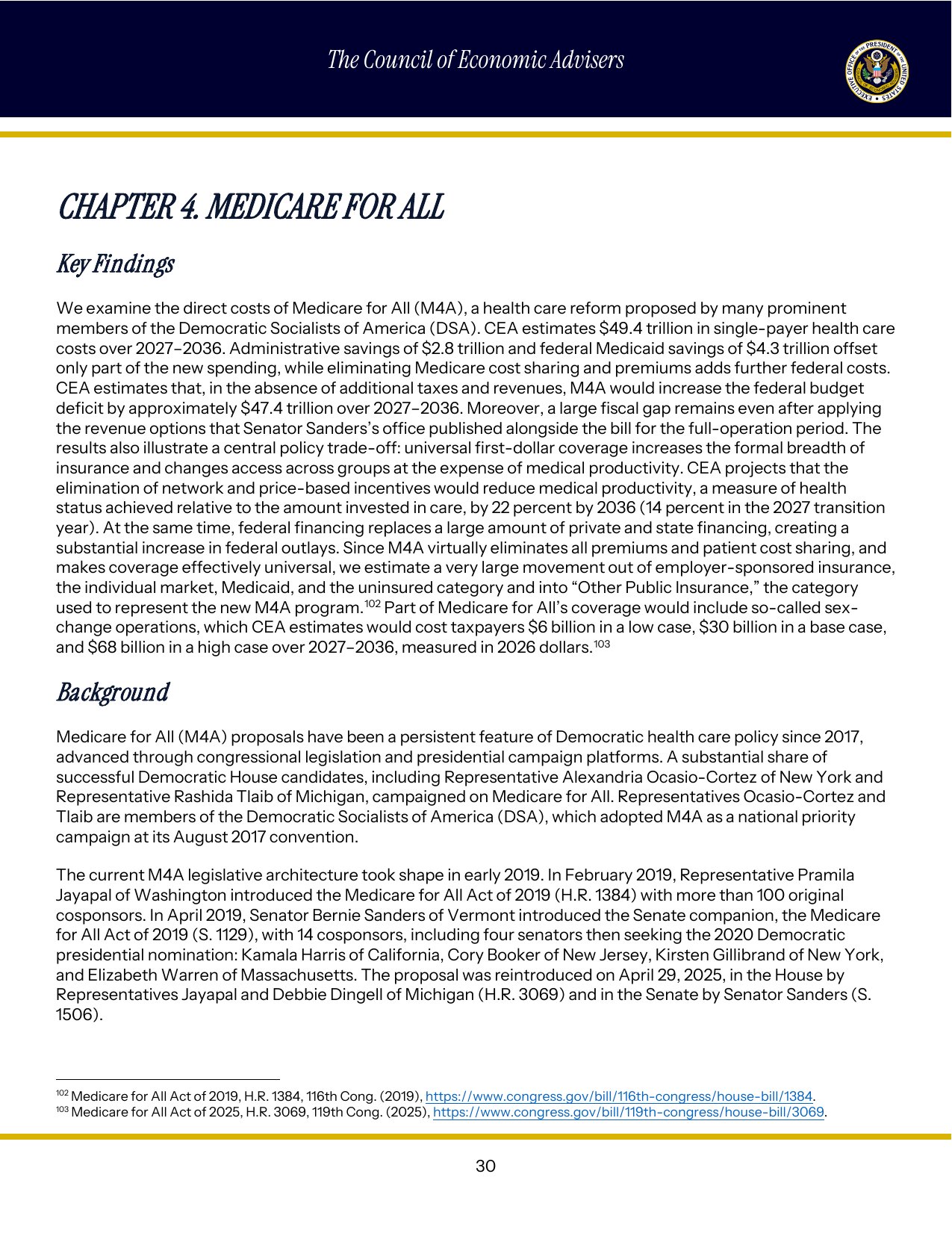
The opening page of Chapter 4, where the CEA puts single-payer costs at $49.4 trillion over 2027 to 2036 before offsets. (Council of Economic Advisers, October 2026, public domain U.S. government work)
Is the CEA's number an outlier? By the report's own account, no. It says earlier ten-year estimates clustered between $32 trillion and $38 trillion for windows ending around 2030, which it translates to roughly $43 trillion to $51 trillion for a window ending in 2036. That range includes the Mercatus Center's 2018 estimate of $32.6 trillion and the left-leaning Urban Institute's figure of about $34 trillion. The CEA's $47.4 trillion lands inside the band it describes.
The Report Gives the Wealth Tax Every Benefit of the Doubt
The CEA scored the wealth tax using the Sanders and Ro Khanna Make Billionaires Pay Their Fair Share Act, a flat 5 percent annual tax on the entire net worth of anyone above $1 billion. For the budget table, it accepted the sponsors' own revenue estimate of $3.94 trillion, before subtracting $449 billion in lost income tax from lower wages.
Even on those generous terms, the council finds a cost to workers. Its central estimate is that real wages fall about 2.5 percent, roughly $1,700 a year for the median full-time worker, with about 1.1 million fewer jobs by year ten. It also projects a $3.8 trillion drop in stock market value, which it pegs at about $2,100 for the median 401(k).
The 32-hour workweek is no hypothetical either. The report cites the Thirty-Two Hour Workweek Act, H.R. 10323, introduced September 8, 2026, and estimates it would push unemployment from 4.1 percent to somewhere between 6.6 and 8.2 percent.
What the $49 Trillion Leaves Out
The headline figure counts only what hits the federal budget, and that makes it a floor rather than a ceiling. The Green New Deal shows up at just $370 billion in Table ES-1, but Chapter 6 puts its full cost to households and businesses at more than $12 trillion over 25 years, or over $91,000 per household. Rent control registers $16 billion in the table, while Chapter 5 estimates it would destroy about $545.5 billion in economic value and leave 3.3 million fewer rental units after ten years.
The police and prison chapter is not scored in dollars at all. Instead, the CEA estimates that an extra 1,000 crimes per 100,000 people is associated with 173 more deaths per 100,000 when the added crime is violent.
Outside analysts have gone higher. Adam Michel, director of tax policy studies at the Cato Institute, tallied the DSA platform in September and came up with $71 trillion to $212 trillion in new spending over a decade, including a federal jobs guarantee the CEA did not score. "There aren't enough resources at the top to pay for socialism," Michel wrote.
Who Pays When the Bill Comes Due?
The CEA runs two scenarios, and they are alternatives rather than costs to add together. Borrow the money, and the council projects 10-year Treasury yields up 5.8 points, likely past 10 percent, with 30-year mortgages above 12 percent and cumulative excess inflation of 130 to 160 percentage points over a decade. Raise taxes instead, and the effective individual income tax rate climbs from about 14.1 percent of adjusted gross income to about 39.6 percent, with after-tax hourly wages down 28.4 percent.
Keep in mind who wrote this. The CEA is the President's own economic shop, and its modeling choices, from interest-rate sensitivity to labor-supply elasticities, are the kind reasonable economists argue over. But the core arithmetic is not complicated, and the CEA showed its work, footnote by footnote.
That arithmetic says the socialist agenda is mostly one policy wearing several hats. When a candidate on your ballot this November says "Medicare for All," the White House has now put a number on it: $47.4 trillion, with the sponsor's own funding plan covering less than half.
Top photo: The Eisenhower Executive Office Building, home of the Council of Economic Advisers, seen from the Washington Monument on June 8, 2026. (G. Edward Johnson, CC BY 4.0, via Wikimedia Commons)