

Headlines on Wednesday said U.S. housing starts surged 9.9% in October and beat forecasts. The Census Bureau's own release says that jump falls inside its margin of error, so the agency cannot say starts rose at all. The firmer number in the same report went the other way: single-family building permits fell 8.7% to their lowest level since January 2023, and the Fed minutes released hours later point to more rate hikes.
What did the headlines say?
"U.S. Housing Starts Surge 9.9% in October, Beating Forecasts," read one business headline after the 8:30 a.m. release. Total starts came in at a seasonally adjusted annual rate of 1,309,000, well above the 1.245 million economists polled by Reuters had expected, according to Reuters. Most of that came from apartments. Buildings with five or more units jumped 25.5% to 433,000, a category Reuters called very volatile.
What does the Census release actually say?
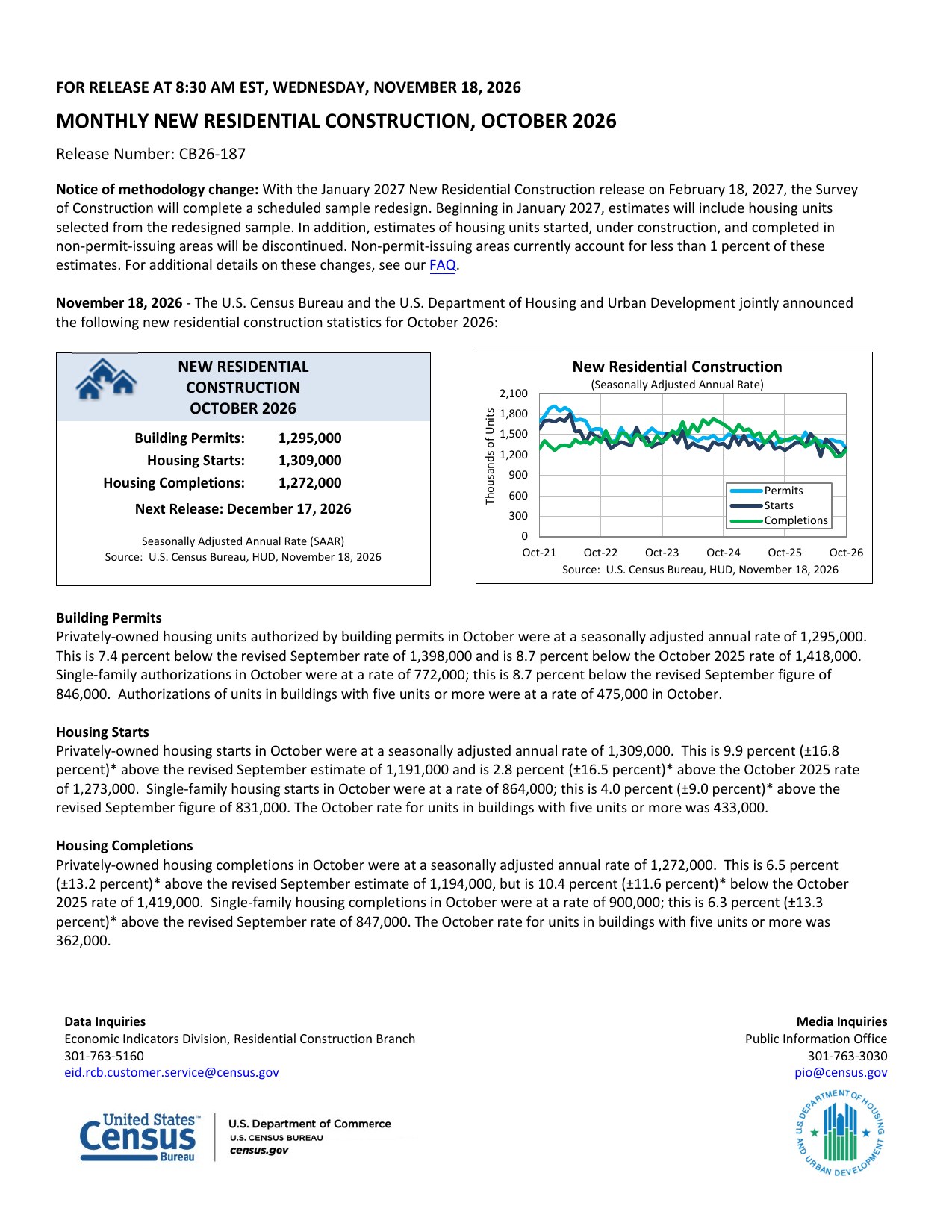
The joint Census and HUD report prints the 9.9% gain with a range attached: "9.9 percent (±16.8 percent)." That means the true change could sit anywhere from a 6.9% drop to a 26.7% gain. The footnote spells it out: "The 90 percent confidence interval includes zero. In such cases, there is insufficient statistical evidence to conclude that the actual change is different from zero."
The same caveat covers the single-family starts gain of 4.0% (±9.0%) to 864,000, and the 2.8% rise from a year earlier. The bureau's explanatory notes add that "it may take three months to establish an underlying trend for building permit authorizations, six months for total starts."
Official record
"Monthly New Residential Construction, October 2026," Release Number CB26-187, U.S. Census Bureau and U.S. Department of Housing and Urban Development, released November 18, 2026. Page 1 is shown below.
"Privately-owned housing starts in October were at a seasonally adjusted annual rate of 1,309,000. This is 9.9 percent (±16.8 percent)* above the revised September estimate of 1,191,000." Census Bureau release, page 1
Read or download the full 7-page release (PDF) or view it on census.gov.
Why do the permit numbers matter more?
Permits are the paperwork builders file before they break ground, and Census says its permit table comes from a count that is "not subject to sampling error." That number carries no asterisk. Total permits fell 7.4% to 1,295,000, and they are down 8.7% from October 2025.
Single-family permits are the cleanest read on new homes for families. They dropped to 772,000, down 8.7% in one month and 12.9% from a year ago. Every region fell. The South, where most American homes get built, lost 7.5%, and the West dropped 14.5%. Reuters reported it was the third straight monthly decline and the lowest level since January 2023.
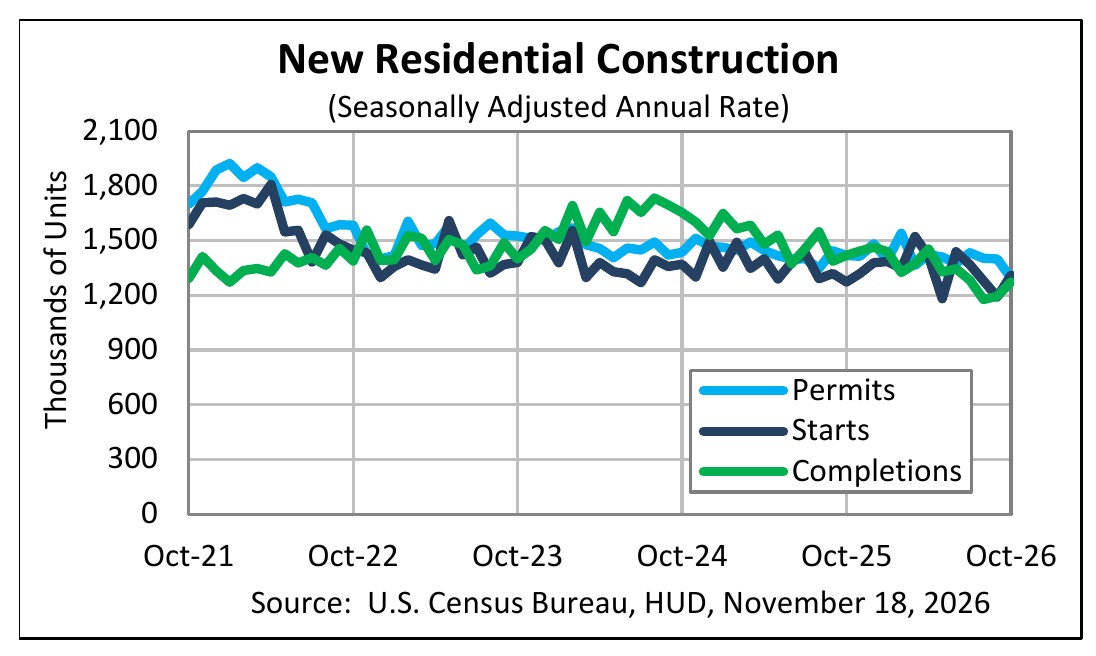
Five years of permits, starts and completions, seasonally adjusted. Permits (light blue) slid at the far right of the chart in October. U.S. Census Bureau and HUD chart from the November 18, 2026 release (U.S. government work, public domain).
What are builders saying?
A day earlier, the National Association of Home Builders reported its confidence index fell four points to 25 in November, the lowest reading since April 2012. Its gauge of prospective buyer traffic sank to 16. Some 46% of builders cut prices this month, the highest share of the post-Covid period, and 68% offered sales incentives.
"Mortgage rates above 7%, softer consumer confidence and an uncertain economic outlook are holding buyers back," said NAHB Chief Economist Robert Dietz. NAHB Chairman Bill Owens said, "Higher fuel prices are prompting subcontractors to raise their rates sharply." Owens also tied stepped-up immigration enforcement to labor shortages on job sites.
The rate pressure is real. Freddie Mac put the 30-year fixed at 7.11% in its Nov. 12 survey, against 6.24% a year earlier. On a $400,000 loan, that gap adds roughly $230 a month to principal and interest.
What did the Fed minutes add?
At 2 p.m. Wednesday, the Federal Reserve released the minutes of its Oct. 27-28 meeting, where it held its benchmark rate at 3.75% to 4% on a 10-2 vote. Both dissenters wanted a quarter-point hike. The minutes say "almost all participants" judged that "further action to raise the target range" would likely be appropriate, and "a couple of participants" said an increase of more than 25 basis points "could warrant consideration at the next meeting if incoming inflation data were unfavorable."
The Federal Reserve's Eccles Building in Washington, D.C. Photo by Tim Evanson via Flickr, licensed CC BY-SA 2.0.
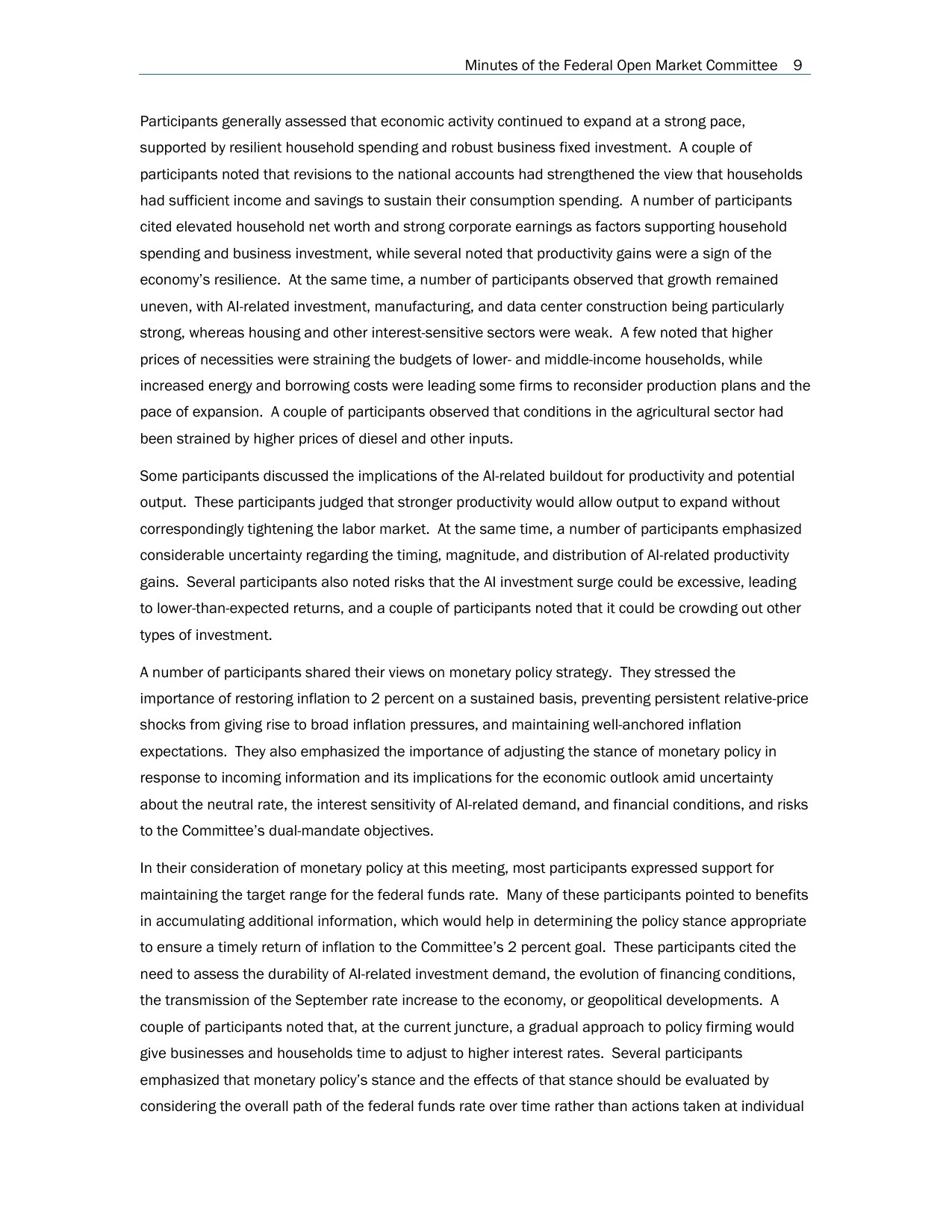
The Fed's own staff saw the housing damage. The minutes say "residential mortgage activity declined further amid the sharp rise in mortgage rates," and that growth was uneven, with data centers strong "whereas housing and other interest-sensitive sectors were weak."
Official record
"Minutes of the Federal Open Market Committee, October 27-28, 2026," Board of Governors of the Federal Reserve System, released November 18, 2026. Printed page 9 is shown below.
"A few noted that higher prices of necessities were straining the budgets of lower- and middle-income households, while increased energy and borrowing costs were leading some firms to reconsider production plans and the pace of expansion." FOMC minutes, page 9
Read or download the full 15-page minutes (PDF) or view them on federalreserve.gov.
What happens in December?
Markets have made up their minds. CME FedWatch put a 91.7% chance on a quarter-point hike at the Dec. 8-9 meeting and 8.3% on a half point, InvestmentNews reported. That would be the second hike of this cycle, after September's quarter-point move, the Fed's first increase since 2023. President Trump wants the opposite. "Interest rates in the United States should be 1%, or less," he posted after the September move, as the Daily Wire reported.
For a family trying to buy its first house, Wednesday's real news was the permit line, not the starts headline. Fewer permits now mean fewer new homes on the market next year, and a Fed that says more hikes are coming gives builders little reason to file more. Watch the Dec. 17 Census release. If single-family permits fall a fourth straight month, the trend Census says takes three months to confirm will be in the books.
Top photo: A new house under construction in Pittsfield Township, Michigan. Photo by Dwight Burdette via Wikimedia Commons, licensed CC BY 3.0.















