

The full Second Circuit will not take a second look at New York's fight with three Amish schools over its school vaccine law. A short order dated Nov. 17 denied rehearing, but three judges signed 20 pages of dissents saying the law forces Amish parents to choose between their faith and their schools while it exempts medical cases and never covers teachers. The schools already have a petition waiting at the Supreme Court, and New York's answer is due Dec. 2.
What did the court actually decide?
The order in Miller v. McDonald, No. 24-681, says an active judge asked for a poll after the panel ruled on June 30, and "there being no majority favoring in banc review, rehearing in banc is hereby DENIED." It does not list a vote count. Judges Michael Park, Joseph Bianco and Steven Menashi dissented in two written opinions, one by Park and one by Menashi. Judge Matthew Schwartz took no part.
That leaves in place the June 30 panel opinion by Judges José Cabranes, Richard Wesley and Eunice Lee, which upheld New York Public Health Law 2164 for the second time.
Official record
Miller v. McDonald, No. 24-681, U.S. Court of Appeals for the Second Circuit, order denying rehearing en banc with dissents by Judges Park and Menashi, dated Nov. 17, 2026. Page 3 is shown below.
"If the panel decision stands, PHL 2164 appears likely to result in the closure of every Amish school in the state." Judge Michael H. Park, dissenting, page 12 of his opinion
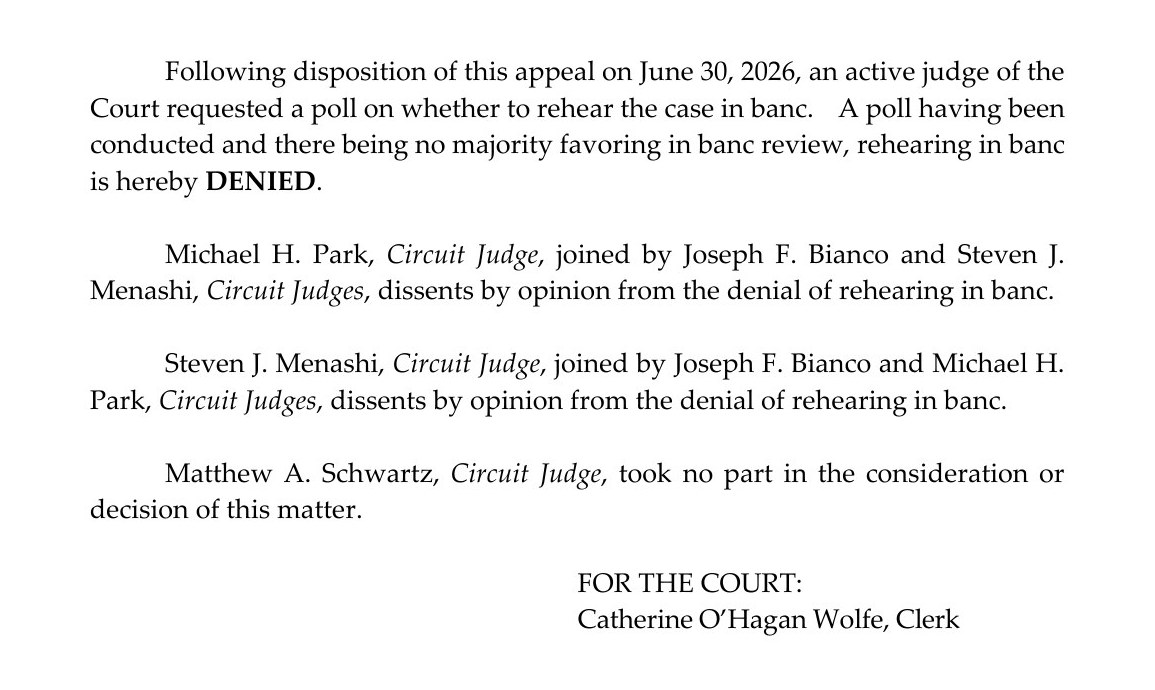
Read or download the full 23-page order and dissents (PDF) or view it on the Second Circuit's website.
How did three Amish schools end up in federal court?
For more than 50 years, New York let parents with "genuine and sincere religious beliefs" skip school vaccinations. In June 2019, after measles outbreaks in Brooklyn and Rockland County, lawmakers repealed that exemption and kept the medical one. Park writes that New York became only the second state, after California, to do so.
The Health Department audited the plaintiff schools in late 2021. Park notes that no measles case had been reported in New York's Amish community, but the state's own budget memo told the department to focus on private schools "with high rates of religious exemptions." The panel opinion puts the resulting fines at $118,000: $52,000 for Dygert Road School, $46,000 for Twin Mountain School and $20,000 for Shady Lane School. The state got there mostly by charging $2,000 for each out-of-compliance student for a single day. The department counts every day an unvaccinated child attends as a separate violation.
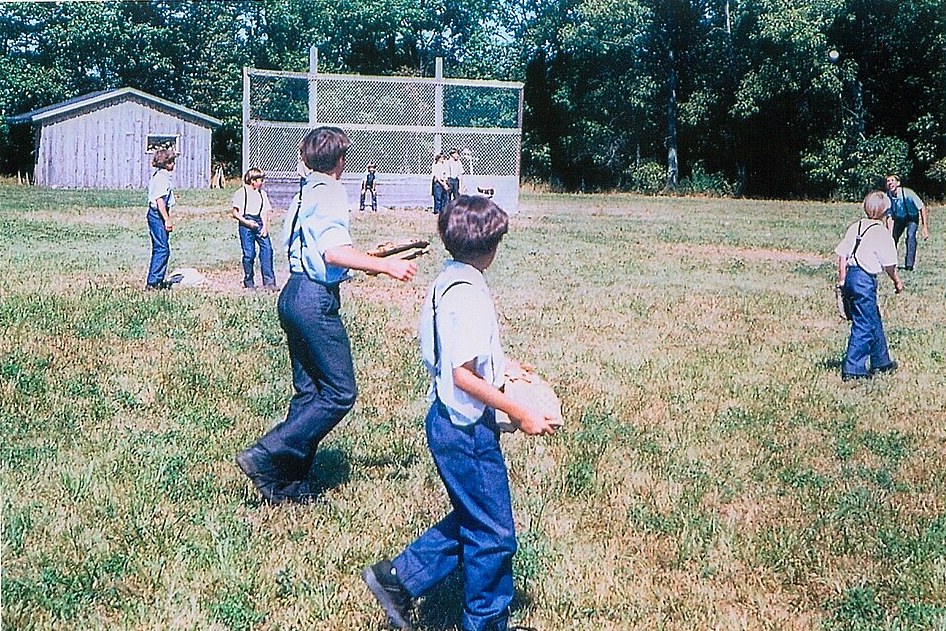
Amish boys play baseball in Lyndonville, in western New York. Photo by Ernest Mettendorf via Wikimedia Commons (released into the public domain by the photographer).
The Amish parents say vaccination violates their faith and that homeschooling is no answer, because group schooling in their own one-room schoolhouses is how they pass that faith on. "We believe it would be an abomination to our Creator to inject such [vaccines] into our bodies," the parents said in the record Park quotes.
Didn't the Supreme Court already weigh in?
It did. After the Second Circuit first upheld the law in March 2025, the Supreme Court decided Mahmoud v. Taylor, the Maryland storybook case, holding that laws which "substantially interfere with the religious development" of children get strict scrutiny. On Dec. 8, 2025, the justices wiped out the Second Circuit's ruling and sent it back for another look.
The panel reached the same result. It said Mahmoud covers "ideological indoctrination," and that a "health-and-safety condition on in-person school attendance" is different. Park calls that "backwards." In his view, a court is supposed to ask first whether a law burdens religious parents, then whether the state's reason is strong enough. Otherwise, he writes, "the free exercise right under Yoder and Mahmoud would end wherever government's good intentions begin."
Who does New York's law actually exempt?
Menashi's dissent goes after the claim that the law treats everyone alike. A child unvaccinated for medical reasons can attend school, and a child unvaccinated for religious reasons cannot. Measured against the goal of stopping disease, he writes, "both pose the same risk." He adds that the law defines "child" as someone between two months and 18 years old, so students who have turned 18 are not covered, and neither are teachers or school employees.
Menashi says the Second Circuit has now sided with the Third, Fourth and Ninth Circuits against the First and Tenth on that question, which "entrenches a circuit split."
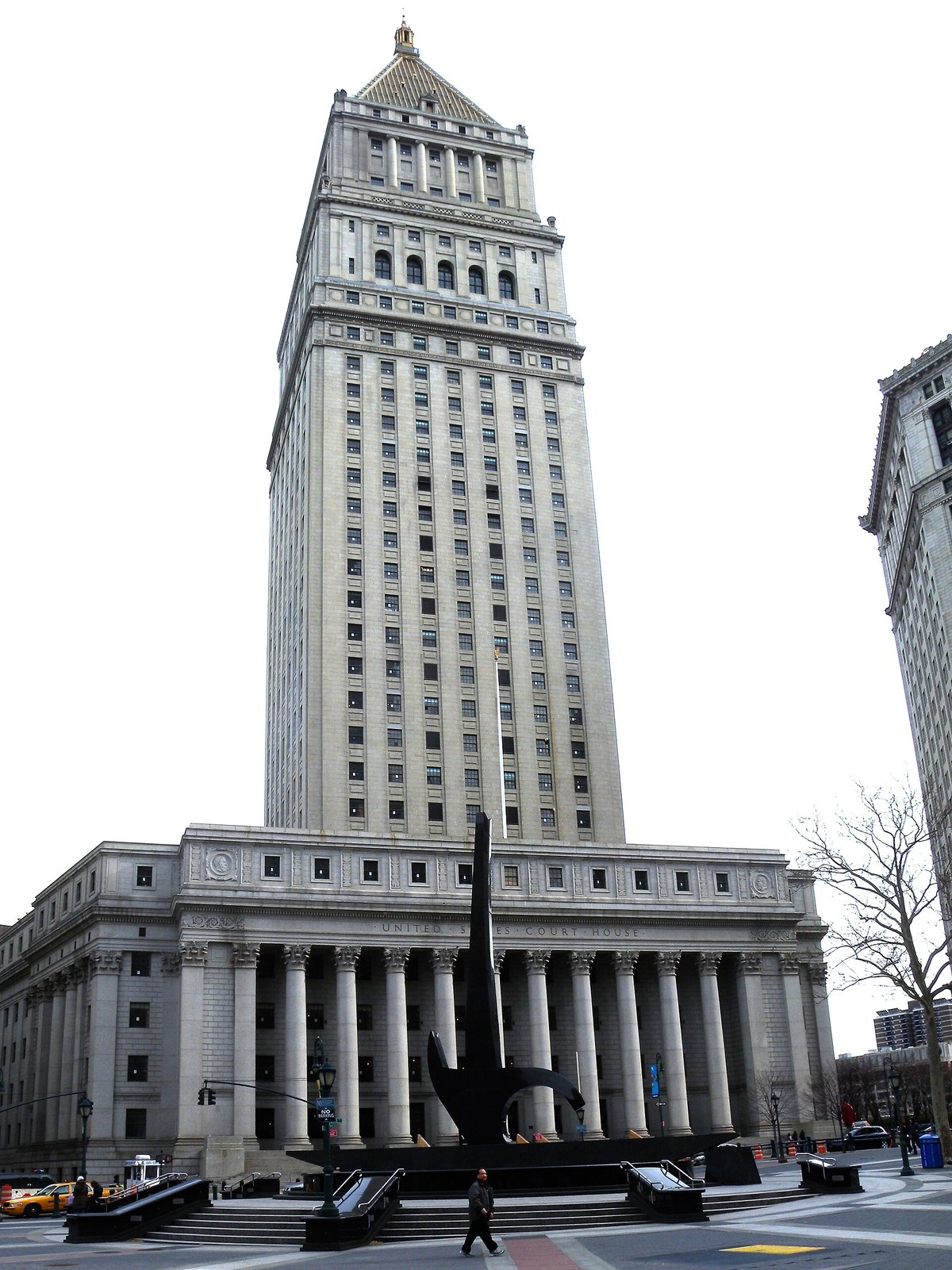
The Thurgood Marshall U.S. Courthouse at Foley Square in Manhattan, where the Second Circuit sits. Photo by Jim Henderson via Wikimedia Commons (CC0 public domain dedication).
What is New York's side?
The state's case rests on its 2019 record, which the panel quotes at length. Religious exemptions outnumbered medical ones five to one. In six Rockland County schools, up to 20% of students had religious exemptions. New York City health officials traced 44 measles cases, including 26 students with religious exemptions, to a single child with a religious exemption. Citing the plaintiffs' own allegation that nearly all Amish schoolchildren are unvaccinated, the panel called their schools "precisely the circumstances that most concerned the State."
The legislative record cuts the other way too. Park points to lawmakers who doubted the faith claims outright. State Sen. James Skoufis said on the floor that the religious exemption "is made up. It's fake. Because there is no religion that objects to vaccines." None of that doubt reached this case. Menashi notes New York itself "has not questioned the sincerity of the Amish plaintiffs."
What happens next?
The schools filed a new petition for certiorari on Sept. 28, docketed as No. 26-438. It asks the justices whether the law fails under Mahmoud, whether refusing religious exemptions while allowing secular ones is unconstitutional, and whether Employment Division v. Smith should be reconsidered. The petition, filed by First Liberty Institute and Lehotsky Cohn, says 45 other states and the District of Columbia allow religious exemptions to school vaccine mandates.
The docket shows New York asked for and got an extra month to respond, to Dec. 2. More than 20 amicus briefs are already filed for the schools, including from Alabama and other states, Florida, the Heritage Foundation, the Jewish Coalition for Religious Liberty and an Old Order Amish bishop, Elmer Stoltzfus. The full Second Circuit had its chance to fix this and passed. Three of its judges just wrote the Supreme Court a road map.
Top photo: An Amish schoolhouse for grades one through eight near Rebersburg in Centre County, Pennsylvania, Aug. 23, 2015. Photo by Smallbones via Wikimedia Commons (CC0 public domain dedication).















