The Justice Department announced Monday that it has charged Honduras's former consul general in Atlanta with demanding bribes, the first case ever brought under the Foreign Extortion Prevention Act. Prosecutors say Ada Evila Serrano Nuñez collected more than $375,000, starting around July 2023. Congress did not pass the law until December 2023, then repealed and rewrote it in July 2024, and the bribery counts now charged under it begin in August 2024.
What exactly is Serrano charged with?
According to the Justice Department's Nov. 16 release, an indictment unsealed after her arrest charges one count of conspiracy to violate the Foreign Extortion Prevention Act, known as FEPA, one count of violating FEPA, and one count of conspiracy to commit money laundering. The U.S. Attorney's Office in Atlanta says a grand jury returned the indictment on Sept. 1, and that Serrano, 72, was arrested Nov. 15 at Hartsfield-Jackson Atlanta International Airport.
Three others were arrested on a separate criminal complaint charging conspiracy to demand bribes: her sons Luis Euceda Serrano, 39, and Angel Euceda Serrano, 42, and Mario Antonio Castellanos Velasquez, 63, a former consulate employee. All four appeared Monday before U.S. Magistrate Judge Regina D. Cannon and are being held by the U.S. Marshals, the Atlanta release says. All are presumed innocent.
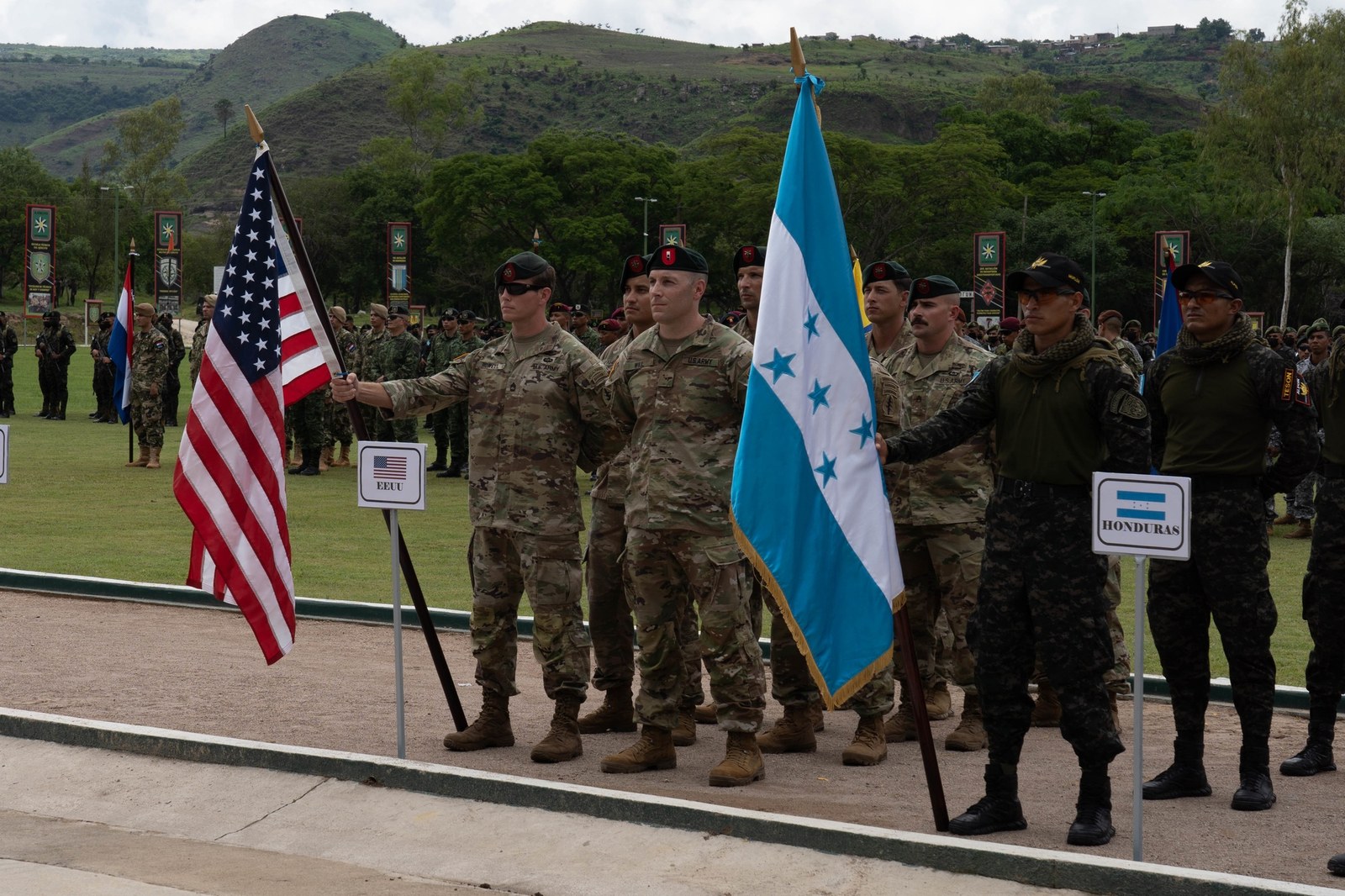
U.S. and Honduran flags at the opening ceremony of the Fuerzas Comando exercise in Tegucigalpa, Honduras, June 13, 2022. U.S. Army photo by Staff Sgt. Carolina Sierra via DVIDS (public domain).
Who actually paid the bribes?
A company, not travelers at the counter. The Justice Department says a Tennessee business it calls Consular Services Company booked appointments at the consulate for its clients and drove them there. After Serrano became consul general, prosecutors allege, she required the company to pay a bribe for each person it brought, in exchange for access to appointments for passports, identification documents and other services. Castellanos allegedly coordinated with the company's people so its clients got in once the money was paid.
FOX 5 Atlanta, citing the indictment and an FBI affidavit, reported that the company charged its clients about $300 apiece, which covered the ride and the bribe. Its headline says Serrano "extorted $375K from travelers." The government's own framing is split. Assistant Attorney General A. Tysen Duva said companies should "compete based on the strength of their products and services," while U.S. Attorney Theodore S. Hertzberg said Serrano extorted "innocent people." Neither release says whether the company or anyone in it will be charged.
Why does the August 2024 start date matter?
Because the scheme, as the government tells it, is older than the law. The Atlanta release says the bribe demands began "around July 2023." Congress first passed FEPA as section 5101 of the defense bill President Biden signed in December 2023, as the National Law Review recounts. Seven months later, Public Law 118-78, signed July 30, 2024, repealed that section outright and enacted a new version as 18 U.S.C. 1352.
The Justice Department's release dates the FEPA conspiracy from "at least in or around August 2024" through March 2026, the month Serrano's tenure ended. That is the first full month after the rewrite took effect. So the $375,000 figure covers a period that begins a year before the statute in the headlines existed, and the releases do not say how much of it falls inside the FEPA window.
Official record
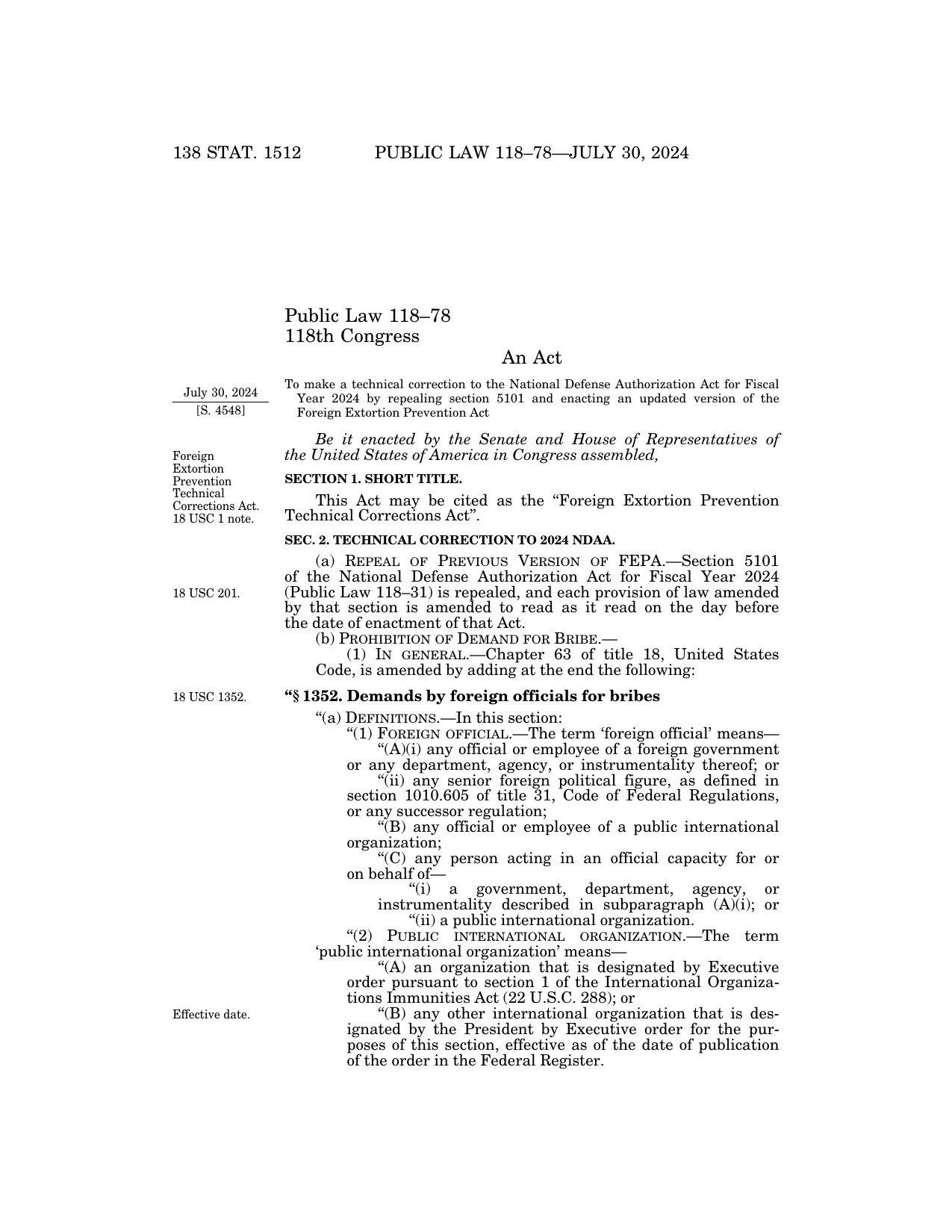
Public Law 118-78, the Foreign Extortion Prevention Technical Corrections Act, signed July 30, 2024 (138 Stat. 1512). The first page of the Act, shown below, repeals the December 2023 version of FEPA and creates the current offense at 18 U.S.C. 1352.
"Section 5101 of the National Defense Authorization Act for Fiscal Year 2024 (Public Law 118-31) is repealed, and each provision of law amended by that section is amended to read as it read on the day before the date of enactment of that Act." Public Law 118-78, Sec. 2(a)
Read or download the full 4-page law (PDF) or view it at govinfo.gov.
Then how do the earlier payments come in?
Through the money laundering count. The Justice Department says that from about July 2023 through at least December 2024, Serrano directed that the cash be paid to her sons, who made deposits of $100 to $6,000 at a time into their own bank accounts in north Georgia. That window starts before FEPA and stops 15 months before the bribery window closes.
Federal money laundering law does not depend on FEPA. Its list of "specified unlawful activity" in 18 U.S.C. 1956(c)(7)(B)(iv) includes an offense against a foreign nation involving "bribery of a public official." Neither release names the predicate offense the grand jury relied on, and the indictment itself has not been posted publicly, so that point remains open until the court filings are available.
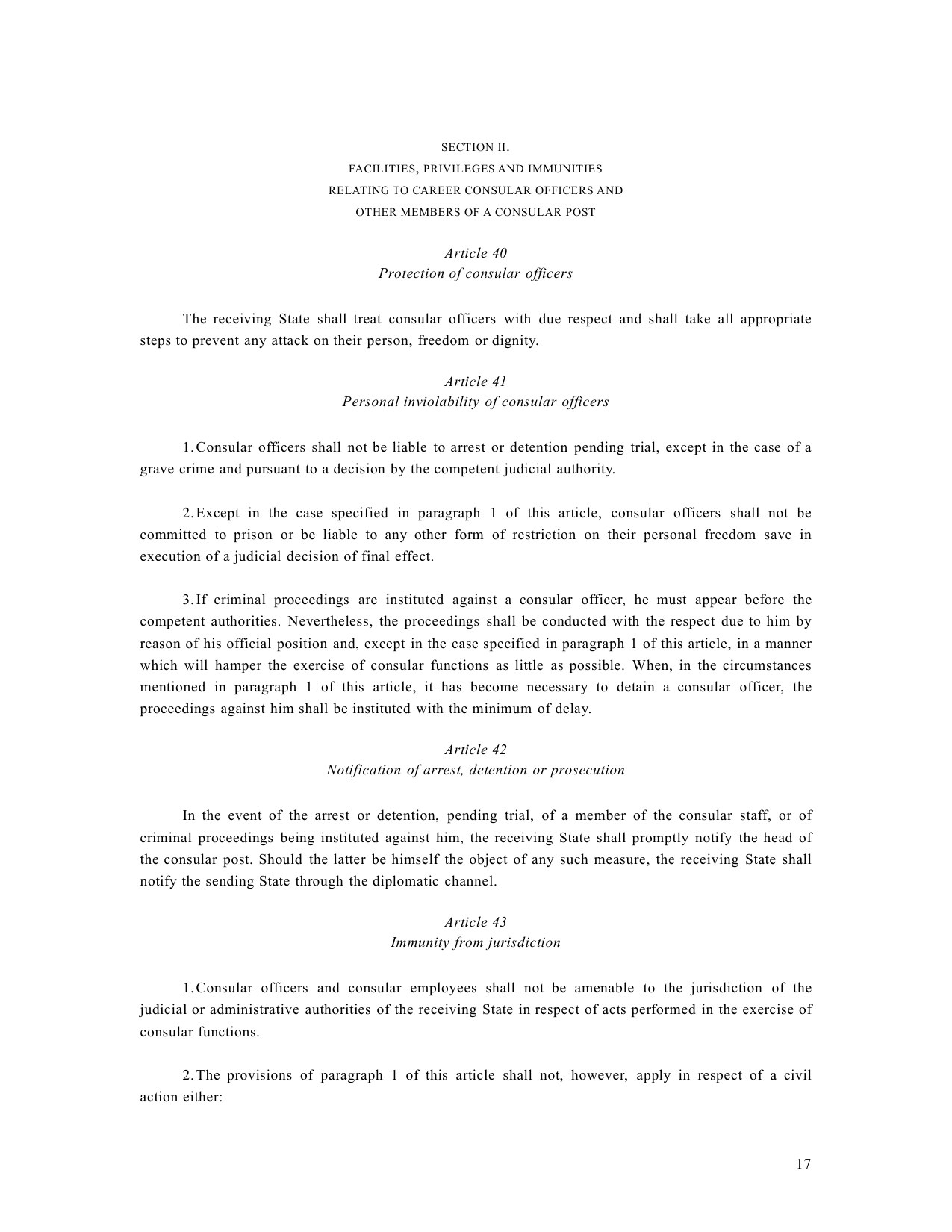
Page 17 of the 1963 Vienna Convention on Consular Relations, with Article 41 on arrest and Article 43 on immunity for "acts performed in the exercise of consular functions." United Nations treaty text, legal.un.org.
Doesn't a consul have immunity?
Only for official work, and Serrano no longer holds the post. Article 43 of the Vienna Convention on Consular Relations shields consular officers from local courts "in respect of acts performed in the exercise of consular functions." Consuls do not get the broad personal immunity ambassadors do. Article 41 separately allows a consular officer to be arrested for "a grave crime" on the decision of a court. The Atlanta release says Serrano served from July 2022 through March 2026, and neither release addresses immunity at all.
If convicted on the FEPA count, she faces up to 15 years in prison and a fine of up to $250,000 or three times the value of the bribe, under section 1352. Prosecutors also allege she used encrypted messaging apps and capped the company's daily appointments to avoid notice. FOX 5 reports the indictment quotes an October 2023 recorded meeting in which she warned the others to be careful about possible hidden cameras and microphones.
What does the first FEPA case tell us?
The Justice Department picked a debut case that fits the statute's core: a foreign official on U.S. soil, a U.S. company paying, cash deposited in Georgia banks. The Criminal Division's FCPA unit and the Atlanta U.S. Attorney's Office are prosecuting it together.
The open questions are the ones the releases leave out: how much of the $375,000 the FEPA counts actually cover, what crime the 2023 deposits are tied to, and whether the company that paid will be treated as a victim or a co-conspirator. Those answers will come from the indictment and the September grand jury record, once they are in the public file.