Cleveland Fed President Beth Hammack went on Bloomberg TV Monday and made her case for more interest rate hikes, just smaller ones. Homebuyers hearing that the Fed is still leaning on the brakes may take comfort in last week's headline that mortgage rates fell a fourth straight week, to 7.11%. That number was measured before the bond market moved. The 10-year Treasury yield that mortgages follow jumped right after Freddie Mac's survey window closed, and a daily rate gauge already reads 7.51%.
What did Hammack actually say?
"I like moving in smaller increments," Hammack said in the Nov. 16 interview, according to a Reuters report on the interview. She said predictability helps "businesses and households" plan, then added the warning: "if we get behind the curve and we need to put more restriction in, we absolutely can move in those larger increments." Reuters reported she sees inflation pressures mounting but is not ready to push the Fed onto a faster track.
The direction is not in doubt, only the speed. Hammack is a voting member of the Fed's rate committee this year, and she already voted for a hike at the last meeting and lost. Markets are listening: the Newsquawk market wrap for Monday put fed funds futures pricing at about 26 basis points of tightening for December, roughly one full quarter-point hike.
Who already voted to raise rates?
The Fed's own Oct. 28 statement held the federal funds rate at 3.75% to 4% on a 10-2 vote. The two dissenters were Governor Lisa Cook and Hammack, who "preferred to raise the target range for the federal funds rate by 1/4 percentage point at this meeting." The statement itself says plainly that "Inflation remains elevated."
The next decision comes Dec. 8-9, a meeting with fresh economic projections, according to the Fed's calendar. Hammack's position is that one more hike is not the end of it. Her preference is a steady series of them.
Official record
Federal Open Market Committee statement, released Oct. 28, 2026, at 2:00 p.m. EDT. The voting record at the bottom of page 1 lists the two members who wanted a rate hike.
"Voting against the monetary policy action were Lisa D. Cook and Beth M. Hammack, who preferred to raise the target range for the federal funds rate by 1/4 percentage point at this meeting." FOMC statement, Oct. 28, 2026
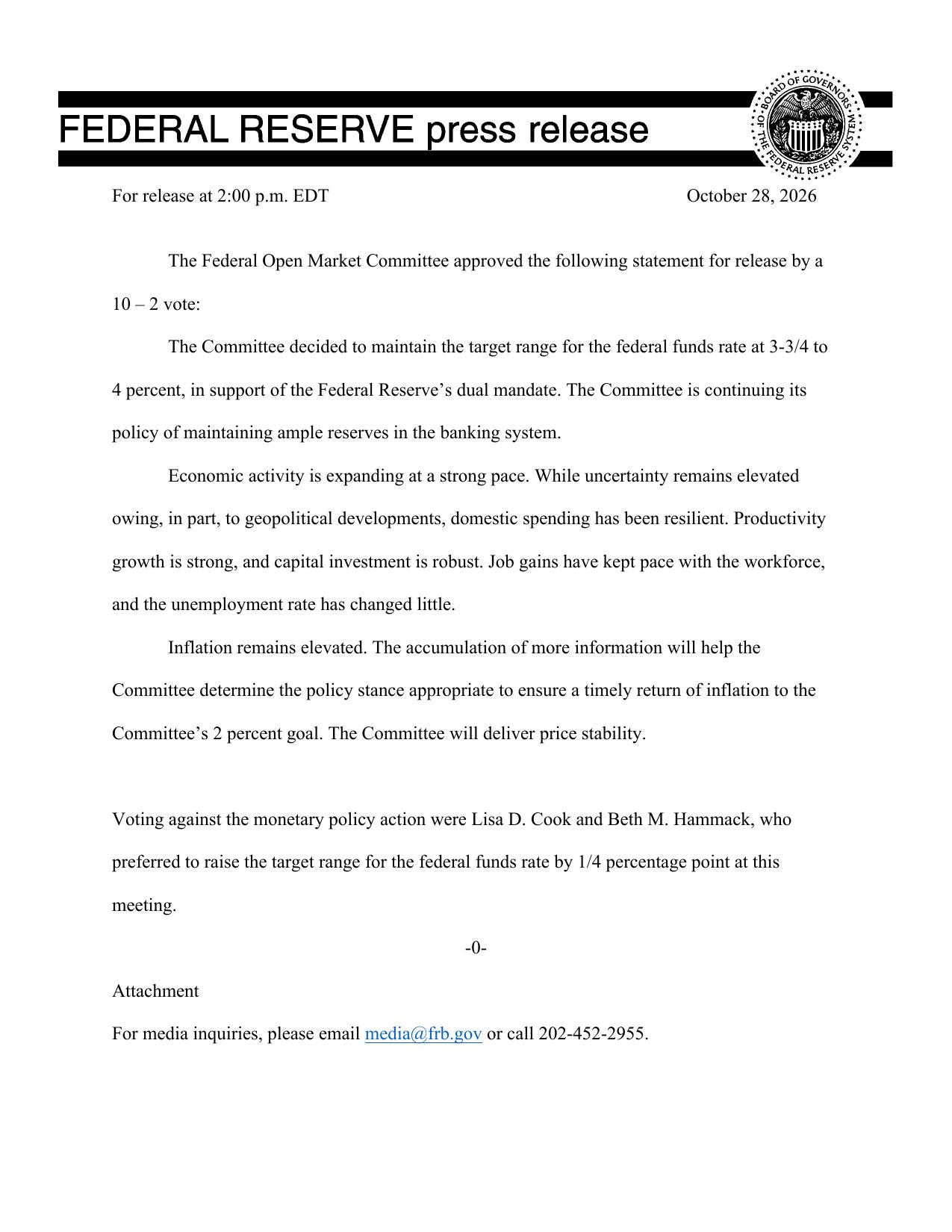
Read or download the full 2-page statement (PDF) or view it on federalreserve.gov.
Why the 7.11% headline is already stale
Freddie Mac's Primary Mortgage Market Survey for Nov. 12 put the average 30-year fixed rate at 7.11%, down from 7.18% the week before, under the headline "Mortgage Rates Decline for Fourth Consecutive Week to 7.11%." Freddie called it "a welcome development." But Freddie's own methodology note says each weekly figure covers applications from 12:00 a.m. Thursday of the prior week through 11:59 p.m. Wednesday. The Nov. 12 number reflects Nov. 5 through Nov. 11.
Look at what the bond market did around that window. Treasury's daily par yield curve shows the 10-year at 4.84%, 4.86%, 4.88% and 4.98% on the four trading days inside Freddie's window, an average of about 4.89%. There was no Treasury reading on Nov. 11, Veterans Day. Since the window closed, the 10-year has finished at 5.10% on Nov. 12, 5.15% on Nov. 13 and 5.12% on Monday, an average of 5.12%, or nearly a quarter point higher.
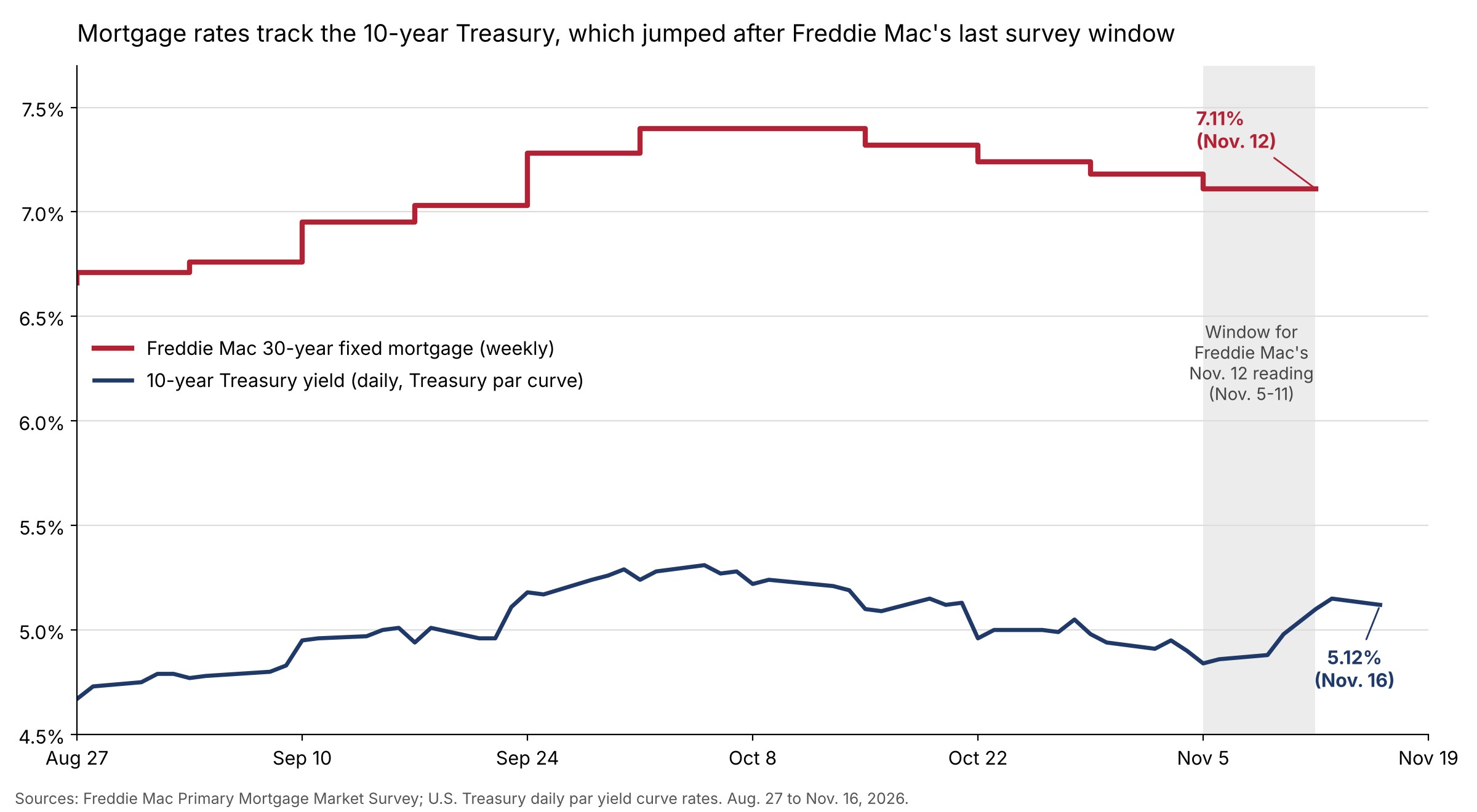
Freddie Mac's weekly 30-year rate against the daily 10-year Treasury yield, Aug. 27 to Nov. 16, 2026. The shaded band is the Nov. 5-11 window behind the 7.11% reading. PatriotAddict chart from Freddie Mac and U.S. Treasury public data.
Daily trackers have already caught the move. Mortgage News Daily's 30-year index stood at 7.51% on Monday, Nov. 16. The Deseret News reported that the index rose 0.32 point over three days to 7.5% on Nov. 13, while Zillow's rate quoted by NerdWallet went from 7.09% to 7.25% in a single day. Daily indexes and Freddie's weekly average are built differently, so they will not match to the decimal. They point the same way.
What does this cost a family buying a home?
A year ago, Freddie Mac's 30-year average was 6.24%, according to the same survey. On a $400,000 loan, principal and interest at 6.24% come to about $2,460 a month. At 7.11%, the payment is about $2,691, roughly $231 more every month and about $2,770 a year. At the 7.51% the daily gauge shows now, it is about $2,800, close to $340 a month more than last fall. Those figures are PatriotAddict's standard amortization math, before taxes and insurance.
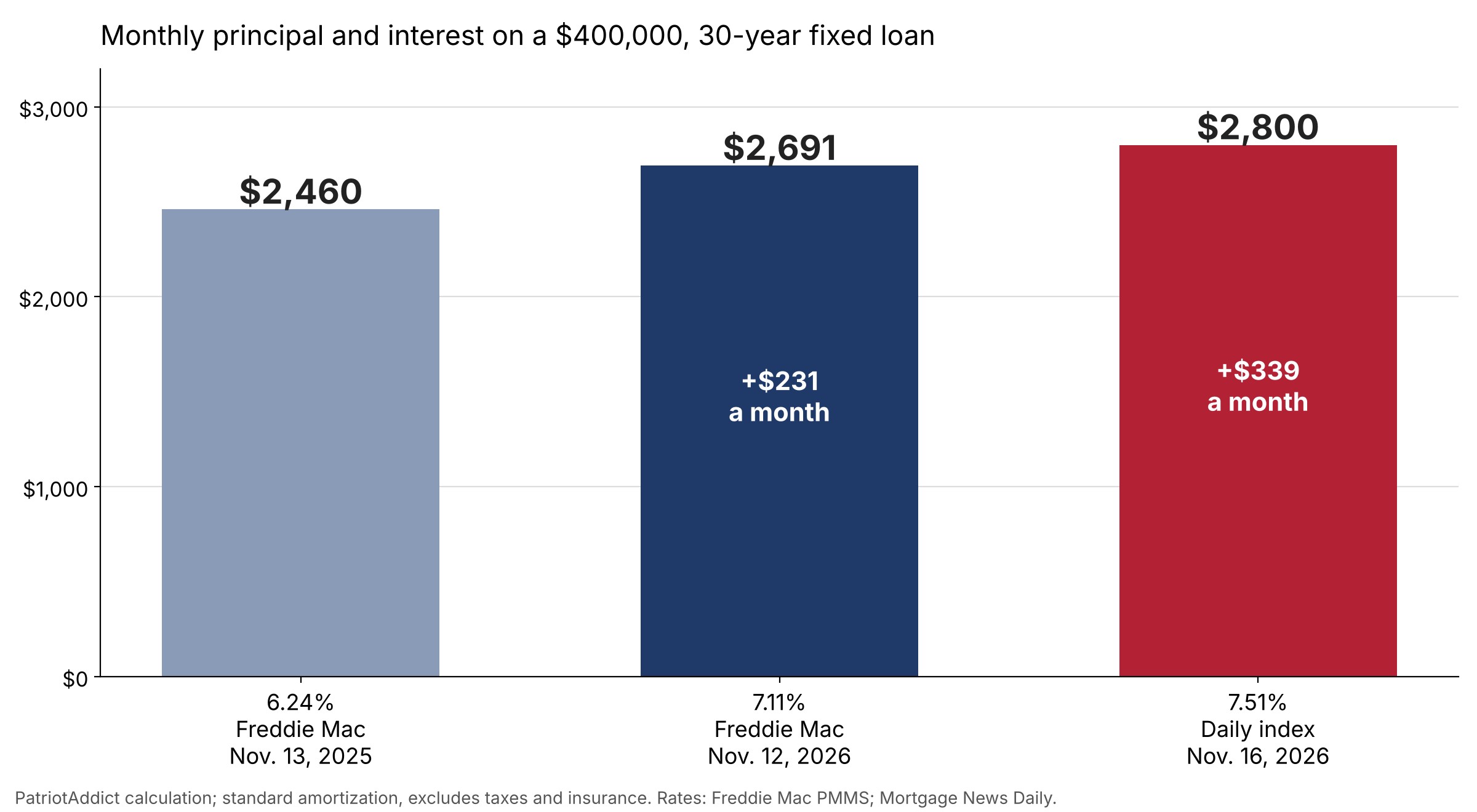
Monthly principal and interest on a $400,000, 30-year fixed loan at last year's Freddie Mac rate, last week's Freddie Mac rate and Monday's Mortgage News Daily index. PatriotAddict calculation from Freddie Mac and Mortgage News Daily rates.
The pressure goes beyond the 10-year. Treasury's table puts the 2-year yield, which tracks expected Fed moves, at 4.83% on Monday against 3.60% on Nov. 17, 2025. The 10-year was 4.13% that day and 5.12% now. Borrowers already feel it: the Associated Press reported last week that sales of previously occupied homes fell last month to their slowest annual pace in more than 16 years.
What comes next for mortgage rates?
Freddie Mac's next reading arrives Thursday, Nov. 19, at noon Eastern, and it will be the first to cover the climb in yields since Nov. 12. If the 10-year holds above 5.1%, the four-week streak of declines is at serious risk. The Fed meets three weeks later with at least one voter openly arguing for a string of hikes.
Hammack's case is that inflation is the bigger threat and that steady, predictable hikes are the way to fight it. Families shopping for a house should take her at her word. The 7.11% headline was a snapshot of an earlier week, and the bond market has already moved on.