

Defense Secretary Pete Hegseth said Friday that "80 new propaganda cells across 30 universities" had popped up under new names, and that the Pentagon has "systematically dismantled every single one" in the last two months. The Department of War's own written announcement, issued four days earlier, describes something narrower: more than 80 "termination-related actions" across 30 universities. It never uses the words Confucius Institute.
What did Hegseth actually say?
In a video posted on social media, Hegseth said the Defense Department had designated China's Confucius Institutes a threat to national security, Reuters reported. Per the fuller Reuters account, he said the centers were operating under disguise at American universities and that the Pentagon had added them to its list of institutions that threaten US national security.
His line on the numbers: "It turns out that 80 new propaganda cells across 30 universities had popped up using different names and different charters, but with the same mission: to steal intellectual property and to infiltrate the minds of American students." The Chinese embassy in Washington had not responded to Reuters' request for comment. I could not open the video itself, so the quotes above come from Reuters.

The Pentagon, May 11, 2021. Photo: Air Force Staff Sgt. Brittany A. Chase, Department of Defense, via Wikimedia Commons, public domain. File photo.
What does the October 19 release say?
The Department of War's release on war.gov announced completion of "initial research security audits" of 30 universities. I read its full text as reproduced by Mirage News, because war.gov would not load for me.
"Overall, the audits resulted in more than 80 termination-related actions across the 30 universities. These actions included the termination of relationships with entities on the NDAA Section 1286 list, as well as precautionary terminations involving entities not specifically identified on the list." — Department of War release
A termination-related action is a severed relationship with a foreign entity. It is not a counted campus center. The release says all 30 universities "have fully mitigated identified relationships with foreign entities of concern" on the Section 1286 list published in July 2026. It names seven schools that went further: Oklahoma State, Penn State, UNC Chapel Hill, South Carolina, USC, UT Austin and Virginia Tech.
Under Secretary Emil Michael called it "30-for-30." The words Confucius and Institute do not appear anywhere in it.
Where do Confucius Institutes come in?
The link is in the August order. Military Times reported that the Pentagon told 30 institutions to audit ties to foreign entities named under Section 1286 of the fiscal 2019 defense authorization act, "as well as organizations associated with rebranded Confucius Institutes." Reports were due Aug. 31. The department did not name the 30 institutions.
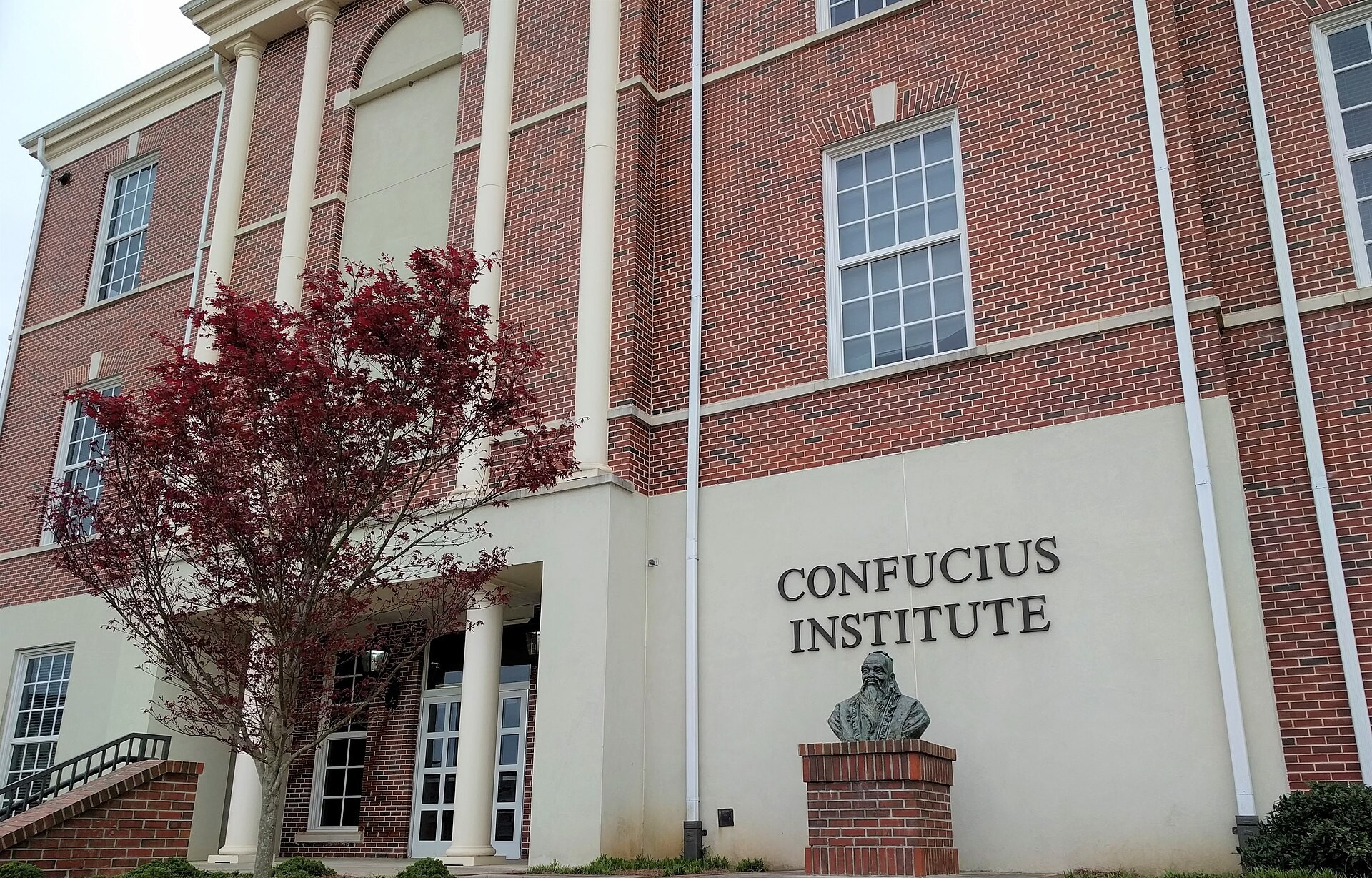
The Confucius Institute building at Troy University in Alabama, March 16, 2018. It is a campus center of the kind Hegseth described, not one of the unnamed 30 schools. Photo: Kreeder13 via Wikimedia Commons, CC BY-SA 4.0.
The same report notes that a government watchdog found in 2023 that almost all of the institutes had closed after Congress restricted federal funding to schools that host them. Some schools kept getting support from Chinese partner groups tied to the old institute. That is the gap Hegseth is describing.
Is Confucius on the Section 1286 list?
Not that I could find. The 1286 list covers foreign institutions the Pentagon says engage in problematic activity, and from fiscal 2026 the department cannot fund fundamental research involving a listed organization. Military Times counts 130 organizations from China, Russia and Iran on the fiscal 2025 list. I searched the copy hosted by the University of Southern California's compliance office, last updated Sept. 14, and found no Confucius entry. That is a university's copy and it predates Friday, so a newer update could change the answer.
Official record
Letter from House Select Committee on China Chairman John Moolenaar to Secretary of War Pete Hegseth, October 1, 2026 (16 pages).
"The Department has also taken steps to address research security concerns at U.S. universities, including notifying 30 institutions of identified risks and directing corrective action." — Rep. John Moolenaar
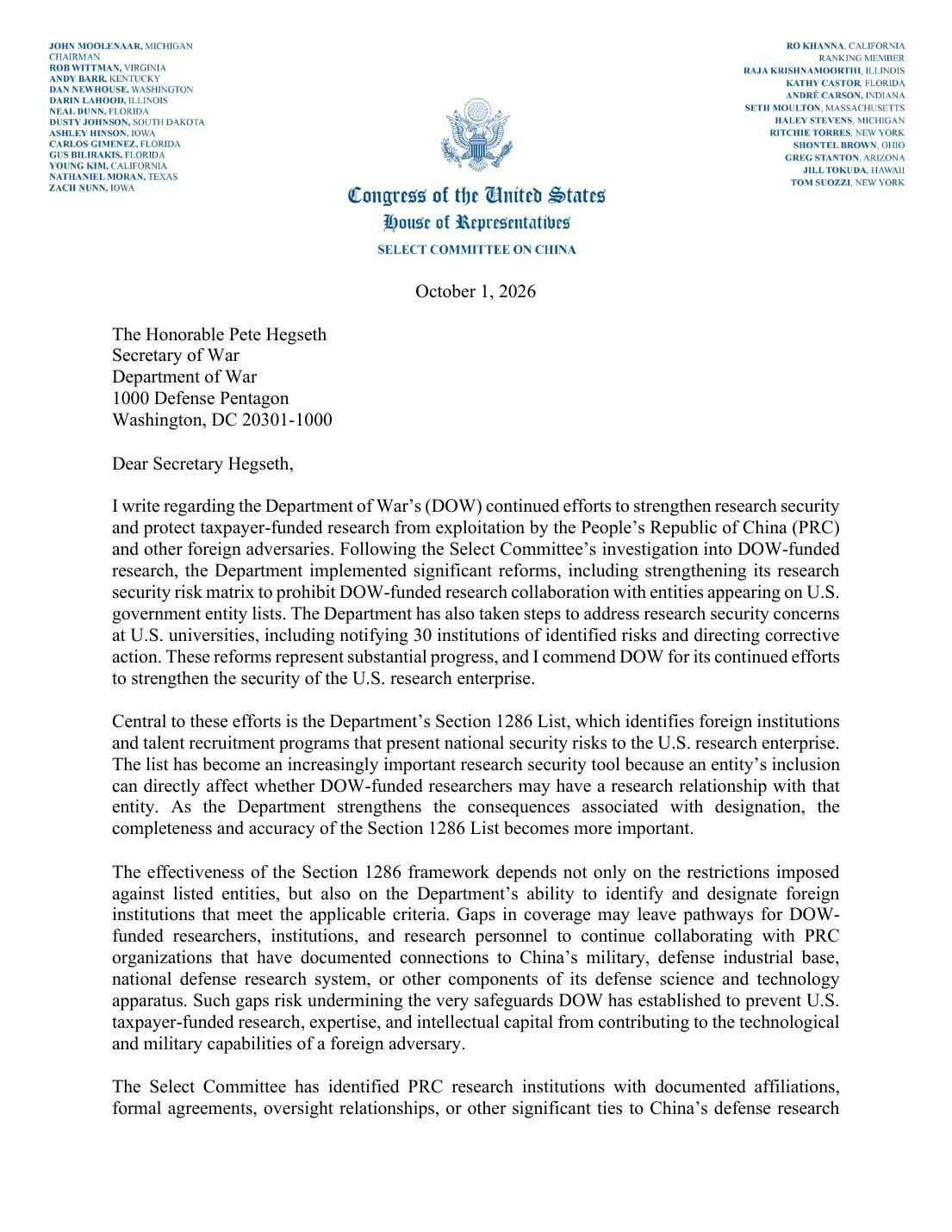
Static capture of page 1 · read the full letter (PDF) on the Select Committee site
What is the Select Committee asking for?
The letter is a request to expand the list. It asks the department to add 14 Chinese Academy of Sciences institutes, 62 defense laboratories and 58 universities with formal ties to China's defense industry regulator, plus talent recruitment programs. I searched the full text for "Confucius" and found no mention.
What is still unproven?
Three things. The 30 universities and the 80 "cells" have not been named in any document I could find. The release does not say how many terminations involved a Confucius successor as opposed to a lab, a research partner or a precautionary cut. And no published designation shows what standard was applied.
The concern is plausible. The 2023 watchdog finding shows some schools kept support from Chinese partners after the institutes closed. But a number from a video is not a number from a document. Until the department publishes the list, "80 propaganda cells" is Hegseth's description, and "80 termination-related actions" is what the Pentagon put in writing.
Header photo: Secretary of War Pete Hegseth at the Pentagon, May 11, 2026. Photo: U.S. Department of War via Wikimedia Commons, public domain. Cropped; file photo, not from Friday.















