

Nidal Hasan is set to face an Army firing squad at Fort Hood on Dec. 3, and Washington is now arguing over whether the public should get to watch. That fight is loud, but it is not the most important document in this case. A 2011 Senate report says an instructor and a colleague called Hasan a "ticking time bomb" years before he murdered 13 people, and the Army wrote up his obsession with jihad as "praiseworthy research."
Trump Approved the Sentence. The Livestream Is Still Undecided.
President Trump approved Hasan's death sentence on Oct. 2, the Army said in an official release. Under military law, only the president can approve the execution of a service member. On Oct. 6, Acting Army Secretary Adam Telle set the execution for 1 p.m. Central on Dec. 3 at Fort Hood, by firing squad.
Defense Secretary Pete Hegseth recommended the firing squad, and Pentagon spokesman Sean Parnell put it bluntly: "Judgement day for Hasan has finally come," Stars and Stripes reported. Two days later Hegseth told Real America's Voice the public would be able to watch. "It's going to be soldiers with rifles," he said, according to Stripes.
Now the president is hedging. Axios reported Monday that Trump has privately told people a livestream "might not happen," according to four people who spoke with him. One confidant summed up his thinking: Trump "wants the bastard to pay," but "he doesn't want to make the guy a martyr," Axios wrote. Publicly, Trump said Saturday he would make the final call.
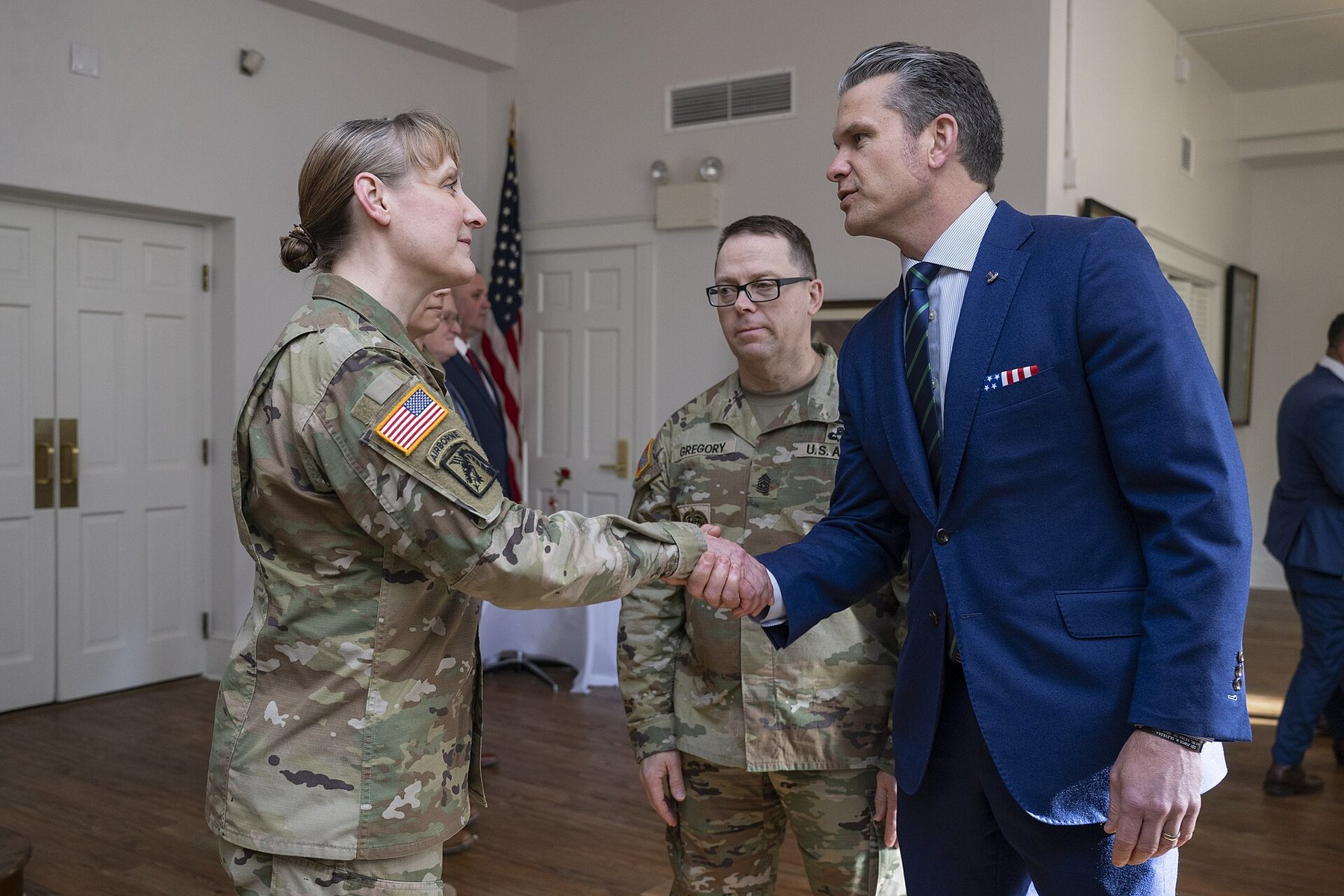
Pete Hegseth at the U.S. Army War College, Carlisle Barracks, Pa., April 23, 2025. Hegseth recommended the firing squad for Hasan and announced the plan to make the execution public. (U.S. Department of Defense photo, public domain, via Wikimedia Commons)
The Pushback Is Coming From His Own Side Too
On Monday, Archbishop Timothy Broglio, who oversees Catholic chaplains and Catholic troops across the armed forces, told Catholic soldiers to stay off the firing squad. "I oblige any Catholics assigned to the firing squad to request to be excused from this action contrary to the teaching of the Church," he said, as reported by Army Times. Broglio said he presided at the funeral of one of Hasan's victims. He still asked whether America wants to "imitate the terrorists of this world" by broadcasting the killing.
Vice President JD Vance has said he would not watch a livestream. A senior official told Axios, "If I had to bet, I would bet the president doesn't authorize this," and then added the line that matters most: "Hasan will be executed for his crimes, and that's what matters."
That is the right order of priorities. The camera question will be settled by one man in the Oval Office. The question of how a jihadist wore an Army major's oak leaf while murdering soldiers has a paper trail, and Congress wrote it down 15 years ago.
What the Senate Found in 2011
In February 2011, Sen. Joe Lieberman, the independent chairman of the Senate Homeland Security Committee, and Sen. Susan Collins, its top Republican, released a special report titled "A Ticking Time Bomb: Counterterrorism Lessons from the U.S. Government's Failure to Prevent the Fort Hood Attack." Its basic conclusion: the Defense Department and the FBI "collectively had sufficient information to have detected Hasan's radicalization to violent Islamist extremism but failed both to understand and to act on it."
Page 8 is where it gets ugly. The report says Hasan's radicalization "was on full display to his superiors and colleagues during his military medical training." An instructor and a colleague "each referred to Hasan as a 'ticking time bomb.'" Nobody disciplined him. Nobody discharged him. Instead, his Officer Evaluation Reports "sanitized his obsession with violent Islamist extremism into praiseworthy research on counterterrorism."
Official record
"A Ticking Time Bomb," Special Report of the U.S. Senate Committee on Homeland Security and Governmental Affairs, Joseph I. Lieberman, Chairman, and Susan M. Collins, Ranking Member, Feb. 3, 2011. Executive summary, page 8.
"Not only was no action taken to discipline or discharge him, but also his Officer Evaluation Reports sanitized his obsession with violent Islamist extremism into praiseworthy research on counterterrorism."
Senate Homeland Security Committee, page 8
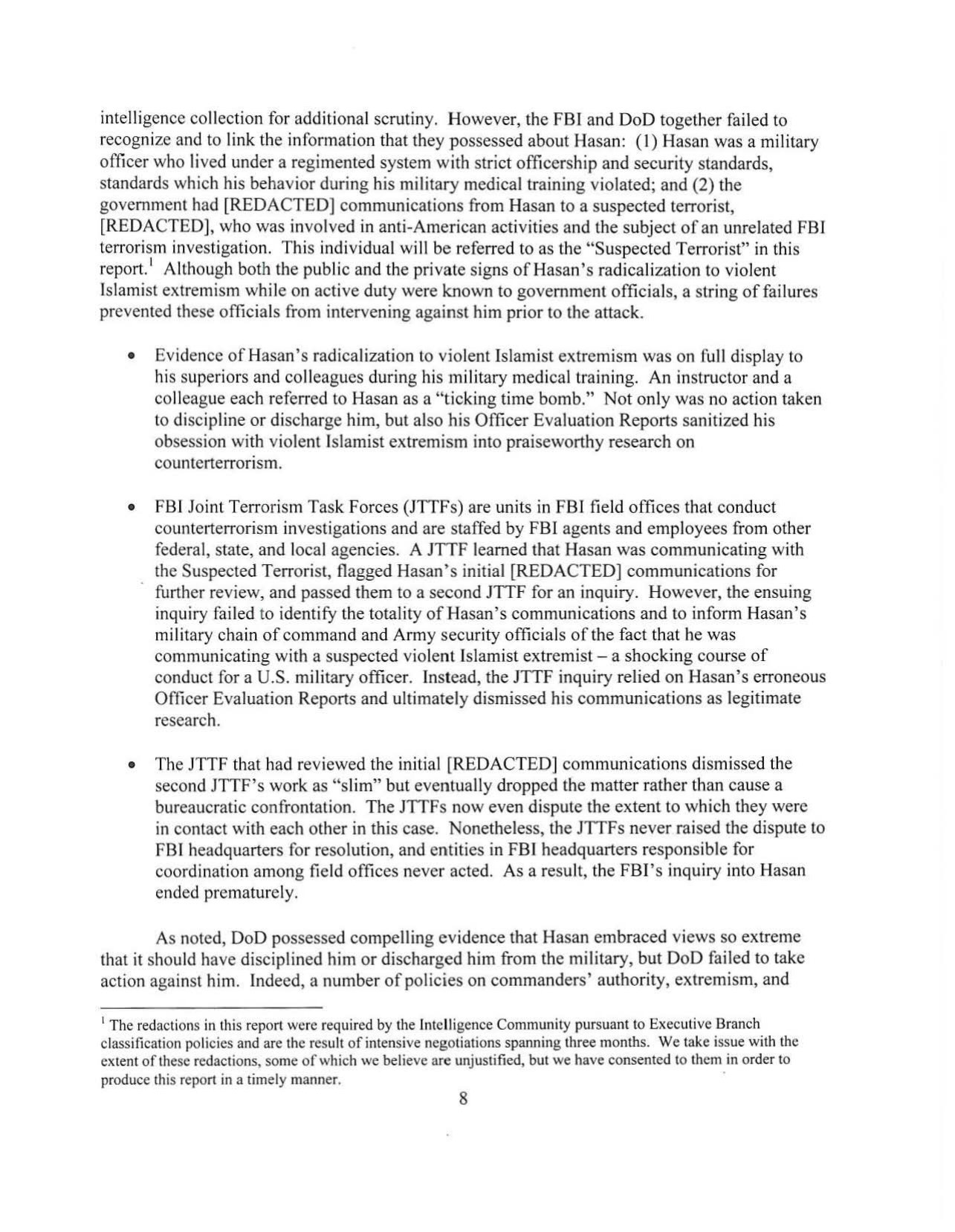
Read the full 91-page report (PDF) on the official Senate Homeland Security Committee site.
The FBI Saw His Messages and Let It Go
The same page lays out the FBI side. A Joint Terrorism Task Force learned Hasan was communicating with a suspected terrorist who was the subject of a separate FBI terrorism investigation. The report redacts that person's name and the details of the messages, because the intelligence community required it. The committee wrote that it took "issue with the extent of these redactions, some of which we believe are unjustified."
The inquiry that followed "relied on Hasan's erroneous Officer Evaluation Reports and ultimately dismissed his communications as legitimate research." In other words, the Army's whitewashed paperwork helped the FBI talk itself out of acting. One task force called the other's work "slim," then dropped the matter "rather than cause a bureaucratic confrontation." Nobody told Hasan's chain of command.
Read those two findings together. The Army's evaluations made Hasan look like a counterterrorism scholar. The FBI then used those evaluations to clear him. Each agency leaned on the other's mistake.
"Workplace Violence" Was the Pentagon's Answer
The report did not stop at the warning signs. It went after how the Pentagon described the attack afterward. The Defense Department, "including Secretary Gates's memoranda," the committee wrote on page 9, "still has not specifically named the threat represented by the Fort Hood attack as what it is: violent Islamist extremism. Instead, DoD's approach subsumes this threat within workplace violence or undefined 'violent extremism' more generally."
That was a bipartisan Senate finding, signed by a Democrat-turned-independent and a moderate Republican. It was not talk radio. Witnesses said Hasan shouted "Allahu akbar" as he opened fire on soldiers preparing to deploy, and at his 2013 court-martial he told the court he had switched sides, Stripes recounted. Twelve active-duty soldiers and a retired soldier working as a civilian were killed.
Read the Calendar the Army Picked
The Army's own release contains a detail most coverage skipped. Army Regulation 190-55 requires the Army secretary to pick an execution date "within 60 to 150 days from the date the President approved the death sentence." Trump approved on Oct. 2. That window runs from Dec. 1, 2026, to March 1, 2027. Dec. 3 is day 62, two days from the earliest date the rules allow.
The day of the week was chosen on purpose too. Nov. 5, 2009, the day of the shooting, was a Thursday. So is Dec. 3, 2026. Hegseth pointed out the matching day and hour himself, per Stripes. One more small thing: the Army release says the jury convicted Hasan "of all 42 counts." Stripes and the National Institute of Military Justice both list 13 counts of premeditated murder and 32 of attempted premeditated murder, which adds up to 45. The Army has not explained the difference.
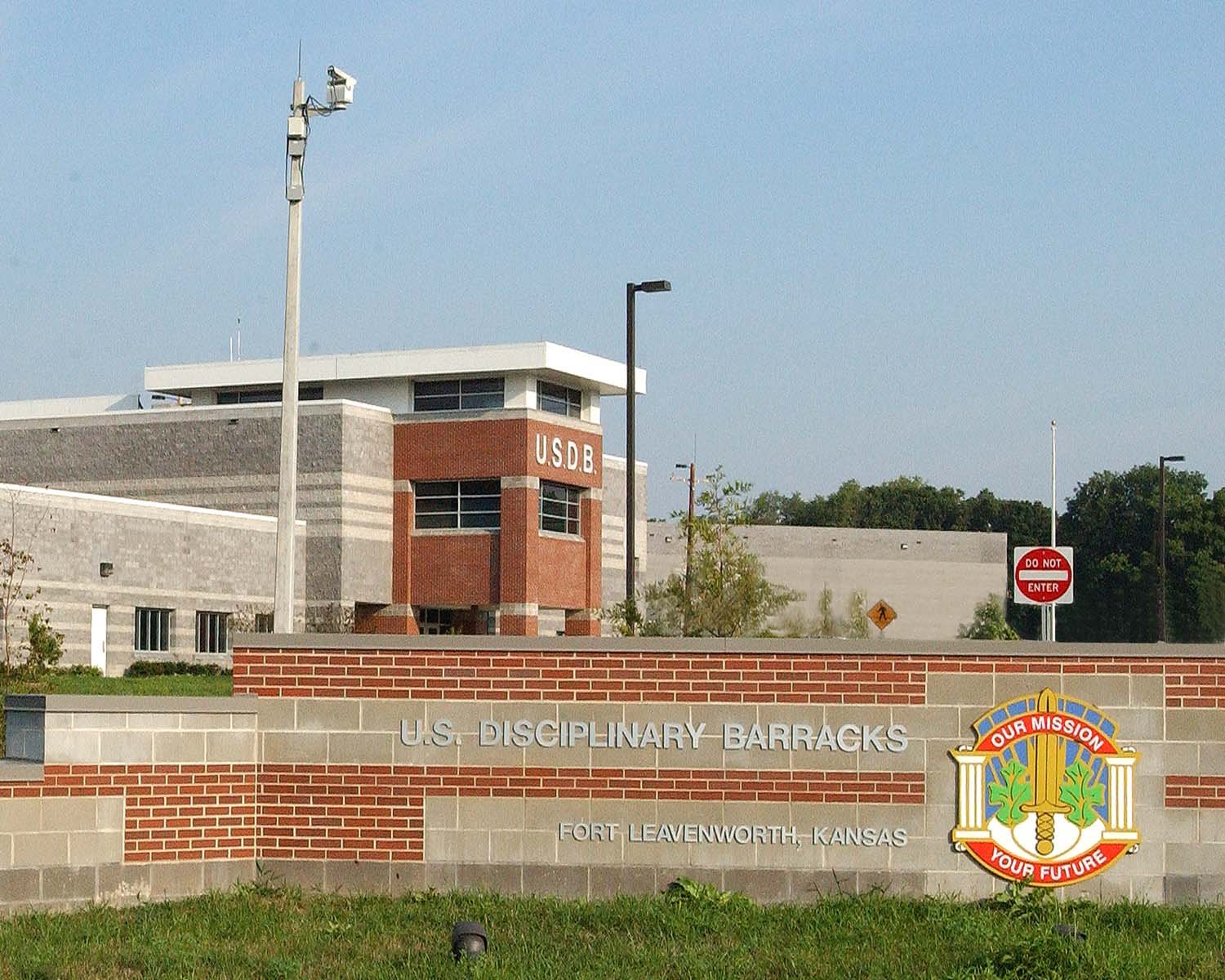
The U.S. Disciplinary Barracks at Fort Leavenworth, Kan., home of the military's death row, where Hasan has been held for more than a decade. (U.S. Army photo, public domain, via Wikimedia Commons)
The Last Time a President Did This, the Soldier Is Still Alive
Fast is good. It may not be enough. On July 28, 2008, President George W. Bush approved the death sentence of Army Pvt. Ronald Gray for murders and rapes at Fort Bragg, the first such order in 51 years, according to a contemporary American Forces Press Service report. A federal judge halted the execution. Gray is still on military death row 18 years later, Stripes noted.
Gray's route ran through a habeas corpus petition in federal court in Kansas, and the National Institute of Military Justice reported that petition was still pending, and stayed, at the end of 2022. Hasan can take the same road. An article in the Army's own Army Lawyer journal said a habeas appeal could put the process on hold "potentially for years," the AP reported in a story carried by the Little Apple Post. We found no report of a petition filed as of Tuesday morning.
Gray is not the only one waiting. The same NIMJ review lists Hasan Akbar, who was sentenced to death for a March 2003 attack on members of the 101st Airborne Division in Kuwait as the Iraq invasion began, as Gray's longest-serving neighbor on the row. We found no public record of any president acting on his sentence.
What Actually Matters on Dec. 3
Whether the cameras roll is Trump's call, and reasonable conservatives disagree about it. What should not be up for debate is the record. The Senate found the warning signs sitting in Hasan's own training record and in communications the FBI had already collected. The system turned them into glowing evaluations and a closed inquiry.
Executing Hasan closes his case. It does not close the question the Senate asked in 2011 about why the Army kept a man its own people called a ticking time bomb in uniform. If the Pentagon wants this execution to send a message, the clearest one would be telling the country, by name, what Hasan was. The Senate already did.
Top photo: Army Chief of Staff Gen. George W. Casey Jr. and his wife, Sheila, honor the fallen at the Fort Hood memorial ceremony, Nov. 10, 2009. (Cherie Cullen, U.S. Department of Defense, public domain, via Wikimedia Commons)















