

President Trump's Russian diesel deal, all 4.8 million tons of it, works out to about nine days of what America burns, by our math from federal data. The Treasury license behind it is a single paragraph with no volume cap and no U.S.-only requirement, and four days after the announcement the national pump price for diesel is about where it was on Friday.
What Trump Announced, and What Treasury Signed
On Friday, Oct. 9, after a phone call with Vladimir Putin, Trump posted that Russia would "immediately" supply more than 300,000 tons of diesel, then 500,000 tons in November and 1 million tons "immediately thereafter," with another 3 million tons "within a short period of time," according to the Associated Press. His stated reason was plain: "Lower prices for Americans, especially our Great Farmers, Ranchers, and Truckers, is my Greatest Priority."
The Kremlin's readout gave no tonnage. It said Russia "confirmed its readiness to supply oil and oil products to the American and global markets," as The National News Desk reported. Russian Deputy Prime Minister Alexander Novak told state media that Moscow is lifting its own diesel export restrictions "ahead of schedule" and could start U.S. supplies this month, per AP.
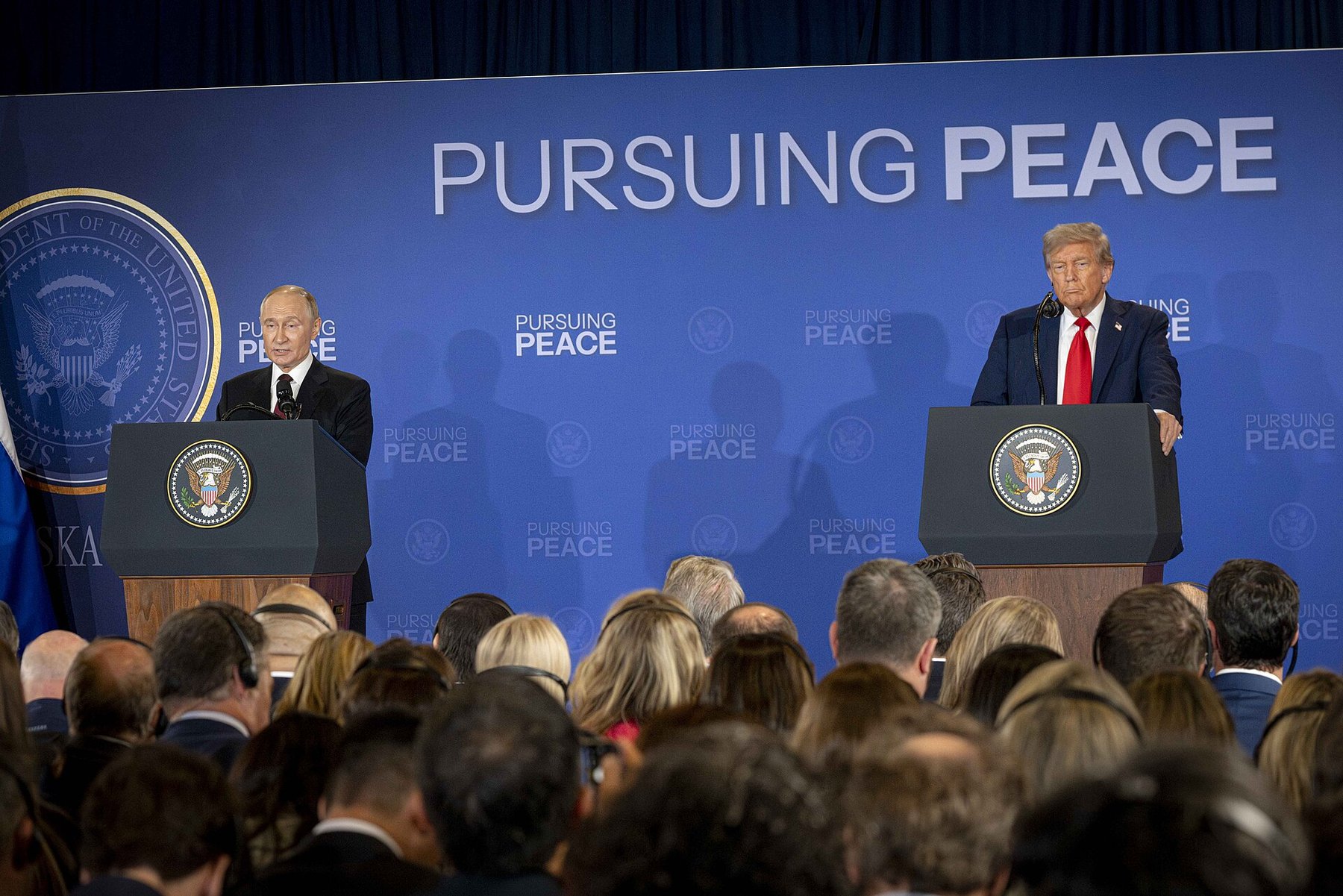
Putin and Trump hold a joint press conference at Joint Base Elmendorf-Richardson in Anchorage, Alaska, Aug. 15, 2025. (DoD photo by Benjamin Applebaum, public domain, via Wikimedia Commons)
Within hours, Treasury's Office of Foreign Assets Control issued General License 135. That one-page document is the only part of the deal that exists on paper. No bilateral agreement has been published.
The License Is One Paragraph, and It Has No Cap
We read General License 135 in full. Paragraph (a) authorizes "all transactions" barred by two sets of Russia sanctions rules that relate to "the sale, delivery, offloading, or importation, including importation into the United States, of diesel fuel of Russian Federation origin." It runs until 12:01 a.m. on April 7, 2027, which is 180 days from signing. Paragraph (b) carves out any debit to U.S. accounts held by Russia's central bank, its National Wealth Fund, or its Finance Ministry.
Here is what the license does not say. It names no tonnage, so nothing in it ties Russia to the 4.8 million tons Trump listed. It does not require the diesel to come to America, since it covers sales anywhere. And it sets no loading date. AP described the license as covering diesel "that has been loaded onto tankers as of Friday," but no such cutoff appears in the text Treasury posted.
Official record
U.S. Treasury, Office of Foreign Assets Control, Russia-related General License No. 135, signed by OFAC Director Bradley T. Smith, Oct. 9, 2026.
"...all transactions prohibited by the Russian Harmful Foreign Activities Sanctions Regulations, 31 CFR part 587, or the Ukraine-/Russia-Related Sanctions Regulations, 31 CFR part 589, that are related to the sale, delivery, offloading, or importation, including importation into the United States, of diesel fuel of Russian Federation origin are authorized through 12:01 a.m. eastern daylight time, April 7, 2027."
General License No. 135, paragraph (a)
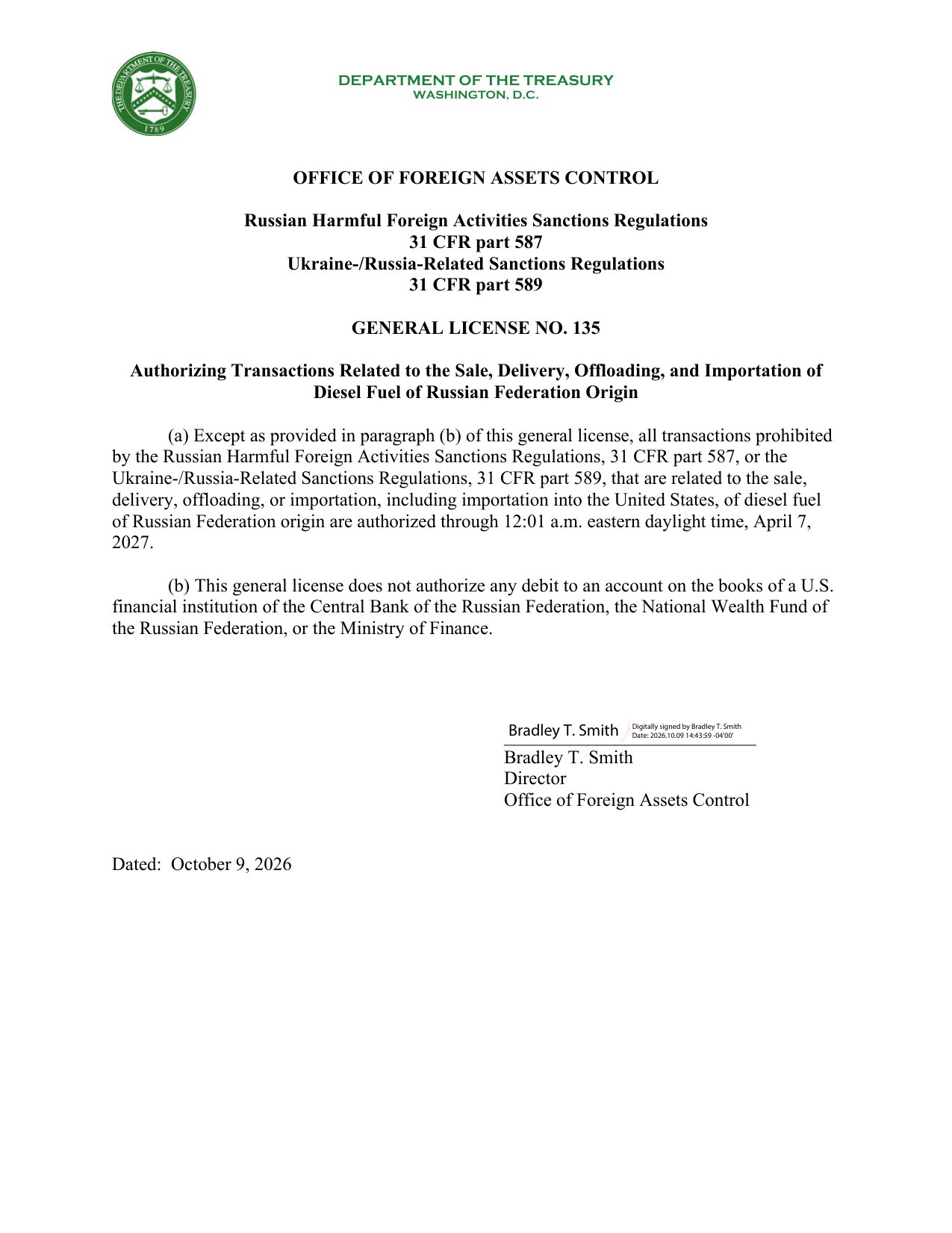
Read or download the full one-page license (PDF) or view it on Treasury's website.
How Much Diesel Is 4.8 Million Tons?
Diesel is sold by the ton overseas and by the barrel here, which makes headline numbers hard to judge. The United Nations energy statistics yearbook uses 7.23 barrels per metric ton for gas oil and diesel. On that factor, Trump's full list (300,000 plus 500,000 plus 1 million plus 3 million tons) comes to about 34.7 million barrels.
Now the demand side. In the four weeks ending Oct. 2, the U.S. used an average of about 3.77 million barrels a day of distillate fuel, the category that covers diesel and heating oil, according to the Energy Information Administration's Weekly Petroleum Status Report data. Divide one into the other and the whole package equals about nine days of American consumption. That is our arithmetic, and it assumes every ton lands here, which Trump himself did not claim.
The first tranche is smaller still. The "immediate" 300,000 tons is about 2.2 million barrels, or roughly 14 hours of U.S. use. U.S. distillate stocks fell 2.25 million barrels in the single week ending Sept. 25. Even the full 34.7 million barrels is about a third of the 105.1 million barrels sitting in U.S. storage as of Oct. 2.
Has the Pump Price Moved?
Not much yet. Diesel futures dipped on Friday's news, AP reported, and AAA's national average was $6.28 that day. When we checked AAA this morning, Oct. 13, the average was $6.279, up about a penny from Monday's $6.267. The record is $6.528, set Sept. 22. A year ago, a gallon of diesel cost $3.653.
A truck at the diesel pumps of the Fort Pierce Service Plaza on Florida's Turnpike. Diesel averaged $6.279 a gallon nationally on Oct. 13, per AAA. (Photo by DanTD, CC BY 4.0, via Wikimedia Commons)
Energy analysts quoted by AP were not expecting a big drop. "What does this do to prices? I think probably not much," said Clayton Seigle of the Center for Strategic and International Studies. Michael Lynch of the Energy Policy Research Foundation said Russian diesel sent here would mostly come out of other buyers' supply, which "will keep the price basically where it is now."
There is a real supply case for the move. The war with Iran has squeezed world fuel markets, and Russia itself has banned diesel exports since July after Ukrainian strikes on its refineries, according to AP, which cited International Energy Agency estimates that Russian diesel output is down about 30%. Any extra barrels in a tight market help at the margin. The open question is whether nine days' worth moves a $6 gallon before Nov. 3.
Does a 2022 Law Stand in the Way?
Treasury's license is only one layer. In April 2022 Congress passed the Ending Importation of Russian Oil Act, Public Law 117-109. Section 2 bans all Russian products under chapter 27 of the tariff schedule, which covers fuels, "in a manner consistent with any implementation actions issued under Executive Order 14066."
Section 3 sets out how a president ends that ban, and the bar is high. He must consult four committees and send them a report at least 45 days ahead. He then certifies that Russia has agreed to withdraw its forces under a deal Ukraine accepts, poses no immediate threat to any NATO member, and recognizes Ukrainians' right to choose their own government. The ban lifts 90 days later unless Congress passes a joint resolution of disapproval.
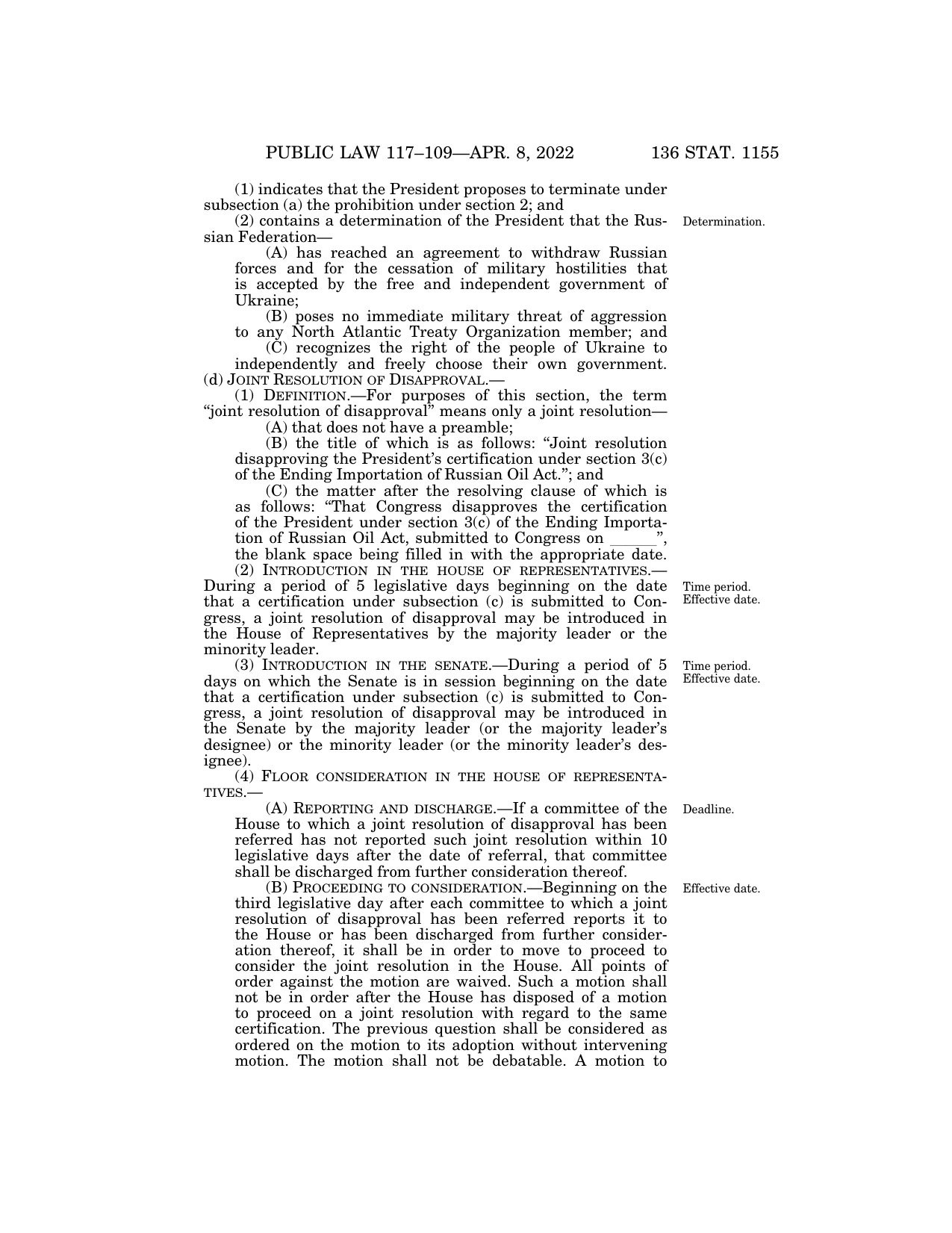
Page 136 Stat. 1155 of the Ending Importation of Russian Oil Act, listing the three findings a president must certify before the import ban can end. Click for the full six-page law (PDF). (U.S. Government Publishing Office, public domain)
License 135 does not mention the 2022 act, and it does not cite Executive Order 14066. Lawyers at HSF Kramer flagged the gap, writing that "questions may therefore arise" over whether the license can authorize imports the statute covers. Our reading is that the administration's best argument sits in Section 2's own wording, which ties the ban to how the executive branch implements it. We found no White House explanation of either point as of this morning.
Six Senators, Four of Them Republicans, Want It Reversed
On Sunday, Republican Sens. Susan Collins, Lisa Murkowski, Thom Tillis and John Curtis joined Democratic Sens. Jeanne Shaheen and Richard Blumenthal in a statement reported by AP via PBS. "Congress was clear: the U.S. should not import oil from Russia until it ends its aggression against Ukraine and ceases threats against our NATO Allies," they wrote. "The Administration must immediately reverse course."
Tillis told NBC's "Meet the Press" there is a legitimate case that the president would not be following the law if the purchases go ahead. Sen. John Barrasso of Wyoming took the other side on CBS. "The president is balancing and has to make tough decisions," he said, calling the deal "just another point of leverage for the president to use against Putin."
The deal also lands one month after Trump signed the Graham sanctions law, which targets Russia's energy revenue. HSF Kramer notes that law preserves Treasury's power to issue general licenses but does not touch the 2022 import ban either way.
What Happens Next
The license is live now, so traders can move Russian diesel without breaking OFAC rules until April 7. Whether any of it reaches a U.S. port is a separate matter, because the 2022 statute is still on the books. Watch for two things: a tanker actually bound for an American terminal, and any certification or report sent to the four committees Section 3 names.
For the farmers and truckers Trump named, the measure that matters is the AAA board. It read $6.279 this morning, and the next weekly EIA inventory report will show whether any new supply has shown up. Nine days of diesel is real fuel. It is not, by itself, a price cut.
Top photo: President Trump walks with Russian President Vladimir Putin at Joint Base Elmendorf-Richardson, Anchorage, Alaska, Aug. 15, 2025. (DoD photo by Benjamin Applebaum, public domain, via Wikimedia Commons)















