

A Christian pastor who prayed outside China's embassy in Washington spent five hours in a holding cell after Chinese diplomats told the Secret Service the sidewalk "belongs to China." The Rev. Patrick Mahoney now faces an unlawful entry charge, with a court date Oct. 21. Federal records tell a different story about who owns that ground. China does not even own the land its own embassy sits on. The United States does.
What Happened Outside the Embassy
Mahoney leads the Christian Defense Coalition. On Sept. 28 he went to the Chinese Embassy to protest the red-carpet treatment Xi Jinping got during his September state visit, The Christian Post reported on Saturday. He laid his own red fabric on the sidewalk, printed with the names of people Beijing has persecuted, including jailed publisher Jimmy Lai and the Uyghurs.
According to Mahoney, embassy staff came outside "visibly angry, agitated, upset." He says Secret Service officers spoke with the diplomats, then told him: "The Chinese government has said this sidewalk belongs to China." He refused to leave. "This is a public sidewalk," he told them. He was arrested and held for five hours.
In an Oct. 4 post, Mahoney said he had been charged with "unlawful entry" and must appear in court on Oct. 21. Crosswalk also covered the arrest. The Christian Post asked the Secret Service for comment, and as of its report no response had come back.
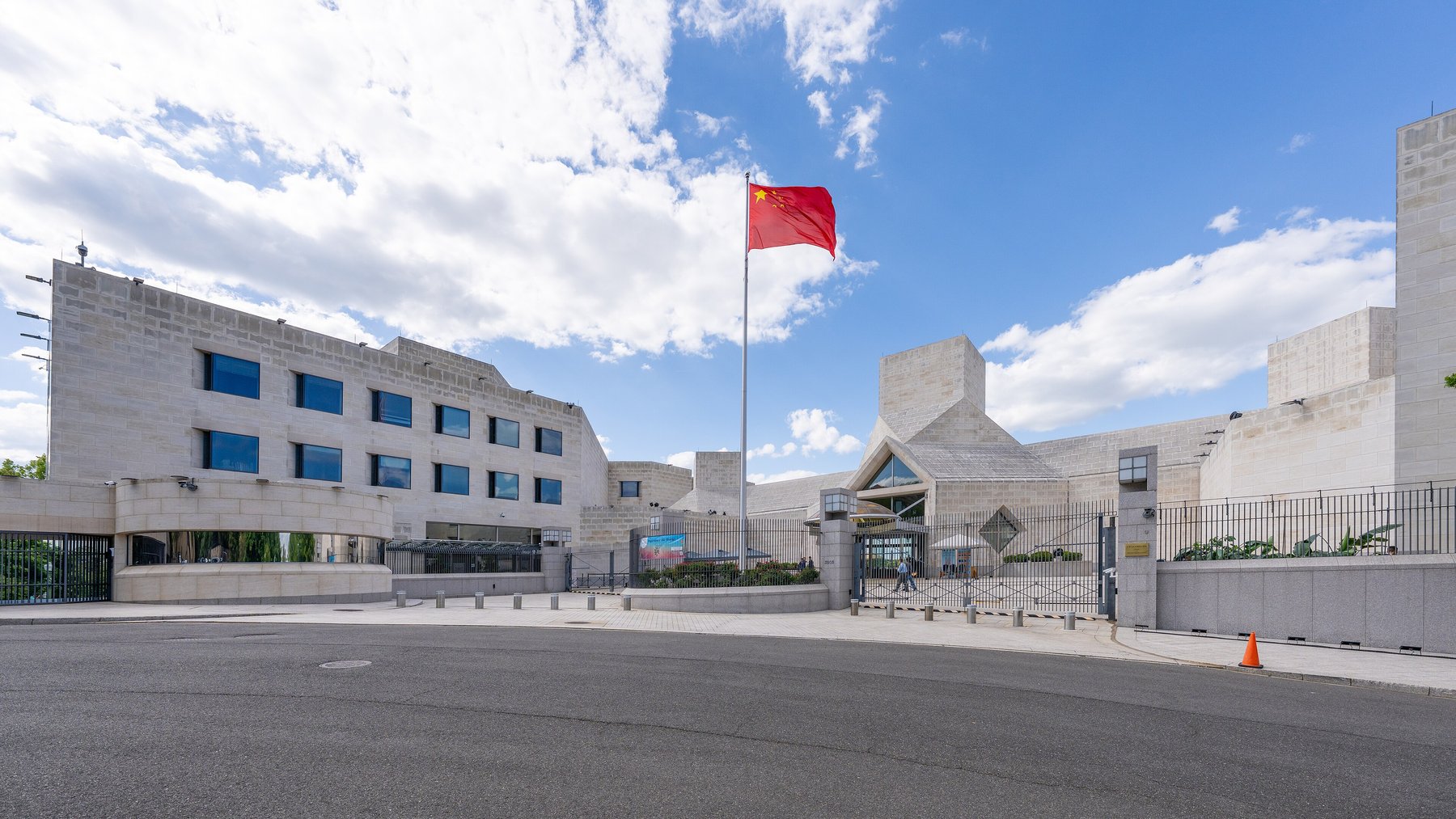
The Chinese Embassy at 3505 International Place NW, Washington, D.C., April 30, 2026. The sidewalk runs outside the embassy's fence line. (Photo by ajay_suresh via Flickr and Wikimedia Commons, CC BY 4.0)
Who Actually Owns the Ground Under China's Embassy?
Here is the part the coverage has missed. China's embassy is not on a normal city block. Its chancery, designed by I.M. Pei's firm and opened in 2009, sits in the International Chancery Center in Northwest Washington.
That center was created by Congress in the International Center Act of 1968. According to the National Capital Planning Commission, the federal agency that reviews building there, the law created the center "on a federally owned parcel of land" bounded by Connecticut Avenue, Van Ness Street, Reno Road and Tilden Street. The act let the Secretary of State divide the parcel into lots and "lease individual plots to foreign governments."
In plain terms, China is a tenant. The State Department is the landlord, and the land stays American. Countries that got a lot there signed long-term leases, The Washington Diplomat reported, 99 years in that account. So when a Chinese diplomat says a sidewalk outside the fence belongs to China, the claim is wrong twice. China does not own the sidewalk, and it does not own the lot behind it either.
Mahoney says the District Department of Transportation confirmed to him that the spot is a public sidewalk. We could not independently confirm the exact square of pavement where he stood, or the boundary lines in China's lease. What the federal record does settle is the bigger point: on that corner of Washington, the owner of record is the United States.
What Does "Unlawful Entry" Actually Require?
The charge Mahoney describes is a D.C. misdemeanor. The unlawful entry statute, D.C. Code § 22-3302, punishes a person who stays on property "without lawful authority to remain" and "shall refuse to quit the same on the demand of the lawful occupant, or of the person lawfully in charge thereof." For public property, the law adds the occupant's "agent."
That wording puts one question at the center of this case. Who was the "lawful occupant" or "person lawfully in charge" of that sidewalk? By Mahoney's account, the officers did not say the Secret Service or the District wanted him gone. They said China did. If prosecutors move forward, they will have to name the person in charge of a public sidewalk and show that person, not a foreign diplomat, told him to leave.
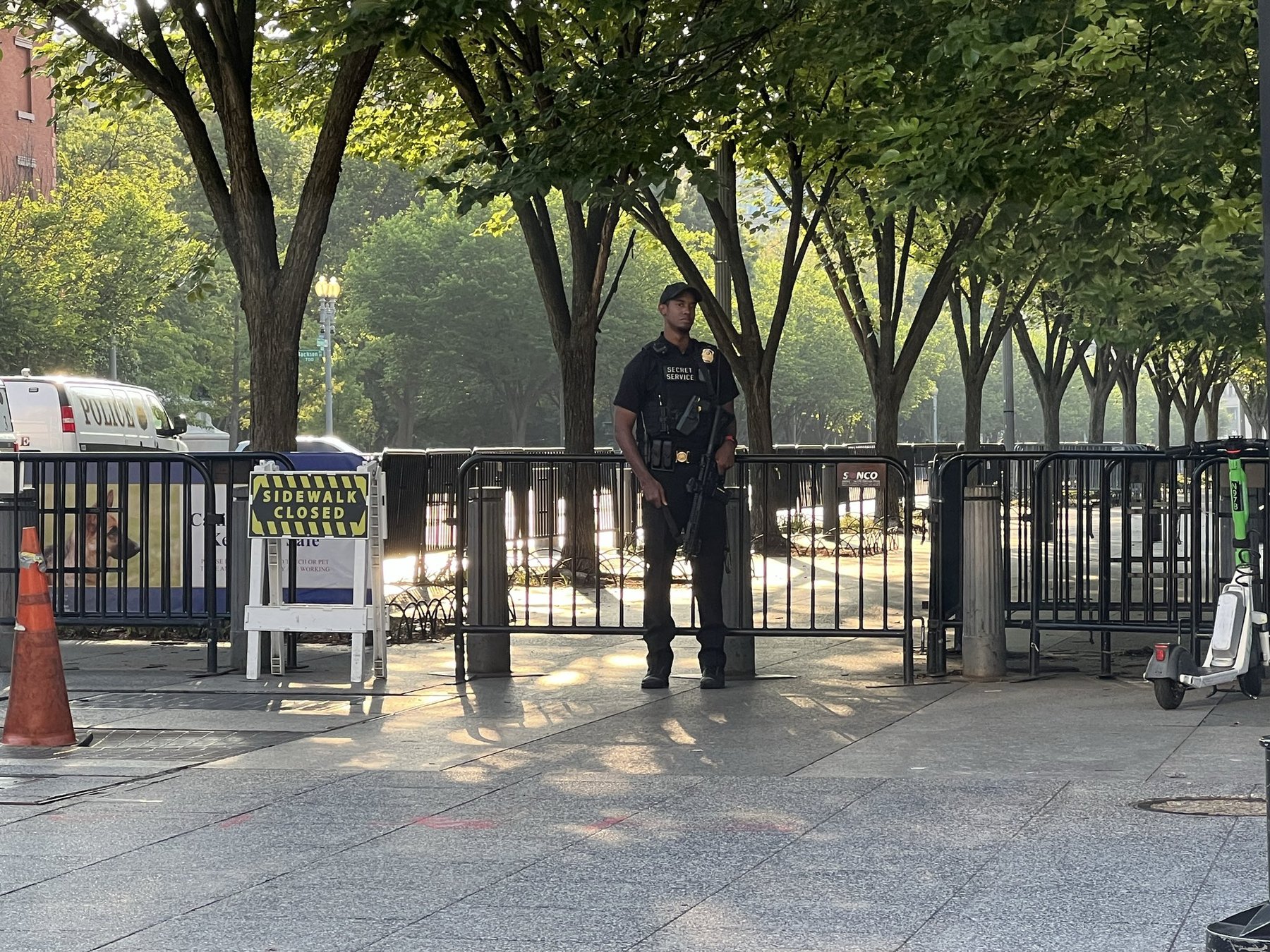
A Secret Service Uniformed Division officer on guard near the White House, July 14, 2024. The Uniformed Division also protects foreign diplomatic missions in the Washington area. This photo is not from the embassy arrest. (Photo by Misha Komadovsky, public domain, via Wikimedia Commons)
The Secret Service's Uniformed Division does guard embassies. Federal law, 18 U.S.C. § 3056A, assigns it to protect "foreign diplomatic missions" in the D.C. metropolitan area. Guarding a building is one job. Enforcing a foreign government's claim to a public sidewalk is another one entirely.
The Supreme Court Already Ruled on Protests Outside Embassies
This is not new legal ground. In 1988, the Supreme Court decided Boos v. Barry, a case brought by Americans who wanted to hold signs like "RELEASE SAKHAROV" on the public sidewalks outside the Soviet Embassy. A D.C. law banned signs within 500 feet of an embassy that brought a foreign government into "public odium."
The Court struck that ban down. Justice Sandra Day O'Connor's opinion described the sidewalks it covered as "traditional public fora," and the Court rejected the argument that diplomats must be shielded from criticism. "In public debate our own citizens must tolerate insulting, and even outrageous, speech," she wrote. She added that the Court was "not persuaded that the differences between foreign officials and American citizens require us to deviate from these principles here."
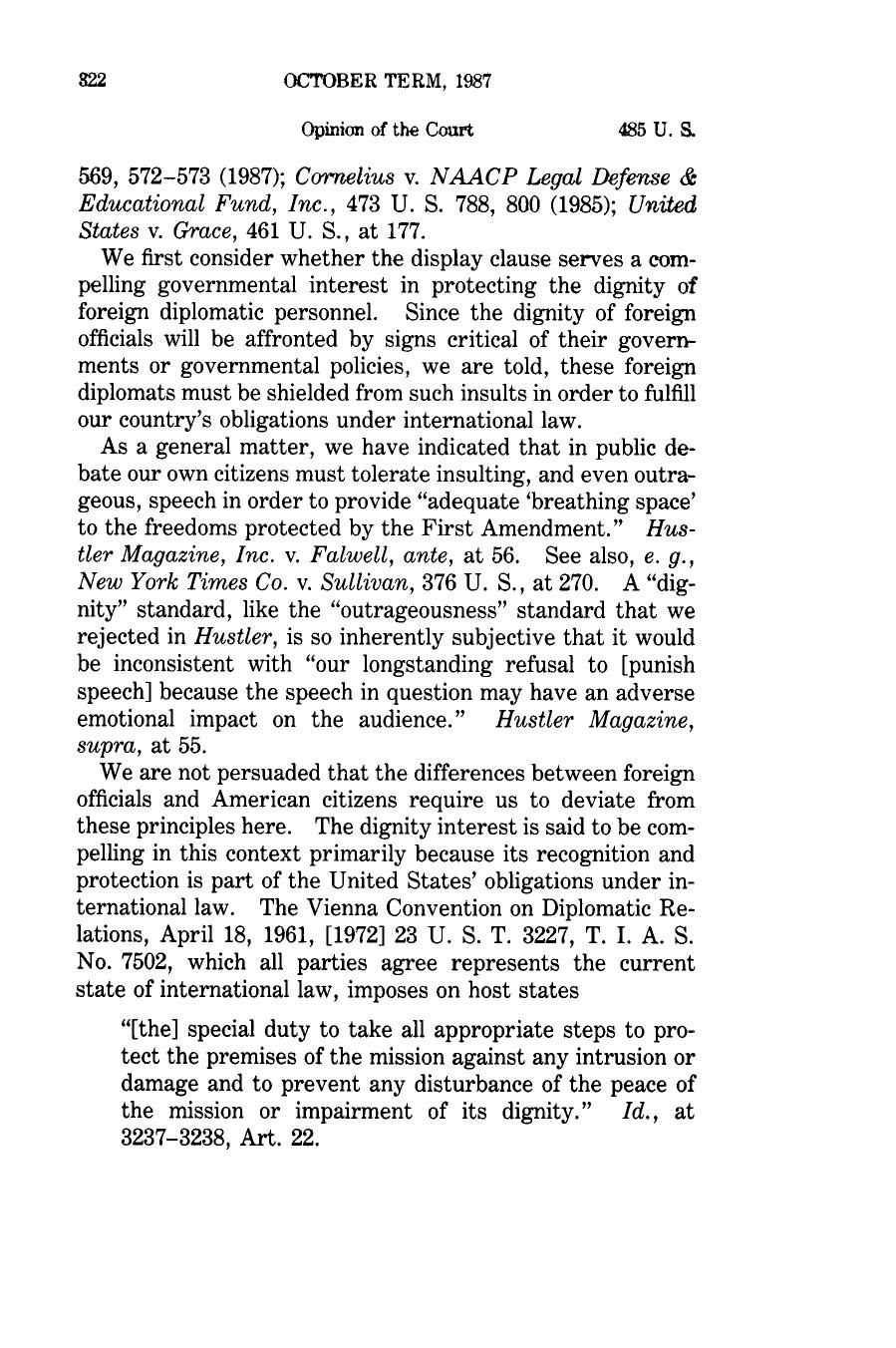
Page 322 of Boos v. Barry, 485 U.S. 312 (1988), where the Court weighs a foreign diplomat's "dignity" against Americans' right to protest. (United States Reports via Library of Congress, public domain)
The Government's Best Argument, and Why It Has Limits
To be fair to the Secret Service, the United States does owe embassies protection. The Vienna Convention on Diplomatic Relations gives host countries a "special duty" to protect a mission's premises "against any intrusion or damage" and to prevent "any disturbance of the peace of the mission or impairment of its dignity." The Court quoted that very language in Boos.
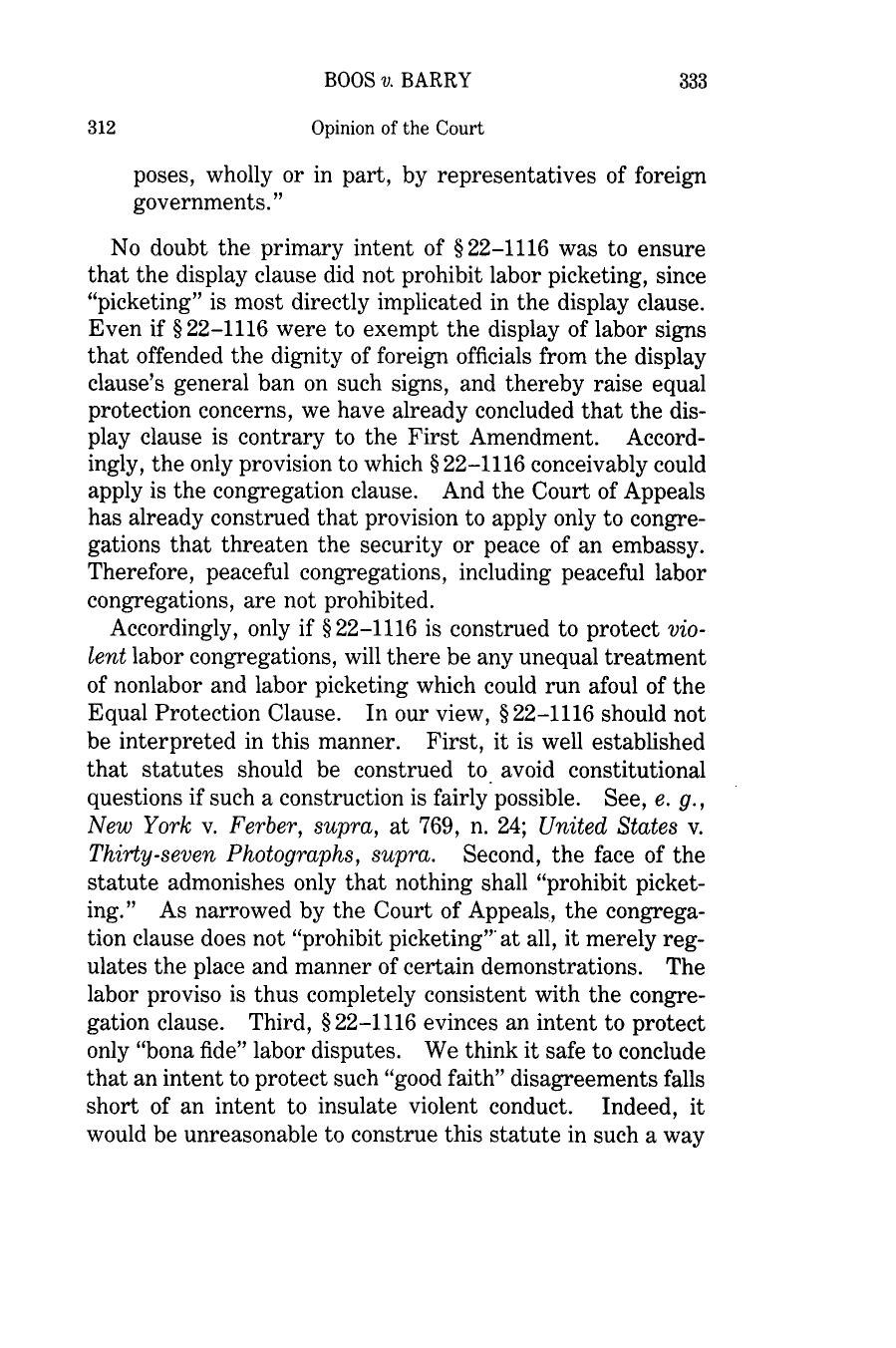
The same opinion also kept part of the D.C. law, a clause letting police order a crowd within 500 feet of an embassy to disperse. But the Court accepted it only as narrowed by the appeals court, applying to gatherings "that threaten the security or peace of an embassy." Then it said this: "Therefore, peaceful congregations, including peaceful labor congregations, are not prohibited."
Official record
Boos v. Barry, 485 U.S. 312, decided March 22, 1988. Opinion of the Court by Justice O'Connor, page 333, from the official United States Reports.
"And the Court of Appeals has already construed that provision to apply only to congregations that threaten the security or peace of an embassy. Therefore, peaceful congregations, including peaceful labor congregations, are not prohibited."
485 U.S. at 333
Read or download the full 28-page opinion (PDF) · official Library of Congress copy
Mahoney was one man praying with a strip of fabric. Nobody has publicly claimed he threatened anyone. And he was not even charged under the embassy statute. He was charged with unlawful entry, which depends on who controls the property.
Congress Once Voted to Name That Plaza After a Chinese Dissident
There is another piece of history here. In February 2016, the U.S. Senate unanimously passed Sen. Ted Cruz's bill renaming the plaza in front of the Chinese Embassy "Liu Xiaobo Plaza," after the jailed Nobel Peace Prize winner. The embassy's address would have become 1 Liu Xiaobo Plaza.
Beijing hated it. The Obama White House called it a "ploy," and the bill never became law. But every senator voted on the premise that the space in front of China's embassy was American ground, ours to name. Ten years later, a Chinese diplomat's say-so was enough to put an American pastor in a cell on that same stretch of Washington.
What Happens Next
Mahoney is due in court Oct. 21. Prosecutors can drop the charge or set a trial date, he told The Christian Post. He says lawyers from the American Center for Law and Justice are working with him, and that the ACLJ had already written to the Secret Service before his arrest stating the sidewalk is not Chinese property.
Mahoney is no stranger to arrest. He told the Post he has been arrested 112 times over decades of activism, but never before at this embassy. He also said Congress is out of session for the midterms, so he is waiting on the government's next move before asking lawmakers to step in.
The stakes go past one misdemeanor. If a foreign government can point at an American sidewalk, call it its own, and get a praying pastor removed by U.S. agents, then the rule Boos v. Barry set 38 years ago means very little. The government owes the public a simple answer before Oct. 21: on whose authority was Patrick Mahoney told to leave?
Top photo: The Embassy of the People's Republic of China in Washington, D.C., Oct. 8, 2022. (Photo by Amaury Laporte via Wikimedia Commons, CC BY 2.0)















