Florida Attorney General James Uthmeier and Gov. Ron DeSantis announced 20 arrests for illegal voting on Thursday: 16 noncitizens who allegedly claimed citizenship to register, and four felons who voted while still on probation. Read the state's own list of defendants closely and something jumps out. Some of these people had been voting for 20 years or more, yet every voting charge released so far covers only the 2024 elections.
Who Florida Says Voted Illegally
The charges came from a statewide operation run by the Office of Statewide Prosecution with the Florida Department of Law Enforcement, the Department of State's Office of Election Crimes and Security, and U.S. Citizenship and Immigration Services. According to the attorney general's office, as reported by News4JAX, investigators built each case from the voter's own paperwork, down to poll-book signatures and vote-by-mail certificates. Cases span nine counties, from Brevard to Polk.
"These defendants swore they were qualified electors, cast ballots in our elections, and later confirmed they were never eligible to vote," Uthmeier said. Every count is a third-degree felony. Statewide Prosecutor Brad McVay told reporters that 12 of the 20 were already in custody and promised "many more arrests," according to the Florida Phoenix.
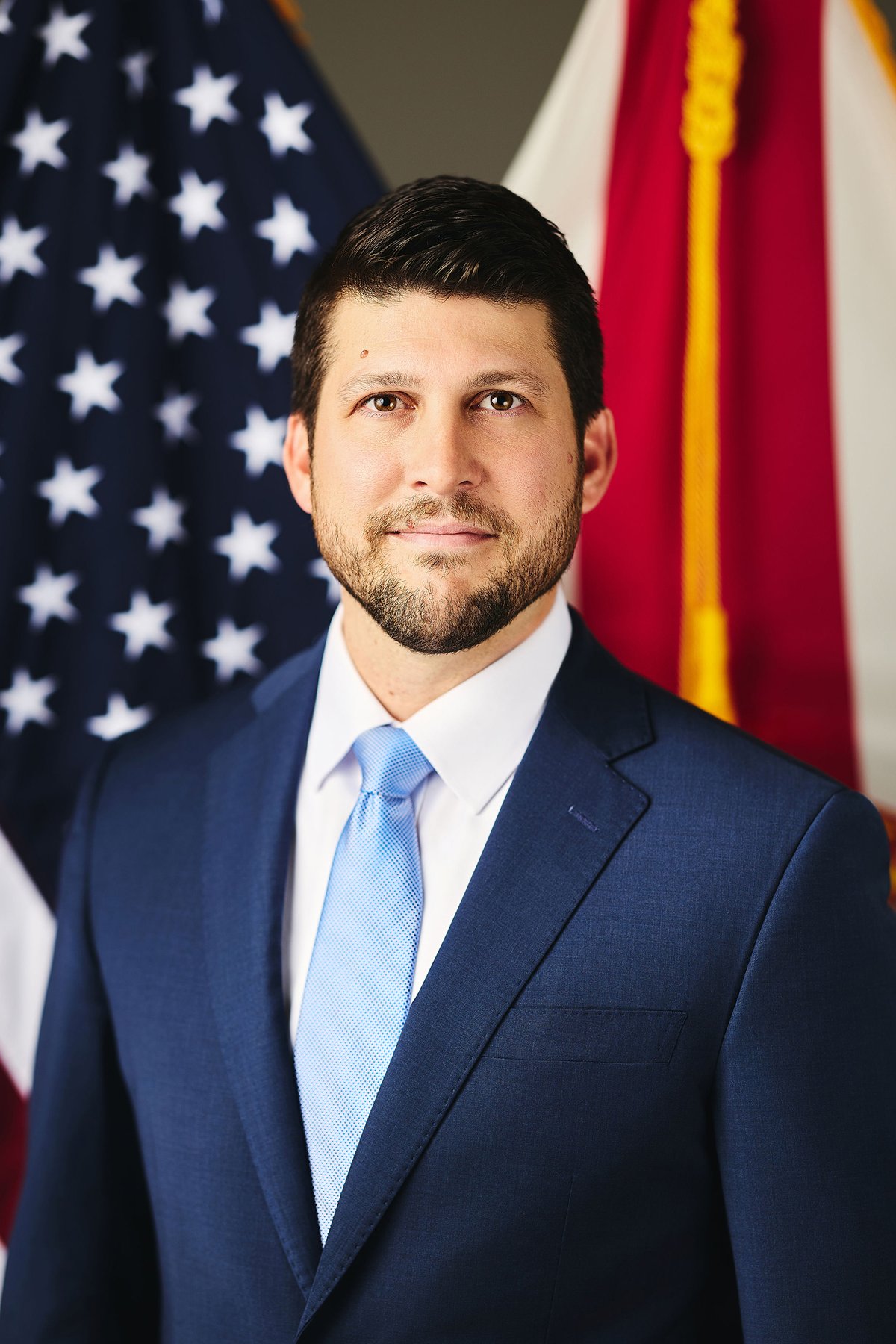
Florida Attorney General James Uthmeier, whose office announced the 20 prosecutions on September 24. (Office of the Attorney General of Florida, via Wikimedia Commons, public domain)
The noncitizens named so far are all lawful permanent residents. That means green-card holders, legally in the country, who allegedly checked the citizenship box anyway. Canales, a Chilean national from Ocala, is accused of listing Florida as her place of birth on two separate registrations, in 2012 and 2022.
Twenty Years of Voting, One Count
Twelve defendants have been named in detail so far, in the attorney general's release as published by ABC7 Sarasota and WGCU. Line up their voting histories against their charges and the gap is hard to miss.
Giorgio Mucelli, a Canadian citizen from Melbourne, allegedly voted in seven general elections from 2004 through 2024. He faces one count of voting as a noncitizen, plus one count of false affirmation. Craig William Smith of Ocala, a Bahamian national, registered in 2002 and has a voting history the state says dates to 2006. His two voting counts are the 2024 primary and the 2024 general. Selvin Whilby of Tampa, a Jamaican national, has voted by mail since 2008, according to the state. He also faces two counts, both from 2024.
Tracey Jones of Lakeland registered in 1995. She is charged over a single early vote cast on October 26, 2024. Wherever the release ties a charge to a specific ballot, that ballot was cast in 2024. Mucelli's release doesn't name the election behind his single count.
The Registration Charges Follow the Same Line
The pattern holds for the lie on the registration form, too. The three noncitizens who registered in 2024 each face a False Swearing count on top of the voting charge. Astrid Navarrete Quintana of Fort Myers registered August 19, 2024. Kadian Johnson of Lehigh Acres registered September 30, 2024. Manon Raux of Naples registered September 18, 2024. The felon in the group, Donta White of Tampa, filed two registrations in October 2024 and faces two False Swearing counts.
Now look at the ones who registered in November 2022 or earlier. Mei-Lin Johnston registered November 8, 2022. Alejandro Garcia Villegas registered September 20, 2022. Canales, Smith, Whilby and Jones go back further. None of those six faces a false swearing charge. Each is charged only with voting in 2024. (Mucelli's registration date wasn't released.) The exception is James Hollingsworth of DeSoto County, who registered in 2021. He has two False Swearing counts, matching his two 2024 mail ballots, though the release doesn't say what those counts rest on.
The state's announcement never explains the split. But its own election crimes office already told the Legislature why this happens.
Florida's Election Cops Warned About the Clock in January
On January 15, the Office of Election Crimes and Security filed its 2025 annual report with the governor and legislative leaders. Its first recommendation was to lengthen the statute of limitations. "In general, the statute of limitations in the state of Florida for election crimes is three years," the office wrote, and cases found after that window "cannot then be charged by prosecutors."
Official record
Florida Department of State, Office of Election Crimes and Security, Annual Report to Governor and Legislature, January 15, 2026. The excerpt below covers the executive summary, the illegal-voting case sections and the office's recommendations to lawmakers.
"Sometimes OECS does not become aware of allegations that an election crime has been committed until after the statute of limitations has passed. Those cases cannot then be charged by prosecutors."
Office of Election Crimes and Security, 2025 annual report, page 322
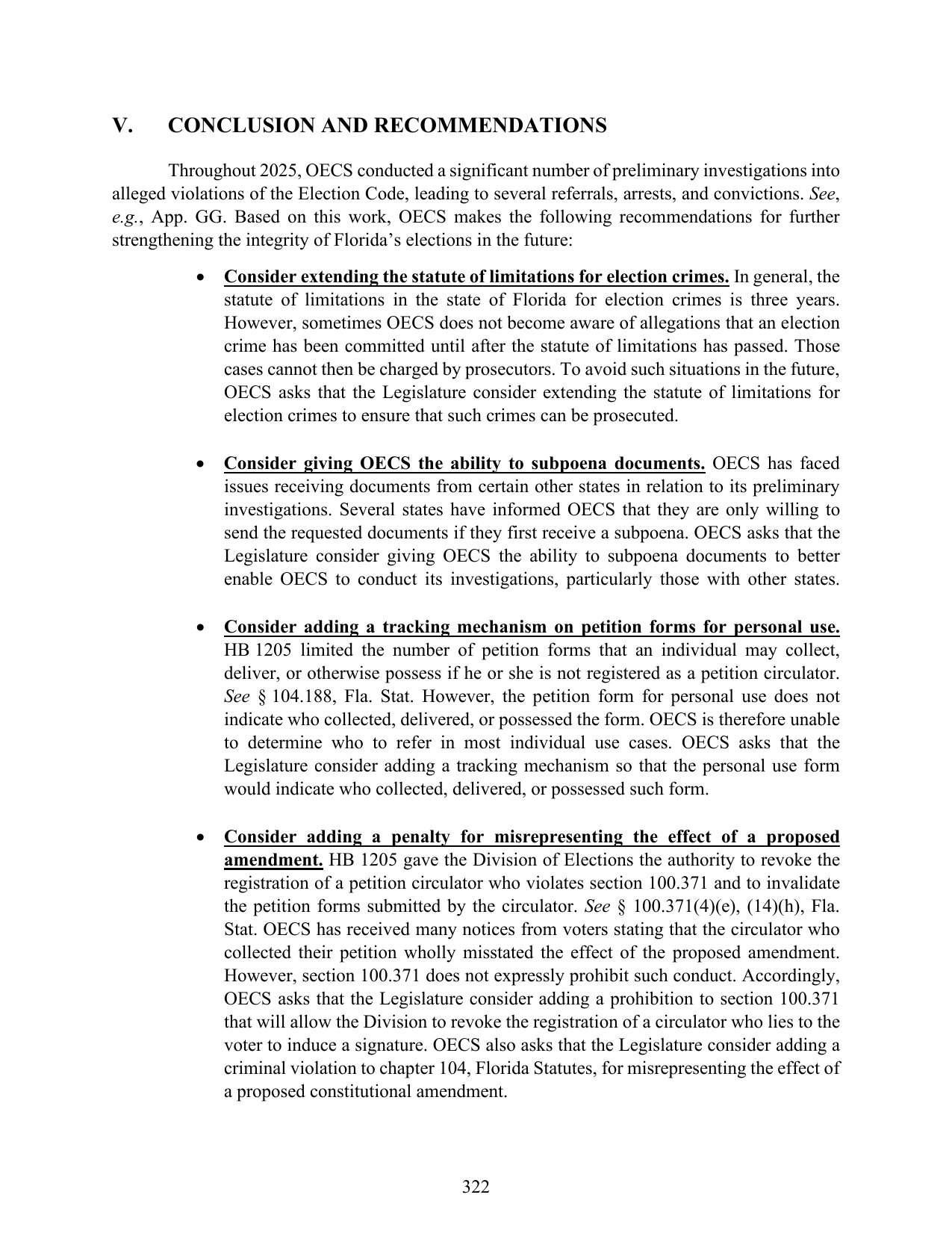
Read or download the 9-page excerpt (PDF) · full 686-page report on the Department of State's website
The report includes a case that shows the cost. Gordon Louis, a Haitian national and permanent resident who registered in 2001, voted in 7 elections and tried to vote in 2 others, according to the report. Federal prosecutors could charge him for only the 2020 general election. The other ballots were out of reach because the state's three-year clock and the federal five-year clock "had lapsed."
The same report found at least 198 likely noncitizens who illegally registered or voted in 2025 and sent 170 of them to law enforcement. It also counted 44 people arrested or convicted of election crimes that year out of 3,478 complaints.
The Fix Passed. It Came Too Late for 2022.
Lawmakers listened. HB 991, which passed 77-28 in the House and 27-12 in the Senate, "creates a five-year statute of limitations for a prosecution of a felony violation of the Election Code," effective July 1, 2026, according to the Senate's bill summary.
Run the dates and the problem is obvious. A ballot cast in the November 8, 2022, general election aged past three years in November 2025, eight months before the new law took effect. The U.S. Supreme Court held in Stogner v. California (2003) that a state can't use a new limitations law to revive a prosecution that has already expired. On that math, 2024 was the only election cycle left on the table for most of these defendants. The five-year window protects future cases. It can't reach back for the old ones.
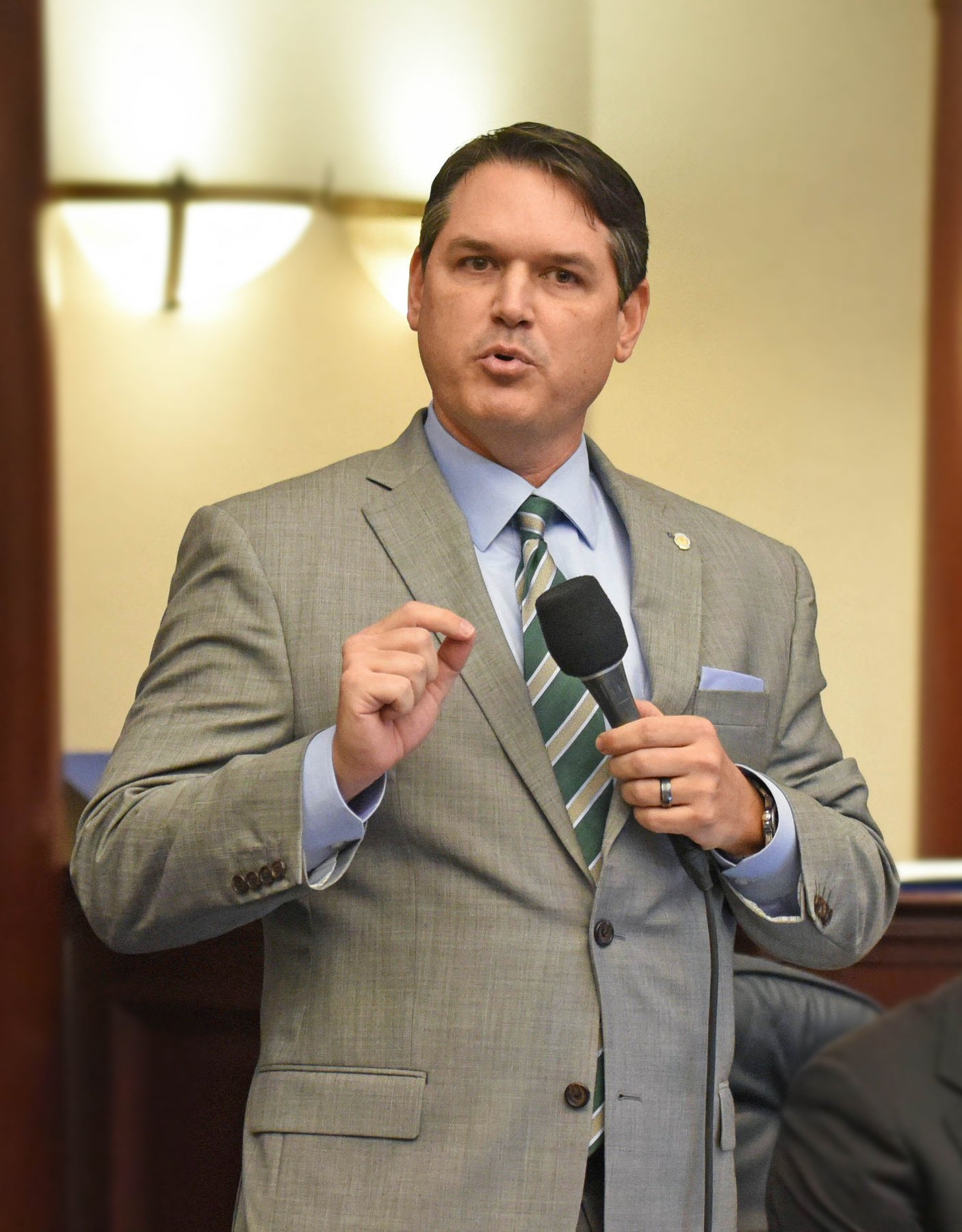
Cord Byrd, now Florida's secretary of state, during his time in the Florida House in 2018. Byrd said Thursday he will leave office after November to lead a new national group of election officials. (Florida House of Representatives, via Wikimedia Commons, public domain)
The Citizenship Check That Starts After the Midterms
HB 991 also goes after how these registrations happen in the first place. Starting January 1, 2027, the state must check new registrants and anyone updating a registration against Department of Highway Safety and Motor Vehicles REAL ID data on citizenship. By July 1, 2027, Florida driver licenses issued to citizens must show citizenship status.
Hollingsworth, a Canadian national and permanent resident since 1967, registered through that same DMV agency in 2021, according to the attorney general's office. None of the new checks will be in place for the November 3 election. Until January, Florida registration still runs mostly on the sworn statement that these defendants allegedly signed falsely.
Critics Call the Timing Political
David Becker of the Center for Election Innovation and Research, a former Justice Department trial attorney, told Florida reporters that federal practice is to avoid bringing these cases "certainly not 40 days before an election." Florida House Democratic Leader Fentrice Driskell said the timing "reeks of voter intimidation" and pivoted to the Hope Florida grand jury, both per the Florida Phoenix.
There is a fair point buried in the history. DeSantis announced 20 voter fraud arrests five days before the 2022 primary, and several of those cases were later dismissed, some because judges ruled the statewide prosecutor lacked jurisdiction. Those 2022 defendants were felons convicted of murder or sex offenses, and NPR reported that at least one had been mailed a voter registration card after applying.
This batch looks different. According to the state, most of the named noncitizen defendants later signed a form or put it in writing that they are not U.S. citizens. Hollingsworth allegedly emailed his supervisor of elections to say he had been voting. Each defendant is presumed innocent, and the court cases will decide the rest.
What Happens Next
The cases go to the Office of Statewide Prosecution, and the state says more arrests are coming. Byrd used Thursday's event to announce the Association of State and Local Election Officials, a new national group he will lead after the election to export what he called "the Florida blueprint."
That blueprint now has one lesson written into law. Illegal votes that surface more than three years late have gone unpunished, and the state's own filings show it. Florida closed that gap for future cases in July. For people who allegedly voted for decades before 2024, the only ballots still open to prosecution are the most recent ones.
Top photo: Gov. Ron DeSantis speaks at a joint press conference with the Department of Homeland Security at the Miami Air and Marine Branch, February 26, 2025. (Ozzy Trevino, U.S. Department of Homeland Security, via Wikimedia Commons, public domain)