

A federal judge in Buffalo has ruled that New York cannot stop ordinary residents from buying body armor, finding the ban unconstitutional because the state could not point to a single post-ratification law that looks like it. The Wednesday order takes effect immediately, but the state asked for and got a 14-day stay to seek relief from an appeals court.
What did the judge rule?
U.S. District Judge John L. Sinatra Jr. issued a 47-page Decision and Order on Oct. 21 in Heeter v. James, No. 24-CV-623 in the Western District of New York. He granted summary judgment to the challengers, Benjamin Heeter, Joseph Wurtenberg and the Firearms Policy Coalition, and permanently enjoined enforcement of the purchase and sale ban. The case page is hosted by the Firearms Policy Coalition, which brought the suit in July 2024.
The challenged provisions are Penal Law 270.21 and 270.22 and General Business Law 396-eee. Together they bar anyone outside an "eligible profession" from buying body armor. The opinion opens by calling it a "first-of-its-kind law prohibiting law-abiding residents" from purchasing armor for self-defense.
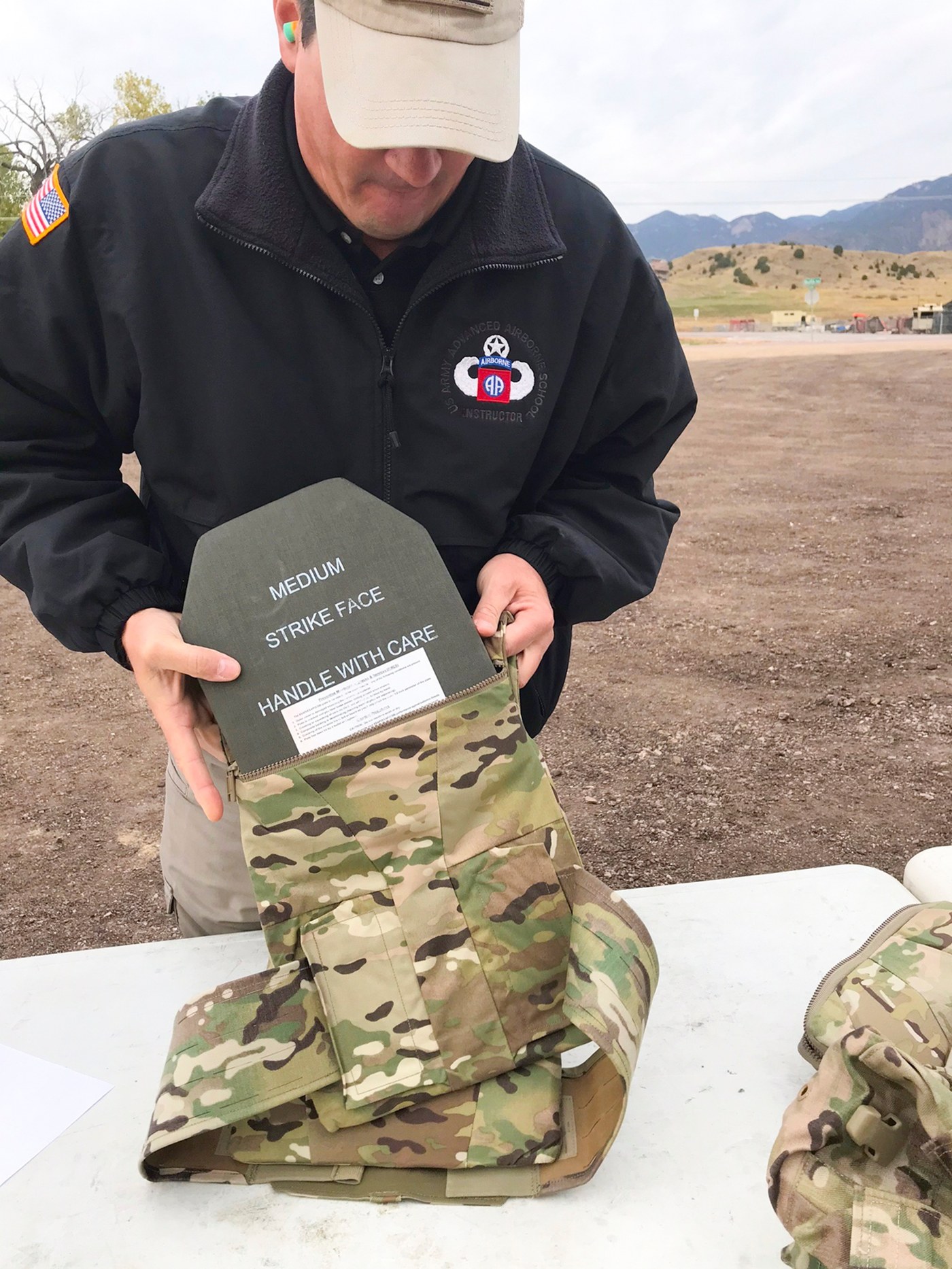
A trainer shows how a ballistic plate loads into a plate carrier during a vest field test at Fort Carson, Colorado, Oct. 18, 2017. Photo: Staff Sgt. Lance Pounds, U.S. Army, via DVIDS, public domain. Military equipment shown for illustration.
What did the court say body armor is?
The state argued that body armor is "not an 'Arm' as the term would have been commonly understood in 1791 or 1868," and called it a "tactical accessory" to firearms. The judge disagreed in the second paragraph of his ruling.
Official record
Heeter v. James, No. 1:24-cv-00623-JLS-HKS, Document 95, Decision and Order, W.D.N.Y., filed Oct. 21, 2026 (page 2 shown).
"Indeed, body armor is an 'Arm' protected by the plain text of the Second Amendment. As such, regulation in this area is permissible only if the State demonstrates that the new enactment is consistent with the Nation's historical tradition of sufficiently analogous regulations. New York fails that test." — Judge John L. Sinatra Jr.
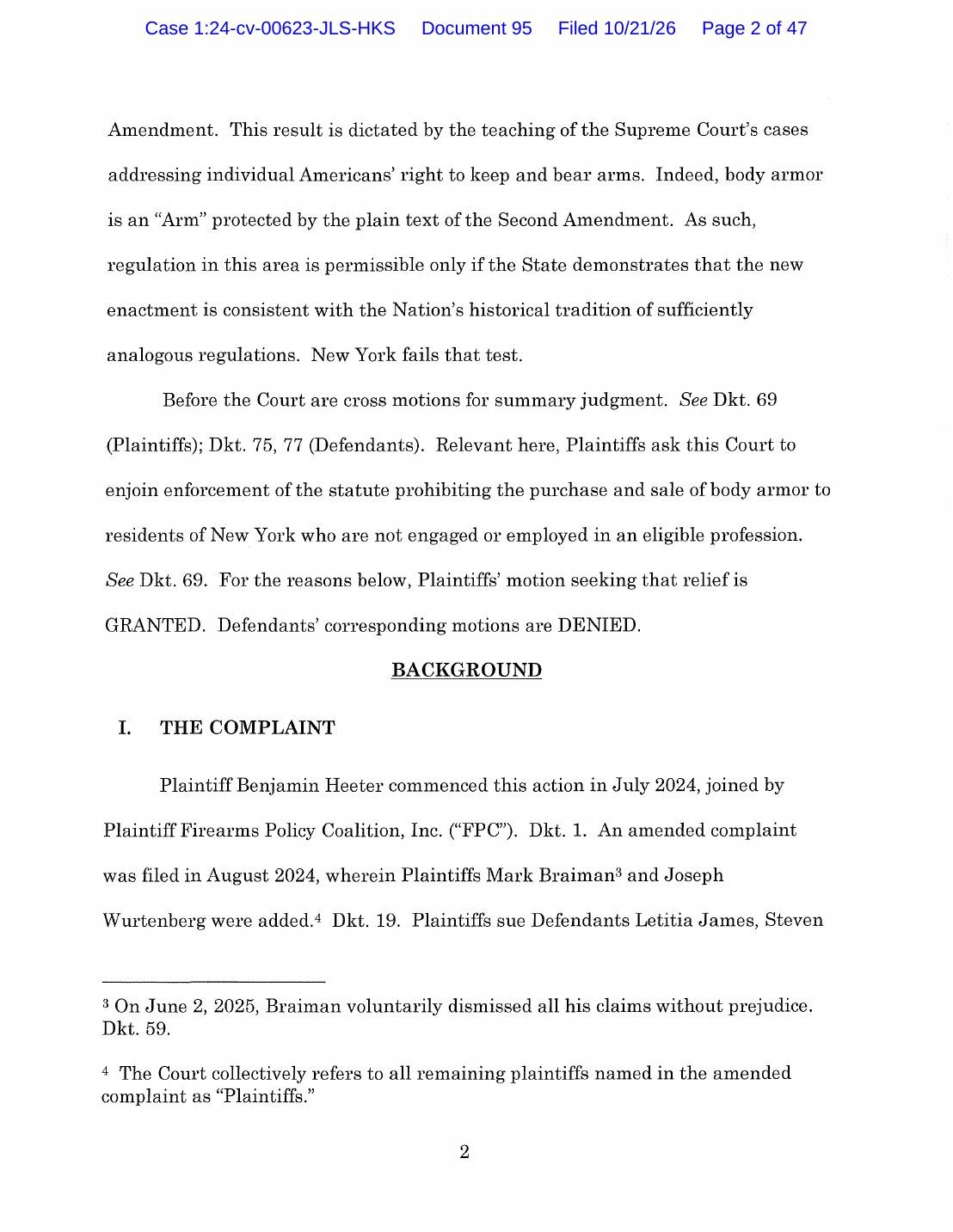
Static capture of page 2 · read or download the full 47-page opinion (PDF) · case page
Did Kevlar not existing in 1791 matter?
The state said modern synthetic armor "was never contemplated by the Founders." The opinion answers with Heller, which held that the Second Amendment reaches "all instruments that constitute bearable arms, even those that were not in existence at the time of the founding." Then it adds: "That Kevlar did not exist at the Founding does not alter the constitutional principles guiding the Court's analysis."
On common use, the judge cited plaintiffs' market-report estimates of more than 82,000 units sold in 2023, more than 87,000 in 2024 and more than 93,000 in 2025. He also noted that 49 states do not ban civilian purchases, and that one amicus, Armored Republic Holdings, reported selling over 2.5 million body-armor products to American civilians. The state offered no evidence that body armor is uncommon. It only challenged whether the market reports were admissible, and the court admitted them.
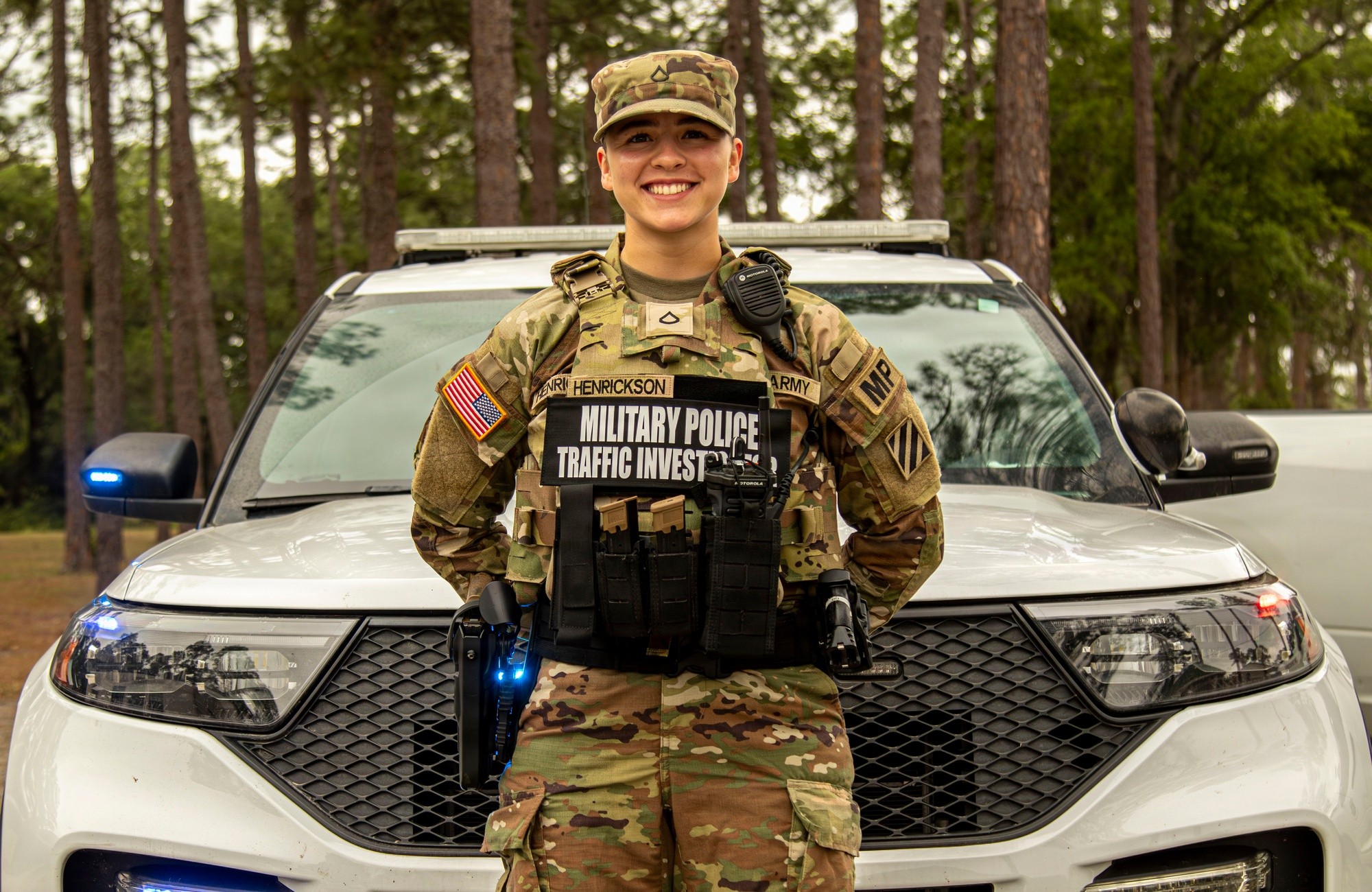
Pfc. Rebecah Henrickson, a military police officer, wears a new outer tactical vest at Fort Stewart, Georgia, May 1, 2026. Photo: Staff Sgt. Anthony Herrera, U.S. Army, via DVIDS, public domain. Illustration only; the case concerns civilian purchases.
Why did New York's history argument fail?
Under Bruen, once the text covers the conduct, the state must show a tradition of similar regulation. The opinion says New York "is unable to identify a single regulation on body armor post-ratification" and instead leaned on English law that predates the country. The judge noted the Supreme Court has said the Statute of Northampton, as understood in the Middle Ages, "has little bearing on the Second Amendment adopted in 1791."
The state also argued that armor has been regulated to prevent public fear. The judge found the offered laws were written for different problems and "had no 'how' methodologies that remotely resemble the State's outright ban on civilians purchasing body armor." He concluded the ban "violates 'the constitutional right to keep and bear arms,'" quoting Wolford v. Lopez, the Supreme Court's 2026 decision.
What happens next?
The injunction is effective immediately, but the judge granted the state's request for a 14-day stay pending appeal. Unless the Second Circuit extends it, the stay lapses in early November. I did not find an appeal filing as of Saturday, so whether New York asks for more time is unknown.
Two limits are written into the order. The state's separate crime of wearing body armor while committing a violent felony with a firearm, Penal Law 270.20(1), is untouched. And only the state defended the law on the merits. The district attorneys named as defendants argued only that they were the wrong parties, and the judge ordered the injunction to run against them too, citing their prosecution duties.
For a gun owner in New York, the practical question is simple. If the stay ends without relief from the appeals court, buying a plate carrier from a retailer should no longer be a crime. Read the order itself before relying on that, because the state can still appeal.
Header photo: Soldiers of the 10th Mountain Division during a vest evaluation at Fort Drum, New York, Oct. 29, 2019. Photo: David Jordan, PEO Soldier, via DVIDS, public domain.















