The Federal Reserve's own staff saw core inflation stuck at 3.4% in August, and then Washington changed how it measures prices. Minutes released Wednesday show the Fed expected the government's new formula to knock that number down to 3.2% before a single price changed. When the official figure came in at 3.0%, it read like a cooldown. By the Fed's own math, about half of it was paperwork.
The Fed Released Its Notes on the First Rate Hike Since 2023
On Oct. 7 the Fed published the minutes of its Sept. 15-16 meeting, the one where it raised its key rate a quarter point to a range of 3.75% to 4%. The vote was 12 to 0. Chairman Kevin Warsh voted yes, and so did Gov. Jerome Powell, the former chairman, and Gov. Lisa Cook.
The headline most outlets ran was the line about what comes next. "Most participants assessed that another increase in the target range for the federal funds rate would likely be appropriate by year end," the minutes say. Stocktwits led with that. The more telling paragraph sits on page 3.

Federal Reserve Chairman Kevin Warsh, who led the unanimous September vote to raise rates. (Official Federal Reserve portrait, public domain, via Wikimedia Commons)
The Fed's Staff Ran the Numbers Two Ways
In the staff review of the economy, the Fed's economists estimated that overall inflation, measured by the personal consumption expenditures (PCE) price index, "edged up to 3.8 percent in August." Core inflation, which strips out energy and most food, "was estimated to have remained at 3.4 percent." Remained means no progress.
Then comes the second set of numbers. "Under the new methodology that the Bureau of Economic Analysis (BEA) had announced would be implemented at the end of September, the staff estimated that total inflation would be 3.6 percent in August, with core inflation at 3.2 percent." Same month, same prices. The formula alone was worth two tenths of a point on both measures.
Official record
Minutes of the Federal Open Market Committee, September 15-16, 2026, released Oct. 7, 2026 (15-page PDF). Page 3, Staff Review of the Economic Situation.
"Under the new methodology that the Bureau of Economic Analysis (BEA) had announced would be implemented at the end of September, the staff estimated that total inflation would be 3.6 percent in August, with core inflation at 3.2 percent."
FOMC minutes, page 3
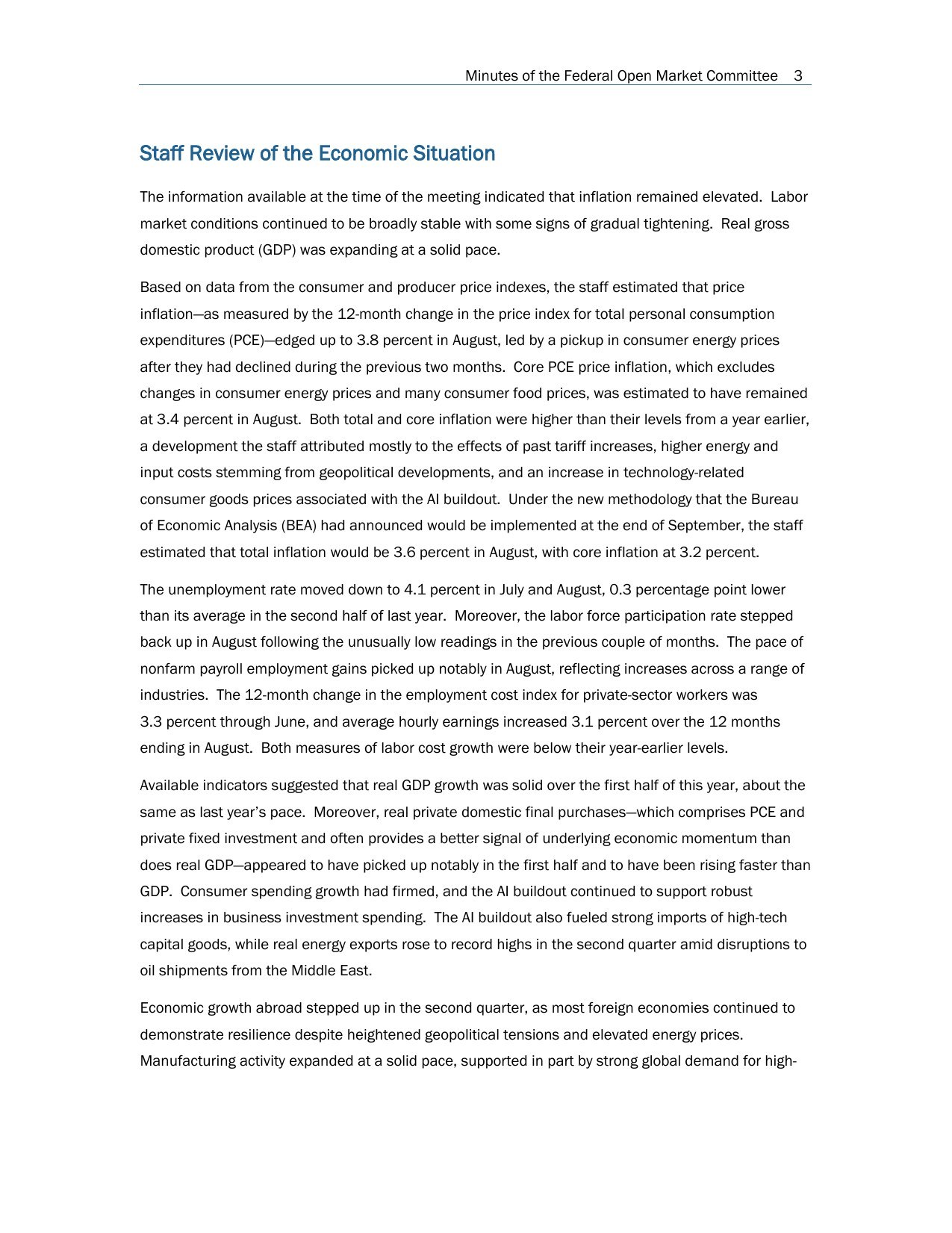
Read or download the full 15-page minutes (PDF) · official Federal Reserve copy · HTML version
What Washington Changed in the Formula
BEA laid out the changes in a June preview of its annual update. Three kinds of spending got new price measures. Portfolio management and investment advice fees will no longer be priced with a Labor Department producer price index; BEA will instead estimate the "quantity" of those services from employment data. Computer software moves from a single consumer price index to a blend that includes producer prices for game software and IT hosting. Legal services get a new composite, because the old consumer index for legal fees has gone mostly unpublished since 2023 and, in BEA's words, "recently exhibited erratic changes."
The Fed knew which items mattered. According to the minutes, a few participants pointed to software and portfolio management fees in particular as items that "had made relatively large contributions to recent PCE inflation readings," and said those contributions "would likely be reduced somewhat with the upcoming changes." BEA applied the new methods back to January 2021, so the old numbers were rewritten too.
Then the Official Number Came In at 3.0%
BEA's August report, released Sept. 30 under the new methods, put overall PCE inflation at 3.4% and core at 3.0%. Forecasters had braced for worse, and one Tech Times headline summed up the day: inflation "cooled" while BEA "rewrote how it measures prices." A preview by FXStreet, published by TMGM that morning, listed the consensus for core at 3.4%, up from a previously reported 3.3% in July, and overall inflation at 3.7%.
Here is the arithmetic, and it is ours. The Fed staff's old-method estimate for core was 3.4%. The published figure was 3.0%. That is a gap of 0.4 points. The staff's own estimate credits 0.2 of it to the new formula. The other 0.2 is the actual data coming in softer than the staff expected. Run the same math on overall inflation (3.8% to 3.6% to 3.4%) and you get the same split. Half the "drop" was real. Half was a new ruler.
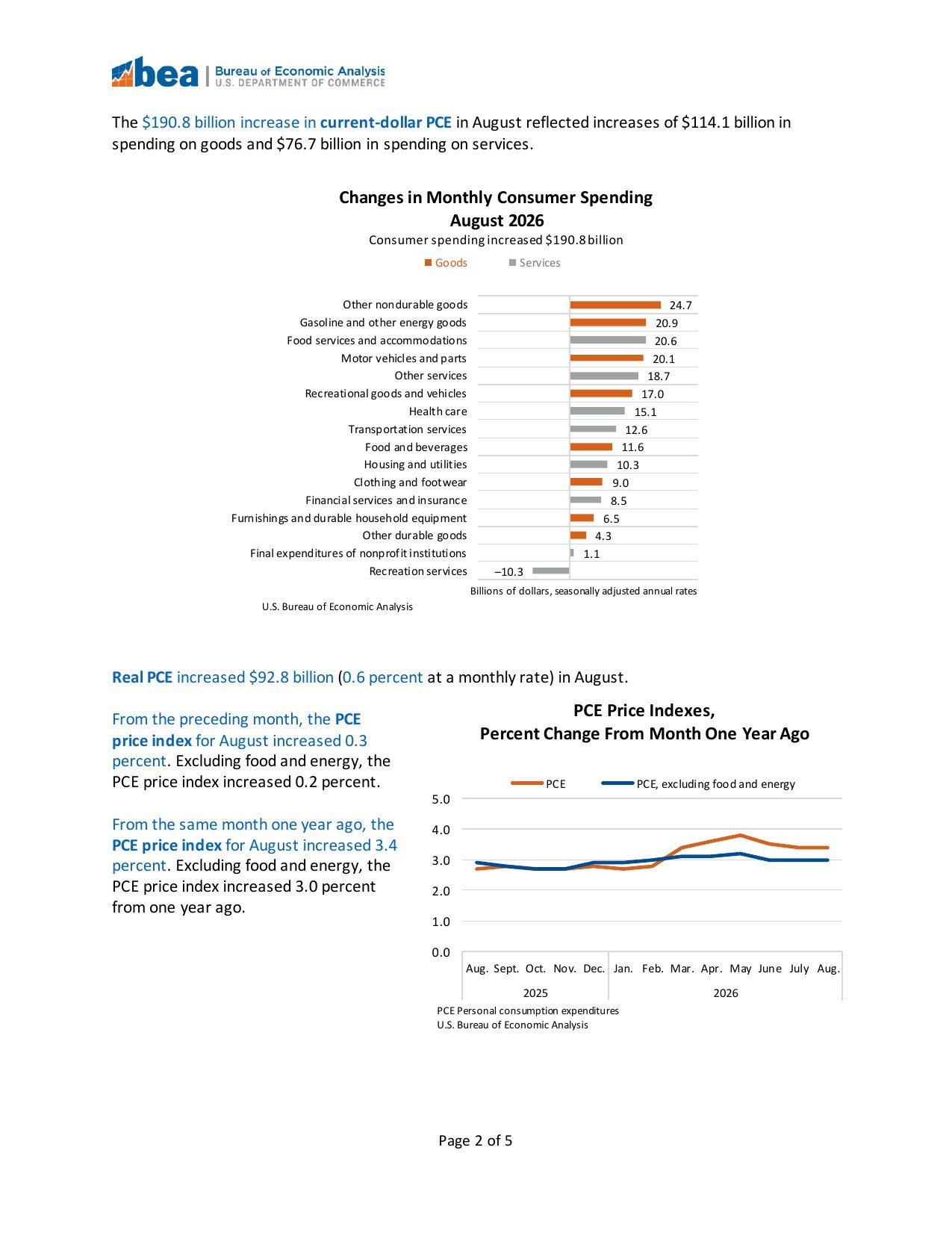
Page 2 of BEA's Sept. 30 release. The blue line is core PCE inflation under the new methods: flat at 3.0% from June through August, after peaking near 3.2% in May. (U.S. Bureau of Economic Analysis, public domain)
Under the New Math, Inflation Did Not Cool at All
There is a second catch. Because BEA restated the past along with the present, the fair comparison is new method against new method. BEA's own historical comparison table shows core inflation at 3.0% in August and also 3.0% in July. Overall inflation was 3.4% in both months. The last time core was lower was January 2026, at 2.9%.
So on an apples-to-apples basis, August was a flat month, not a cooler one. Prices on the restated series are rising a little faster than they were at the start of the year. The "softer than expected" story came from holding a new-method number up against old-method forecasts.
Markets moved anyway. FXStreet put the odds of an October hike at 72.5% before the PCE release. By Oct. 7, Stocktwits reported those odds near 20% on the CME FedWatch tool, and it tied the slide to separate remarks from Fed Vice Chair Philip Jefferson and New York Fed President John Williams that the Fed can wait for more data. The Fed meets next on Oct. 27-28.
Your Gas Bill Did Not Get the Memo
None of this changed what families pay. AAA's national average for regular gas was $4.37 on Oct. 7, against $3.12 a year earlier, as reported by 24/7 Wall St. The New York Fed's September consumer survey, released the same day as the minutes, found Americans expect 3.9% inflation over the next year, the highest reading since May 2023. They expect food prices to climb 5.5%.
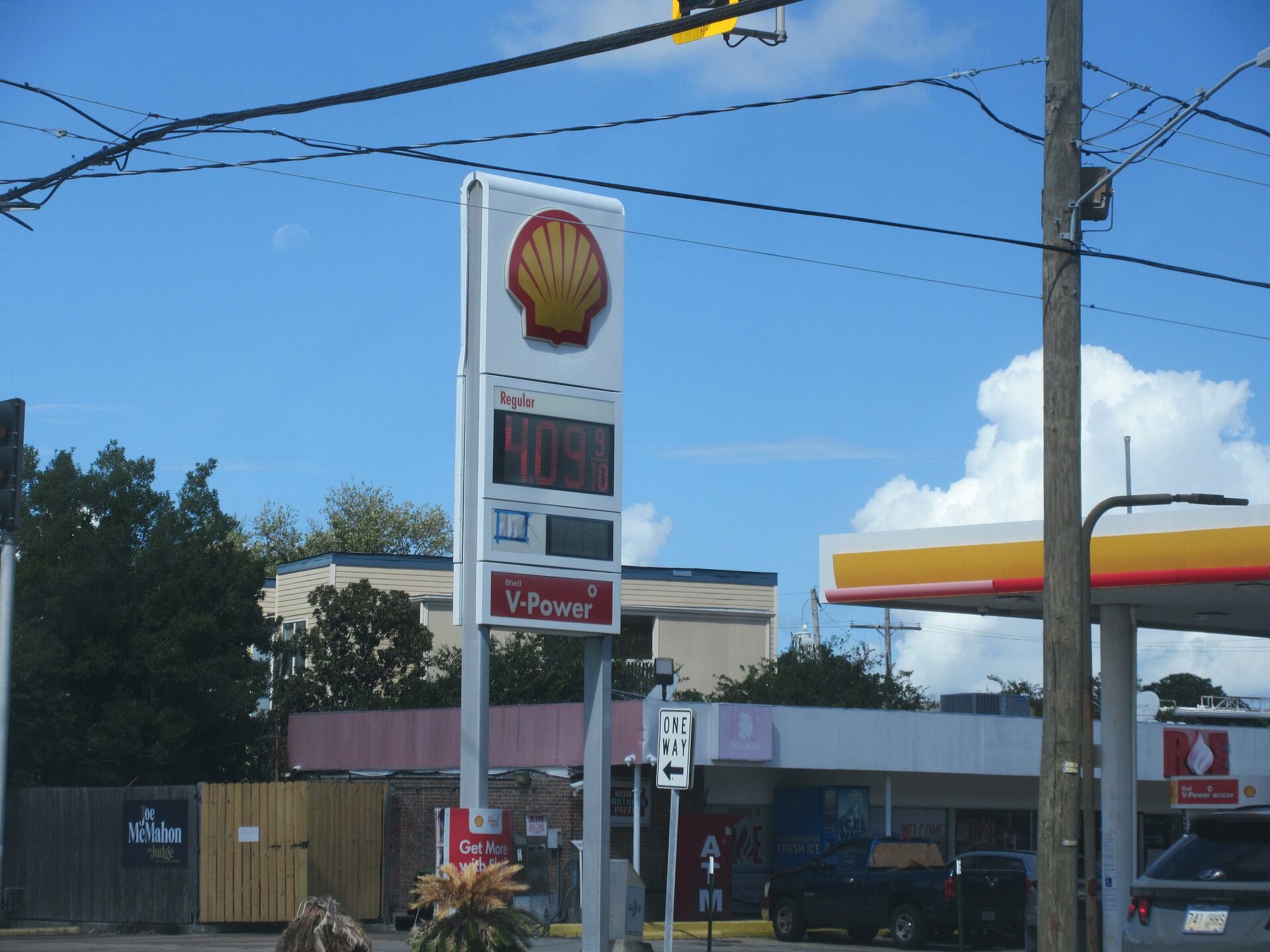
Regular gas at $4.09 a gallon on West Napoleon Avenue in Metairie, Louisiana, Oct. 1, 2026. (Photo by Infrogmation, CC BY-SA 4.0, via Wikimedia Commons)
The Fed itself sees the strain. "Several participants noted, however, that low- and moderate-income households faced strains, with higher energy prices weighing disproportionately on their real disposable income," the minutes say. A couple of officials flagged farm country, where the crop sector "had been strained because of worsening drought and higher prices for diesel and other inputs."
The staff blamed the jump in inflation from a year earlier "mostly" on "the effects of past tariff increases, higher energy and input costs stemming from geopolitical developments, and an increase in technology-related consumer goods prices associated with the AI buildout." Several officials called "further tariff increases" an upside risk to prices.
The same minutes cut the other way on trade, too. Several participants said business activity had been supported by "the high level of corporate earnings, less restrictive regulations, and tariff refunds." Officials also judged the job market "close to maximum employment," with unemployment at 4.1% in July and August.
Five Years Above Target, and the Fed Knows It
One line from the minutes deserves a wider audience. "Some participants expressed concerns that, after more than five years of inflation above 2 percent, elevated inflation rates could begin to affect inflation expectations and wage- and price-setting decisions." More than five years back from September 2026 lands in 2021, President Biden's first year in office. Families have been paying for it ever since.
The staff forecast does not see inflation back to the Fed's 2% goal until 2029. Several officials said today's rate is "not restrictive or only mildly restrictive," which, in our reading, means the Fed does not think it has squeezed the economy much yet.
What to Watch Next
The Labor Department's September consumer price report lands Oct. 14, per 24/7 Wall St. CPI did not get BEA's new formula, so it is a cleaner read on whether prices actually cooled. BEA's September PCE report follows on Oct. 29, the day after the Fed's decision.
BEA's changes may well be better statistics; the agency gave real reasons for each one. But a measurement fix is not a price cut. When the Fed's own staff says a new formula is worth two tenths of a point, that is two tenths nobody gets back at the pump or the grocery store. If the Fed eases off in October because of a number that was half bookkeeping, working families will be the ones who pay for it.
Top photo: The Marriner S. Eccles Federal Reserve Board Building in Washington, D.C. (Federal Reserve photo, public domain, via Wikimedia Commons)