President Trump's 2026 Columbus Day proclamation, signed Wednesday, says Columbus raised "a mighty cross" when he first made landfall in the Bahamas and quotes him dedicating the land to Christ. Check the voyage journal, though, and those words come from an entry written two months later on a different island. The real record of Columbus's faith goes further than the White House let on.
Trump Signed His Second Columbus Day Proclamation Five Days Early
The proclamation is dated October 7 and sets Monday, October 12, 2026, as Columbus Day. It orders the American flag flown on all public buildings "in honor of the great Christopher Columbus and all who have contributed to building our Nation." Once again, there is no companion proclamation for Indigenous Peoples' Day.
That makes two years running. NPR reported that Joe Biden became the first president to officially recognize Indigenous Peoples' Day on the same date in 2021. Trump's 2025 proclamation dropped it and blasted the "left-wing arsonists" who tried to "destroy his name and dishonor his memory." This year's version swaps that line for a pledge that Columbus's legacy will never be "erased by radical extremists."
This year's text also leans harder into faith. It quotes Pope Leo XIII, calls the founding "the fruits of his faith and unrelenting devotion," and asks Americans "to never abandon, forsake, or forget the beauty of our faith."
What the White House Says Happened at Landfall
The centerpiece is a scene on the beach. "When they arrived," the proclamation says, "as a sign of devotion to God and respect to Ferdinand and Isabella of Spain, Columbus raised a mighty cross in the newly discovered land as a sign that 'Your Highnesses hold this land for your own, but chiefly as a sign of our Lord Jesus Christ.'"
The 2025 proclamation told the same story. "Upon his arrival, he planted a majestic cross in a mighty act of devotion," it said of October 12, 1492.
Official record
Proclamation, "Columbus Day, 2026," signed by President Donald J. Trump on October 7, 2026, and published on WhiteHouse.gov.
"When they arrived, as a sign of devotion to God and respect to Ferdinand and Isabella of Spain, Columbus raised a mighty cross in the newly discovered land as a sign that 'Your Highnesses hold this land for your own, but chiefly as a sign of our Lord Jesus Christ.'"
Columbus Day, 2026 proclamation, third paragraph
Read the full proclamation at WhiteHouse.gov · compare the 2025 proclamation
The Journal Puts That Cross in December, Not October
Columbus's own logbook is lost. What survives is the abstract made by the Dominican friar Bartolomé de las Casas, who quotes the Admiral directly in places and summarizes him in others. Its October 12 entry describes the landing in detail, and there is no raised cross in it.
Here is what the abstract records instead, in the Markham translation: "The Admiral took the royal standard, and the captains went with two banners of the green cross." Each banner carried an F and a Y, for Ferdinand and Ysabel, with a crown over each letter. Columbus then called the fleet's secretary, Rodrigo Escovedo, to bear witness that he "had taken, as he now took, possession of the said island for the King and for the Queen."
The quote the White House used belongs to a later entry. Under Wednesday, December 12, the abstract reports a large cross set up at the entrance of a harbor, "as an indication," in the Admiral's words, "that your Highnesses possess the country, and principally for a token of Jesus Christ our Lord, and the honour of Christianity," according to the 1924 Boni edition excerpted by The Forerunner. By then the fleet had been in the Caribbean for two months. A chronology from BYU's Religious Studies Center has Columbus reaching Hispaniola on December 6, so that cross went up on Hispaniola, not on the island he named San Salvador.
The White House wording ("hold this land for your own, but chiefly as a sign of our Lord Jesus Christ") is a looser rendering of that December line. The meaning survives. The date and the place do not.
Columbus Planted Crosses Everywhere He Went
Here is the part the proclamation undersold. The cross was no one-time gesture on day one. It was a habit. "As in all parts, whether islands or mainlands, that he visited, the Admiral always left a cross," Las Casas wrote in the abstract.
One of those crosses still exists. The Cruz de la Parra, enshrined in Baracoa, Cuba, is believed to be the only survivor of 29 crosses Columbus planted in the New World. Las Casas dated it to December 1, 1492, when "he placed a large cross at the entrance of that port." When Pope John Paul II visited Cuba in 1998, he was offered the relic as a gift and declined to take it off the island.
And on the morning of the landing itself, the banners Columbus's captains carried ashore bore the cross. So the White House had the faith right. It just compressed two months of crosses into one beach scene, and borrowed the words from the wrong one.
Pope Leo XIII Told the Story More Carefully
The proclamation quotes Leo XIII's 1892 encyclical Quarto Abeunte Saeculo, written for the 400th anniversary of the voyage. Both quotes check out against the English text: Columbus's achievement, "for the greatness of his mind and heart, can be compared to but few in the history of humanity," and he "looked for a something greater and higher than did these others."
Read a few paragraphs further and the Pope describes the landings this way: to whatever shores Columbus was driven, "his first act was to set upon the shore the standard of the holy Cross." A standard is a flag. That fits the green-cross banners in the journal's October 12 entry, the kind John Vanderlyn painted into his landing scene in the U.S. Capitol Rotunda.
Leo XIII also ordered that on October 12, 1892, or the following Sunday, cathedrals and convent chapels "throughout Spain, Italy," and "the two Americas" celebrate "a Solemn Mass of the Most Holy Trinity."
The Statue Story Checks Out, Mostly
The proclamation calls the Columbus statue now standing near the White House "an exact replica" of the Baltimore monument that rioters toppled and threw into the harbor on July 4, 2020. The Baltimore history is right. President Reagan and Mayor William Donald Schaefer unveiled the original in Little Italy in October 1984, according to the monument's history.
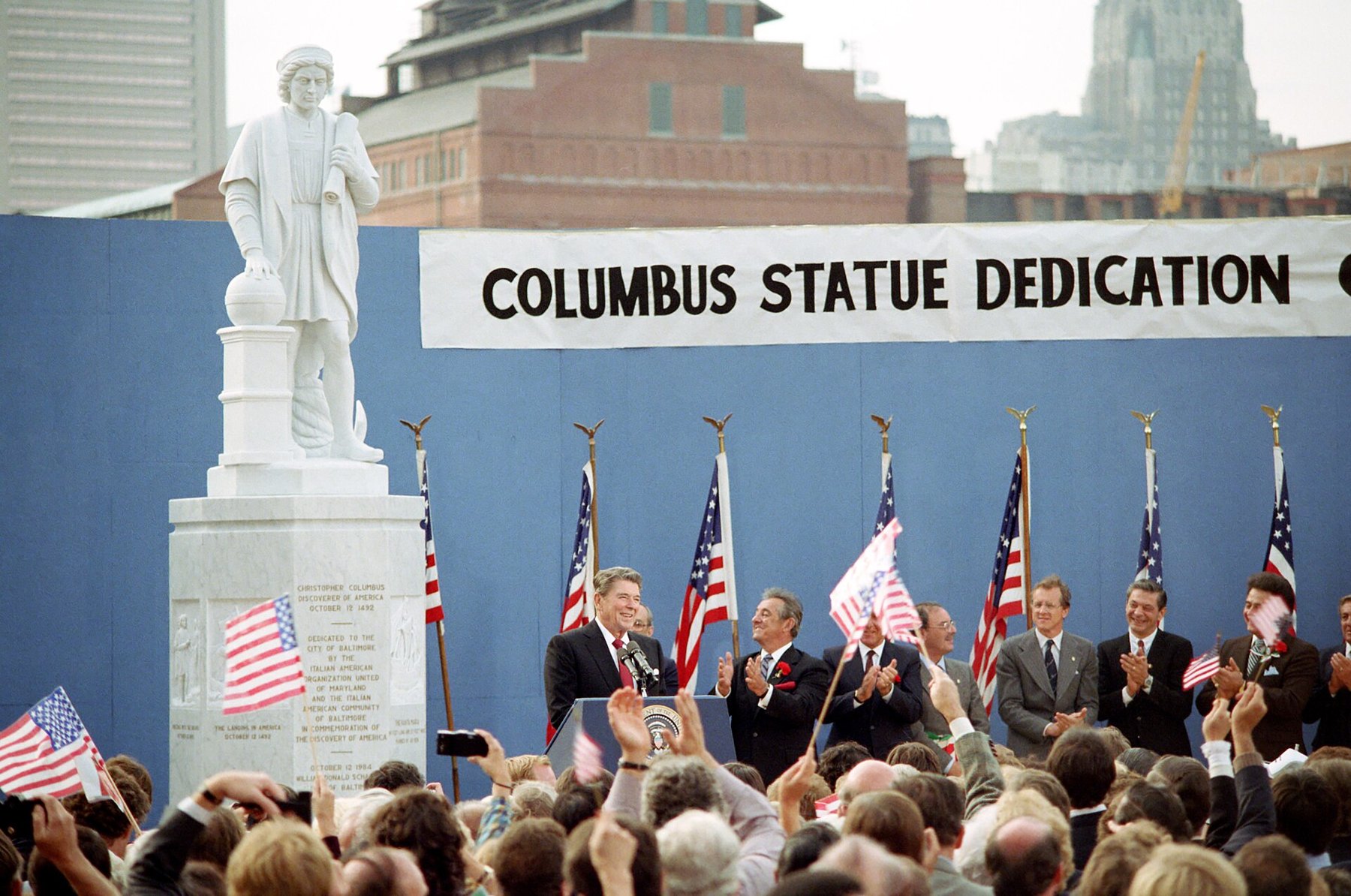
President Ronald Reagan speaks at the dedication of the Christopher Columbus statue in Baltimore, October 8, 1984. Protesters toppled the statue on July 4, 2020. (White House Photographic Office, Reagan Library via DPLA, public domain, via Wikimedia Commons)
"Exact replica" sells the replica short. The Knights of Columbus fished the broken statue out of the water in twelve pieces and found it could not be saved. The two replicas they commissioned were made from resin mixed with marble remnants of the original, so the White House statue literally carries pieces of the one Reagan dedicated. In November 2020, during Trump's first term, the National Endowment for the Humanities put $30,000 toward that work.
The replica went up on the north side of the Eisenhower Executive Office Building in March 2026, as CNN and The Hill reported at the time.
Why the Details Matter on Columbus Day
Columbus is a fight the left picked. Pew Research Center, as cited by NPR, counted 30 states and three territories that still recognize Columbus Day in some way in 2025, against 17 states plus Washington, D.C., that commemorate Indigenous peoples on that Monday. Critics comb every presidential word on Columbus looking for an error to wave around.
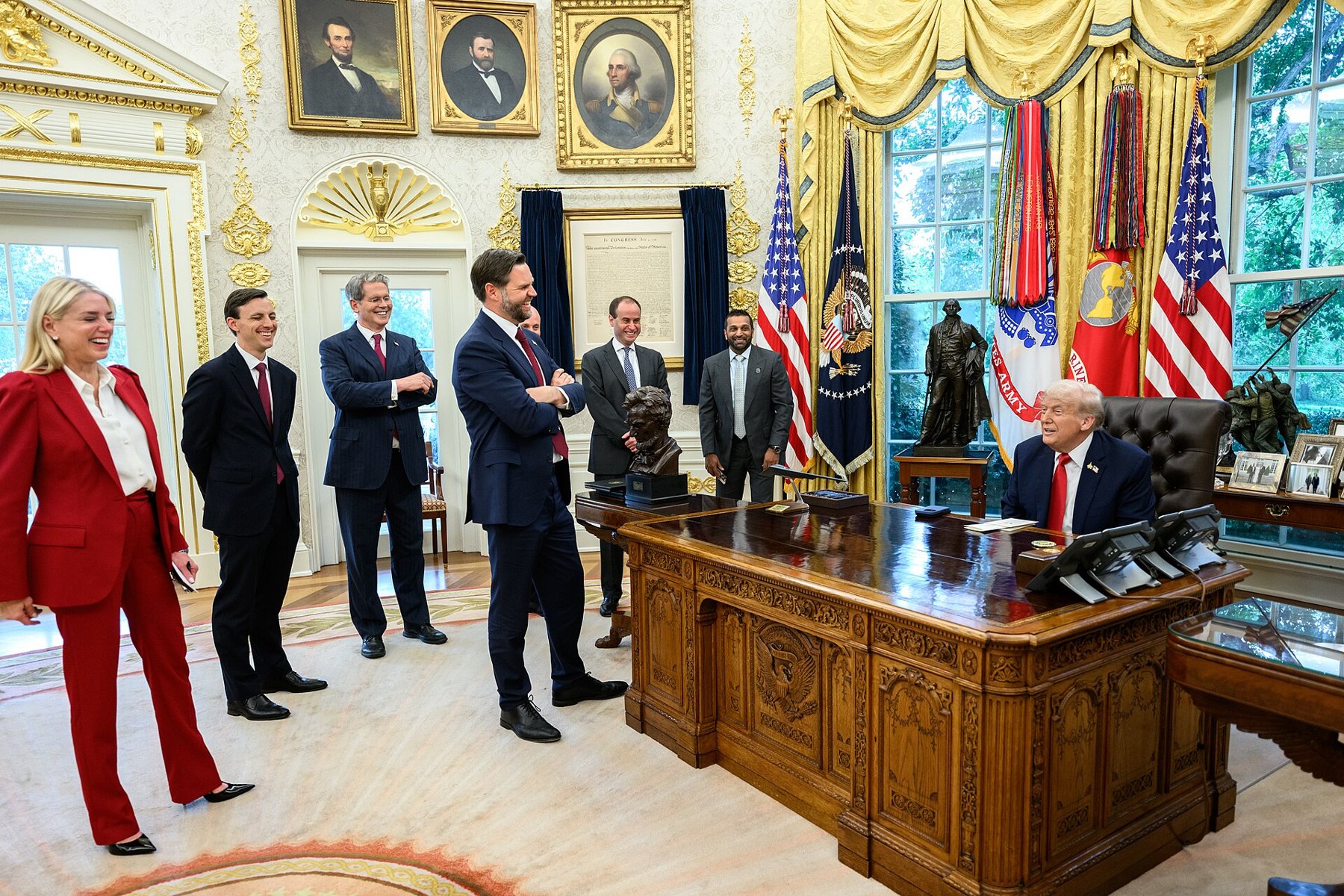
President Donald Trump at the Resolute Desk with Vice President JD Vance and aides before an Oval Office signing, September 25, 2025. (Official White House Photo by Joyce N. Boghosian, public domain, via Wikimedia Commons)
The best answer to them is the primary record, and the primary record is on Columbus's side here. His captains carried the cross ashore on day one. He kept planting crosses for months, and one of them still stands in Cuba. Getting the date and the island right costs nothing and leaves the critics with less to grab.
What Happens Monday
Columbus Day remains a federal holiday under the 1934 joint resolution and 36 U.S.C. 107, which asks the president to proclaim the second Monday of October each year. Federal offices close, and under this proclamation the flag flies on every public building.
The replica in front of the Eisenhower building will be the administration's natural backdrop. If the White House marks the day there, it has a better story to tell than the one in its proclamation: a man who planted his faith on every shore he reached, from the Bahamas to Cuba to Hispaniola.
Top photo: John Vanderlyn's "Landing of Columbus" (1846) in the U.S. Capitol Rotunda, showing the royal standard and the green-cross banners described in the journal's October 12 entry. (Architect of the Capitol, public domain, via Wikimedia Commons)