

Federal Reserve Governor Lisa Cook told a Santiago audience on Friday that stock prices are still propping up consumer spending and the Fed should keep raising rates. By the closing bell, the Dow and the Standard and Poor's 500 had both fallen into correction. Her case rests on one number she says shows inflation has run above target for 67 months, and the government's own price tables back it up.
What did Cook actually say?
Cook's prepared remarks to the Central Bank of Chile's annual conference were released at 12:15 p.m. Eastern on Nov. 20, with stocks already sliding. She explained why she dissented at the Fed's October meeting, when the rest of the committee held the federal funds rate at 3.75 to 4 percent. She wanted another quarter-point hike.
Her first reason: "financial conditions are too accommodative." She said the current rate "does not appear to be curtailing the AI buildout, and equity prices continue to support consumer spending." Her second: "waiting longer to implement rate increases risks getting behind the curve. If we fall behind, additional and larger rate increases may be required later to catch up."
She was blunt about where she stands. "I am skeptical that September's single 1/4 point rate increase will be enough to change the path of inflation," Cook said.
Official record
"The U.S. Economy in Global Context," remarks by Governor Lisa D. Cook at the XXIX Annual Conference of the Central Bank of Chile, Santiago, Nov. 20, 2026. The page with her dissent rationale (printed page 9) is shown below.
"[W]aiting longer to implement rate increases risks getting behind the curve. If we fall behind, additional and larger rate increases may be required later to catch up, which could increase stress on our financial system and have unnecessarily damaging effects on American households." Gov. Lisa D. Cook, Nov. 20, 2026
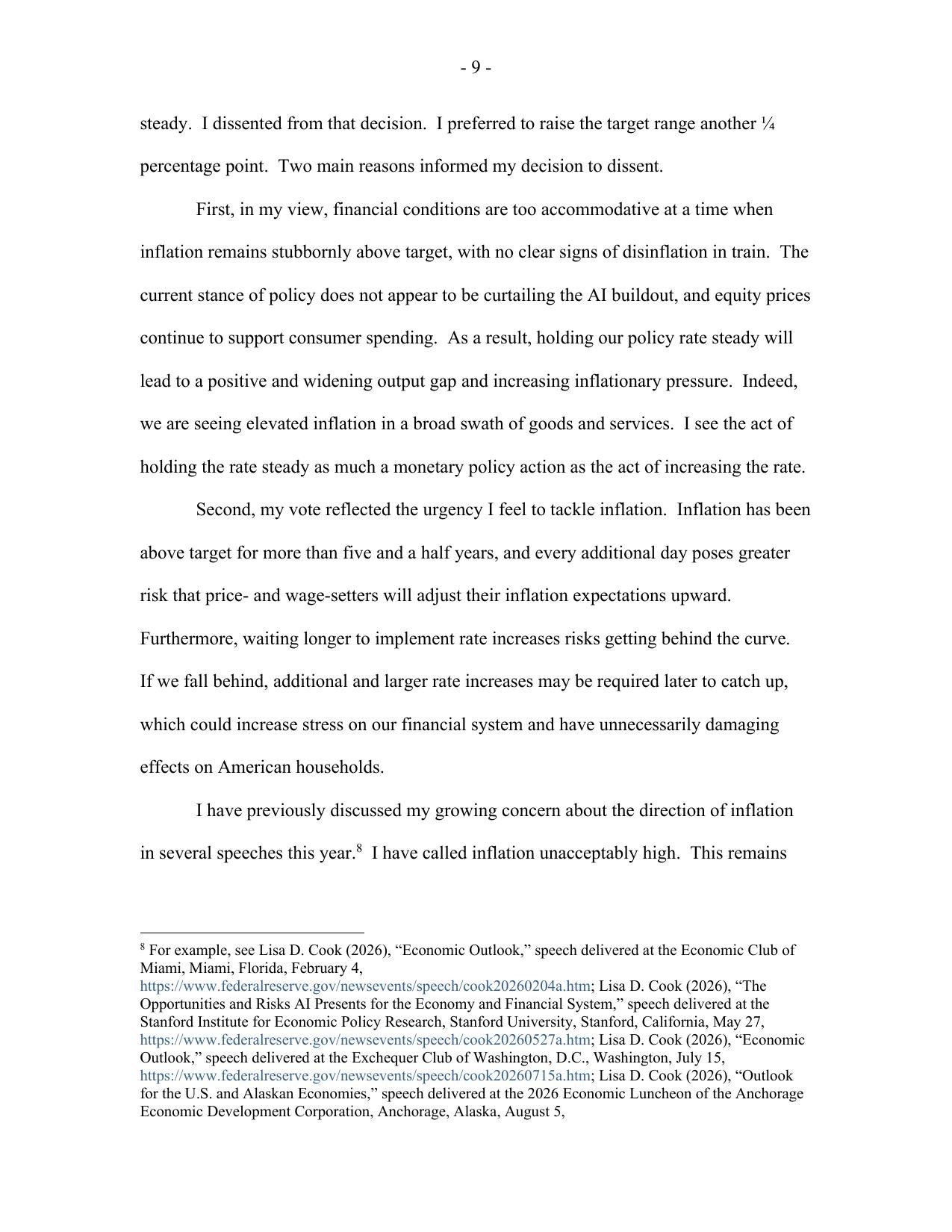
Read or download the full 12-page speech (PDF) or view it on the Federal Reserve's website.
How bad was Friday on Wall Street?
Bad. The Dow Jones Industrial Average closed at 48,147.33, down 949.73 points, according to index data posted by the St. Louis Fed. That is 11.4 percent below its Aug. 5 record of 54,349.12, past the 10 percent line that defines a correction. The Nasdaq Composite fell 5.28 percent to 22,617.73, below where it ended 2025, so the index has given back every point it gained this year.
The Standard and Poor's 500 dropped about 3.7 percent to 6,910.39, per Yahoo Finance's market wrap. That leaves it more than 11 percent under its Oct. 6 record close of 7,818.93 and down 8.6 percent for the week. Nvidia alone fell 14 percent, and the Cboe volatility index, Wall Street's fear gauge, briefly touched 40.
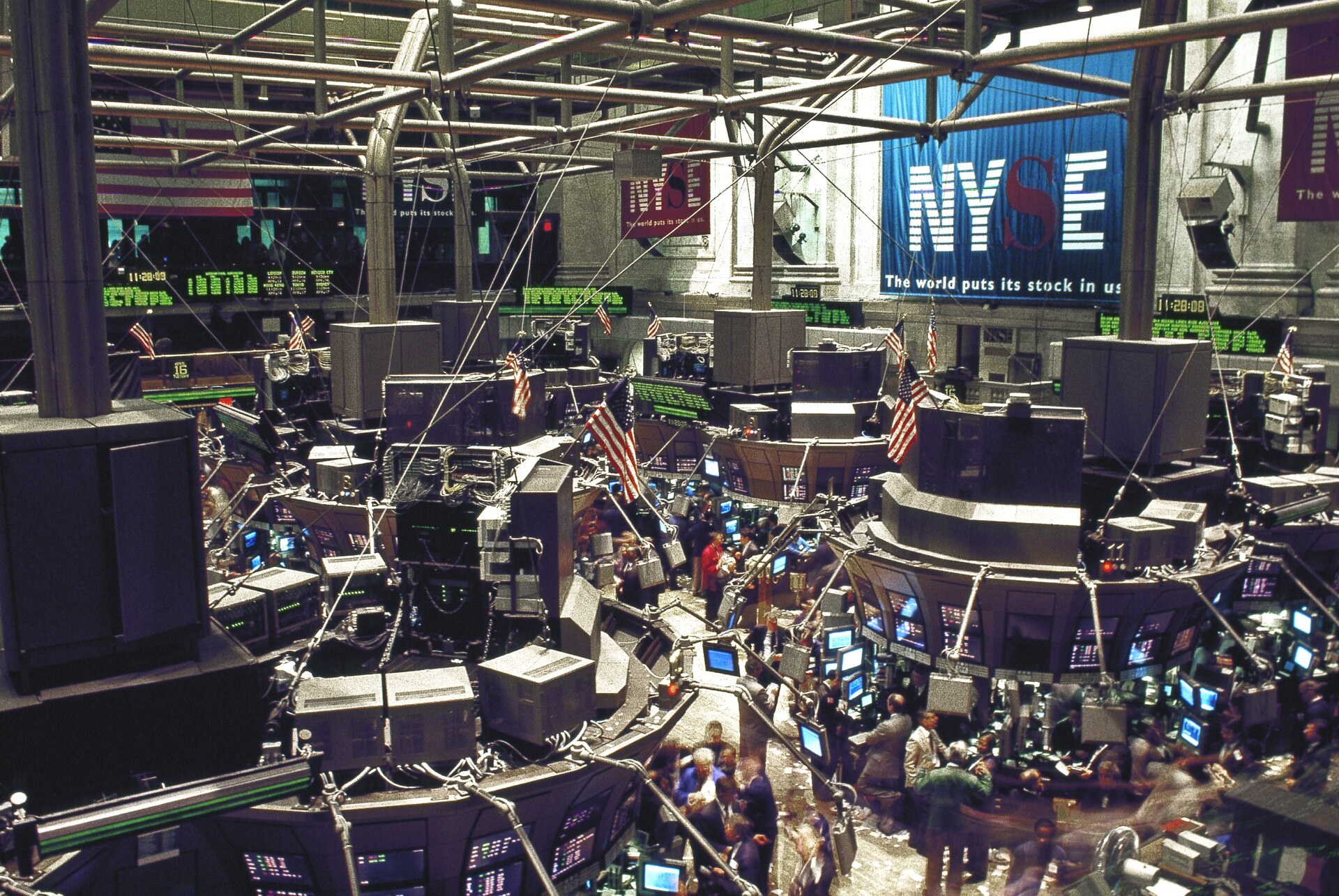
The New York Stock Exchange trading floor on Wall Street. Photo by Carol M. Highsmith via the Library of Congress and Wikimedia Commons (public domain).
Most of the damage hit AI and chip stocks, which is the very "AI buildout" Cook says rates have failed to cool. President Trump has already put his own explanation on the record. After the first post-election drop on Nov. 5, he wrote that "the Stock Market crashed today because the Dumocrats had a big Tuesday."
Is the 67-month number real?
Yes. Cook said inflation "is well above the Fed's 2 percent target and has been for 67 months." PatriotAddict checked that against the Commerce Department's personal consumption expenditures price index, the Fed's preferred gauge, using the Bureau of Economic Analysis series. The 12-month rate last sat at or below 2 percent in February 2021, at 1.8 percent. It has been above 2 percent every month since, from March 2021 through September 2026. That is exactly 67 months.
The streak started two months into the Biden administration and never broke. It has also gotten worse this year. Headline PCE inflation was 2.8 percent in February 2026 and 3.7 percent in September. Core PCE, which strips out food and energy, rose from 3.0 to 3.1 percent over the same stretch. Cook blamed tariffs, the Middle East conflict that pushed up oil, and AI spending. She estimated October at 3.8 percent headline and 3.2 percent core.
Does the jobs data hold up too?
It does. Cook put October unemployment at 4.1 percent and payroll growth at 165,000. The Bureau of Labor Statistics figures match: the unemployment rate was 4.1 percent, down from 4.2 percent in September, and total nonfarm payrolls rose from 159,128,000 to 159,293,000. That steady job market is why Cook says she can afford to focus on prices.
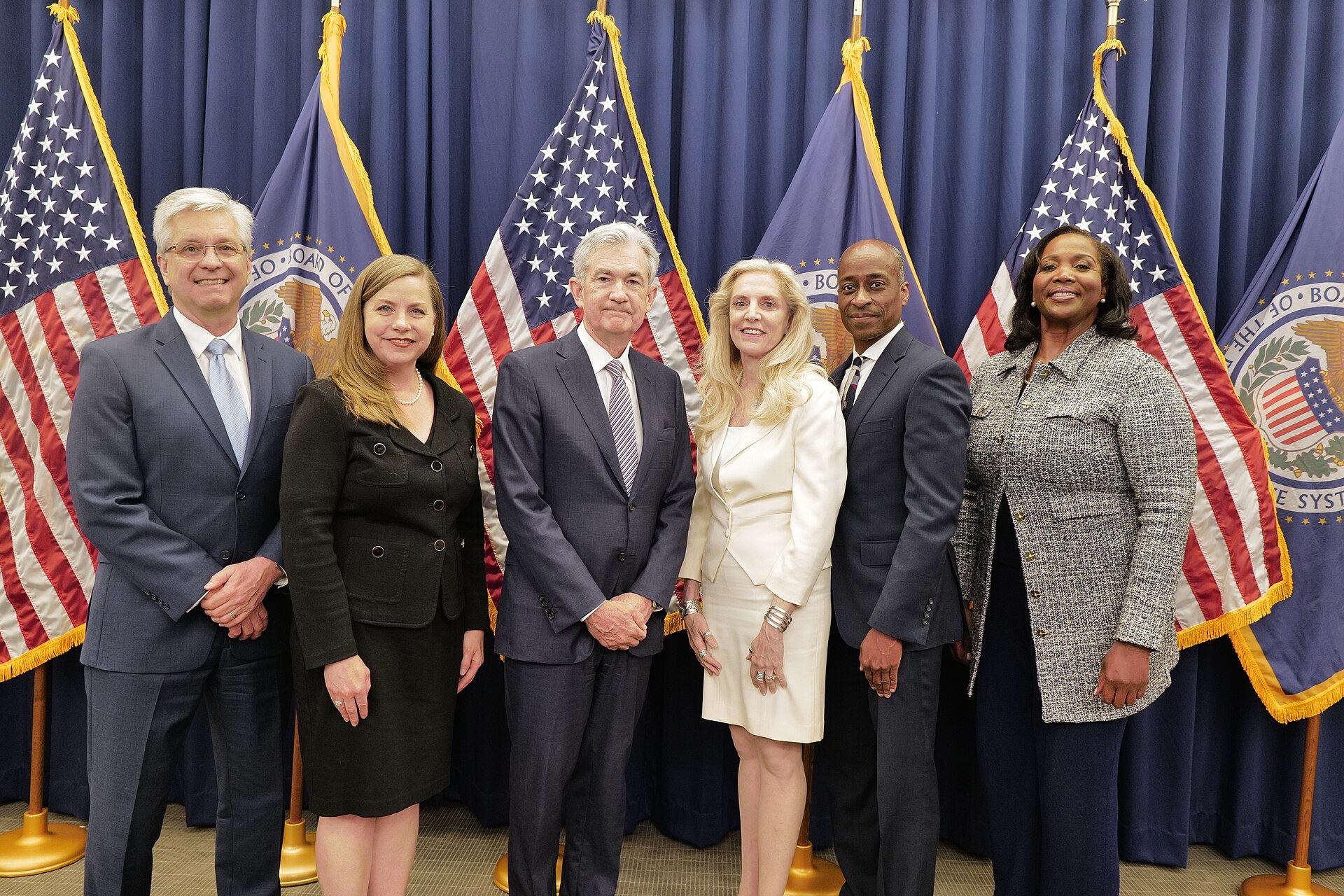
Federal Reserve governors after the May 23, 2022 swearing-in ceremony, with Lisa Cook at far right. Federal Reserve photo via Wikimedia Commons (public domain).
Why does it matter that it's Cook saying this?
Cook is a Biden appointee, and Trump tried to fire her in 2025 over mortgage fraud allegations she denies. The Supreme Court ruled 5-4 on June 29 that she can keep her seat for now while the case continues. Two years ago, in a Nov. 20, 2024 speech, she was arguing for more rate cuts. Today she is one of the loudest voices on the board for tighter money.
That puts her on a collision course with the administration. Treasury Secretary Scott Bessent warned on Nov. 13 against rate hikes driven by the energy shock tied to the Iran war. Cook's answer, in effect, is that 67 months is too long to keep waiting for prices to settle on their own.
What does this mean for your wallet?
Higher rates hit families through borrowing costs first. Freddie Mac's weekly survey put the average 30-year fixed mortgage at 7.28 percent on Nov. 19, up from 7.11 percent a week earlier. A December hike would add to that pressure on mortgages, car loans and credit cards.
The next test lands Wednesday, Nov. 25, when the government releases October PCE inflation. The Fed meets Dec. 8 and 9. Traders priced roughly 97.5 percent odds of a quarter-point hike, Yahoo Finance reported, citing CME data. If October comes in near Cook's 3.8 percent estimate, a falling stock market may not be enough to talk the Fed out of it.
Top photo: Lisa Cook takes the oath of office as a Federal Reserve governor on May 23, 2022, in Washington. Federal Reserve photo via Wikimedia Commons (public domain).















