"GOA discovered a secret FBI program called NICS Monitoring, used to track firearm purchases of Americans who were legally eligible to buy a gun but were suspected of a crime. Is that right?" Sen. Ted Cruz asked FBI Director Kash Patel at a Senate Judiciary Committee oversight hearing on September 15. Patel's answer was one word: "Yes." That single syllable confirmed something the federal government had spent five years trying to keep quiet, backed at one point by a federal court order: the FBI built a system that lets agents watch a law-abiding American's future gun purchases, using the same background check that just approved the sale.
A Background Check That Never Stopped Watching
The National Instant Criminal Background Check System exists to answer one question for a licensed dealer at the counter: is this buyer legally prohibited from receiving a firearm? Congress built it that way on purpose in the 1993 Brady Act, and it wrote an explicit limit into the statute barring federal officials from turning NICS into a registry of firearms, owners, or transactions involving anyone who passes.
NICS Monitoring runs the opposite direction. ATF agents ask the FBI to flag a specific person, usually someone suspected of straw purchasing, trafficking, or another potential federal violation, for a window of 30 to 180 days, renewable. If approved, FBI personnel watch for that person's next NICS transaction and alert ATF the moment it happens, whether the purchase is approved or not. The buyer is never told. No warrant is issued. No charge has to exist.

Sen. Rand Paul, chairman of the Senate Homeland Security and Governmental Affairs Committee, sent ATF a formal records demand about NICS Monitoring in April 2025, seventeen months before Kash Patel confirmed the program under oath. (Official Senate portrait, Wikimedia Commons, public domain)
Passing a background check is supposed to settle the question. Under NICS Monitoring it opens a new one, and the government keeps asking it every time that same person walks back into a gun store.
A Senator Asked These Exact Questions Seventeen Months Earlier
Patel's one-word answer was not the first time Washington heard about NICS Monitoring. Sen. Rand Paul, chairman of the Senate Homeland Security and Governmental Affairs Committee, sent then-Acting ATF Director Daniel Driscoll a formal letter on April 10, 2025, after Gun Owners of America's Freedom of Information Act fight forced the program into partial view.
Official record
Letter from Sen. Rand Paul, Chairman, Senate Homeland Security and Governmental Affairs Committee, to Acting ATF Director Daniel Driscoll, April 10, 2025.
"The existence of this program, and the ATF's longstanding push to conceal it from the public, raise questions about its general use and its potential to infringe on Americans' civil liberties." — Sen. Rand Paul
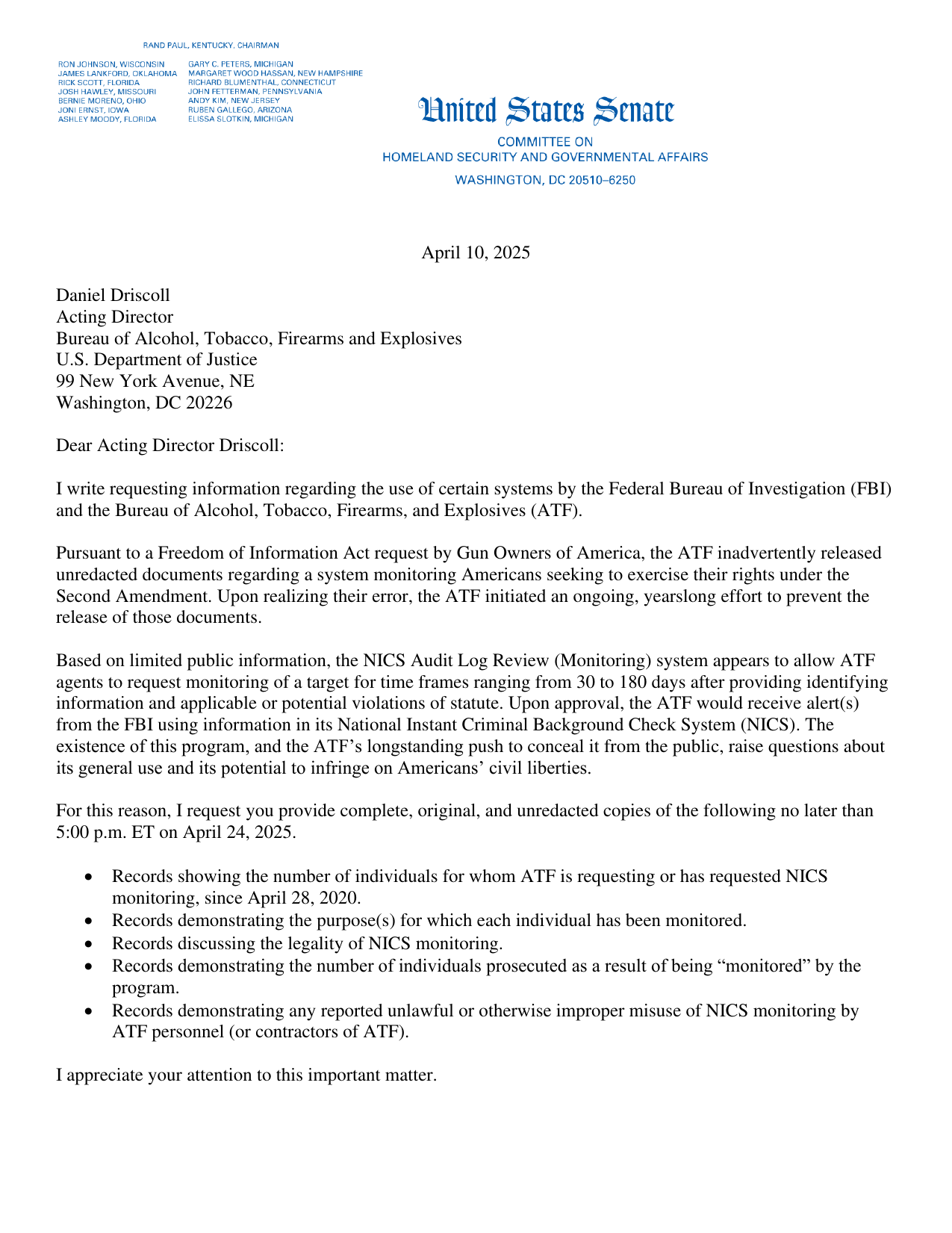
Read or download the full letter (PDF) · hsgac.senate.gov
Paul demanded unredacted records on how many Americans had been monitored since April 2020, the stated purpose for each case, any legal analysis of the program, how many monitored individuals were ever prosecuted, and any documented misuse by ATF personnel. He set a deadline of 5 p.m. on April 24, 2025. Cruz's September 15 question and Patel's one-word answer are the closest thing the public has gotten to those answers, seventeen months late and still missing most of the numbers Paul actually asked for.
How Gun Owners Found Out, and How the Government Tried to Bury It
The paper trail starts in April 2021, when AmmoLand News investigative reporter John Crump published a leaked internal ATF document describing the monitoring system. AmmoLand handed the document to Gun Owners of America, which filed a FOIA request and, after ATF stalled, sued. The case is Gun Owners of America, Inc. v. Bureau of Alcohol, Tobacco, Firearms and Explosives, No. 1:21-cv-02919, in federal court in Washington.
ATF produced records across thirteen rounds of litigation. In the final batch, the agency accidentally released material it had meant to redact under FOIA's exemptions, exposing more detail about the monitoring program than it intended. Rather than accept the mistake, ATF asked the court to order GOA to destroy the documents and swear never to discuss them. GOA refused, calling the request a classic prior restraint on a nonprofit that had done nothing but receive government records lawfully. On July 23, 2025, U.S. District Judge Amy Berman Jackson sided with the agency anyway, ordering GOA to sequester the unredacted material and barring the group from disseminating, disclosing, or using it for any purpose. GOA has appealed.
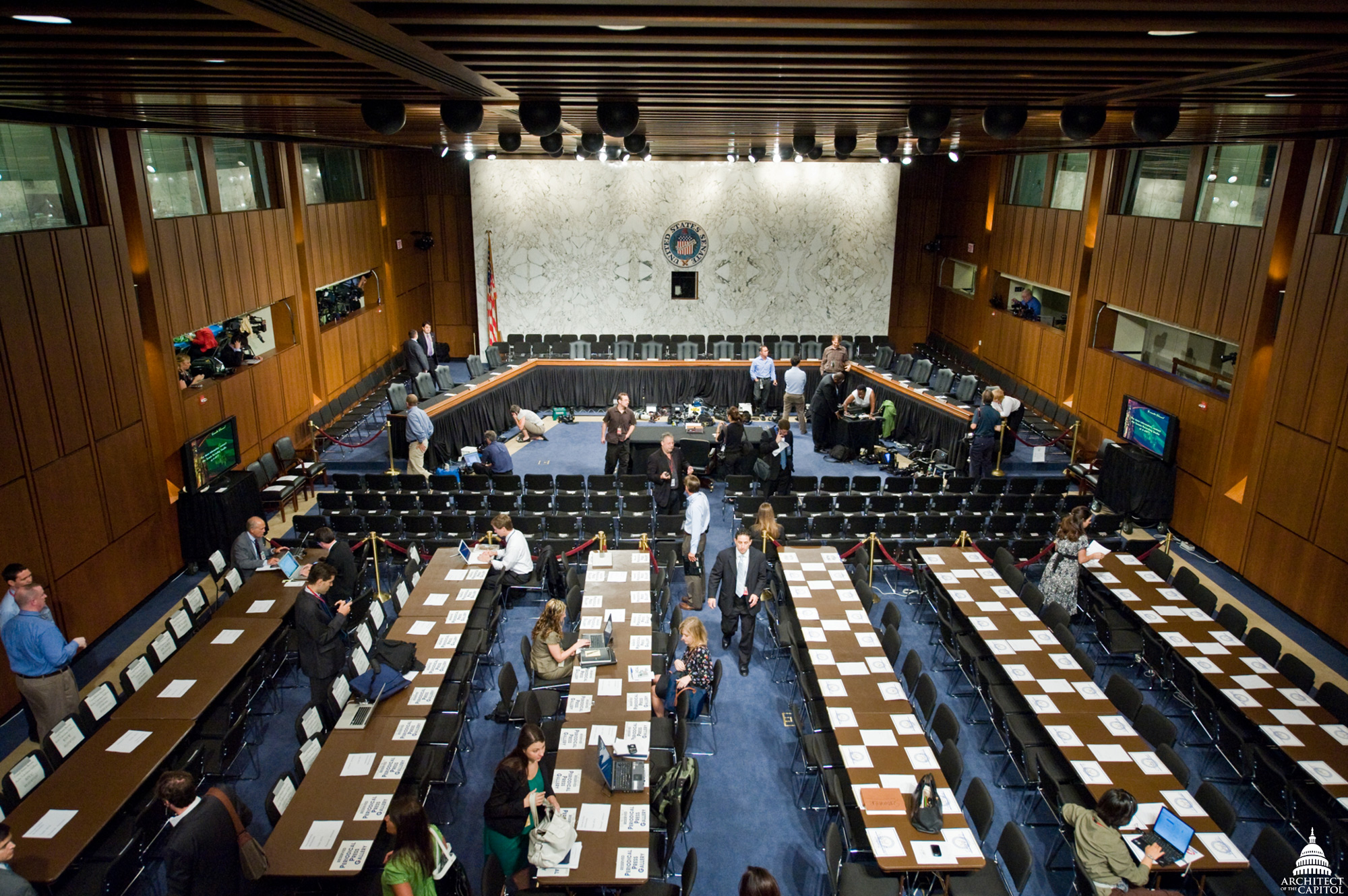
A Senate committee hearing room in the Hart Senate Office Building. Senate Judiciary Committee hearings, including the September 15 oversight session where Patel was questioned, are typically held in rooms like this one. (Architect of the Capitol via Wikimedia Commons, public domain)
So the government that built a secret surveillance file on lawful gun buyers also got a federal judge to gag the organization that exposed it, on the theory that the agency's own paperwork mistake entitled it to silence. The FOIA fight and the gag order run on a separate track from Paul's committee letter, but they describe the same program from two directions: a court blocking disclosure while a Senate chairman was demanding it.
The Defense: '61 Alerts' Against a Number Nobody Will Give
Two days after Patel's admission, ATF Director Robert Cekada posted a defense of the program on X. He said NICS processed 14.6 million lawful purchase or transfer checks in 2025, that ATF had used 343 NICS alerts under a revised policy adopted in April 2025, and that only 61 remained active as of September 17. "Keep that in perspective!" he wrote, adding that every alert was tied to a documented federal investigation and that the alerts are not used to monitor lawful purchasers or enforce state gun laws. Patel endorsed the defense the same day, calling NICS Monitoring a "PUBLIC program narrowly tailored to illegal firearm traffickers and serious violent federal crimes" and adding that the FBI would "always back the Second Amendment."
Gun Owners of America answered within a day. In a September 18 post on X, the group said Cekada's statement contained two false statements and three misleading ones, starting with the claim that alerts are not used to monitor lawful purchasers. If a background check clears a buyer and the FBI still flags his next attempt, GOA argued, that is monitoring of a lawful purchaser by definition, whatever label the agency puts on it. A follow-up published September 21 went further: ATF's 61 active alerts, GOA said, describe only ATF's own current use, not the FBI system as a whole, which federal records show has also been used by the U.S. Marshals Service, the Secret Service, and the Army. Neither Patel nor Cekada has disclosed a total count across every agency that has requested a NICS alert, GOA noted, or said how long the resulting purchase data is kept.
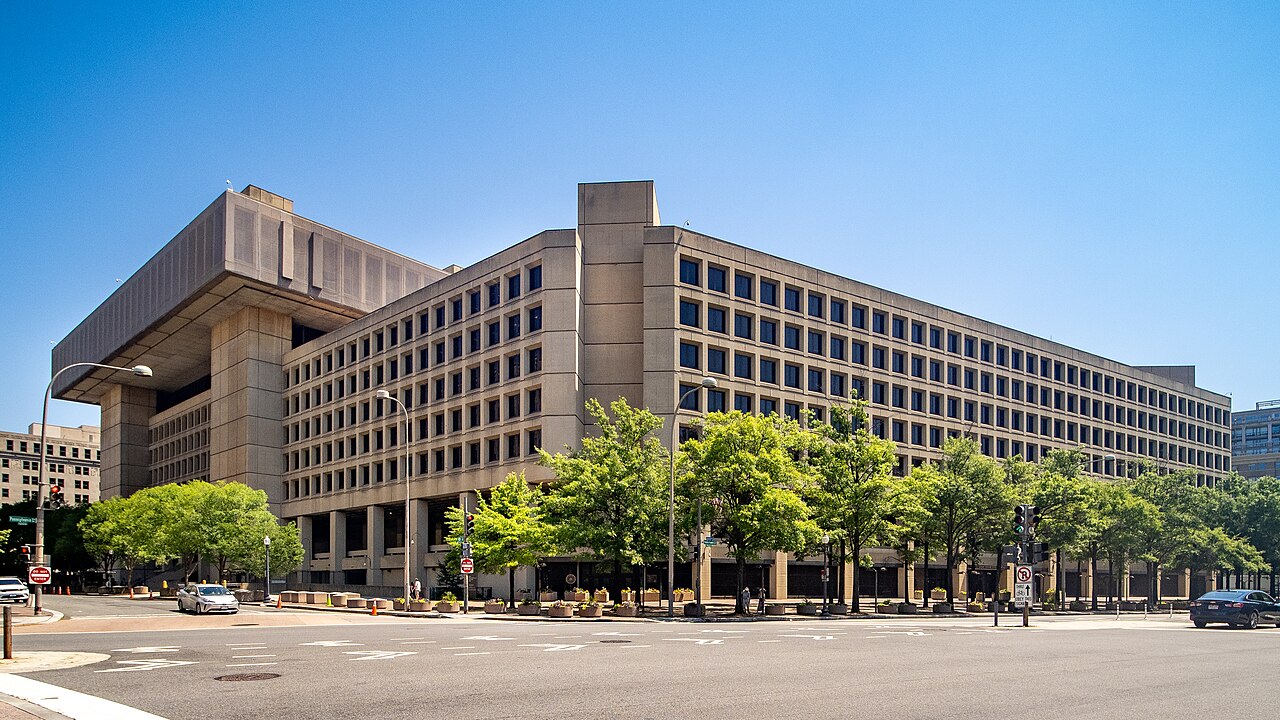
FBI headquarters, the J. Edgar Hoover Building, in Washington, D.C. (ajay_suresh via Wikimedia Commons, CC BY 2.0)
What Being 'Monitored' Actually Looked Like
The FOIA records GOA eventually pried loose describe cases that never involved a charge, let alone a conviction. One man was flagged after officers trespassed him from a property because they believed he was "experiencing a mental health crisis." He had no firearm with him at the time. Another was flagged for buying a gun while, in the FOIA records' own words, involved in an "anti-social movement" that the documents never name.
Aidan Johnston, GOA's director of federal affairs, said in a statement included in the Senate committee's own April 2025 announcement that the group had "since learned that the FBI abused NICS Monitoring to enforce California's 'assault weapons' ban," a state law with no federal counterpart. If accurate, that means a system defended publicly as a tool against trafficking and violent crime was also used to track people over a state regulatory dispute the federal government has no authority to enforce.
The Law Congress Actually Wrote
None of this squares with the statute. Section 103(i) of the Brady Handgun Violence Prevention Act, Pub. L. 103-159, says plainly that no federal department, agency, officer, or employee may use the background check system "to establish any system for the registration of firearms, firearm owners, or firearm transactions or dispositions, except with respect to persons prohibited from receiving a firearm." NICS Monitoring targets people who are not prohibited. That is the entire point of the "monitoring" label: the buyer passed.
ATF's April 2025 policy revision added layers of internal sign-off, written justification, and defined time windows. Those changes made the program more orderly. They did not make it legal, because the underlying activity, watching a non-prohibited citizen's approved firearm purchases without a warrant, is exactly what Congress told the government it could not do when it wrote the Brady Act in the first place.
The Number That Still Isn't Public
Seventeen months after Rand Paul's deadline passed unmet, the country has a one-word confirmation that NICS Monitoring exists and a dueling set of numbers nobody trusts. ATF says 61 people are being watched right now, using a system that only counts its own agency's alerts. GOA says the real figure, across every agency that has ever requested one, has never been disclosed. The buyers on that list, whoever and however many they are, were never charged with anything. They walked into a gun store, passed the same check every other American passes, and left knowing the government approved the sale. What they did not know is that passing was the reason someone kept watching.