A billionaire private equity founder just told Congress no. Leon Black skipped a deposition, refused to hand over nondisclosure agreements tied to Jeffrey Epstein, and sued the House Oversight Committee instead of answering its questions. The House responded by holding him in contempt of Congress on September 16, and Chairman James Comer used the same week to introduce a bill that would void every NDA like the ones Black is protecting, for good, and retroactively.
What the Survivor's Voice Protection Act actually does
The bill is H.R. 10389, and Comer named it plainly: the Survivor's Voice Protection Act. Its core move is narrow and blunt. Any nondisclosure clause is void and unenforceable the moment it stops a sexual abuse victim, or anyone else, from disclosing facts about that abuse. It does not touch settlement amounts or payment terms, which can still stay confidential. It only kills the part of the contract that gags the truth about what happened.
That provision applies to agreements signed before the bill becomes law, not just future ones. A grown survivor holding a fifteen-year-old NDA signed as part of a settlement could, if this becomes law, speak about the abuse itself without breaching that contract. Comer's own statement puts the reasoning in one line: "we've learned how powerful men weaponized nondisclosure agreements to silence survivors of sexual abuse."
The bill also reaches into state law. Section 3 supersedes any state statute that would still allow one of these NDAs to be enforced, so a survivor cannot get a federal green light to speak and then get sued in state court anyway. States are free to write stronger protections than the federal floor, just not weaker ones. It is the kind of preemption clause that usually draws a fight on its own, and this bill has not gotten one yet, because almost none of the coverage so far has looked past the headline provision to the mechanics underneath it.
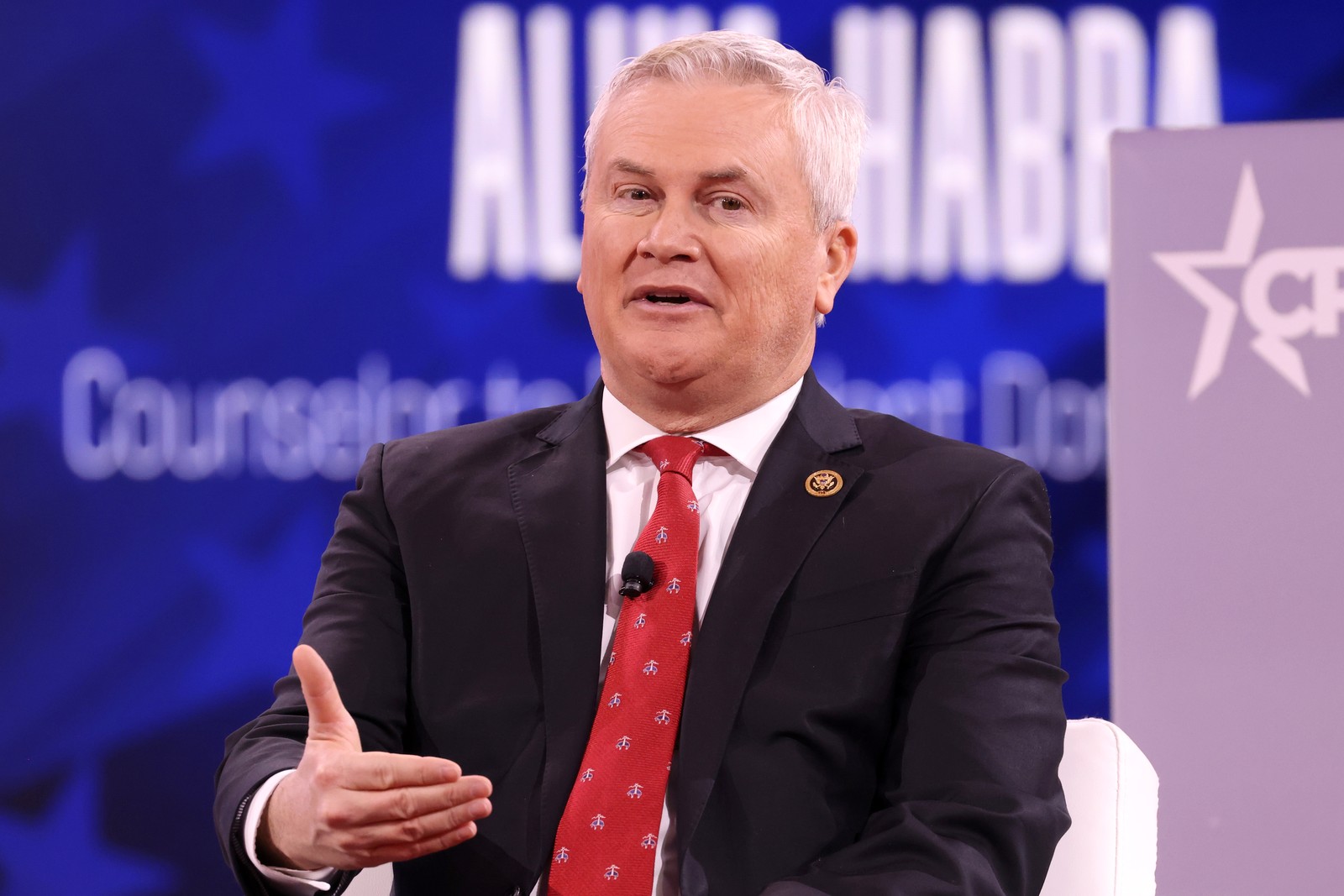
House Oversight Chairman James Comer, whose committee has spent months building the Epstein document record that produced both the Leon Black contempt vote and this bill. (Gage Skidmore, CC BY-SA 2.0)
The billionaire who forced the issue
Black is not a bystander to this story. He ran Apollo Global Management and paid Epstein roughly $158 million between 2012 and 2017, years after Epstein pleaded guilty in 2008 and had to register as a sex offender, for what Black has called tax and estate planning advice. He has told Congress before, in his own words, "I knew Jekyll. I didn't know Hyde."
Black is also not just a witness to how Epstein operated. A civil lawsuit filed in 2023 accuses him of raping an autistic 16-year-old girl in 2002 inside Epstein's Manhattan townhouse, according to Fox Business's reporting on the filing. He has denied wrongdoing. That allegation is part of why the committee wants his NDAs specifically, not just his bank records: an NDA is the exact instrument that keeps an accusation like that one out of public view for two decades.
Comer's committee subpoenaed him in July for a deposition and for copies of NDAs the committee believes are relevant to the Epstein investigation. Black got a delay to September 3, then simply did not show up, withheld the documents, and filed suit against Comer and the committee, arguing the subpoenas reach for private information with no legitimate legislative purpose. The Oversight Committee voted 41-0 on September 15 to recommend contempt. The full House followed the next day, approving the resolution by unanimous consent.
More than a dozen Epstein survivors put out a joint statement afterward: "By moving to hold Leon Black in contempt, Chairman Comer is sending a clear message that wealth and influence do not put anyone beyond the reach of congressional oversight." They added a second line worth sitting with: "Wealth, power and proximity to Jeffrey Epstein cannot be allowed to shield anyone from scrutiny."
Official record
H.R. 10389, Survivor's Voice Protection Act, 119th Congress, introduced September 15, 2026, referred to the House Judiciary Committee.
"A nondisclosure clause shall be void and unenforceable only to the extent that the nondisclosure clause prohibits a victim of sexual abuse from disclosing such sexual abuse or facts related to such sexual abuse." — H.R. 10389, Sec. 3(a)
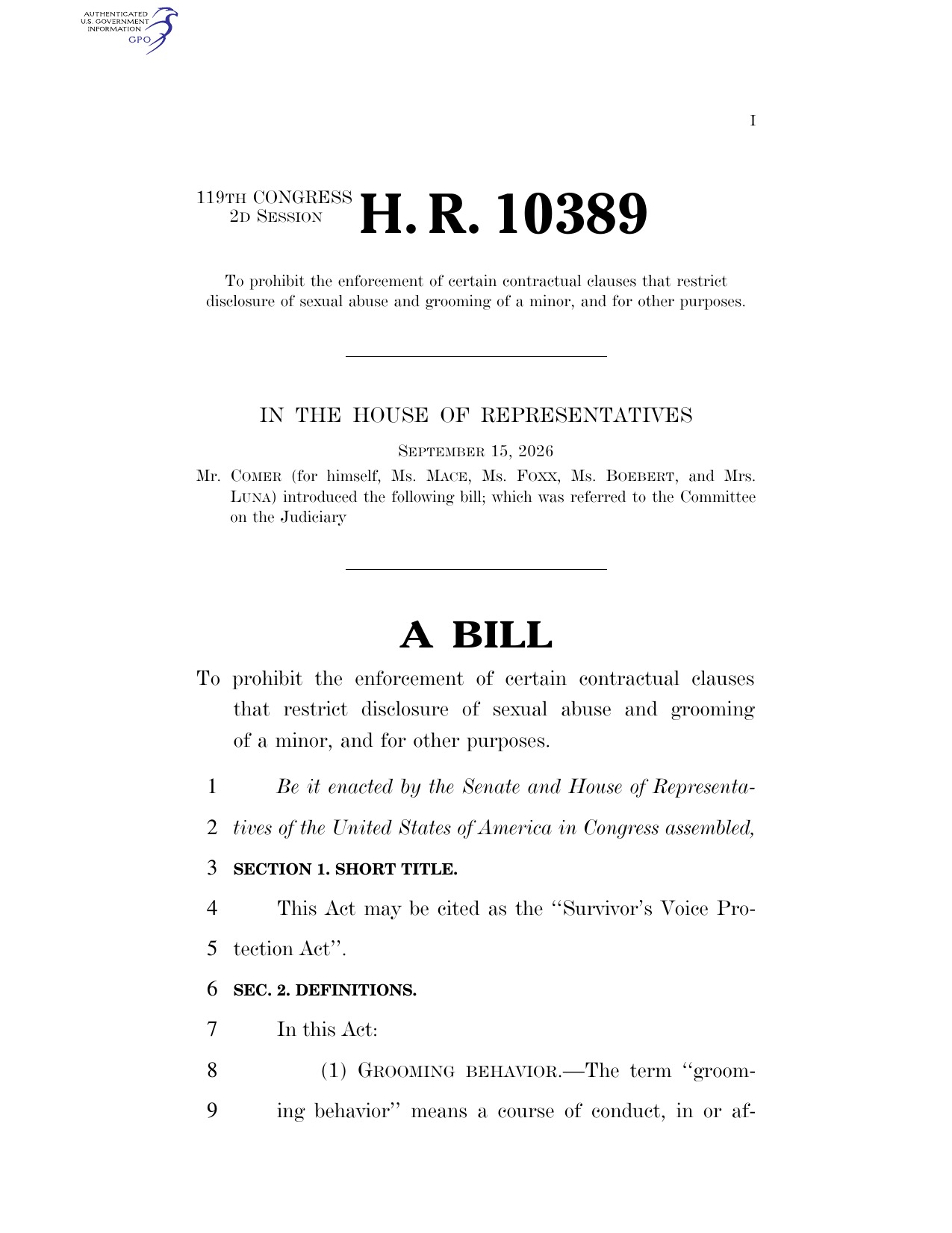
Read or download the full 7-page bill text (PDF) · view the bill on GovInfo
The fine print most coverage skipped
The bill does more than void NDAs. Section 4 creates a new federal duty: a "fiduciary," defined broadly enough to cover guardians, trustees, officers, directors, and employees acting for someone else, must report suspected grooming of a minor to law enforcement if they have reasonable cause to believe it is happening. Fail to report, and a victim can sue that fiduciary directly for damages.
Read the actual text of Section 4(d), and that right to sue only exists if two things are both true: the fiduciary failed to report, and the abuser was later convicted. If the abuser is never charged, is acquitted, or takes a plea to a lesser offense that does not technically match the statute's definition of sexual abuse, the civil claim against the enabler who looked away does not exist. Given how rarely sexual abuse cases actually end in conviction, that condition quietly narrows a provision that press coverage has mostly described as a flat new reporting mandate with real teeth.
There is a second detail buried in the bill's own effective-date language. The NDA-voiding section takes effect immediately on enactment. The fiduciary reporting duty does not: Section 4(g) delays it 180 days, and gives the Attorney General that same window to write rules spelling out exactly when a fiduciary has to report. Two provisions born from the same investigation, moving at two different speeds.

Rep. Nancy Mace (R-S.C.), one of four original cosponsors, alongside Reps. Virginia Foxx, Lauren Boebert and Anna Paulina Luna. (Office of Rep. Nancy Mace, public domain)
Bipartisan vote, single-party bill
The contempt vote against Black cost nothing politically. Democrats and Republicans on Oversight voted 41-0 to recommend it, and the full House cleared it by unanimous consent, meaning not one member forced a recorded vote against it. The Survivor's Voice Protection Act is a different animal. Every listed sponsor, Comer, Mace, Foxx, Boebert, and Luna, is a Republican, and it now sits with the House Judiciary Committee, where it has no hearing date and no Democratic cosponsor yet attached.
That is not unusual for a bill four days old. But it means the easy part, agreeing a stonewalling billionaire deserves contempt, is done. The harder part, actually rewriting federal contract law to strip enforceability from a category of NDA that corporate lawyers have relied on for decades, still has to survive the Judiciary Committee, a floor vote, and the Senate, none of which has a timeline yet. Section 3(b)'s settlement-amount carve-out reads like an attempt to head off the obvious objection before it lands: that broad NDA restrictions could chill ordinary confidentiality agreements that have nothing to do with abuse. Whether that carve-out is enough to satisfy Judiciary Committee Republicans who have not yet signed on is an open question this bill has not had time to answer.
What happens to Black now
The contempt referral goes to the U.S. Attorney's Office for the District of Columbia, which said it would "review the referral of Mr. Black carefully" but has not committed to charging him. Contempt of Congress is a misdemeanor: up to a year in prison and a $100,000 fine if a court convicts him, though Congress has referred plenty of contempt cases over the years that the Justice Department declined to pursue. Black's federal lawsuit against Comer and the committee is still pending in Washington, and his attorneys maintain the subpoenas exceed the committee's authority.
The committee, for its part, says the Epstein investigation has already produced 19 depositions, roughly 65,000 pages of documents from the Epstein estate and the Justice Department, and Epstein's own bank records, plus two separate referrals to the Justice Department after a witness raised new sexual abuse allegations during an interview.
The actual stakes
An NDA cannot undo what happened to the person who signed it. What it can do is make sure nobody else ever finds out, which is precisely the leverage Epstein's associates spent years buying, and precisely the leverage Leon Black is fighting in federal court right now to keep intact. H.R. 10389 does not close every door: the conviction requirement in Section 4 leaves real gaps for a fiduciary whose employer or client is never charged, and a bill sitting in the Judiciary Committee is a long way from a law on the President's desk.
But voiding the silence itself, not just punishing the one man who refused to hand it over, is the part of this story that outlasts any single contempt case. Congress spent years treating Epstein's paper trail as something to subpoena piece by piece. This is the first real attempt to make sure the next Leon Black cannot buy that same silence in the first place.