

The Pentagon and Lockheed Martin announced a 10-year F-35 framework on Oct. 22, and the coverage reads like a done deal for at least 850 jets. Lockheed's own release says the plan depends on multiyear authority and appropriations that Congress has not yet provided. Neither announcement names a price, and a June GAO report on the same aircraft has the fleet's mission capable rate at 44 percent.
What does the framework actually promise?
Lockheed's Oct. 22 release describes 850 U.S. aircraft over 10 years, with initial spares, 10 years of modification kits and sustainment, and orders from foreign customers across Lots 21 through 30. Production stays at 156 aircraft a year. The company says the government expects savings of billions of dollars from long-term pricing and volume discounts.
The release then states the condition. The agreement depends on multiyear authority and appropriations. Only after that would the F-35 Joint Program Office and Lockheed finalize contract terms, pricing and schedules through a formal contract award. The Pentagon also issued its own release, which this post could not open directly, so the terms here come from Lockheed's text and Defense News.

The U.S. Capitol dome. Any multiyear F-35 buy needs authority and funding from Congress first. Photo: Architect of the Capitol via Wikimedia Commons, public domain. Cropped.
Where does Congress stand on the money?
Defense News reports that the House and Senate versions of the annual defense policy bill would both allow multiyear F-35 contracts. The House passed its bill in July. Senate Democrats blocked theirs from reaching the floor that month, and leaders pushed it to after the November midterms.
The same report says a stopgap spending law runs through Dec. 11, holds spending at last year's levels, and generally bars new programs or multiyear buys. Congress funded 47 F-35s in fiscal 2026, while the Pentagon's fiscal 2027 request is for 85. Eighty-five is also what 850 jets over 10 years works out to per year. Neither announcement disclosed a total contract value or a per-jet price, according to Defense News.
Why is the 44 percent number in the same conversation?
Because the Government Accountability Office's June report, GAO-26-108113, covers the same airplane. From fiscal 2021 to fiscal 2025, the fleet's mission capable rate fell from 67 percent to 44 percent. The full mission capable rate, the share of time a jet can perform all of its missions, fell from 38 percent to 25 percent.
GAO says the Joint Program Office's reset plan needs an estimated $13.7 billion more than previously planned through fiscal 2031. It also says the program will rely on industry to deliver more than $7 billion in additional parts, and that capacity constraints persist for key parts. Lifetime U.S. sustainment cost is put at $1.6 trillion, as of 2024.
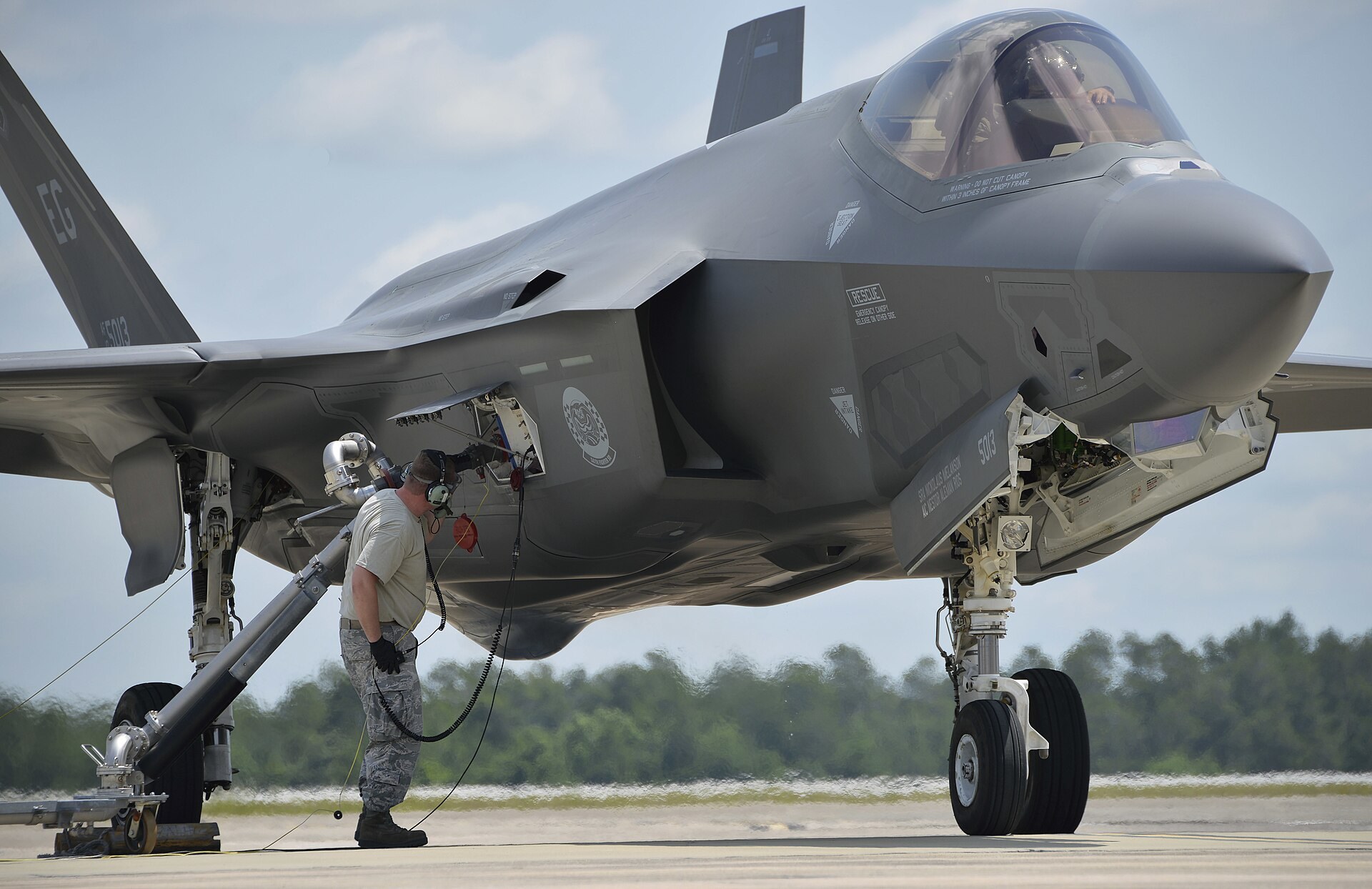
An Airman from the 33rd Aircraft Maintenance Squadron performs a hot pit refuel on an F-35A at Eglin Air Force Base, Florida, May 2016. File photo. Photo: Airman 1st Class Andrea Posey, U.S. Air Force, via Wikimedia Commons, public domain.
Official record
U.S. Government Accountability Office, F-35 Sustainment: Actions Needed to Ensure Updated Strategy Improves Persistent Readiness Challenges, GAO-26-108113, June 2026.
"The mission capable rate (percentage of time the aircraft can perform one of its tasked missions) declined from 67 percent to 44 percent." — GAO Highlights
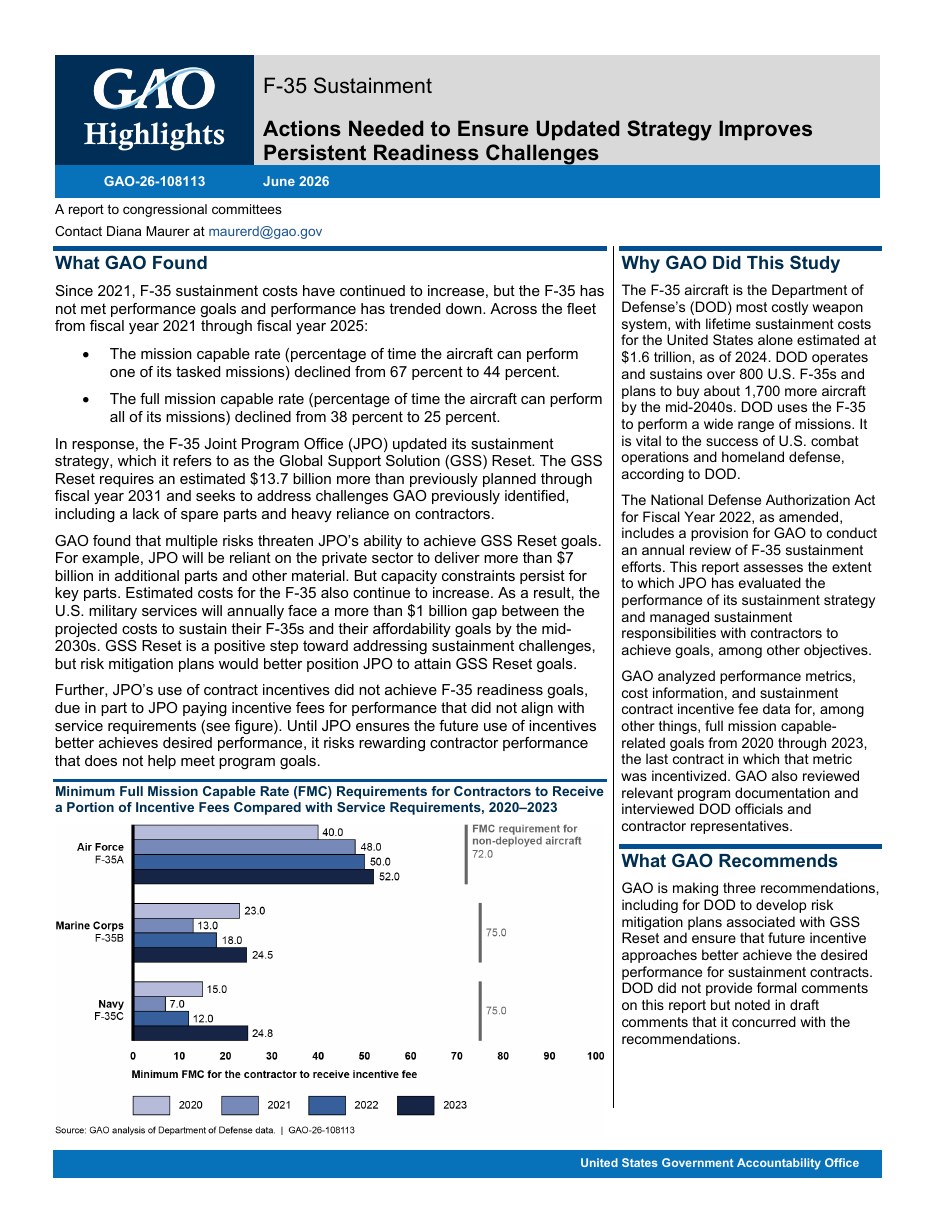
Static capture of the Highlights page · read the full report (PDF, 62 pages) · GAO report page
Did the old contracts reward readiness?
GAO says no. For 2020 through 2023, the program office paid the contractor over $114 million out of around $269 million in available incentive fees meant to improve full mission capable and supply-related rates. In GAO's words, both rates "have generally stagnated or worsened since 2020." The report warns that, without changes, the office risks "rewarding contractor performance that does not help meet program goals."
DOD did not provide formal comments, but noted in draft comments that it concurred with GAO's three recommendations. GAO also counts 48 parts for which a supply study found insufficient supplier capacity.
So is the 850 number real?
It is a real planning figure, and a multiyear buy generally lowers unit cost, which is the stated goal. A framework is not a contract, though, and the release leaves price, schedule and funding for later. The 317,000 jobs and $79 billion in yearly economic activity in Lockheed's release are estimates, not audited results.
The test comes after the midterms, when the defense policy bill and the spending bill have to carry the multiyear language. Pilots do not fly framework agreements. They fly the jets that are mission capable on a given day, and GAO's number for that is 44 percent.
Header photo: An F-35A Lightning II assigned to the 6th Weapons Squadron takes off at Nellis Air Force Base, Nevada, April 8, 2026. Photo: Airman Annika Schermerhorn, U.S. Air Force, via Wikimedia Commons, public domain.















