

Rep. Keith Self introduced a bill Thursday to end the diversity visa lottery, saying, "We cannot allow liberal judges to force the administration to continue a failed immigration program." The order he is reacting to runs two pages, sets a calendar for the State Department, and contains no legal reasoning at all. The government has already appealed it.
What does the judge's order actually say?
It is Document 21 in Red Eagle Law, L.C. v. Rubio, filed Oct. 14 in the Southern District of California. Its first sentence rests on "the reasons stated on the record," so the written text explains nothing. Judge Jinsook Ohta gave her reasoning at the hearing, and Newsweek reports she called the failure to open registration "arbitrary and capricious government action."
What the order commands is procedural. The State Department must announce a registration period and keep it open for 30 days, taking entries under 8 U.S.C. 1153 and 1154(a)(1)(I) and 22 C.F.R. 42.33. Selected entrants are then to be processed "in accordance with its usual procedures and standards, subject to applicable law," until the visas run out or Sept. 30, 2027. No visa is granted by the order itself.
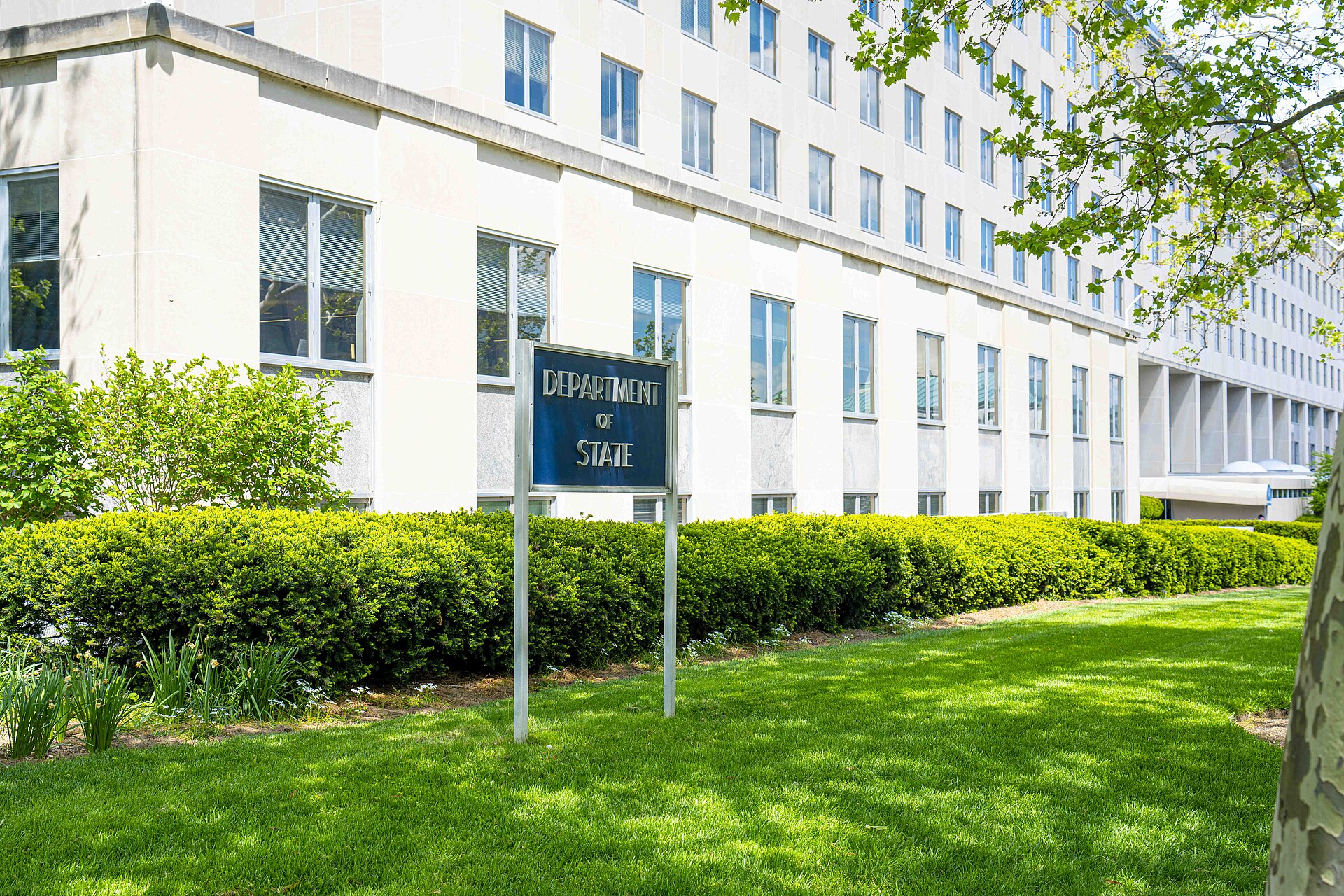
The Harry S. Truman Building, headquarters of the Department of State, Washington, D.C., spring 2024. Photo: U.S. Department of State via Wikimedia Commons, public domain.
Did the government fight the calendar?
It helped move it. According to Immigration Analytics, hours after the injunction the government and the plaintiff jointly asked to change the dates, and the judge agreed the same day. The announcement slid from Oct. 15 to Oct. 29, registration from Oct. 18 to Nov. 1, and selectee notice from Nov. 19 to Dec. 3. The modification order does not say why.
The government then filed a notice of appeal on Oct. 19 and asked Judge Ohta to stay her own order, Newsweek reported. Its arguments are that a court cannot start a lottery after its registration period should already have run, and that the injunction is improperly nationwide. Newsweek says she rejected both. No ruling on the stay request had been reported as of Sunday.
Official record
Red Eagle Law, L.C. v. Rubio, No. 26-cv-4738-JO-VET (S.D. Cal.), Order Granting the Motion for Preliminary Injunction, Document 21, filed October 14, 2026.
"For the reasons stated on the record, the Court GRANTS the motion for preliminary injunction." — U.S. District Court, Southern District of California
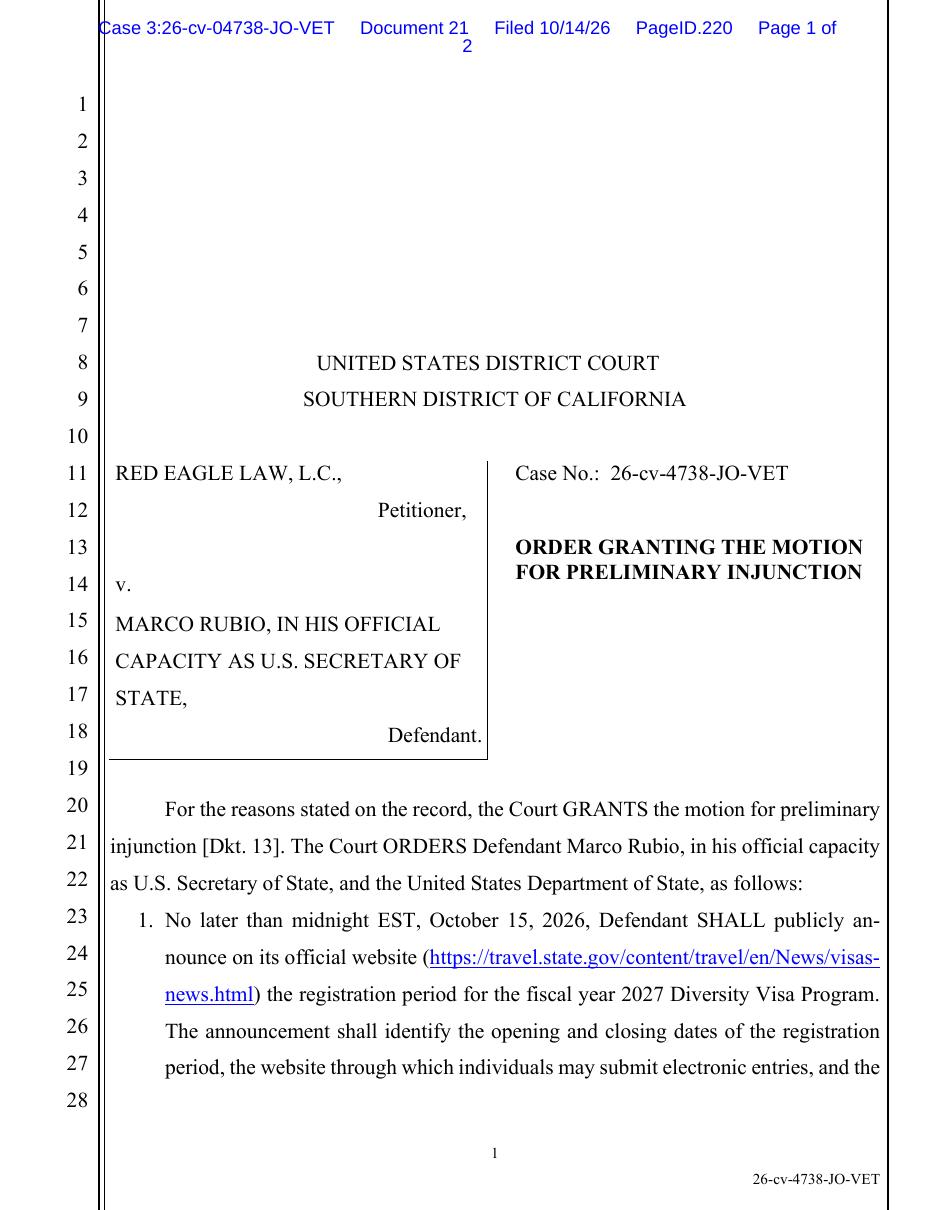
Static capture of page 1 · read the full 2-page order (PDF) · Courthouse News report
Who sued, and what does the statute say?
The plaintiff is an immigration law firm, not an applicant. NEPYORK reports the firm says diversity visa selectees made up nearly 29 percent of its 2026 gross revenue. Judge Ohta denied its first emergency request on Sept. 3, and at argument questioned whether a private firm falls within the interests the Immigration and Nationality Act protects.
The law behind the fight is Congress's. Section 1151(e) says: "The worldwide level of diversity immigrants is equal to 55,000 for each fiscal year." And Section 1153(e) says those numbers go to qualified immigrants "strictly in a random order established by the Secretary of State." The firm argues the statute requires a registration period each year. Justice Department lawyers answer that it sets a deadline for finishing processing, not a date for opening entries.
Why did the program stop in the first place?
In December 2025, Homeland Security Secretary Kristi Noem said, "I am immediately directing USCIS to pause the DV1 program," after saying the Brown University shooting suspect, Claudio Manuel Neves Valente, had entered through it in 2017, CBS News reported. The same report notes the legal mechanism for such a pause was unclear. The State Department said at the time it would pause issuance too.
The court did not rule on the shooter or on vetting. Per Newsweek, it ruled that letting fiscal 2027 begin on Oct. 1 with no registration was a suspension without enough explanation. A State Department spokesperson told Newsweek the department is "putting American interests first in our visa process."
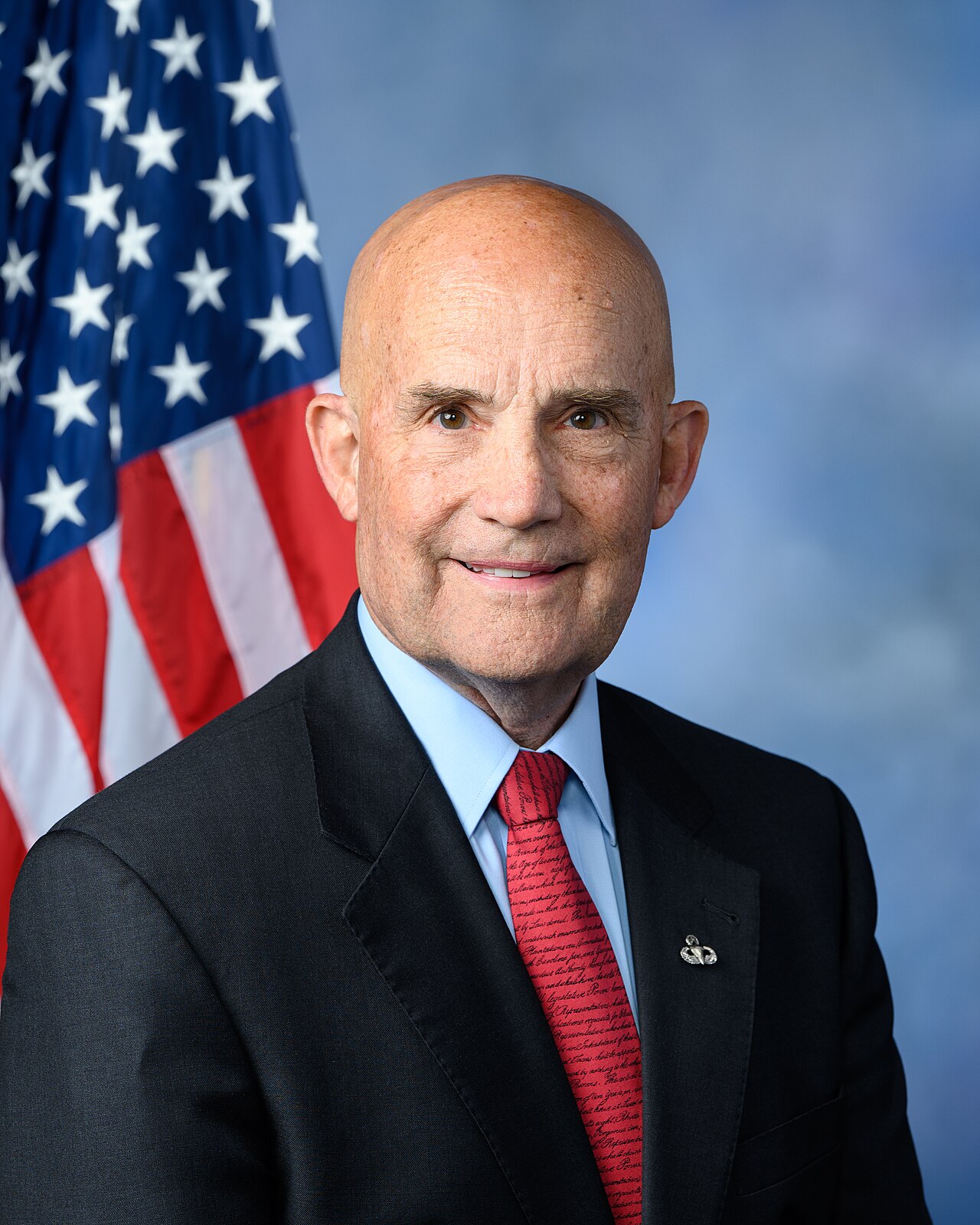
Rep. Keith Self, R-Texas, in his official congressional portrait from the 118th Congress. Photo: U.S. House of Representatives via Wikimedia Commons, public domain.
What would Self's bill change, and can it move?
H.R. 10896, the Terminate the Diversity Immigrant Visa Program bill, was introduced Oct. 22 and referred to House Judiciary with no cosponsors. VisaVerge reports the text was not yet available at introduction. Self's press release ties it to the ruling and to the December pause.
Both chambers are in recess until Nov. 9, per the same Forum bulletin. That means the first test is not in Congress. The State Department's announcement is due Oct. 29, registration opens Nov. 1, and Judge Ohta's ruling on the stay could change either date. A court can make an agency follow the statute as written, and only a repeal can change the statute.
Header photo: Official portrait of Secretary of State Marco Rubio. Photo: U.S. Department of State via Wikimedia Commons, public domain. Cropped.















