

A Daily Caller headline says a federal appeals court "tosses decades-old knife ban." The Fifth Circuit's Oct. 21 opinion in Knife Rights v. Blanche does hold the Federal Switchblade Act's interstate-trade ban unconstitutional, but it strikes one section, upholds the other, and sends the case back to the trial court.
What did the Fifth Circuit actually decide?
The 27-page opinion by Chief Judge Jennifer Walker Elrod, joined by Judges Willett and Wilson, says switchblades are "Arms" covered by the plain text of the Second Amendment. It reverses a Texas district court that had dismissed the challenge to 15 U.S.C. 1242, the section that makes it a federal crime to introduce, manufacture for introduction, transport or distribute switchblades in interstate commerce. The penalty was up to ,000, five years in prison, or both.
The challenge to 15 U.S.C. 1243 lost. That section covers manufacture, sale or possession in federal territory, Indian country and other federal enclaves. The panel did not rule on whether it violates the Second Amendment. It held that the plaintiffs brought only a facial challenge and "do not even address how § 1243 is facially invalid in their opening brief."
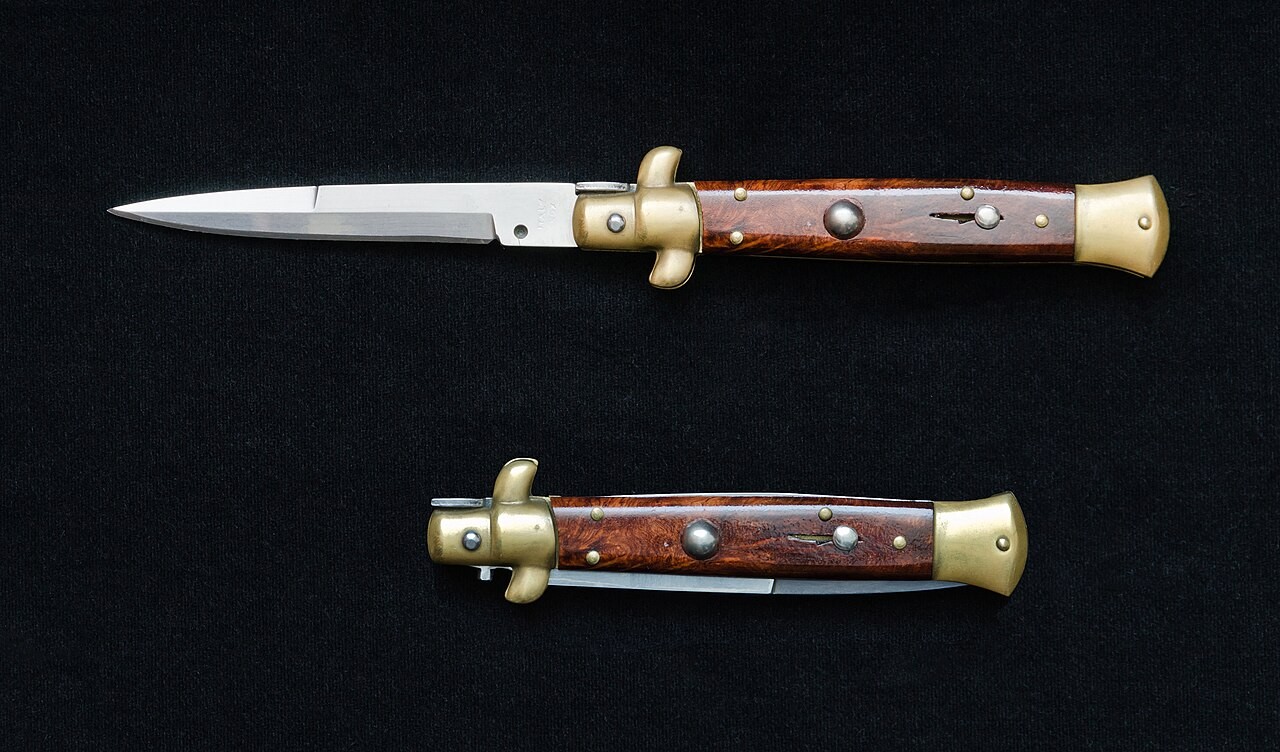
An Italian stiletto-style switchblade, shown open and closed. Photo: Jacek Halicki via Wikimedia Commons, CC BY-SA 3.0.
Is the switchblade law gone?
Not yet. The disposition on page 2 reads: "We REVERSE the district court's grant of the government's motion to dismiss as to the § 1242 claim. We AFFIRM the district court's dismissal of the § 1243 claim, and we REMAND for further proceedings." The case was decided on a motion to dismiss, so it returns to the Northern District of Texas.
The opinion does not itself spell out an injunction or the scope of any relief. I could not find a Justice Department statement on rehearing or a Supreme Court petition as of Sunday. Anyone reading "tossed" as "legal everywhere today" is ahead of the paper.
Official record
U.S. Court of Appeals for the Fifth Circuit, Knife Rights, Inc. v. Blanche, No. 25-10754, opinion filed October 21, 2026.
"We REVERSE the district court's grant of the government's motion to dismiss as to the § 1242 claim. We AFFIRM the district court's dismissal of the § 1243 claim, and we REMAND for further proceedings." — Fifth Circuit panel, opinion at 2
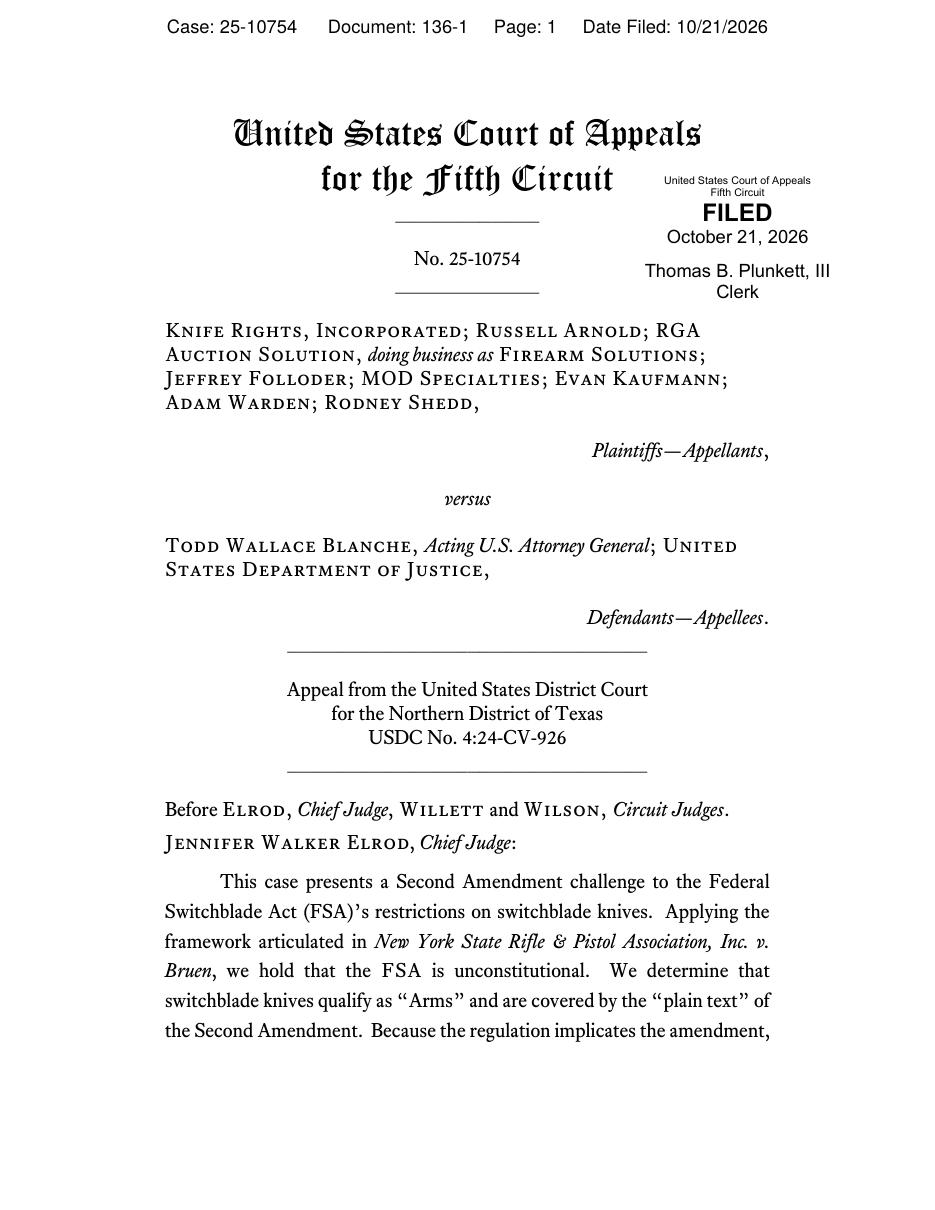
Static capture of page 1 · read the full 27-page opinion (PDF) · CourtListener copy
Why did Washington lose on history?
Under Bruen, once the Amendment's text covers the conduct, the government must show a historical tradition of similar regulation. DOJ pointed to nineteenth-century laws on concealed carry. The court said that answers the "why," and then ruled on the "how" instead: "The government cites no historical analogue that regulates the manufacture, transportation, or distribution of 'inherently concealable weapons,' much less switchblade knives."
The government's best support was a law review article by David Kopel and Joseph Greenlee cataloging nearly two hundred pre-1900 statutes on daggers, dirks and sword canes. The panel counted only two that restrict sales in a way comparable to the federal act, an 1881 Arkansas law and an 1837 Georgia law. "Two laws out of nearly two hundred bring us into outlier territory," the opinion says.
The U.S. Supreme Court Building in Washington, D.C. Photo: Joe Ravi via Wikimedia Commons, CC BY-SA 3.0.
What did Trump's Justice Department argue?
The defendants are Acting Attorney General Todd Blanche and the Department of Justice. The opinion quotes the government's lawyer at oral argument: "we are not in a position to disavow enforcement. I'm, like, affirmatively telling you we will not, have not, are not disavowing enforcement." The panel used that statement to find the plaintiffs faced a credible threat of prosecution, and noted DOJ has brought cases under section 1242.
The opinion also says "millions" of automatic knives are in the country and leans on the Third Circuit's en banc finding that 24 million AR-15s are in common use. That matters beyond knives, because the same common-use reasoning is being argued in the assault-weapon cases.
Is there a split?
The Fifth Circuit cites a Ninth Circuit case, Knife Rights v. Bonta, in which a panel upheld California's switchblade rules against a facial challenge. On July 16 the Ninth Circuit denied rehearing en banc, over a dissent by Judge Tung joined by six other judges. The two cases involve different statutes, so the circuits have not ruled on the same law. They have, however, treated switchblades very differently.
The opinion opens with Rebel Without a Cause, released Oct. 27, 1955, and the Senate subcommittee that followed. It ends by comparing the 1958 act to the laws struck in Heller and Bruen. Whether Washington asks the full Fifth Circuit or the Supreme Court to revisit it is the next question.
Header photo: John Minor Wisdom U.S. Court of Appeals Building, New Orleans, home of the Fifth Circuit. Photo: Ktkvtsh (Timothy Holdiness) via Wikimedia Commons, CC BY 4.0. Cropped.















