The Justice Department sued Denver on Thursday to kill a city ordinance that threatens federal agents with up to 300 days in jail for wearing a mask on duty. Buried on page 17 of the government's complaint is the detail that makes Denver's position awkward: the ordinance itself promises it will never be applied in a way that violates the Supremacy Clause, which is the exact thing the Justice Department says it does.
Denver Wants to Jail Federal Agents for Wearing Masks
The Justice Department announced the lawsuit on October 8. It names the City and County of Denver, Mayor Mike Johnston, City Attorney Michiko Ando Brown and Police Chief Ronald Thomas, and it asks a federal judge in Colorado to declare the city's mask ban and ID mandate invalid as applied to federal officers and permanently block Denver from enforcing them.
"Under the U.S. Constitution, the Supremacy Clause makes clear that states and localities do not have the authority to regulate the Federal Government," said Associate Attorney General Stanley E. Woodward Jr. Assistant Attorney General Brett Shumate of the Civil Division put it more bluntly: "The Federal Government gets to decide which equipment federal officers may or may not wear when performing their official duties."
According to the 20-page complaint, Johnston signed the ordinance on March 3, 2026, the day after the City Council passed it. It bars federal officers from wearing a facial covering during any "interrogation, detainment, arrest, or other activity that restrains the physical movement of an individual." It also requires officers to show a name or badge number on their outermost garment, in lettering readable in "low-light conditions."

Members of ICE's Enforcement and Removal Operations Denver Field Office Special Response Team train outside the city in 2019. Denver's ordinance carves out tactical operations but not ordinary arrests or plainclothes work. (U.S. Immigration and Customs Enforcement, public domain, via Wikimedia Commons)
Every Day Is a New Crime Under the City Code
The penalty is where this stops being symbolic. Because the ordinance declares the conduct unlawful, the complaint explains, a violation falls under Denver's general criminal penalty in D.R.M.C. section 1-13(b): up to 300 days of incarceration and a fine of $999.
It gets worse from there. The complaint quotes section 1-13(c) of the city code, which says "each day an offense and violation continues shall constitute a separate offense and violation," and section 1-13(g), which lets the city pursue civil, criminal and administrative penalties "simultaneously or in succession." Read together, an ICE team that works masked in Denver for a week could face seven separate counts each.
The exceptions are thin. The ordinance allows masks for tactical operations, health and safety rules, medical accommodations, and undercover work approved by a supervisor or a court. According to the complaint, it contains no exception for plainclothes operations, for surveillance, or for an officer trying to keep his family from being doxxed.
The Ordinance Promises Not to Do What It Does
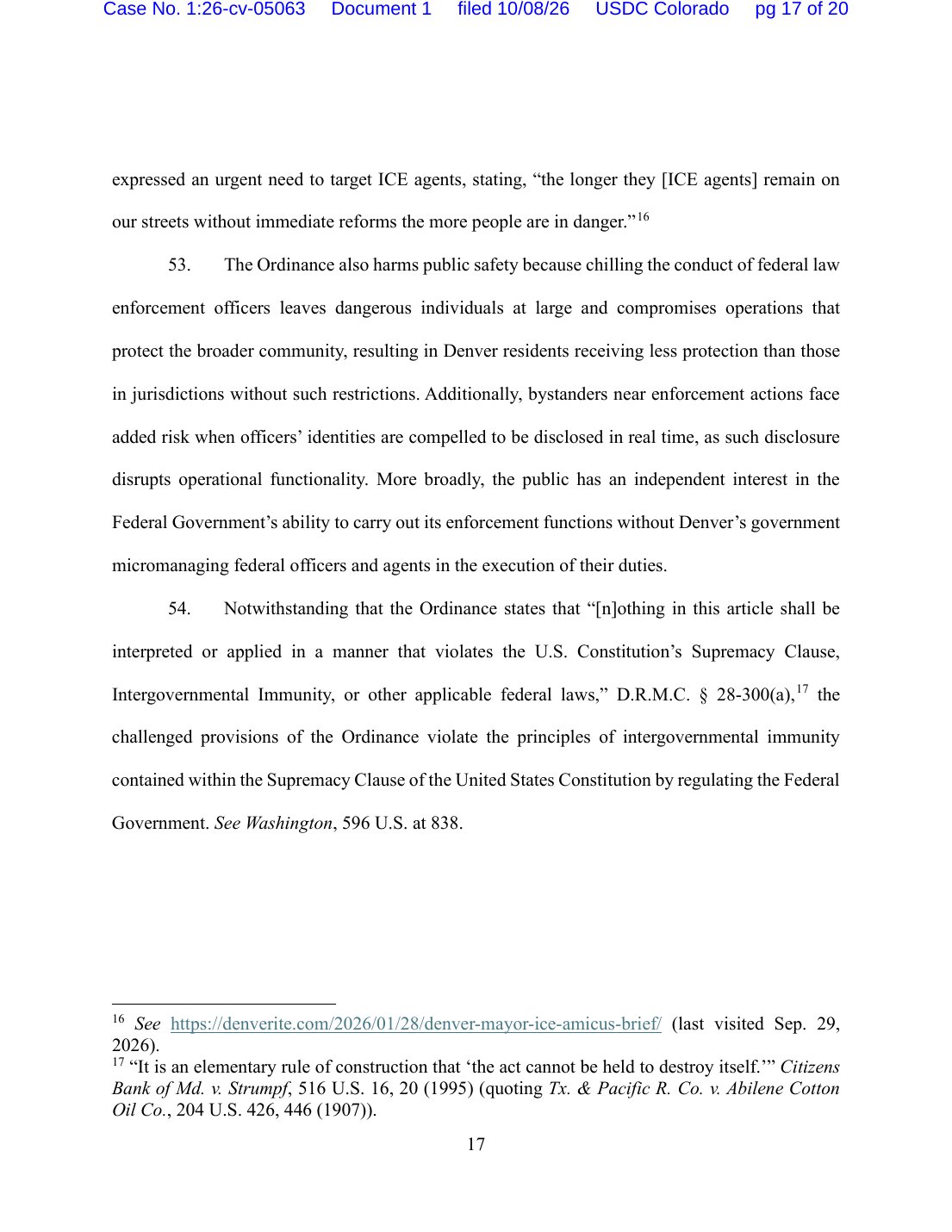
This is the part the coverage skipped. Paragraph 54 of the complaint quotes section 28-300(a) of the ordinance, Denver's own words: "Nothing in this article shall be interpreted or applied in a manner that violates the U.S. Constitution's Supremacy Clause, Intergovernmental Immunity, or other applicable federal laws."
In other words, the City Council wrote a disclaimer into the law admitting the Supremacy Clause problem, then passed a law aimed at federal agents anyway. The Justice Department's answer sits in footnote 17, quoting the Supreme Court in Citizens Bank of Maryland v. Strumpf (1995): "It is an elementary rule of construction that 'the act cannot be held to destroy itself.'" A savings clause, in plain English, cannot rescue a law whose whole purpose is the thing the clause says it won't do.
Official record
United States v. City and County of Denver, No. 1:26-cv-05063 (D. Colo., filed Oct. 8, 2026), Complaint for declaratory and injunctive relief, page 17. Source: U.S. Department of Justice.
"Notwithstanding that the Ordinance states that '[n]othing in this article shall be interpreted or applied in a manner that violates the U.S. Constitution's Supremacy Clause, Intergovernmental Immunity, or other applicable federal laws,' D.R.M.C. § 28-300(a), the challenged provisions of the Ordinance violate the principles of intergovernmental immunity contained within the Supremacy Clause of the United States Constitution by regulating the Federal Government."
United States v. City and County of Denver, Complaint, paragraph 54
Read or download the full 20-page complaint (PDF) · view the Justice Department announcement
What Denver's Own Leaders Said About ICE
The complaint builds its case from the city's own record. It quotes Johnston in November 2024, before Trump took office, describing what would happen if federal immigration agents came to Denver: "More than us having [Denver Police Department] stationed at the county line to keep them out, you would have 50,000 Denverites there. It's like the Tiananmen Square moment with the rose and the gun, right?"
It also quotes the mayor in January 2026, as reported by Denverite: "ICE isn't keeping us safe from the bad guys. Right now, they are the bad guys." The complaint uses that line as evidence the threat of prosecution is real, not hypothetical.

Mike Johnston, now Denver's mayor, photographed in 2017 during his run for Colorado governor. He has vowed to defend the mask ordinance in court. (CBdenver, CC BY-SA 4.0, via Wikimedia Commons)
The council record cuts the same way. Per the complaint, co-sponsor Councilwoman Lewis said on January 12 that "the problem that we are trying to solve is that federal law enforcement agents are wearing masks to conceal their identities," and the committee presentation featured a photo of a masked person wearing an ICE badge. At the March 2 vote, the complaint says, she described the ordinance as preparation for "when ICE gets here."
A Supporter Admitted the ID Rule Wouldn't Change His Mind
One quote in the complaint undercuts the city's main selling point. Supporters say the ID mandate helps residents tell real officers from impostors. According to paragraph 29, a council member the complaint calls "Councilman Cashmann," who voted yes, said at the March 2 meeting: "I don't care what it says on their shirt or their coat, I'm not opening the door, and certainly not answering the door at my home to someone wearing a mask."
Meanwhile, federal regulations already cover identification. The complaint points to 8 C.F.R. 287.8(c)(2)(iii), which requires an immigration officer making an arrest to identify himself and state the reason for the arrest "as soon as it is practical and safe to do so." The difference is who decides when it is safe. Under federal rules it is the officer on the scene. Under Denver's rules it is the city.
Why Agents Cover Their Faces in Denver
The complaint lists two recent doxxing incidents in Colorado. On January 14, 2026, an ICE deportation officer and his wife were doxxed in the Denver area, with her name and photo posted on Facebook, Instagram, Threads and LinkedIn, and a photo of the family's home and its address shared online. On September 22, deportation officers from ICE's Durango sub-office were doxxed when their images went up on Instagram.
The filing also names a website, ICESpy.org, as one of the tools people use to run officers' faces through facial recognition and then hunt down their families, including children. That is the practical reason federal agencies leave mask decisions to the officer, and the reason the complaint says federal officers "cannot and will not comply" with the ordinance.
Mayor Johnston Says He'll Fight to the End
Johnston is not backing down. In a statement shared on Instagram after the city was served, he said Denver would "fight to the very end on this battle," Denver7 reported, "to make sure that every law enforcement officer, local or federal, that operates in Denver does not wear a mask (and) is easily identifiable to the public." Denver7 also reported that the head of the Denver police union, Brian Pacelko, asked earlier this year what happens to a Denver officer who tries to enforce the ordinance and gets arrested by a federal agent for obstruction. Council sponsor Flor Alvidrez did not give a definitive answer.
The city's argument is that the rule covers local, state and federal officers equally, so it is not singling out Washington. The Justice Department's complaint does not rely on a discrimination theory. It argues the ordinance directly regulates federal operations, which the Supreme Court said in United States v. Washington (2022) that states and cities may not do.
The Track Record Favors the Feds
Denver is walking into a losing streak. The complaint lists courts that have already blocked similar laws: a unanimous Ninth Circuit injunction against California's officer-ID law, a federal judge in New York on August 3, Senior Judge Robert Payne in Virginia on August 18, and a federal court in Philadelphia on July 2. PatriotAddict covered the Virginia fight, where the Fourth Circuit also refused to revive the state's mask ban, in our report on Judge Payne's 287(g) ruling.
The Justice Department says this is the latest in a string of Civil Division suits against sanctuary-style laws, including in Maryland, New York, Virginia, Connecticut, New Jersey, California, Philadelphia and Milwaukee. It is also not Denver's first fight with this administration this fall. The city is a plaintiff in the LULAC lawsuit over ICE at polling places.
The ordinance has been on the books for 219 days. In that time, by Denver's own design, it has threatened the officers who go after violent criminals and transnational gangs with jail time for protecting their own faces. Now a federal judge will decide whether a city can criminalize federal law enforcement just by promising, in the fine print, that it isn't.
Top photo: The City and County Building in Denver, seat of the city government that passed the mask ordinance. (Daniel Hartwig, CC BY 4.0, via Wikimedia Commons)