

The Justice Department announced criminal charges Monday against 28 green card holders in California, accusing them of falsely claiming citizenship to register to vote and, in most cases, of casting ballots. The department's own release describes a ballot for 23 of the 28. For the other five, it describes only a voter registration, some dating to 2002, plus a false statement on naturalization paperwork. All 28 sit on a list of 20,000 names DOJ wants California to set aside before counting mail ballots.
What exactly are the 28 accused of?
Federal agents arrested 11 of them across the state on Monday, and the DOJ release says all 28 are lawful permanent residents. They are not citizens and cannot vote. According to the release, the defendants swore on voter registration forms that they were citizens, and many later told immigration officials on naturalization paperwork that they had never claimed citizenship or registered.
The charges vary by district. Thirteen defendants in the Central District face felonies, including false statements in a naturalization application. Six in the Eastern District are charged with voting by an alien in a federal election, a misdemeanor with a one-year maximum. Five in the Northern District and four in the Southern District face a mix that includes attempted procurement of naturalization and false statements under oath. The felonies carry up to five years. Nobody has been convicted, and no pleas were taken Monday.
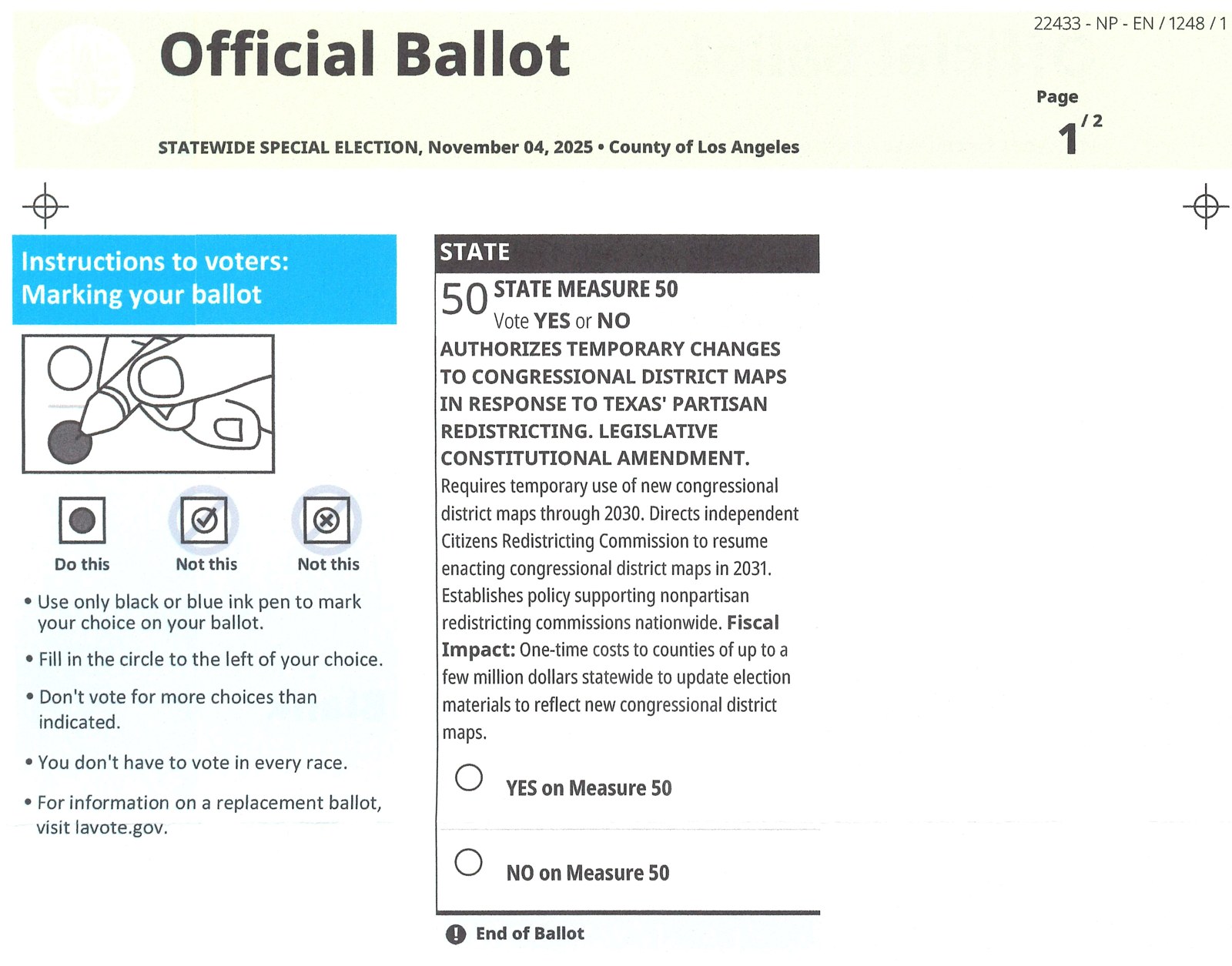
A California special election ballot of the kind mailed to Los Angeles County voters (2025 Proposition 50 ballot). Image: State of California, Los Angeles County, via Wikimedia Commons, public domain.
Did all 28 actually vote?
Not according to the release. Eight of the 13 Central District defendants are described as voting or submitting a ballot, and every defendant in the other three districts is. That makes 23. The remaining five, all in the Central District, are described as registering in years like 2002, 2003, 2006, 2007 and 2012 and then allegedly lying in naturalization paperwork filed between 2018 and 2026. No vote is described for them.
That does not prove those five never voted, and the case against the other 23 is serious. Illegal voting is a crime, and a few of the described cases are plain: two defendants allegedly registered and voted on Election Day in November 2024, and one allegedly voted in three elections through the June 2026 primary. But the department's framing, that "California is mailing ballots to noncitizens," says First Assistant U.S. Attorney Bill Essayli, rests partly on registrations that are years or decades old. KPBS reported the same pattern: some of the 28 do not appear to have voted, and some registered more than 20 years ago.
What does 28 out of 20,000 prove?
Acting Deputy Attorney General Trent McCotter said each of the 28 "appears on the list of more than 20,000 likely noncitizen registrants" DOJ gave California, and that the state "refused to look at that list." That is a fair point on the 28. The list found real cases, if the charges hold.
It is a thin basis for the other 19,972 names. Twenty-eight is 0.14 percent of 20,000, and charging the strongest cases says nothing about the rest. McCotter told reporters the list came from cross-referencing voter rolls against other databases, removing anyone with evidence of citizenship, and manually checking what was left, ABC News reported. ABC also reported that in Nevada, DOJ sent a list of 185 names and state officials determined every one was a lawful citizen. And the number has moved: a July DHS letter alleged up to 190,000 potential noncitizens on California's rolls, per KPBS. California says it has not been shown how DOJ got from there to here.
Official record
Justice Department press release 26-1222, Justice Department Charges 28 Foreign Nationals in California for Election Crimes, October 19, 2026. The release notes that a complaint "merely contain[s] accusations" and that all defendants are presumed innocent.
"Each of the 28 defendants charged today appears on the list of more than 20,000 likely noncitizen registrants we provided to California election officials last week." — Acting Deputy Attorney General Trent McCotter
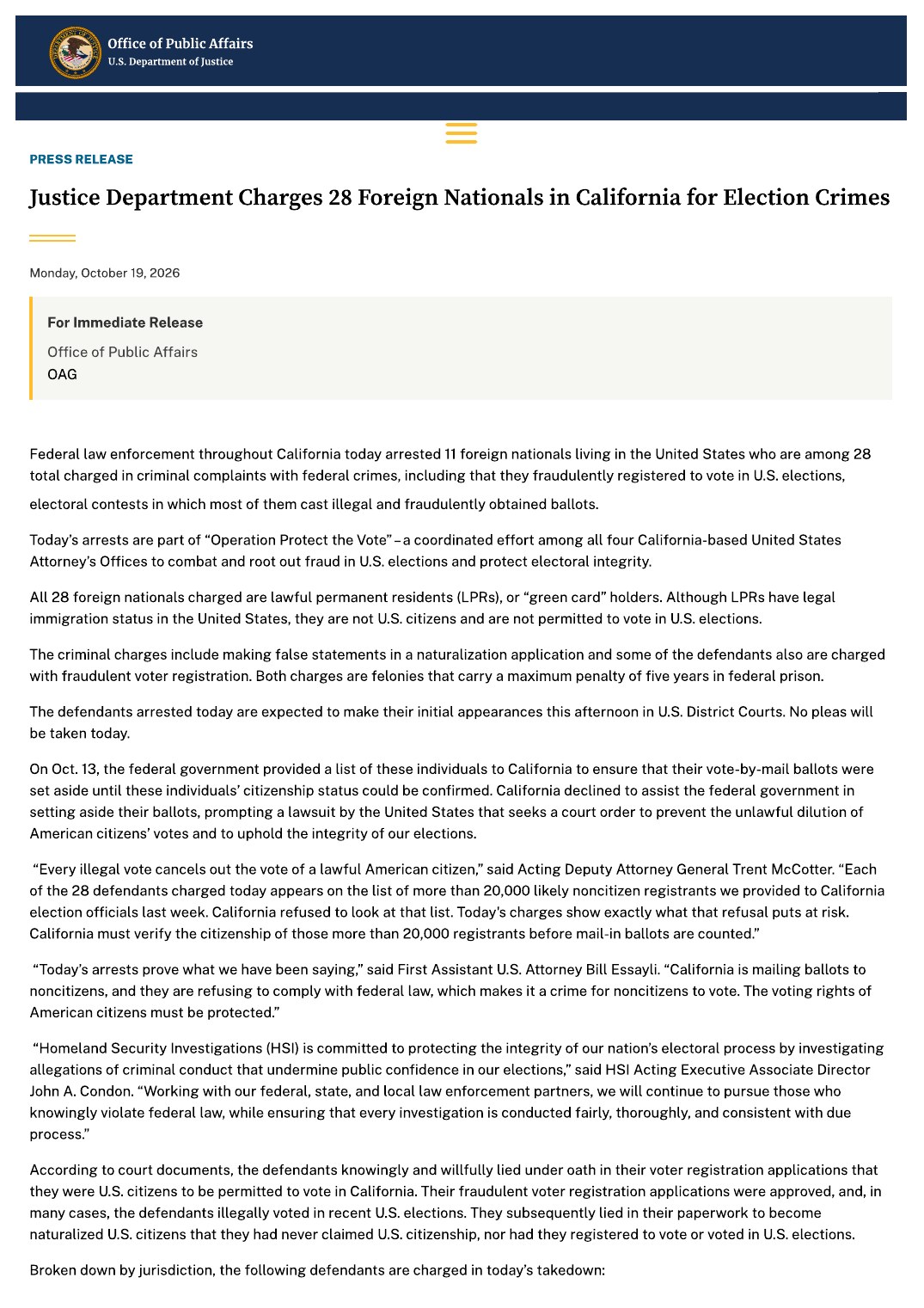
Read or download the full 4-page printout (PDF) · View the release on Justice.gov
Can California be ordered to set those ballots aside?
That is the real fight. DOJ sued California on October 15, and its U.S. Attorney's release asks for an order barring the state from tabulating mail ballots from the listed people until their citizenship is verified. On Monday it filed an emergency motion for a temporary restraining order, MyNewsLA reported. No judge or hearing date was reported as of Monday.
California's answer is the National Voter Registration Act. The statute says states must complete any program to systematically remove ineligible voters no later than 90 days before a federal election, and the election is November 3. DOJ's reply, as Democracy Docket quoted Essayli, is that it never asked for removal: "We asked you to sequester their ballots so a judge can decide whether they may be counted." Whether a court sees a difference between pulling a name and pulling that person's ballot is the question.
What happens to election workers who count a flagged ballot?
McCotter would not say. Asked whether election workers could be charged for processing ballots from the list, he declined to "prejudge or pre-announce" any case, per ABC. KPBS reported that President Trump posted on Truth Social last Friday that California officials "will all go to jail." Los Angeles County's Dean Logan refused to open the thumb drive DOJ sent, saying it would conflict with data security protocols and that "we do not consider the device a secure medium," ABC reported.
Watch two things. First, whether DOJ says that any of the 28 has a 2026 ballot waiting to be counted. The release does not say. Second, what the judge does with the restraining order before November 3. A government that can show a named, charged person with a live ballot has a strong case for a narrow order. A government that can only point to a list has to explain, in open court, how that list was made.
Header photo: an official ballot drop box in Point Arena, Mendocino County, California, a file photo of a county not named in the case. Photo: Missvain via Wikimedia Commons, CC BY 4.0.















