

Sen. Susan Collins, the Republican who chairs Senate Appropriations, says the Government Accountability Office should sue over the White House's $810 million pocket rescission. The 1974 budget law does give the Comptroller General that power. The catch is the job: Gene Dodaro's term ended December 30, 2025, no successor has been confirmed, and the White House has floated the deputy of the budget director whose cancellation GAO says cannot hold.
What did the White House actually cancel?
On September 25, Trump sent Speaker Mike Johnson a special message reporting 11 rescissions totaling $810 million. By far the biggest is $567,401,904 from the Refugee and Entrant Assistance account at HHS. The message calls the programs "operated by pro-illegal immigration non-profits" and says the account is "overfunded due to the Administration's successful border policies."
The rest is a list a lot of readers will not miss, per Fox News: $25 million in migrant-student grants the White House tied to an "LGBT youth summit," $69.6 million from an international-education grant program the message says funded "woke and wasteful projects," and smaller offices at Justice, Commerce, HUD and HHS. Sen. John Kennedy, a Republican, backed the move, saying Congress should cut spending itself and that he was glad OMB Director Russ Vought was doing it, Ballotpedia reports.

The Government Accountability Office headquarters in Washington. Photo: ajay_suresh via Wikimedia Commons, CC BY 2.0.
Why did GAO say it cannot stand?
A pocket rescission works on timing. The president proposes a cancellation days before a fiscal year ends, the money is held back, and it expires before Congress can vote. The Impoundment Control Act gives Congress 45 days to act, and GAO's September 29 decision says that clock runs no earlier than November 9, after the funds' September 30 expiration.
GAO's General Counsel, Edda Emmanuelli Perez, wrote that the amounts "must be made available for obligation unless Congress completes action" on a rescission bill, and that "The President may not force the expiration of budget authority Congress has already enacted and did not rescind." GAO says it took no position on the policies themselves.
Official record
White House special message to Speaker Johnson, September 25, 2026, proposing 11 rescissions totaling $810 million. Page 2 shows proposal R26-1, the $567 million refugee-assistance cut.
"This proposal would rescind a total of $567 million of the $6.3 billion appropriated in FY 2024 for the Refugee and Entrant Assistance account." - Rescission proposal R26-1
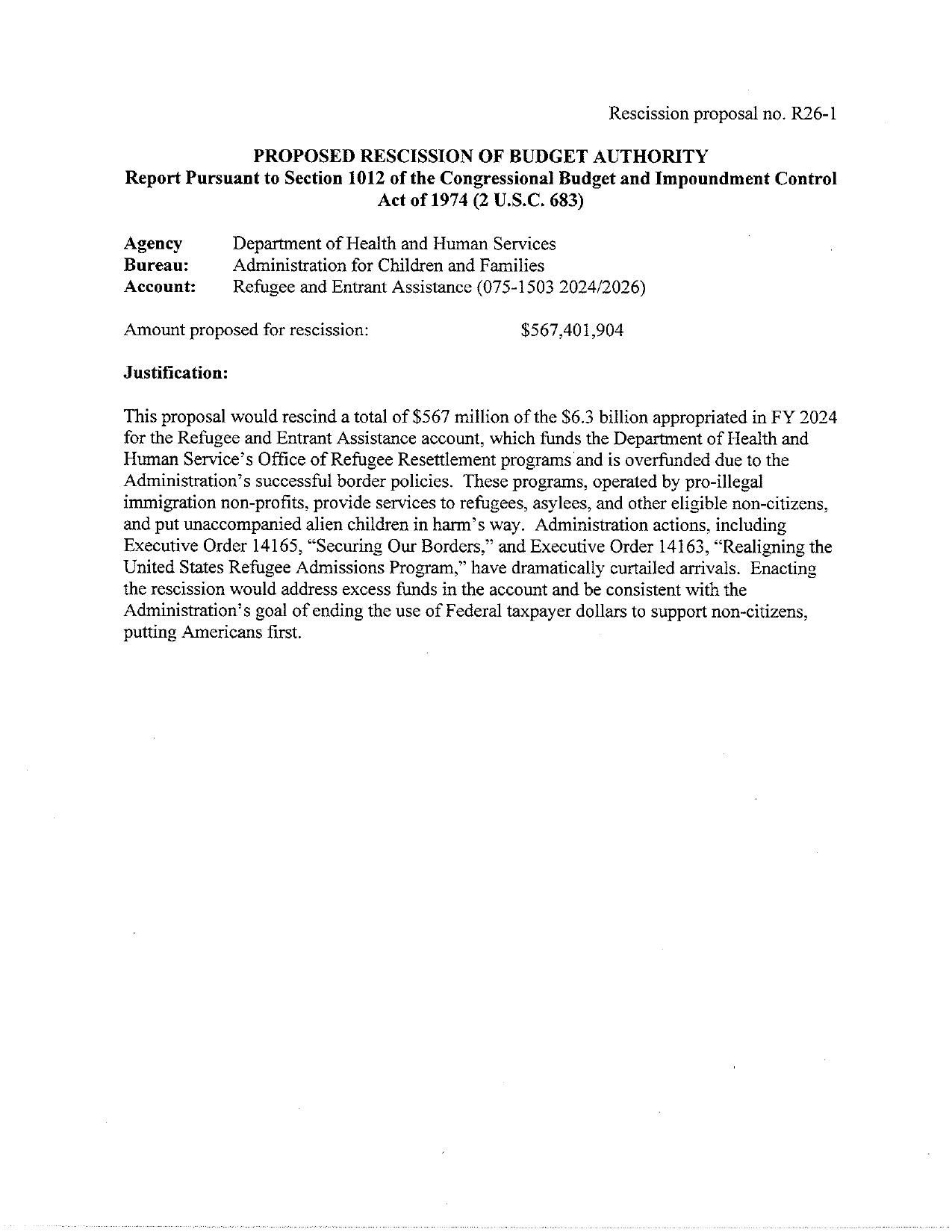
Read or download the full 12-page message (PDF) · View it on WhiteHouse.gov
Who is allowed to sue?
The statute is specific. Under 2 U.S.C. 687, when budget authority required to be made available is not, "the Comptroller General is hereby expressly empowered, through attorneys of his own selection, to bring a civil action" in D.C. federal court. It also imposes a wait of 25 calendar days of continuous session after GAO files an explanatory statement with Congress.
Collins says that power exists and should be used. "They are empowered to sue," she said, adding that the acting GAO head is wary of suing without direct congressional approval, according to a report on Oct. 9. That report adds that a preliminary Supreme Court ruling suggested only the GAO chief can bring such a challenge. A GAO spokesperson said the agency "has not made a decision to file any lawsuits at this time," per congress.net.
Is there a Comptroller General to do it?
Not a confirmed one. GAO's own site lists Orice Williams Brown as Acting Comptroller General since December 30, 2025, when Dodaro's term ended. She serves until the Senate confirms someone. A Comptroller General gets a single 15-year term, and once confirmed can be removed only by Congress, according to NTU's guide to the process.
Getting there starts with a 10-member congressional commission that must send the president at least three names. The Washington Sun reported on Oct. 8 that the commission had not convened nine months after Dodaro left, and that the White House has floated Eric Ueland, Vought's deputy at OMB, for the job. Former Comptroller General David Walker told the paper, "When you're acting, it's not the same as being a confirmed comptroller general."
What happens next?
Nothing soon. The Senate is holding pro forma sessions only until it returns for business November 9, and the House is out until after the election. Republicans run both chambers. If they want the $810 million cut, they can vote on a rescission bill. If they want it restored, they can say so. Collins says she will work with colleagues to address it, but none of the reporting names a bill or a vote.
Readers can like every line of this package and still see the problem. Congress wrote the spending. A budget office that decides which expiring dollars quietly disappear has taken a power the Constitution gave to the House and Senate, and the one officer the law authorizes to challenge it has no confirmed occupant. Vought said GAO's position was "not a surprise," per Ballotpedia, and the same logic would hand a future Democratic OMB the same tool. The Supreme Court already let last year's $4.9 billion pocket rescission proceed. A second one, with a Republican chair of Appropriations calling it unlawful, is now a test of whether Congress defends its own purse.
Header photo: Sen. Susan Collins, official Senate photo, via Wikimedia Commons, public domain.















