A new poll asked 683 Democratic voters how they would feel if they woke up to the headline "President Donald Trump was assassinated while speaking at a rally." Only 43 percent said they would feel negative. The published crosstabs show another 25 percent would feel nothing either way, and 31 percent would feel good. The poll went public the same week a second Butler shooting victim died, and according to the Media Research Center, the network evening newscasts gave it zero airtime.
Who Ran This Poll, and What Did It Ask?
The survey comes from the left, not the right. It was commissioned by Liberal Currents, a left-leaning online magazine, and fielded by the Center for Strategic Politics, a small polling group led by executive director Jordan Buchman. The magazine's writer Chance Phillips published the results on September 21 under the headline "What Are Democrats Thinking?"
According to the methodology statement on the first page of the 51-page crosstab release, the pollster interviewed 683 Democratic voters on September 3 and September 8 through 10, 2026, by text-to-web and online panel. Respondents were screened by self-identification and a voter file match, and the sample was weighted by age, ethnicity and gender. The stated margin of error is plus or minus 3.75 points.
Most of the poll is routine party business, like 2028 primary preferences and whether to end the filibuster. Question block 8 is the part that set off conservative media. It gave respondents five hypothetical morning headlines about Trump leaving office and asked how each would make them feel.
The Number Nobody Is Reporting: 43 Percent
Most coverage led with the roughly one-third who would feel positive about an assassination. The Post Millennial and others ran with it, and the New York Post put the figure at 32 percent. The published crosstabs show 23 percent "very positive" and 8 percent "somewhat positive," which adds to 31. The one-point gap looks like rounding.
The more telling figure is on the other side of the ledger. Just 43 percent of Democratic voters said the assassination of a sitting president at a rally would make them feel negative. Only 32 percent said "very negative." That means 56 percent of the sample either welcomed the news or shrugged at it, and fewer than one Democrat in three picked the strongest available response to the murder of the President of the United States.
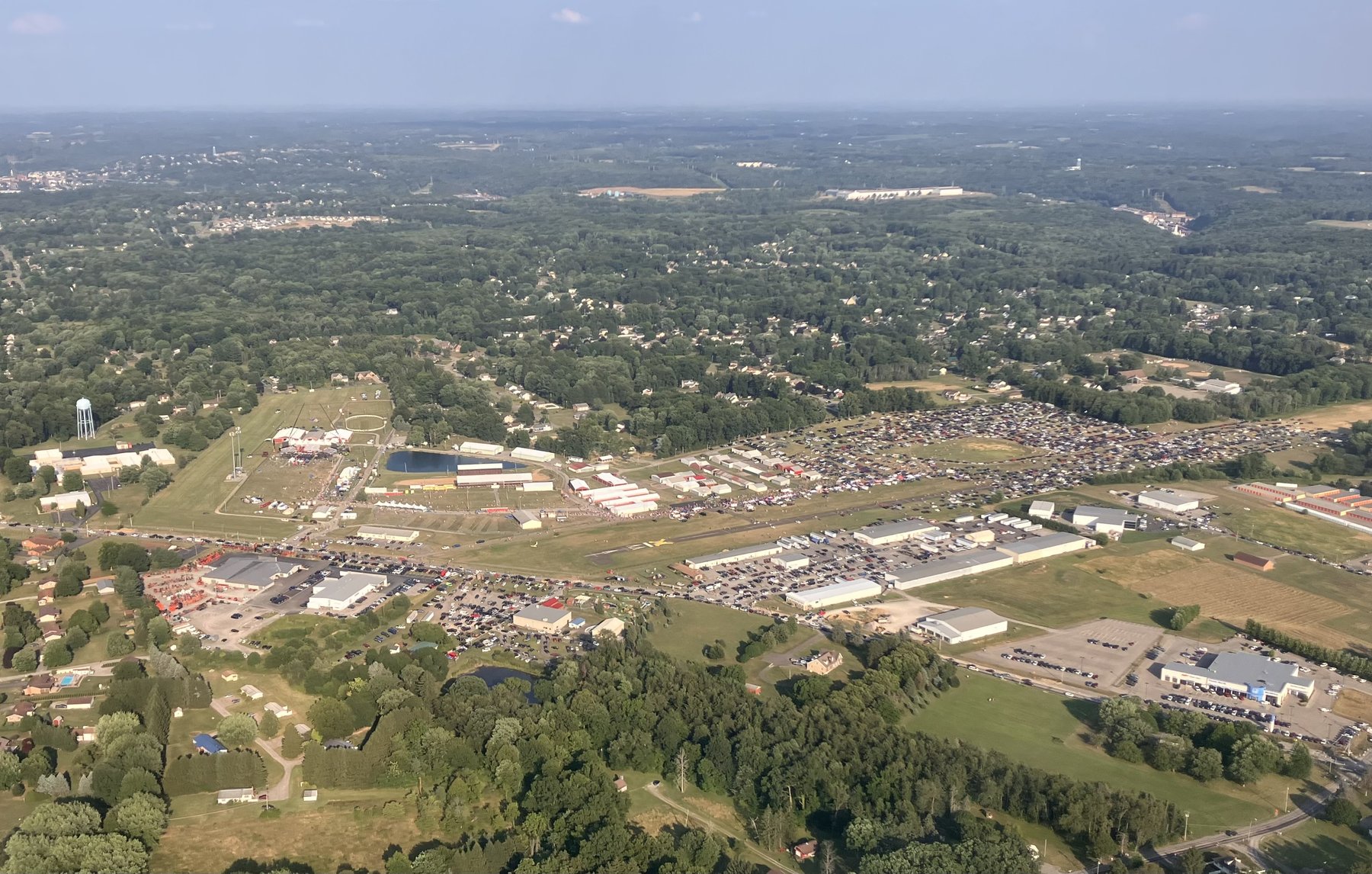
The Butler Farm Show grounds in Pennsylvania from the air in July 2024, around the time of the rally where a gunman fired on Donald Trump. (Designism, Wikimedia Commons, CC0 public domain dedication)
Inside the Crosstabs, Some Groups Split Down the Middle
Page 33 of the release breaks the assassination question out by subgroup, and several of those rows are worse than the topline. Among Democrats who call themselves socialists or progressives, 39 percent would feel positive and 39 percent negative, a net score of zero. Among Democrats who describe themselves as "woke," it is 38 percent positive against 39 percent negative.
Democratic women were far more likely than men to stay out of it. Thirty-five percent of them chose "neither positive nor negative," compared with 13 percent of men. Men were more likely to object (52 percent negative), but they were also more likely to approve (35 percent positive). Only a handful of the subgroups the pollster reported cleared a bare majority saying they would feel bad: men at 52 percent, union members at 53 and the most politically informed half of the sample at 52. Voters under 45 landed at exactly 50.
Official record
Liberal Currents/Center for Strategic Politics National Democratic Poll, September 2026, crosstabs released for publication. Question 8.5 appears on page 33 of 51.
"If you woke up tomorrow morning and saw the following news headlines, how would you feel? :: President Donald Trump was assassinated while speaking at a rally"
Question 8.5, Center for Strategic Politics
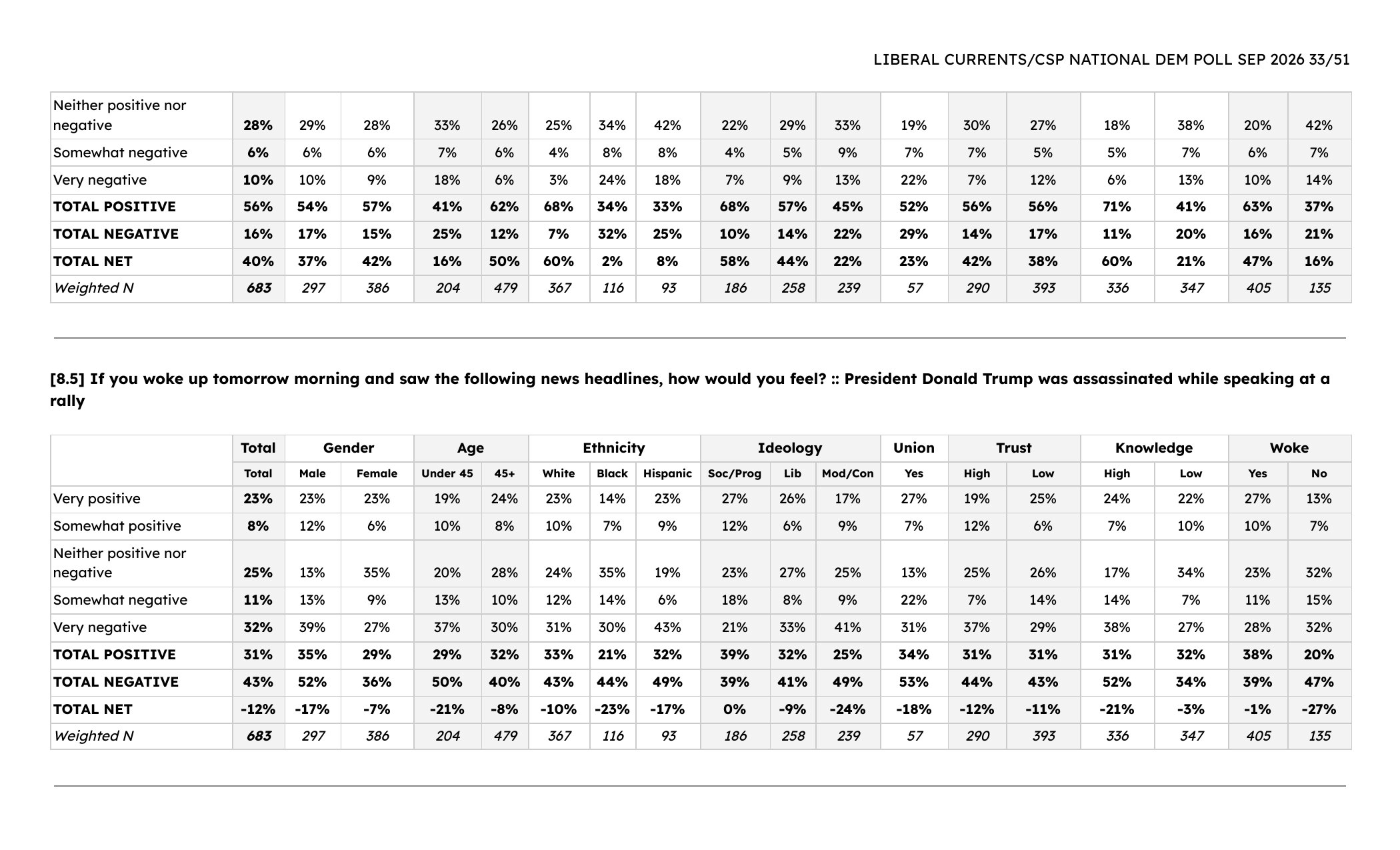
Read or download the full 51-page crosstab release (PDF) · original on the pollster's website
The Pollster's Own Write-Up Called It Reassuring
You might expect the people who ran this survey to be alarmed by those numbers. Phillips's write-up in Liberal Currents took the opposite view. He noted that assassination was the one removal method a "sizable plurality" said would make them feel worse, then offered this: "Thankfully, on net Democrats are not pro political violence."
That "on net" is doing a lot of work. It rests on a net score of minus 12, meaning negative beat positive by 12 points while a quarter of respondents stayed neutral. The same write-up described Democrats as happy with "just about any way" Trump could leave office, and it listed a military coup among the scenarios Democrats would welcome without adding any concern of its own. Nowhere in the piece is there a sentence treating the 31 percent as a problem.
A Military Coup Scored Better Than an Election
The other four headlines tell you where the assassination result sits. The numbers below come from the same crosstabs:
- Impeached and convicted by Congress: 86 percent positive
- Removed by his cabinet under the 25th Amendment: 84 percent positive
- U.S. military leaders remove Trump and "assumed control of the United States" to "safeguard the Constitution": 59 percent positive, 28 percent negative
- Trump "died overnight in his sleep": 56 percent positive, 16 percent negative
- Assassinated while speaking at a rally: 31 percent positive, 43 percent negative
The coup question is worth reading twice. It describes generals seizing control of the country, and 43 percent of Democratic voters said that headline would make them feel "very positive." Among self-described liberals the total positive reaction reached 66 percent. The poll did not ask whether respondents would support or take part in any of these scenarios, only how the headline would make them feel, and that caveat is fair to note. It still measures something real about the mood of a party's voters.
Butler Was Not Hypothetical, and Neither Was Utah
The wording of question 8.5, "assassinated while speaking at a rally," describes something that nearly happened. On July 13, 2024, a gunman fired from a rooftop at Trump's rally at the Butler Farm Show in Pennsylvania. Trump was hit in the ear, firefighter Corey Comperatore was killed, and two other rallygoers were critically wounded.

The approximate spot where Trump's podium stood during the July 13, 2024 assassination attempt, photographed in May 2025. A new building has since gone up behind it. (Cutlass, Wikimedia Commons, CC0 public domain dedication)
One of those two, military veteran James "Jim" Copenhaver, died on Wednesday, September 23, according to a statement from his family's attorney reported by Newsweek. He was 76. Copenhaver was shot in the arm and abdomen at Butler and lived with nerve damage afterward. The statement did not give a cause of death. Trump called him "a true American Patriot" on Truth Social and said Copenhaver kept a positive spirit "despite unimaginable hardships."
The fielding dates matter too. The survey's second wave ran September 8 through 10, ending on the first anniversary of Charlie Kirk's murder. Kirk was shot and killed on September 10, 2025 while speaking to students at a Turning Point USA event at Utah Valley University. Respondents were being asked about a president shot at a rally during the same days the country was marking the killing of a conservative shot at a speaking event.
Did the Networks Cover It?
Not on the evening news. The Media Research Center's Jorge Bonilla reported on September 25 that the poll got zero minutes on the ABC, CBS and NBC evening newscasts. He also found that NBC Nightly News was the only one of the three to report Copenhaver's death. By MRC's count, the same broadcasts found time for a football player's beer-chugging fine and a segment on Alaska's fat bear season.
Ask yourself what the coverage would look like if a Republican-commissioned poll found a third of GOP voters would feel good about a Democratic president being shot at a rally. It would lead the evening news, and every Republican on Capitol Hill would be asked to answer for it. In this case the numbers sat on a pollster's website for days, in a PDF anyone could open, and the networks left them there.
The poll is one survey of 683 people, and it measured feelings, not intentions. That is exactly why the "very negative" column matters. Condemning the murder of a president should be the easiest answer on any questionnaire. Fewer than one in three Democratic voters gave it, and the magazine that paid for the survey called the result a relief.
Top photo: President Donald Trump speaking at a rally at Desert Diamond Arena in Glendale, Arizona, on August 23, 2024. (Gage Skidmore, via Wikimedia Commons, CC BY-SA 2.0)