The Senate voted 49-50 Thursday against a House resolution ordering President Trump to pull U.S. forces out of hostilities with Iran. The Senate's own roll calls show something the coverage skipped: the only two times Trump's opponents have won an Iran war powers vote this year, Republican senators were missing from the chamber.
What Did the Senate Actually Reject on Thursday?
The measure was H. Con. Res. 89, a concurrent resolution that invokes section 5(c) of the War Powers Resolution. It "directs the President to remove the use of United States Armed Forces from hostilities against the Islamic Republic of Iran" unless Congress declares war or passes a specific authorization. It carves out self-defense, a defensive troop presence in the region, and intelligence sharing with coalition partners.
The House passed it 214-208 on July 23, with four Republicans crossing over. It then sat for 63 days before the Senate took it up. On Thursday afternoon, roll call vote 244 recorded 49 yeas and 50 nays, and the resolution died.
Four Republicans voted yes: Susan Collins of Maine, Lisa Murkowski of Alaska, Rand Paul of Kentucky and Thom Tillis of North Carolina. One Democrat, John Fetterman of Pennsylvania, voted no. Maryland Democrat Angela Alsobrooks did not vote, according to the Senate Daily Press log.
Tillis and Cassidy Swapped Sides, So Why Did the Result Flip?
We pulled the member-by-member results for Thursday's vote and for roll call vote 184, the June 23 vote when the Senate adopted a nearly identical measure, H. Con. Res. 86, by 50-48. Only five senators voted differently between the two.
Tillis went from no to yes. Louisiana's Bill Cassidy went the other way, from yes in June to no on Thursday. Those two moves cancel out. The swing came from attendance: Mitch McConnell and Dave McCormick both missed the June vote and both voted no on Thursday, while Alsobrooks, a yes in June, was absent this time.

Bill Cassidy, pictured in his 2011 official portrait from his House years, voted for the Iran resolution in June and against it on Thursday. (Official U.S. House photo via Wikimedia Commons, public domain)
Run the numbers with every seat filled and the June "rebuke" goes away. Give McConnell and McCormick their no votes on June 23 and the tally is 50-50. A tie loses in the Senate. Alsobrooks' absence on Thursday didn't matter either way, since her yes vote would also have produced a 50-50 tie.
Were There Really 14 Iran Votes in the Senate This Year?
Yes. The Senate's 2026 roll call index lists 14 recorded votes on Iran war powers measures between March 4 and September 24. Twelve failed. Supporters never got past 50 yeas on any of them.
The two wins share one detail. On May 19, the Senate voted 50-47 to discharge S.J. Res. 185 from committee, according to roll call vote 129. Three Republicans skipped that vote: John Cornyn, Tommy Tuberville and Tillis. Five weeks later, the motion to actually take up S.J. Res. 185 failed 47-50. The June 23 adoption of H. Con. Res. 86 was the second win, and it came with McConnell and McCormick gone.
The story in the headlines this summer was a Senate turning on Trump over Iran. The roll calls show that both of the Senate's votes against Trump on Iran depended on Republicans who weren't there.

The west front of the U.S. Capitol. The Senate has recorded 14 Iran war powers votes in 2026 and supporters have won two. (Architect of the Capitol via Wikimedia Commons, public domain)
Why Did Thom Tillis Change His Vote Now?
Tillis had voted against every earlier Iran resolution. The Washington Sun reported that he warned in July he would take a "very different posture" if the fighting ran past Sept. 10, which was 60 days after the administration notified Congress that hostilities had resumed. On Wednesday he said the vote mattered to get "some strategic clarity around here so we can measure our success."
Tillis is not running for reelection. Neither is Cassidy, who has heard complaints about the war from Louisiana voters and declined to explain his no vote on Thursday, according to the same report. So the Senate's net Republican count on Iran stayed at four, with one retiring senator replacing another.
Would the Resolution Have Done Anything If It Passed?
Not much, and the White House has said so in writing. A concurrent resolution never goes to the President's desk, so there is nothing to sign or veto. That point got lost in some coverage. The Libertarian Institute wrote Thursday that Trump "likely would have vetoed it," but NPR noted in June that the adopted H. Con. Res. 86 "will not be sent to the White House for a signature."
The administration goes further. In a Statement of Administration Policy on the next House resolution, the Office of Management and Budget argues that these measures carry no legal weight at all, and that even if they did, the Supreme Court's 1983 decision in INS v. Chadha would make them unconstitutional legislative vetoes. Chadha struck down laws that let Congress override the executive branch without passing a bill and presenting it to the President.
Official record
Executive Office of the President, Office of Management and Budget, Statement of Administration Policy on H. Con. Res. 93, Sept. 15, 2026 (2 pages).
"Although concurrent resolutions such as H. Con. Res. 93 lack the force of law and even if it were otherwise should be deemed unconstitutional legislative vetoes under controlling Supreme Court precedent, I.N.S. v. Chadha, 462 U.S. 919 (1983)..."
Office of Management and Budget
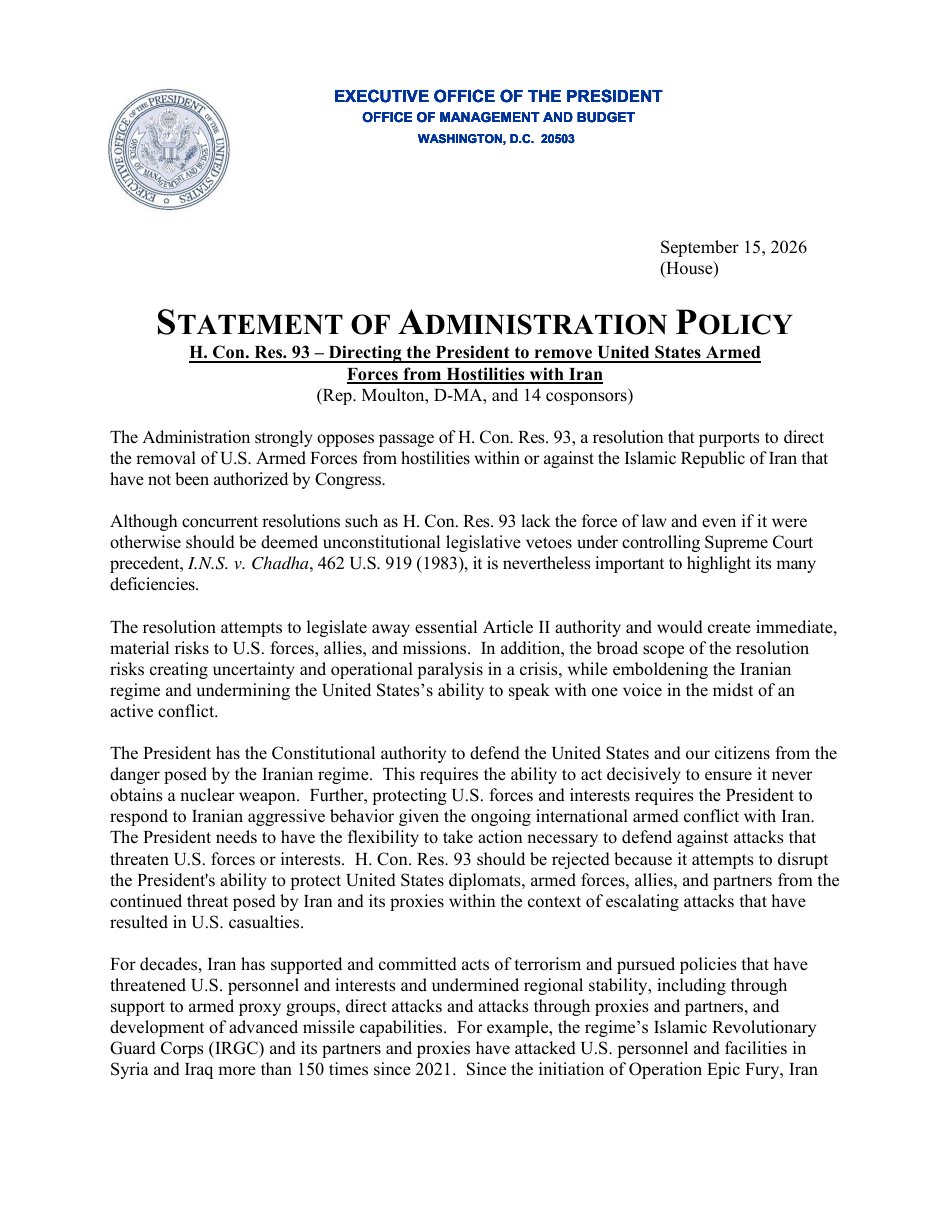
Read or download the full 2-page statement (PDF) · view the original on whitehouse.gov
The statement also says the resolution "attempts to legislate away essential Article II authority" and would leave the United States unable "to speak with one voice in the midst of an active conflict." After the House passed H. Con. Res. 86 in June, Trump himself called the vote an attempt to limit his war powers during negotiations with Tehran and asked, per NPR, "Who would do such an unpatriotic thing."
Is Another Senate Vote Already Coming?
Almost certainly. The House passed H. Con. Res. 93, from Massachusetts Democrat Seth Moulton, by 220-204 last week, with seven Republicans voting yes, according to the Washington Sun. Three of them, Nancy Mace, Mariannette Miller-Meeks and Zach Nunn, backed an Iran resolution for the first time.
Under 50 U.S.C. 1546, a war powers concurrent resolution sent over by the other chamber goes to committee, which must report it within 15 calendar days, and the full chamber votes within three days after that. Either deadline can be waived if the chamber votes to do so by yeas and nays. H. Con. Res. 89 took 63 days to reach a Senate vote, so the calendar is not a sure guide.
The Senate returns Monday at 3 p.m., with a 5:30 p.m. vote on the Protect College Sports Act already set, per the Senate Daily Press. No vote on H. Con. Res. 93 has been scheduled yet.
What Does the Math Say About the Next Round?
With all 100 senators voting, the lineup from Thursday produces 50-50 at best for the resolution, and 50-50 loses. For Moulton's resolution to pass, a fifth Republican would have to flip, or Fetterman would have to reverse course. Neither showed any sign of it Thursday.
The pressure on Republicans is real. The Washington Sun cites a Pentagon database listing 19 American service members killed and more than 820 wounded, and a Central Command estimate that the fighting cost $43.6 billion through Sept. 3. But the Senate record since March is plain. Supporters of these resolutions have won exactly twice, and both times Republicans were absent.
Top photo: Sen. Thom Tillis (R-N.C.), official portrait. (Official U.S. Senate photo by Renee Bouchard via Wikimedia Commons, public domain)