DHS Secretary Markwayne Mullin has suspended visa-free travel to the Northern Mariana Islands for Chinese nationals, effective 2 p.m. Eastern on Oct. 30. The notice calls the risks "unacceptable," but the only criminal cases it names are two boat-smuggling conspiracies that began before the program did.
What does DHS's notice actually do?
The notice, document 2026-21880, was filed Oct. 26 and published in the Federal Register on Oct. 27. It suspends the CNMI Economic Vitality and Security Travel Authorization Program, known as EVS-TAP, which let prescreened Chinese citizens visit the islands without a visa for up to 14 days.
The suspension covers new applicants and travelers who already hold an approved authorization. Chinese nationals already in the islands can stay out their authorized period, but they will need a visa for any future trip. Chinese tourists can still get one: the notice says "bona fide visitors for business or pleasure from the PRC remain able to obtain a nonimmigrant visa." It also says the suspension "does not reinstate the prior parole policy," which ended Feb. 20, 2025.
Official record
Department of Homeland Security, U.S. Customs and Border Protection, "Suspension of the Commonwealth of the Northern Mariana Islands (CNMI) Economic Vitality and Security Travel Authorization Program (EVS-TAP)," FR Doc. 2026-21880, 10 pages.
"The Secretary has determined that there is good cause to suspend EVS-TAP, while DHS, in consultation with the Secretary of State and the Secretary of the Interior, evaluates the program."
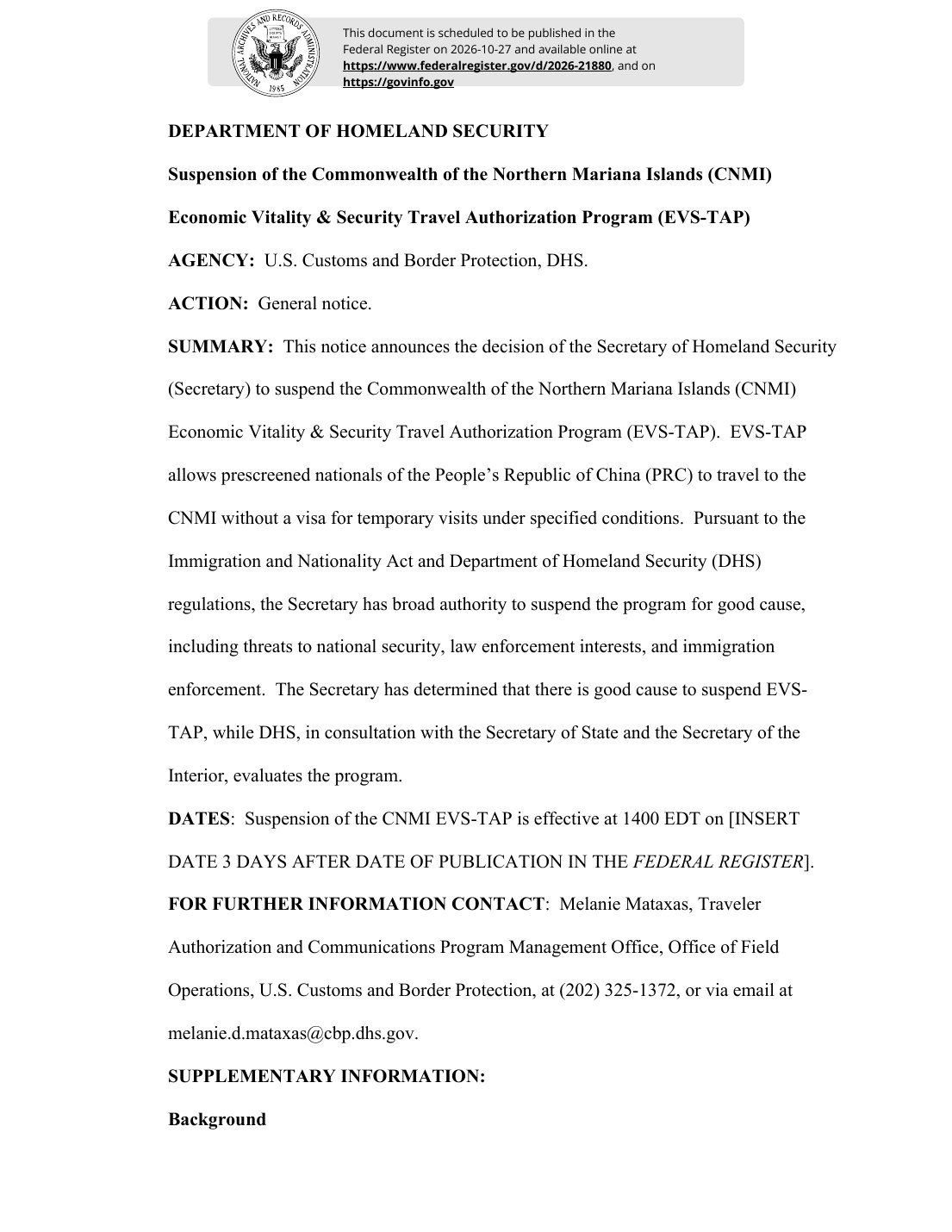
Static capture of page 1 · read the full notice (PDF) · Federal Register entry
The word that matters is "suspend." The same sentence says DHS is still evaluating the program. Del. Kimberlyn King-Hinds told Public Radio Guam it was "suspended, not terminated," according to that report. The notice sets no end date and no list of conditions for coming back.
What evidence does DHS put on the table?
One number: "more than 3,000" Chinese nationals used EVS-TAP in fiscal 2025, a figure the notice sources to CBP's internal arrival data pulled in October 2025. The program only took effect Feb. 20, 2025, so that count covers roughly the last seven months of the fiscal year. The notice does not say how many of those visitors overstayed or were flagged for anything.
On the threat, it uses careful language. The program "may be exploited" for espionage and intelligence collection near sensitive defense sites. Birth tourism "may" be lowered in difficulty by reduced vetting. The sharpest line is a judgment, not a finding: "DHS judges that PRC nationals are almost certainly exploiting EVS-TAP."
Visitors are vetted by CBP rather than by State Department consular officers, and the notice treats that as a gap. It also points to a restored Tinian Air Base and Guam's military installations, where the notice says Chinese nationals could slip over by boat despite a ban on traveling beyond the CNMI.
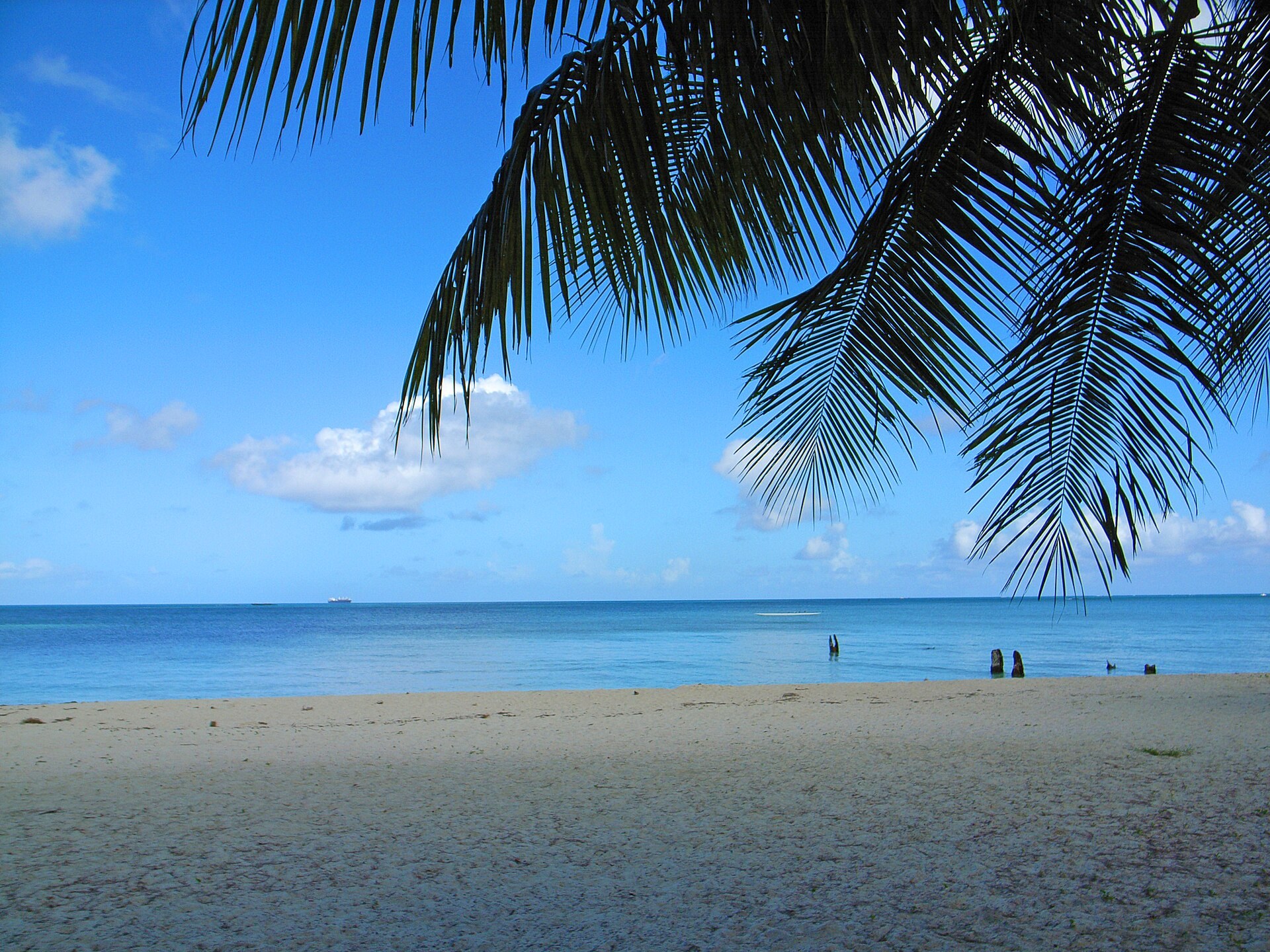
Micro Beach, Saipan, in the Northern Mariana Islands. Photo: tata_aka_T via Wikimedia Commons, CC BY 2.0.
Do the two smuggling cases involve the program being suspended?
No. The notice offers two Justice Department cases and says outright they came "prior to the implementation of EVS-TAP." In the March 2024 release, Kun Gao was sentenced to 30 days in prison for a July 2023 plan to ferry Chinese nationals from Saipan to Guam. By the release's account the boat ran out of fuel near Rota and the Coast Guard had to rescue the group.
The February 2025 release covers Kangle Jiang, who got 30 days for a Dec. 9, 2024 conspiracy to take himself and seven others to Guam. He had been in the CNMI since Oct. 31, 2024, and prosecutors said he used federal rules that let certain foreign nationals visit as tourists. That was under the old parole policy, which was still in force. EVS-TAP began Feb. 20, 2025. The notice adds that most of the people involved were later found at or near military installations. I could not confirm that detail in the DOJ pages I opened, so it rests on DHS's word.
Those cases are real, and they show the old approach leaked. They do not show EVS-TAP leaking. The notice names no spy prosecution and no EVS-TAP traveler charged with anything. It gives no count of births tied to the program. It also leans on the Saipan casino saga, a money-laundering and labor-abuse story that ended in 2020 racketeering indictments of the casino operator's executives.
Who pushed for this, and who pays for it?
Republicans had been asking. The Epoch Times reported that Reps. Chip Roy and Tom Tiffany flagged possible birth-tourism misuse in March, and that Sens. Mike Lee, Rick Scott, John Cornyn and Bill Cassidy called for ending the program in April. Lee and Roy welcomed Tuesday's move. I could not open their posts and am relying on that account.
The notice concedes that businesses "may have developed business plans" around this travel and answers that security outweighs it. King-Hinds called tourism "already facing tremendous challenges," by Public Radio Guam's account, and said Mullin promised to work with the CNMI on the underlying concerns.
So the strongest reading is that DHS has used a statutory lever, Section 212(l)(5) of the Immigration and Nationality Act, to hit pause while it studies a program it already distrusts. The weaker reading, the one the headlines about spies and "birth tourism" invite, is that the government has caught EVS-TAP in the act. On the page, it has not.
Header photo: Saipan, Northern Mariana Islands. Photo: Vincent Camacho (via Unsplash) on Wikimedia Commons, CC0. Cropped.