

The White House said Sunday that "gas and diesel prices will soon drop rapidly." The government's own forecast has regular gasoline at $4.28 now and under $3.60 only on average in 2027. The release's most surprising number, a 400% jump in Venezuelan oil, does check out.
What did the White House actually claim?
The Oct. 25 release, "President Trump Secures Major Deals to Unleash American Energy and Cut Gas Prices at the Pump," opens with that sentence and then lists the evidence: record oil and natural gas output, a Venezuela deal, an October diesel order, more than 130 million barrels of diesel released from other countries' stockpiles, EPA fuel waivers, a Jones Act waiver and a record number of small refinery exemptions.
It also says "the amount of Venezuelan oil coming into the U.S. has increased by over 400% and reached its highest in almost a decade." The release gives no baseline and no source for any figure. I could not find an independent record of the 130 million barrel pledge, so I am leaving that one unchecked.
Official record
White House release, Oct. 25, 2026, and the U.S. Energy Information Administration's Short-Term Energy Outlook, released Oct. 6, 2026.
"Gas and diesel prices will soon drop rapidly thanks to President Donald J. Trump's bold actions to unleash American Energy." — White House, Oct. 25
"We expect retail diesel prices to average about $4.50/gal next year and for gasoline prices to average just under $3.60/gal." — EIA, Short-Term Energy Outlook
Is the Venezuela oil surge real?
Yes. EIA's monthly series for U.S. imports of crude and products from Venezuela shows 795,000 barrels a day in July, the latest month published. The 2025 monthly average was about 147,000, so July is roughly 440% above it. The release does not say which baseline it used, but that one fits.
"Highest in almost a decade" fits too. The last month that came in at or above 795,000 was April 2017, at 857,000. The same table shows a low of 7,000 barrels a day in July 2025, so the starting point matters a great deal. Measured from February of this year (293,000), the rise is about 170%. EIA's next monthly update is scheduled for Oct. 30.
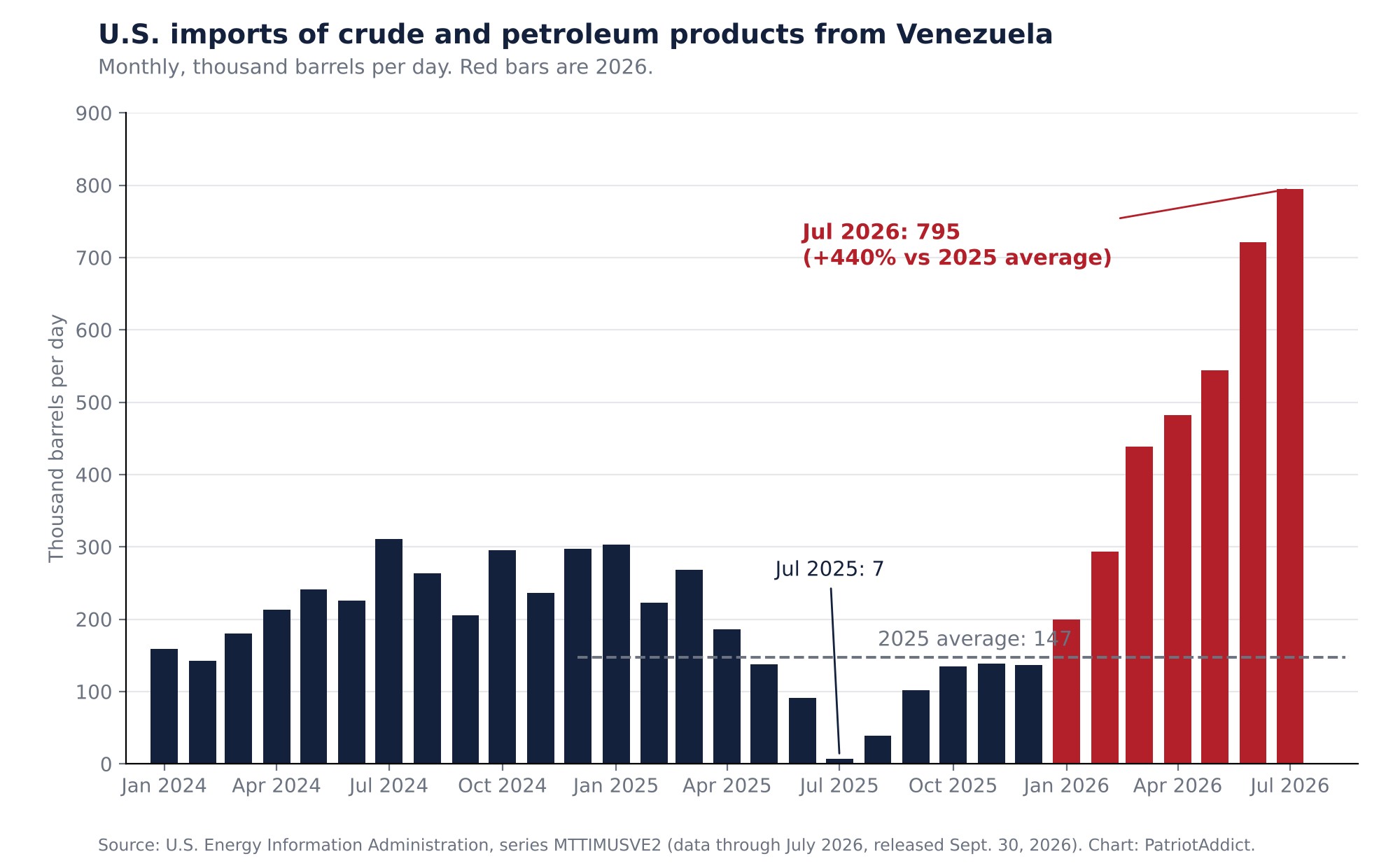
Monthly U.S. imports of crude and petroleum products from Venezuela. Chart built by PatriotAddict from EIA data (public domain U.S. government data).
Where is the pump price right now?
On Oct. 19, EIA's weekly survey had regular gasoline at $4.284 a gallon, down from $4.478 on Sept. 21 but $1.27 above the $3.019 of a year earlier. Its diesel series was $6.276, against $3.620 a year ago. The next weekly update is due today.
Gas has dipped before. It fell from $4.50 in May to $3.78 in early July, then climbed back. A drop is not the same as the "rapid" decline the release promises.
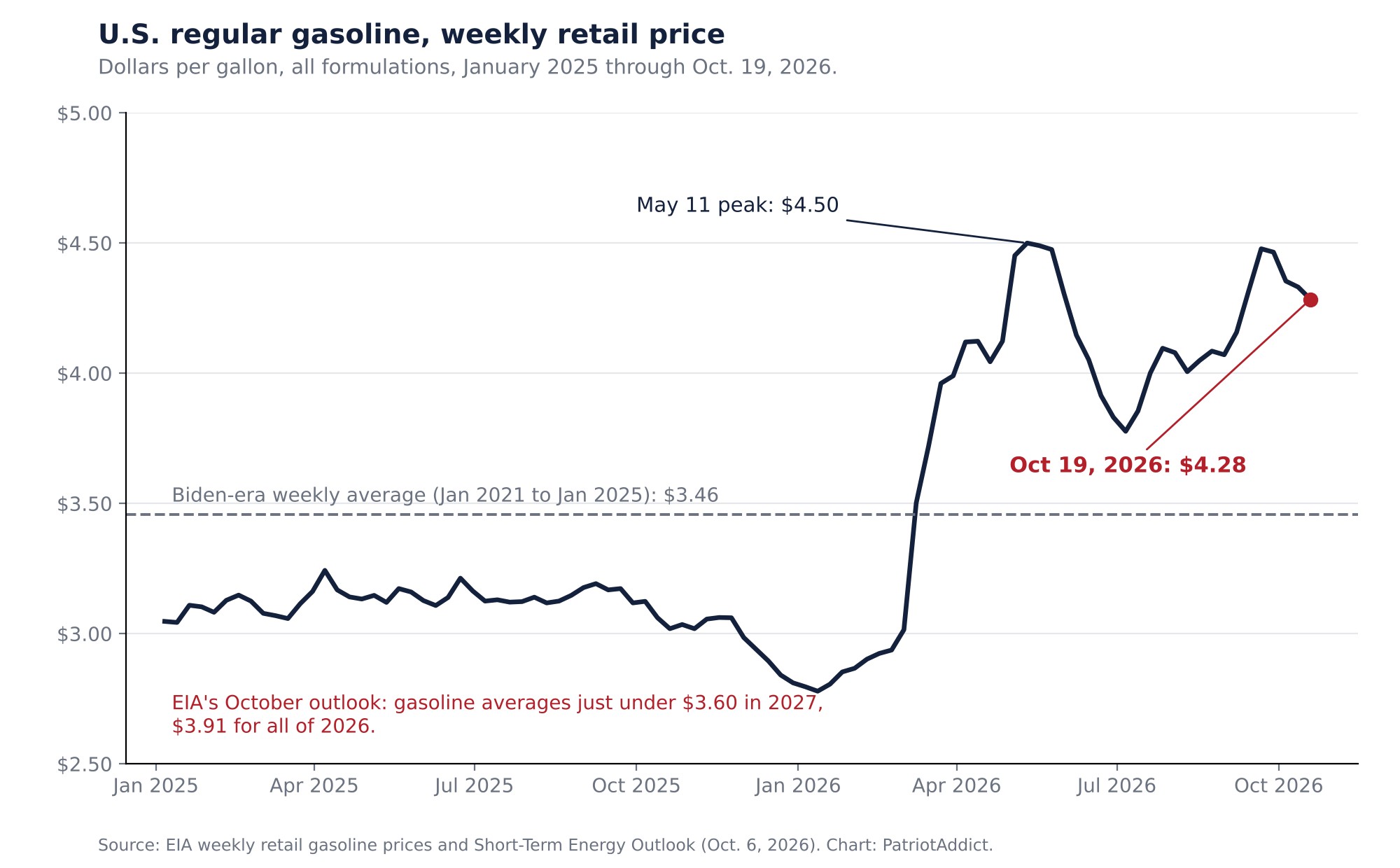
Weekly U.S. regular gasoline prices, January 2025 to Oct. 19, 2026. Chart built by PatriotAddict from EIA data (public domain U.S. government data).
What does the government's own forecast say about "soon"?
The October Short-Term Energy Outlook raised its fourth-quarter Brent crude forecast to $105 a barrel, "$14/b higher than in last month's STEO." It says September gasoline averaged $4.35 and diesel $6.29. The relief arrives next year: Brent at $84, gasoline just under $3.60 and diesel about $4.50.
EIA also expects the Strait of Hormuz picture to improve, with Middle East output and flows "generally increasing through the forecast period," which backs part of the release. But it cites attacks on a Saudi pipeline and "extreme tightness in diesel markets" as reasons for upward pressure now. EIA's table has U.S. crude output at 13.9 million barrels a day in 2026, up from 13.7 million in 2025 and headed to 14.3 million in 2027. I did not check the monthly production record the release claims.
How does this compare with the Biden years?
Bloomberg's Oct. 26 headline says Trump's gasoline prices have overtaken the Biden era ahead of the midterms. I could not open the article, so I cannot say what window it used. From EIA's weekly series, I calculated an average of $3.46 for the Biden term and $3.45 for Trump's second term so far. That second-term figure includes a cheap 2025 (about $3.10). Prices for 2026 alone average $3.86, and the current $4.28 sits 83 cents above the Biden-era average.
That is the number voters see at the pump, and it is why "soon" carries the weight in the White House sentence. The measures it lists may well pull prices down. EIA's forecast says the full effect lands in 2027, which is after the Nov. 3 election.
Header photo: a fuel pump display showing a $67.67 sale for 14.10 gallons in Petaluma, California, February 2026. Photo: Missvain via Wikimedia Commons, CC0. Cropped.















