

A split Ninth Circuit panel threw out the Justice Department's emergency appeal to make California set aside more than 20,000 mail ballots from alleged noncitizens. The 91-page order never rules on whether the list is accurate, and it says the government's emergency was "at least in part, a self-constructed one."
What did the court actually decide?
Jurisdiction, and only jurisdiction. In the per curiam order in No. 26-7070, filed Oct. 26, the panel says the United States "failed to allow the district court adequate opportunity to consider its application for a Temporary Restraining Order. For that reason, we lack jurisdiction over this appeal." It granted Los Angeles County's motion to dismiss and denied DOJ's emergency motion as moot. CBS News reported the dismissal Monday evening.
DOJ had asked for two things: that California "set aside vote-by-mail ballots from persons identified by the Federal Government likely to be noncitizens," and that officials verify citizenship before counting them. Nothing in the per curiam says either request is wrong. It says the appeal was filed too early.
Official record
United States v. State of California, No. 26-7070 (9th Cir. Oct. 26, 2026), on appeal from No. 2:26-cv-12025 (C.D. Cal.).
"The United States's claimed emergency, at least in part, is a self-constructed one." — Ninth Circuit per curiam order, page 15
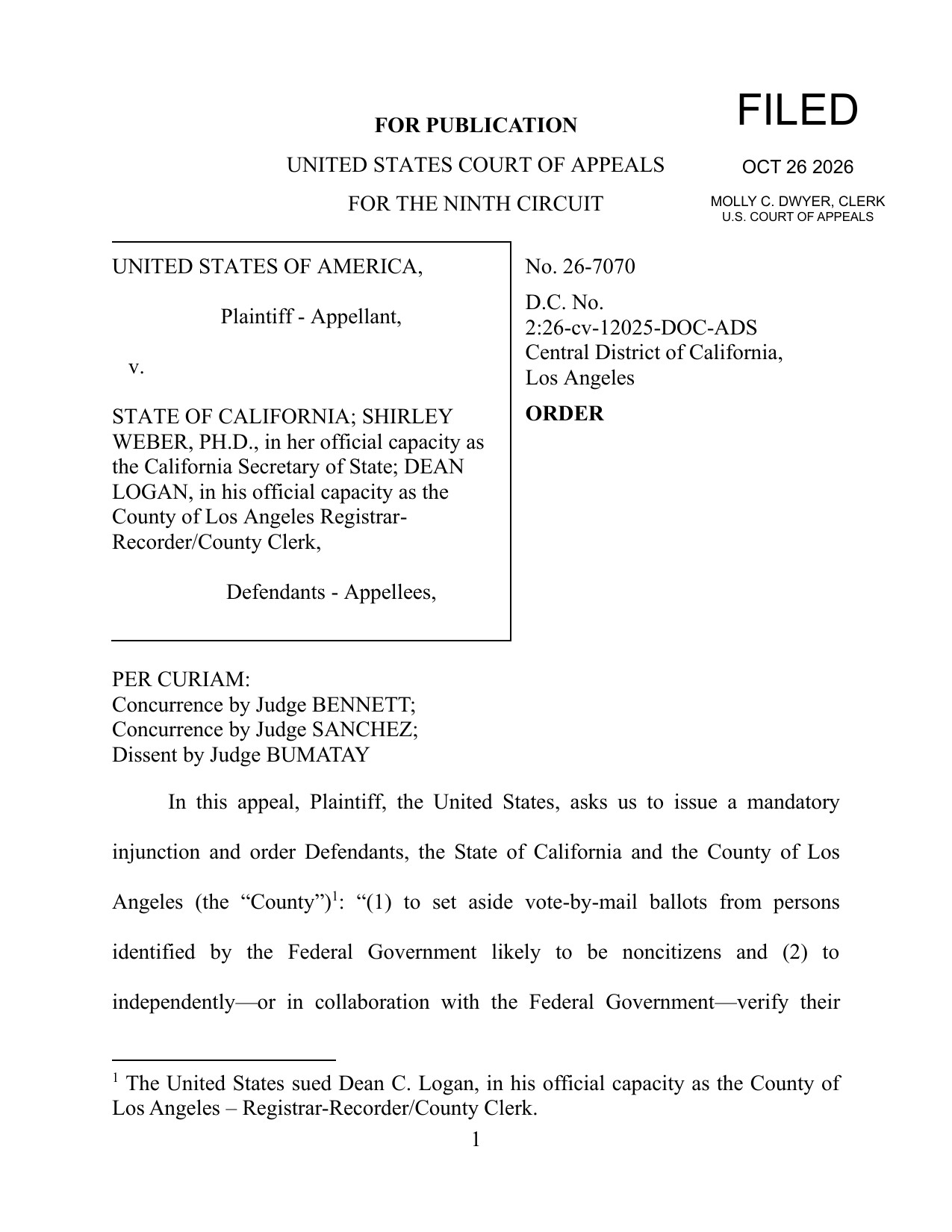
Static capture of page 1 · read the full 91-page order (PDF) · court's copy
Why does the panel call the emergency "self-constructed"?
Because of DOJ's own calendar. The order says the government first wrote to California in July, sent its 20,000-name list on Oct. 13, sued on Oct. 15, and filed a complaint that "said nothing about irreparable harm" and requested no deadline. On Oct. 19 and again on Oct. 21 it asked for a ruling "by November 3, 2026." The district court set a hearing for Oct. 27, a week ahead of that date.
Then, at 8:57 PM on Oct. 21, DOJ asked for a ruling by noon the next day. When none came, it appealed. The panel counted about 15 hours, most of them overnight, and said the Supreme Court's A.A.R.P. v. Trump "constructive denial" precedent involved detainees being loaded on buses, not ballots being counted on a schedule California law has long set.
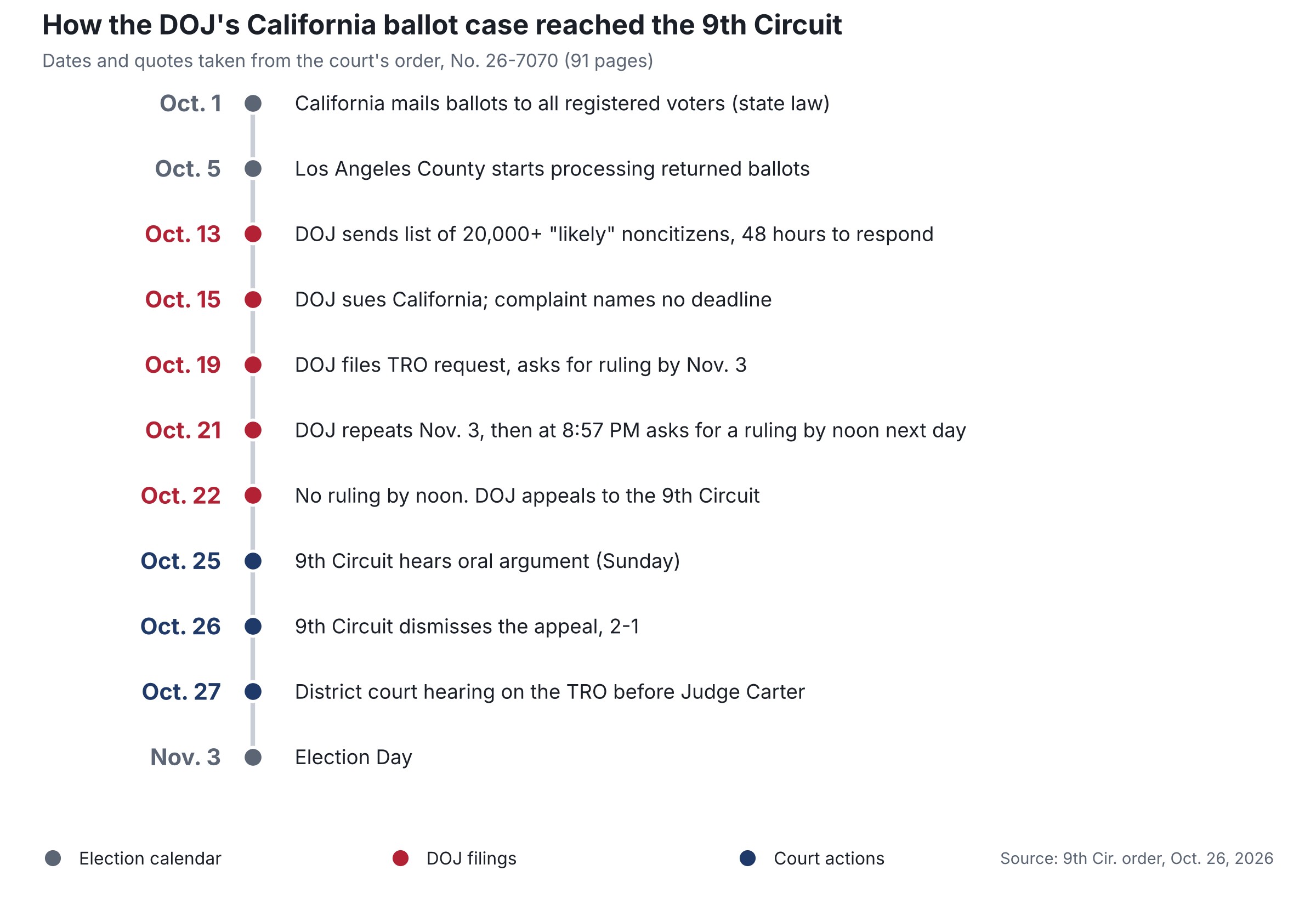
Timeline built from the dates in the Ninth Circuit's order, No. 26-7070. Chart: PatriotAddict.
Is the 20,000-name list accurate?
Nobody has decided. Judge Bennett's concurrence says there is "conflicting evidence about whether the October List accurately identifies noncitizens" and "no factual findings by the district court." In a footnote he notes that the defendants' sample of 200 records from the list showed that "among the records for which birthplace information was meaningfully reported, 38.9% indicated that they were born in the United States." That is California's sample, it is contested, and the court did not adopt it. It is the only accuracy figure in the order.
The numbers moved, too. Judge Sanchez's concurrence quotes DHS Secretary Markwayne Mullin's July 16 letter saying "as many as 190,832 non-citizens" may be registered in California. The list DOJ gave Los Angeles County in October ran to just over 20,000. The order says California Secretary of State Shirley Weber asked DHS in July for its data source and matching method and "Nothing more was heard from DHS." Bumatay's dissent tells it differently: it says Weber's July 23 reply did not offer to verify anyone and that she declined a follow-up call.
What did the three judges say beyond the dismissal?
Judge Mark Bennett, a Trump appointee, wrote that even with jurisdiction he would deny the motion. His reasoning is the part that matters for November: 18 U.S.C. 611 "makes it a crime for a noncitizen to vote," but he found "nothing in the text of 611 that preempts the states' primary authority in election administration." He added that if DOJ wants more verification for mail ballots, "the appropriate audience for that suggestion" is Congress. A concurrence is not the holding, and Bennett wrote that time constraints limited him to the issues he thought dispositive.
Judge Gabriel Sanchez, a Biden appointee, added that the Purcell principle, which discourages court-ordered changes close to an election, would bar the injunction anyway. Judge Patrick Bumatay, also a Trump appointee, dissented. He wrote that the court had jurisdiction and "should've granted the federal government relief," arguing that California is mixing "legal and likely illegal ballots" together. As the Daily Beast noted, the majority included a Trump pick, so this was not a party-line split.
Can California even sort these ballots before it certifies?
The county told the court it could not. Per the order, a Los Angeles County IT official declared that segregating ballots would need new code across several systems that could not be "completed safely and uniformly before Election Day," and that the Registrar cannot verify citizenship before the Dec. 4 certification deadline. Bumatay counters that the county had already processed more than 331,000 ballots, which is the point of DOJ's urgency.
The case is not over. Judge David Carter in the Central District of California set a hearing on the TRO for today, Oct. 27, and told the parties he would "rule promptly." RedState reports the hearing is at 1 PM Pacific. If DOJ has evidence the list is clean, a district judge is where it has to show it.
Header photo: The James R. Browning U.S. Court of Appeals Building in San Francisco, home of the Ninth Circuit. Photo: Carol M. Highsmith, Library of Congress, no known restrictions on publication. Cropped.















