

President Trump said Sunday that Task Force Iron Gate is "in full force and effect" and that "very little gets into, or out of, Iran." The CENTCOM release that created it, dated Nov. 7, describes an internal staff of about 20 civilian and military personnel in Tampa, Florida, that "will coordinate" with other agencies.
What did Trump say, and what did CENTCOM publish?
Trump's post on Truth Social ran at 3:46 p.m. Eastern on Sunday, per the Trump's Truth archive. It ties the task force to what he calls the greatest naval blockade in history. Al Jazeera quotes the line as "Very little gets into, or out of, Iran!"
CENTCOM's own wording is smaller. Adm. Brad Cooper ordered a team to support "ongoing U.S. government efforts to prevent Iran from using ground routes to transport advanced weapons and other materials." Cooper said the task force "reinforces the success of our ironclad blockade against Iran at sea," per Townhall's copy of the release.
Official record
CENTCOM public release, "CENTCOM Launches Task Force to Disrupt Iranian Ground Transit Routes Supporting Illegal Shipments," Nov. 7, 2026. CENTCOM's site refused my automated request, so the wording below is the release text as reproduced by RedState.
"Adm. Brad Cooper has directed the formation of Task Force Iron Gate, an internal staff of approximately 20 civilian and military personnel based in Tampa, Florida." — CENTCOM release, Nov. 7
Read the release on CENTCOM's website.
What does a 20-person staff actually do?
The release says the team will coordinate with other U.S. agencies on stopping "advanced weapons systems, dual-use technologies, sanctioned materials, and illegal revenue streams" across Iran's land borders and the Caspian Sea. It names no ships and no new legal authority. Stars and Stripes reports CENTCOM did not say how the team would disrupt shipments on those routes or whether it would work directly with the governments along Iran's borders.
Iran has seven land neighbors, according to Al Jazeera: Afghanistan, Armenia, Azerbaijan, Iraq, Pakistan, Turkey and Turkmenistan. Andreas Krieg of King's College London told Al Jazeera that "twenty people" cannot police thousands of kilometers of frontier, and that a realistic goal is making Iran's purchasing slower and more expensive. Michael Mulroy, a former Pentagon Middle East official, described the aim as finding where weapons enter Iran and how its energy exports move.
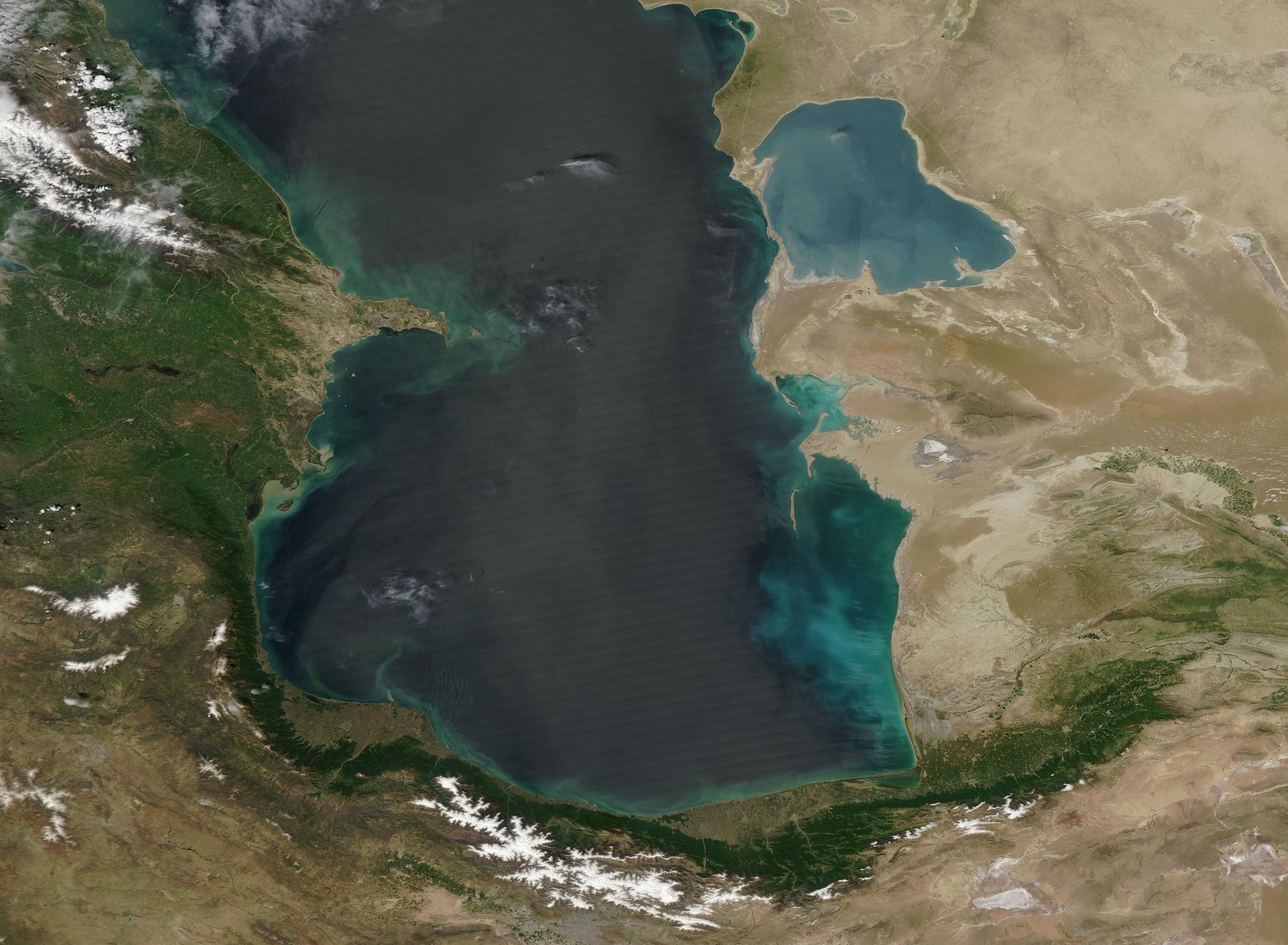
The Caspian Sea from orbit, with Iran's northern coast along the bottom of the frame. NASA MODIS image by Jeff Schmaltz, April 2016, via Wikimedia Commons (public domain).
Why the Caspian and Pakistan?
A June 23 CSIS assessment explains the target. It says Pakistan reportedly authorized re-exports to Iran through its ports and territory as of April 25, giving Iran a land route that does not depend on Gulf shipping. It calls the Caspian "a closed sea governed by its five littoral states," and says routes across it to Iran's northern ports are attractive because they bypass the Persian Gulf.
The same report names China as the most likely first-resort supplier for machine tools, drone components, marine engines and salvage equipment. It adds that pressure on Beijing could push trade through more intermediaries, which makes supply harder to trace but also slower and costlier. Nothing in the CENTCOM release mentions China, Russia or any specific country.
Is Iran actually sealed off?
Nothing I opened measures that. The strongest number in circulation is CENTCOM's own: Cooper said on Oct. 16 that naval operations cost Iran "$25 billion in crude oil export revenue," per a Ground News summary that does not say how it was calculated. That figure covers sea exports. It says nothing about what moves by truck or across the Caspian, and the new task force exists because those routes are open enough to worry about. The IRGC called the plan "just a play on words," Al Jazeera reports, which is propaganda from an adversary and proves nothing either way.
Does this help or hurt the talks?
That is the live fight inside the administration. The Wall Street Journal, as summarized by Just Security, reports that Vice President Vance and envoy Witkoff want diplomacy to end the war and reopen the Strait of Hormuz, while Defense Secretary Hegseth and Cooper favor a return to major combat. Rubio and Treasury Secretary Bessent want tighter sanctions and a continued blockade. Trump told CNN new attacks were "highly unlikely" while talks progress, and Qatar's prime minister was due at the White House Monday.
Joe Kent, a former counterterrorism official who resigned in March, argues the task force lets CENTCOM undercut Vance's diplomacy, per Al Jazeera. I could not confirm that from the release, which frames the team as support for the existing blockade. The record shows a small staff, a presidential post that describes it as already working, and no public detail on what it has done in three days.
Header photo: Adm. Brad Cooper, commander of U.S. Central Command (left), during a visit to Bahrain. U.S. Navy photo by Senior Chief Petty Officer Amanda Dunford, via Wikimedia Commons (public domain).















