

A federal judge in Maryland dismissed the Justice Department's lawsuit against Montgomery County's 100-yard gun-free buffer law on Monday, and gun-news headlines are calling it a "lifeline" for the county. The 33-page opinion never decides whether the law violates the Second Amendment. It rules that DOJ used a statute written for police misconduct, and the judge wrote that DOJ's reading would be a "breathtakingly broad expansion of federal power."
What did DOJ sue over?
The county enacted Expedited Bill 23-26 on July 27, and DOJ filed suit on August 3. The DOJ press release says the law bars law-abiding residents from carrying firearms at thousands of locations with a 100-yard exclusion zone around each one, even for people with a carry license and the property owner's consent. It argues the law conflicts with the Supreme Court's decision in Wolford v. Lopez.
The opinion, in United States v. Montgomery County, No. 26-3025-TDC, quotes the code section. In or within 100 yards of a "place of public assembly," a person may not possess or transport a handgun, rifle, shotgun or ammunition. The definition covers parks, places of worship, schools, libraries, recreational facilities, government buildings open to the public, polling places, courthouses and legislatures.
Official record
Memorandum Opinion, Judge Theodore D. Chuang, U.S. District Court for the District of Maryland, filed Nov. 9, 2026 (ECF No. 39, 33 pages). The conclusion is on pages 32 and 33.
"The Court therefore need not and will not address the remaining Winter factors or the arguments relating to the constitutionality of Bill 23-26E." (Opinion, p. 33)
Read the full opinion (PDF) on CourtListener.
Which statute did DOJ use, and why did it fail?
DOJ sued under 34 U.S.C. 12601, which makes it unlawful for a government to engage in "a pattern or practice of conduct by law enforcement officers" that deprives people of constitutional rights. Judge Chuang wrote that the complaint alleges no actual conduct by any officer. He found no record of enforcement of Bill 23-26E, of the 2022 version of the law, or of earlier county restrictions.
DOJ argued that an unconstitutional law that officers could enforce is itself the pattern. The judge rejected that, noting the bill "contains no language directing Defendants or any law enforcement officers" to do anything. It restricts private conduct. He also read the statute's placement under a "Police Pattern or Practice" heading, and its legislative history, as aimed at problems like excessive force.
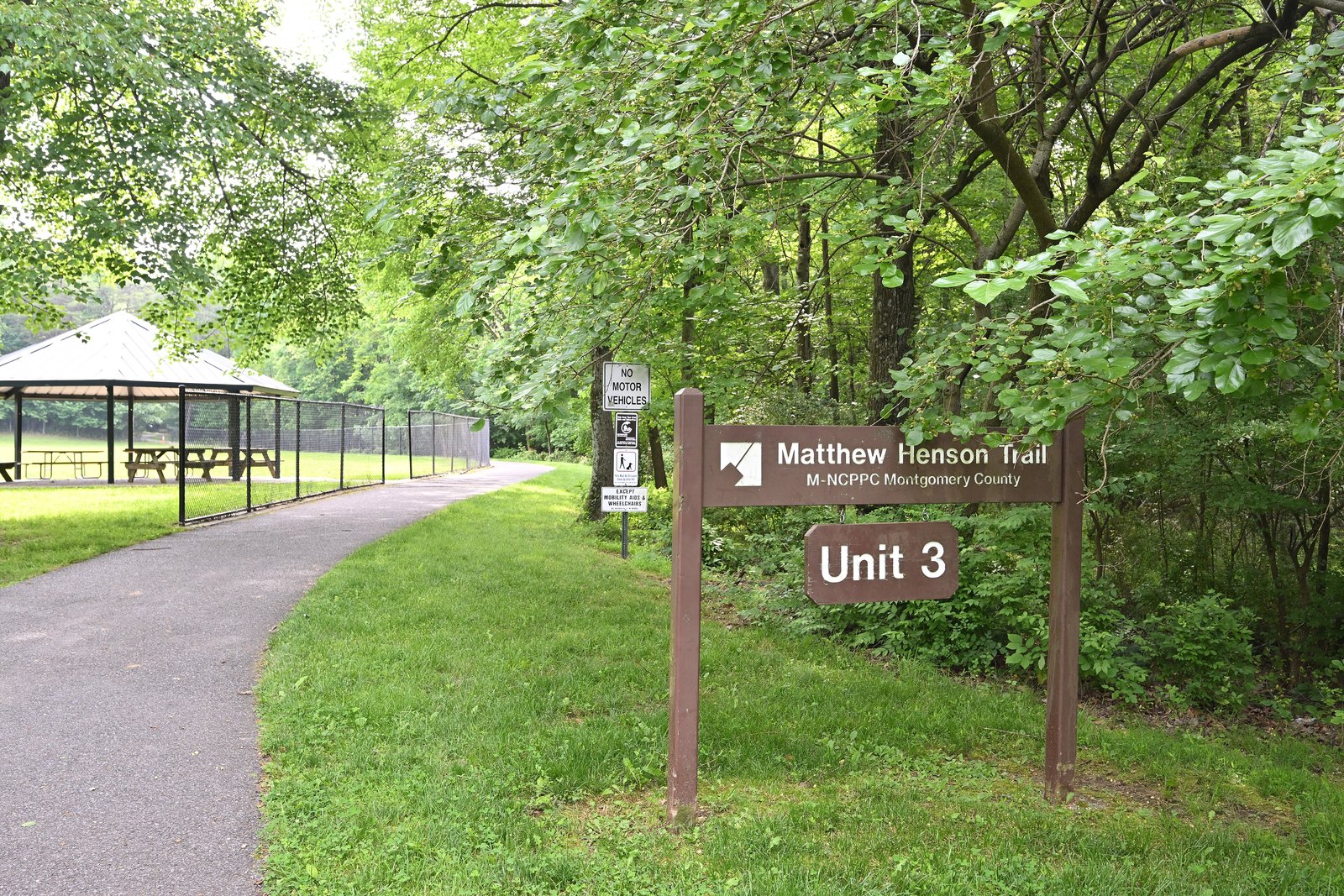
Parks are on the county's list of covered places. This is the Matthew Henson Trail in Silver Spring, a Montgomery Parks site. Photo by G. Edward Johnson via Wikimedia Commons (CC BY 4.0).
What did the judge say about DOJ's own record?
According to the opinion, when the court asked at the October 1 hearing for any case where 12601 was used to attack a law with no police misconduct, DOJ's lawyer acknowledged that "they don't have anything." The opinion also says a DOJ report on its own pattern-or-practice cases from 1994 to 2017 shows it never brought such a challenge.
It is not the first loss on this theory. The opinion cites a July 9 ruling in United States v. California, a Central District of California case over that state's firearms law, which also found no historical precedent for using 12601 this way. The Reload reported that the judge there denied DOJ's request for an immediate block.
Does the ruling say the county's law is constitutional?
No. The judge granted the county's motion to dismiss and denied DOJ's request for a preliminary injunction, and said he would not reach the Second Amendment arguments. The only comment on the merits is a passing one: the bill "almost certainly has some constitutional applications," such as schools, government buildings, courthouses and legislative assemblies. He also noted the bill narrowed the earlier county law, dropping hospitals, health centers, childcare facilities and protest gatherings after a Maryland Supreme Court decision.
Bearing Arms reports the dismissal was with prejudice. The opinion says "a separate Order shall be issued," and I could not open that order, so check it before relying on that detail.
What happens next?
DOJ can appeal to the Fourth Circuit. WJLA reports County Executive Marc Elrich called the ruling "an important affirmation of the County's responsibility to protect public safety," and that Rabbi Menashe Shapiro of the Silver Spring Jewish Center has a separate suit pending before a different judge. That private case can still test the law on the Second Amendment. This one never did.
What the record settles
It settles that DOJ picked the wrong tool, twice now. For gun owners, the useful lesson is that a federal suit built on a police-misconduct statute was always going to be a weak vehicle, and the people who can actually challenge the 100-yard zones are the ones with their own plaintiffs and their own standing. Whether Montgomery County's buffer zones survive the Second Amendment is still undecided.
Header photo: Montgomery County Circuit Court in Rockville. The DOJ case was heard in the U.S. District Court for the District of Maryland, not here. Photo by Tony Webster via Wikimedia Commons (CC BY 2.0).















