A Biden-appointed federal judge in Florida ruled Thursday that Congress had no power to make noncitizen voting a federal crime, and threw out the case against a Jamaican national accused of voting in 2020. Read the full 31-page opinion, though, and the same judge spells out how Congress could write a federal ban that would survive. He also leaves the deportation law for illegal voters fully intact.
A Federal Judge Just Threw Out the Noncitizen Voting Ban in One Case
U.S. District Judge David S. Leibowitz of the Southern District of Florida signed the order on October 1 in United States v. Cox, No. 0:25-cr-60249. He granted the defense motion and dismissed the charge, holding that 18 U.S.C. 611 "is unconstitutional as applied to Cox," according to the opinion posted on GovInfo.
Prosecutors charged Chelsea Cox on October 22, 2025, with a single misdemeanor count for voting in Broward County on October 29, 2020, "fully aware that she was not a United States citizen." In separate court papers, prosecutors also accused her of overstaying a tourist visa more than 20 years ago and getting a Florida driver's license with a fraudulent U.S. Virgin Islands birth certificate, CBS News reported. Those are allegations, and the case never reached trial.
The Justice Department moved to appeal shortly after the ruling, per CBS. Reuters reported that the department has charged at least 60 people with noncitizen voting since President Trump returned to office, and that this appears to be the first time any federal court has found the law unconstitutional.
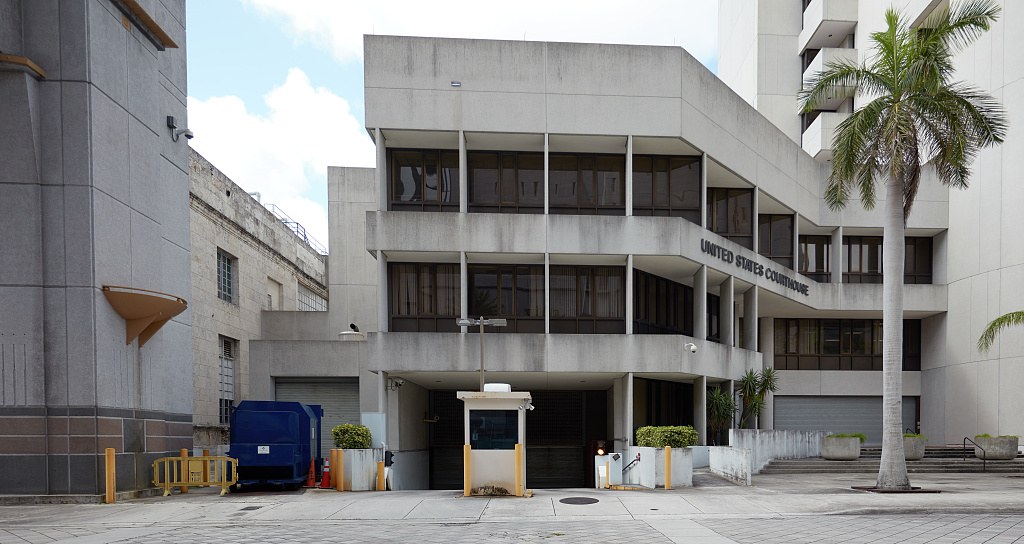
The C. Clyde Atkins U.S. Courthouse in Miami, one of the federal courthouses of the Southern District of Florida. (Carol M. Highsmith Archive, Library of Congress, no known restrictions)
The Judge Says Only States Can Decide Who Votes
Leibowitz's reasoning rests on three parts of the Constitution. Article I says House voters "shall have the Qualifications requisite for Electors of the most numerous Branch of the State Legislature." The Seventeenth Amendment copies that rule for the Senate, and Article II leaves presidential electors to the states.
From that text he concludes that "Congress has no power to say who can vote or who cannot vote in federal elections." He leans on Justice Antonin Scalia's 2013 majority opinion in Arizona v. Inter Tribal Council, which said Congress may regulate "how federal elections are held, but not who may vote in them." He also quotes George Mason at the 1787 Convention warning that the power to set voter qualifications "would be a dangerous [one] in the hands of the [federal] Legislature."
The government's main defense was Oregon v. Mitchell, the 1970 case that let Congress lower the federal voting age to 18. Leibowitz called it "a single Supreme Court case that is very, very weak" and read it as covering voting age only.
Congress's Own Fine Print Sank the Statute
Section 611 was written into law by the 1996 Illegal Immigration Reform and Immigrant Responsibility Act, which President Bill Clinton signed on September 30, 1996, according to the U.S. Code's source credit. That makes the law 30 years old, though the opinion's first sentence calls it a "forty-year-old federal statute."
The fatal detail is an "unless" clause. It exempts noncitizens who vote in a state or local contest that a state allows, as long as that vote is kept separate from the federal races. Court-appointed amicus Paul Clement, solicitor general under President George W. Bush, called that clause "the most damning textual evidence of Congress' overambitious intent." Leibowitz agreed: in his reading, the clause proves Congress meant to bar noncitizens from federal races even in a state that chose to let them vote, which makes Section 611 a federal voter qualification.
Put plainly, the problem is drafting, not the goal. Every state already requires citizenship to vote, as Reuters noted, and the judge says so too.
Page 25 Hands Congress the Fix
This is the part most coverage skipped. On page 25, Leibowitz adopts Clement's sketch of a different statute, one that makes it a federal crime for a noncitizen to vote in a federal election "in violation of a voter qualification set by the states." The court agreed it would "be difficult to identify a constitutional flaw" in that law, and said it "appears to pass muster easily."
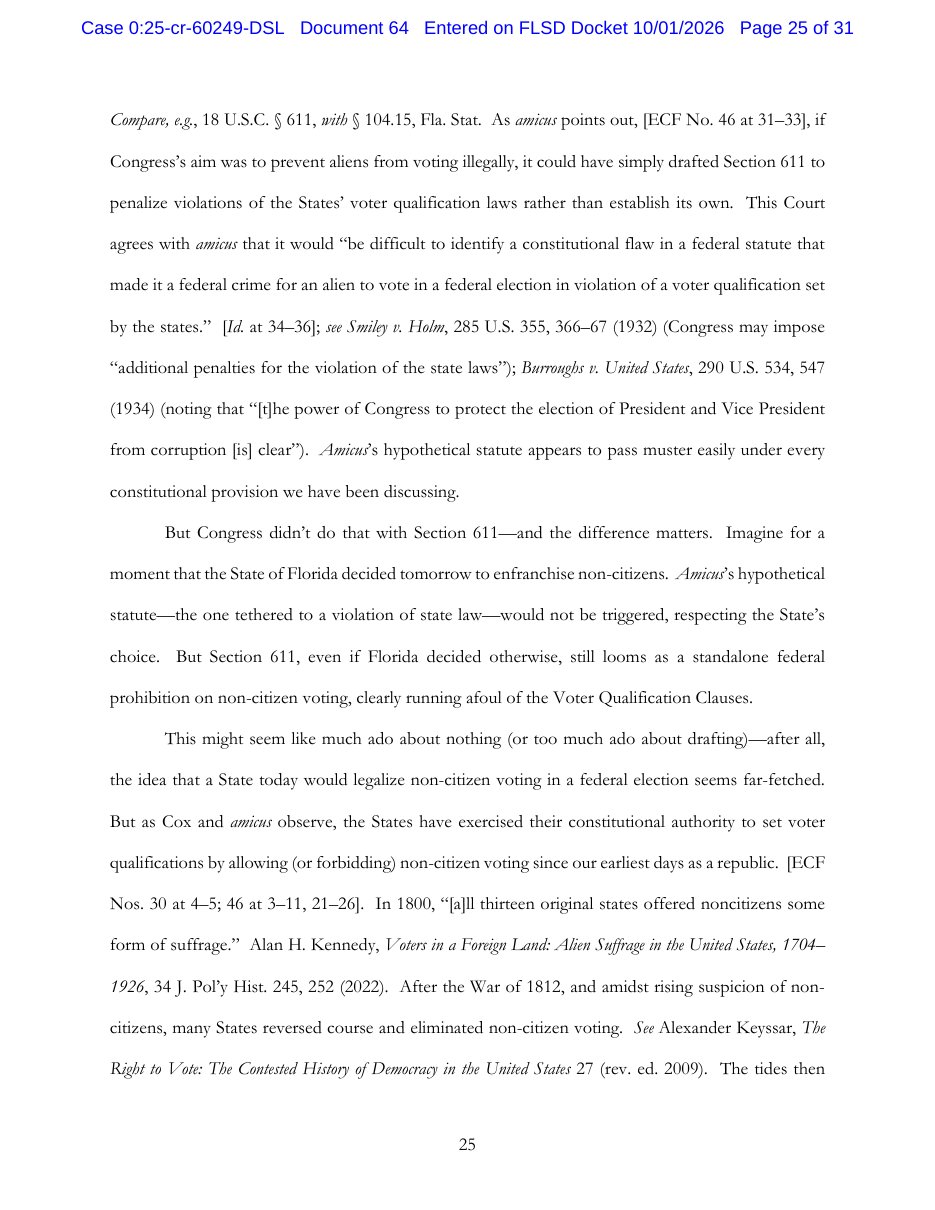
Page 25 of the October 1 opinion, where the court says a federal crime tied to state voter qualifications would be hard to fault. (U.S. District Court, Southern District of Florida, via GovInfo, public domain)
He repeats the point on page 30, calling such a statute "a very different kettle of fish." That is close to a one-sentence amendment. Congress could rewrite Section 611 to punish voting in violation of state citizenship rules, and every state's rules already require citizenship.
The ruling also leaves two other tools alone. Leibowitz notes that 8 U.S.C. 1182(a)(10)(D)(i) makes "any alien who has voted in violation of any Federal, State, or local" law inadmissible, and says that removal statute "rests on Congress's immigration power." In footnote 4 he also accepts that Section 611 still reaches federal elections in the District of Columbia, where Congress has full authority. That is why he ruled on Cox's case alone and declined to strike the law on its face.
Official record
United States v. Chelsea Michelle Ann Cox, No. 0:25-cr-60249 (S.D. Fla.), Memorandum Opinion and Order on Defendant's Motion to Dismiss the Information, signed October 1, 2026 (31 pages). GovInfo case page.
"Can the State of Florida prohibit and punish the exact conduct Defendant Cox allegedly engaged in here? This has already been decided elsewhere and is not addressed here: Florida can and does."
Judge David S. Leibowitz, page 29
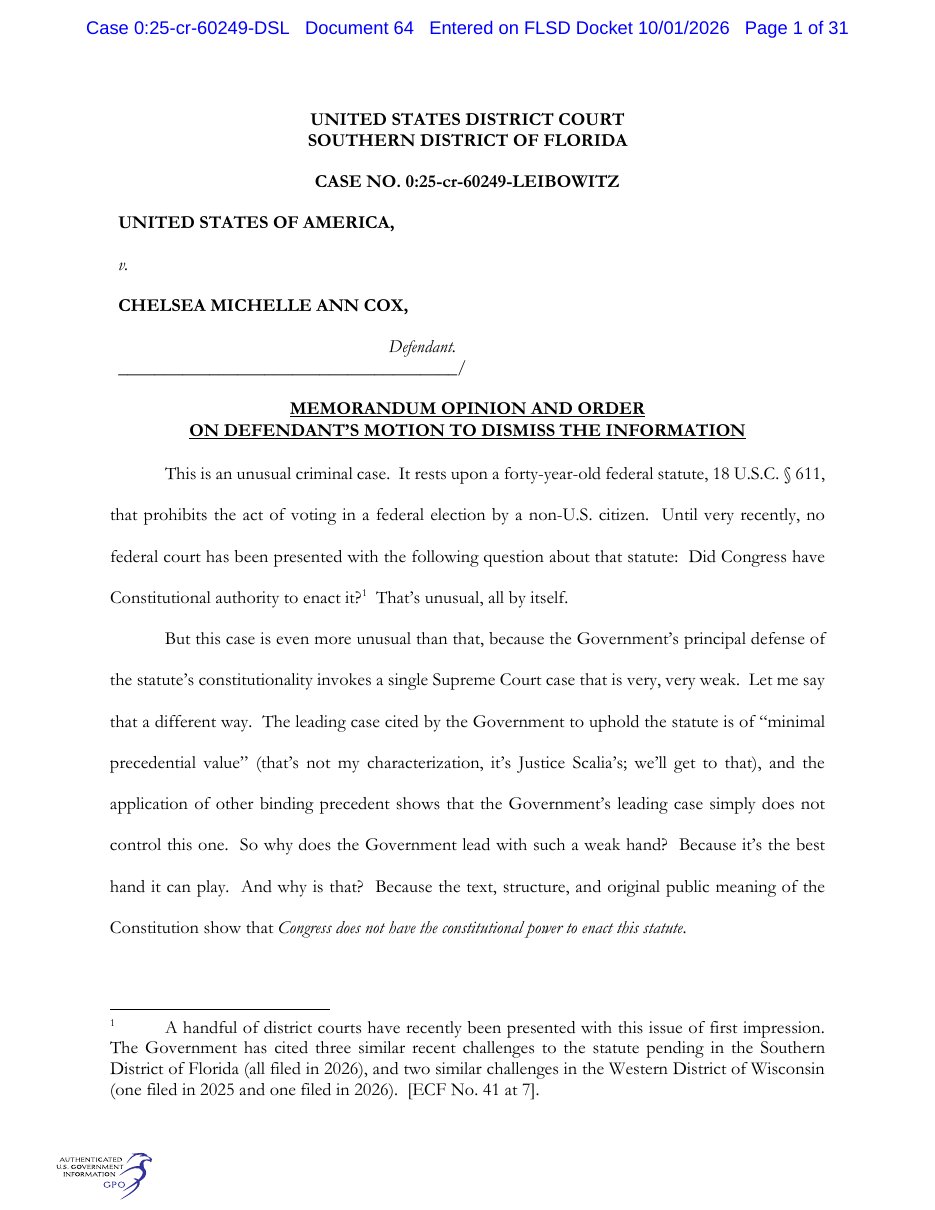
Read or download the full 31-page opinion (PDF) · official copy on GovInfo
Florida's Law Is Tougher, but Its Clock May Have Run Out
The judge's answer to "who prosecutes her, then?" is Florida. His footnote 22 quotes Florida Statute 104.15: anyone who, "knowing he or she is not a qualified elector, willfully votes at any election is guilty of a felony of the third degree." Under section 775.082, that carries up to five years in prison. The federal charge he dismissed was a misdemeanor capped at one year.
Timing is the catch. Florida's general limitations statute, section 775.15, says a prosecution for a third-degree felony "must be commenced within 3 years after it is committed." The 2020 vote is now almost six years old. The statute has some extensions, and prosecutors alleged Cox voted in other federal elections going back to 2012, so whether Florida can still charge her is an open question. We found no outlet that has asked it.
The federal case was close to the wire too. The general federal limit for non-capital crimes is five years under 18 U.S.C. 3282. The court's own background section dates the vote to October 29, 2020, and the charge to October 22, 2025. By our count, prosecutors filed with seven days to spare.
What Happens to the Other Noncitizen Voting Cases?
The ruling binds no other judge. Footnote 1 says the government itself cited three similar challenges pending in the Southern District of Florida, all filed in 2026, plus two in the Western District of Wisconsin. Miami defense lawyer David Oscar Markus wrote that another Section 611 case went to trial weeks ago before Judge Jacqueline Becerra and ended in an acquittal.
The appeal goes to the Eleventh Circuit, which has upheld Section 611 before, but only against due process and Fifth Amendment arguments, as the opinion's footnote 2 notes. No appeals court has ruled on whether Congress had the power to pass the law at all.
Why This Matters for the SAVE America Act
Stephen Richer, the former Republican recorder of Maricopa County, Arizona, now writing for Cato, argues the ruling will shadow the SAVE America Act, which would require documentary proof of citizenship to register for federal elections. He writes that supporters have a strong answer: checking proof of an existing state qualification is a rule about how elections run, which the Supreme Court has said Congress controls.
That is the bottom line. Leibowitz did not legalize noncitizen voting, and he said so in writing. He ruled that Congress wrote the 1996 ban the wrong way, then described the version that would hold up. With the midterms a month out, a rewrite tied to state citizenship rules is a bill Republicans could put on the floor and dare anyone to vote against.
Top photo: Page 1 of the United States Constitution, showing Article I, Section 2, which ties House voter qualifications to state law. (National Archives, public domain)