Justice Samuel Alito's first book, "So Ordered," went on sale Oct. 6 with a blunt warning: the Supreme Court's 2015 same-sex marriage ruling was "perhaps the decisive point in our nation's turn against religious liberty." The line that drew the most attention compares today's traditional believers to Catholics in England who were "found in corners, and alleys, and cellars." Those words are not Alito's. They come from an 1852 sermon by St. John Henry Newman, and that sermon is about a comeback, not a defeat.
What Is Actually in "So Ordered"?
The book is a collection of 19 lectures and speeches Alito delivered between 2007 and 2025, published by Basic Liberty, an imprint of Hachette, at 320 pages. Its chapters cover originalism, textualism, the role of judges, threats to the Constitution, baseball, the Gettysburg Address and religious liberty, according to a review by the Heritage Foundation's Cully Stimson in The Daily Signal.
Several of the religious-liberty speeches were never widely covered when they were given. ABC News reports that the "decisive point" line comes from a 2018 address at Catholic University of America that was not open to the public. Alito calls religious freedom his "pet issue," and he sat for a rare television interview with CBS News' Jan Crawford, aired Oct. 4, to promote the book.
Alito Says His 2015 Prediction Came True
In a 2022 speech to the Magnificat Foundation, now published in the book, Alito said, "Quite suddenly, religious liberty has become controversial." He pointed to cases involving businesses punished for declining to serve same-sex weddings and faith-based groups hit by health and employment rules with no religious exemption. "What we see in these and other cases," he said, "is a refusal to live in peace with those who violate the new moral code."
He also predicted that this dynamic will "virtually guarantee that the Supreme Court will continue to see a steady stream of religious-liberty cases." On that point, the current term already proves him right. The Court has agreed to hear an Ohio man's fight over prayer meetings in his own home and, as of Oct. 1, a Kentucky parish's bid to build a Marian shrine next to its church.
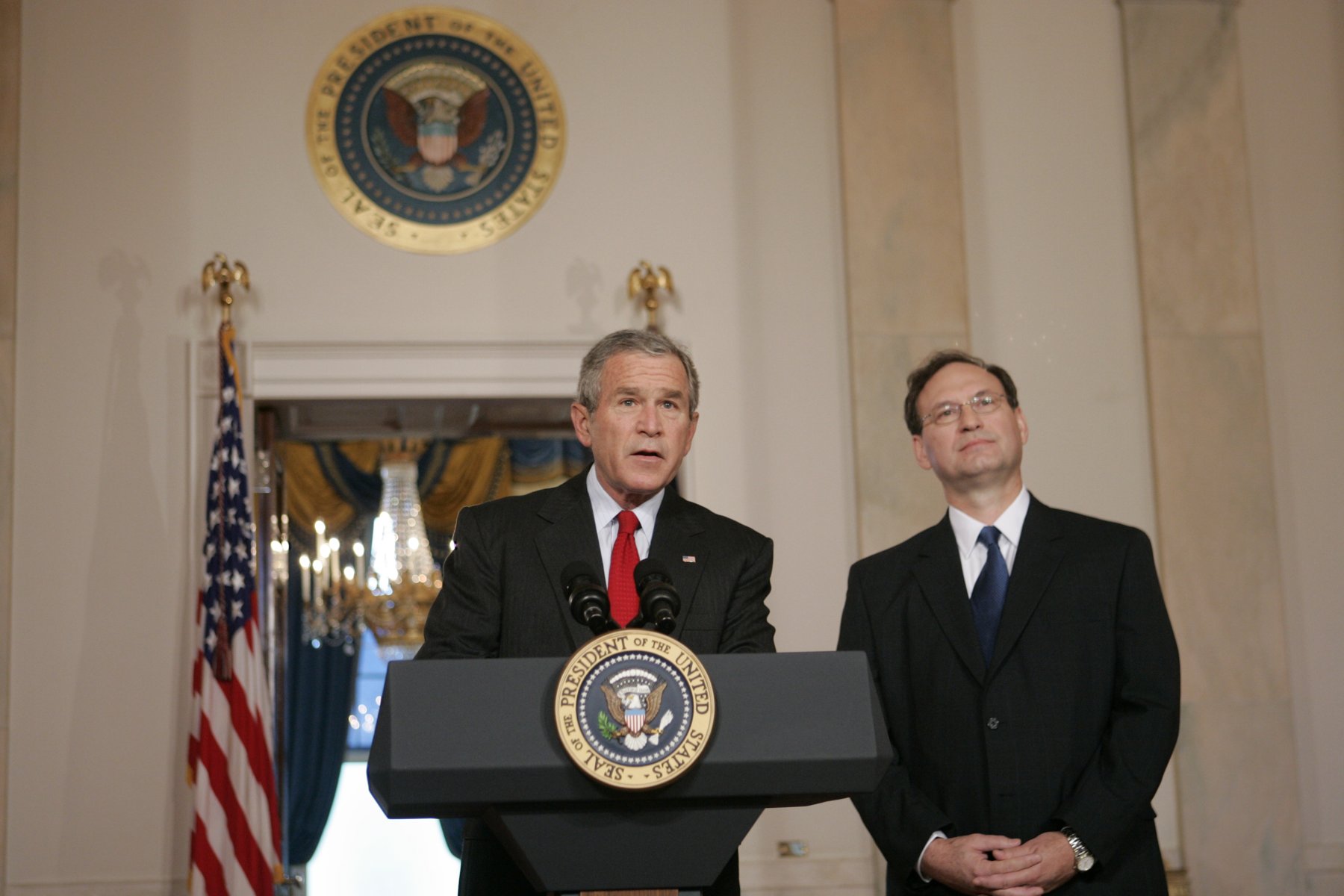
President George W. Bush announces Samuel Alito's nomination to the Supreme Court on Oct. 31, 2005. Alito has now served more than 20 years on the Court. (Photo: White House Photo Office, via National Archives and Wikimedia Commons, public domain)
"It says a lot," Alito said in a 2021 speech at Thomas Aquinas College, "that the parties whose free-exercise rights were violated had to take their claims all the way to our Court."
The Words From the Dissent Everyone Remembers
To understand why Alito ties so much to the marriage case, go back to the text of his dissent in Obergefell v. Hodges. Justice Anthony Kennedy's majority opinion tried to reassure religious Americans, writing that they "may continue to advocate with utmost, sincere conviction that, by divine precepts, same-sex marriage should not be condoned."
Alito did not buy it. "We will soon see whether this proves to be true," he wrote. Then came the sentence that is now quoted in nearly every story about the book.
Official record
Obergefell v. Hodges, 576 U.S. 644 (2015), Alito, J., dissenting, at page 741 of the official United States Reports (Library of Congress copy).
"I assume that those who cling to old beliefs will be able to whisper their thoughts in the recesses of their homes, but if they repeat those views in public, they will risk being labeled as bigots and treated as such by governments, employers, and schools."
Justice Samuel Alito, dissenting, June 26, 2015
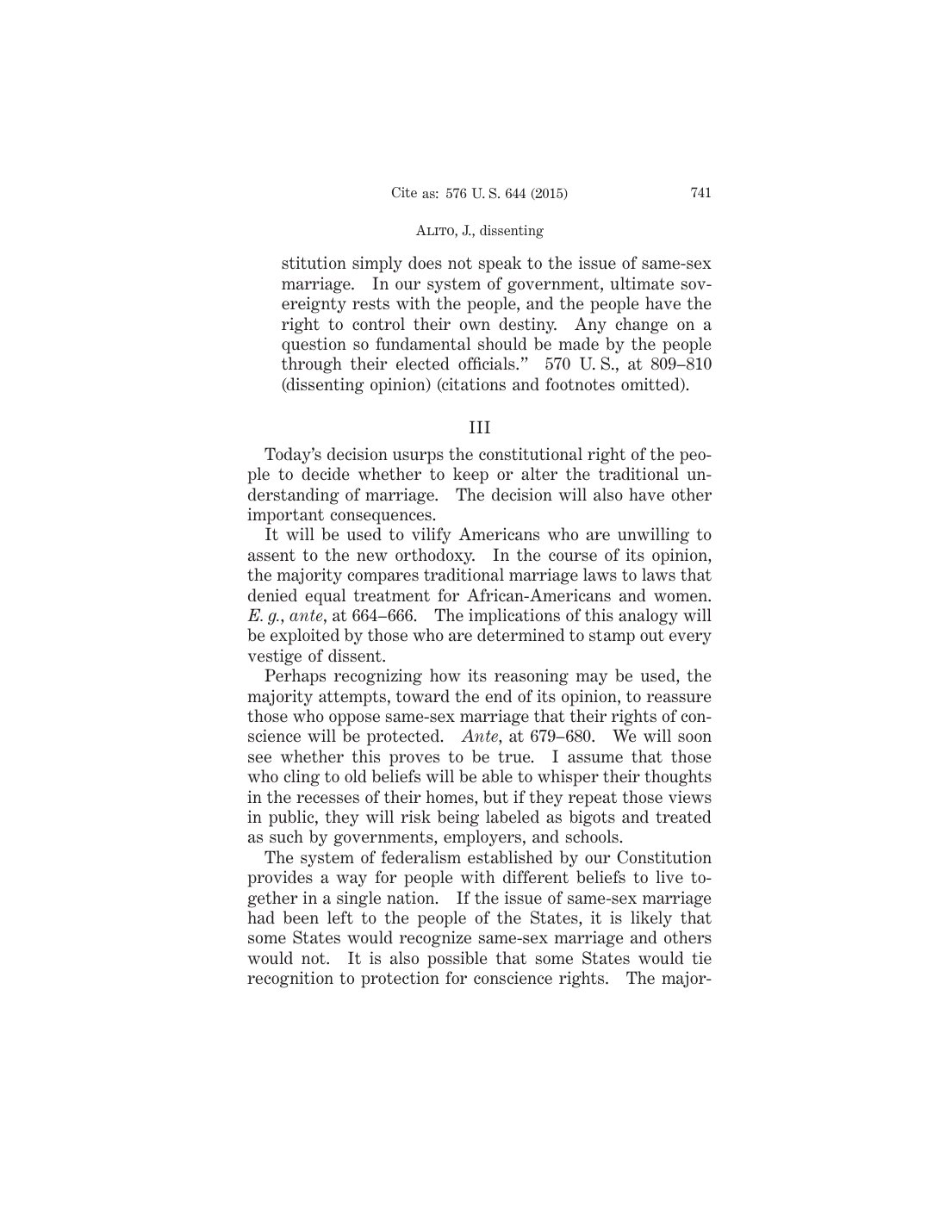
Read or download the full 99-page opinion (PDF) · official copy at the Library of Congress
Chief Justice John Roberts' own dissent in the same case, at pages 711 and 712, was even more specific. He warned that "hard questions" would arise when "a religious adoption agency declines to place children with same-sex married couples," and noted that the Obama administration's solicitor general "candidly acknowledged that the tax exemptions of some religious institutions would be in question." Six years later, the Court decided Fulton v. City of Philadelphia, a fight over a Catholic foster-care agency that looked a lot like what Roberts described.
The Source Behind the "Cellars" Line
The most vivid passage in the coverage comes from Alito's 2021 Thomas Aquinas College speech. ABC News reports that he compared opponents of same-sex marriage to English Catholics after the Reformation, who "had been so beaten down that they were 'a people who shunned the light of day.' They were 'found in corners, and alleys, and cellars, and the housetops, or in the recesses of the country.'"
The inner quotation marks show Alito was quoting someone, but ABC's report never says who. We checked. The words come word for word from "The Second Spring," a sermon John Henry Newman preached at the Synod of Oscott, near Birmingham, England, on July 13, 1852. In the printed 1852 edition, Newman wrote that the world called Catholics "a gens lucifuga, a people who shunned the light of day. Such were Catholics in England, found in corners, and alleys, and cellars, and the housetops, or in the recesses of the country."
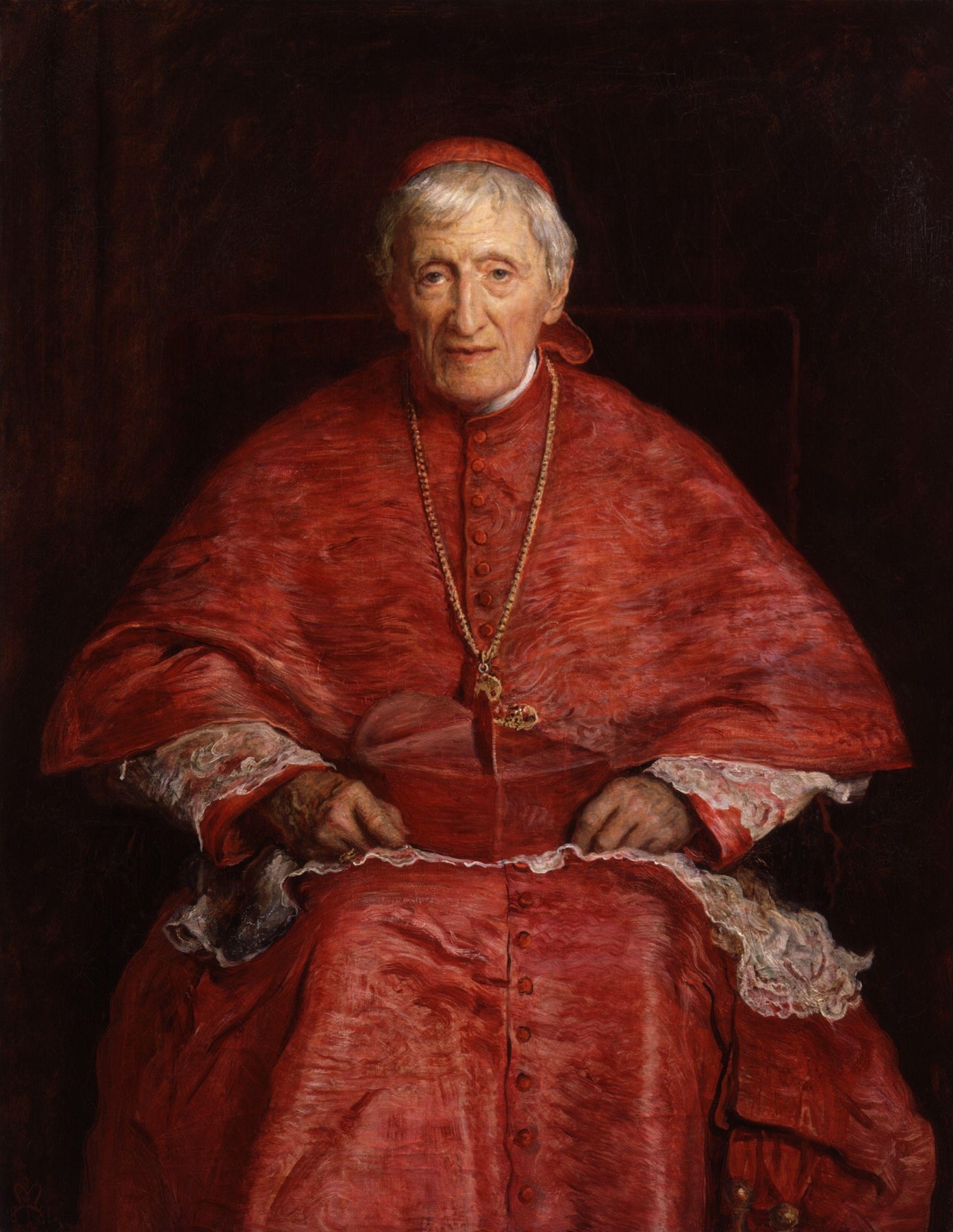
Cardinal John Henry Newman, painted by Sir John Everett Millais in 1881. Newman preached "The Second Spring" in 1852 and was declared a Doctor of the Church in 2025. (Image: National Portrait Gallery, London, via Wikimedia Commons, public domain)
There is a second echo worth noticing. Alito's 2015 dissent said believers would "whisper their thoughts in the recesses of their homes." Newman, 163 years earlier, put persecuted Catholics "in the recesses of the country." Whether Alito had Newman in mind in 2015, we cannot say. By 2021 he was quoting him directly.
Newman's Sermon Was About a Revival
Here is what the coverage leaves out. "The Second Spring" is not a lament. Newman preached it at the first gathering of English Catholic bishops after Rome restored the Catholic hierarchy in England in 1850, which set off a wave of anti-Catholic fury. His point was that the Church everyone had written off was coming back.
"The English Church was, and the English Church was not, and the English Church is once again," Newman told the bishops. "It is the coming in of a Second Spring; it is a restoration in the moral world, such as that which yearly takes place in the physical." The cellars and alleys were the setup. The spring was the message.
Newman himself proves the point. He was canonized in 2019, and Pope Leo XIV declared him a Doctor of the Church on Nov. 1, 2025, only the 38th person to hold that title. His feast day, now on the Church's universal calendar, is Oct. 9, three days after Alito's book hit shelves.
Is Alito Trying to Overturn Same-Sex Marriage?
No, and he says so plainly. Critics are reading the book as an attack on Obergefell, but Alito told CBS News there was "not a realistic prospect" the ruling would be overturned. "I did not think that there was any realistic prospect that it would be overruled because of the passage of time and the developments in the country," he said, pointing to the reliance people have placed on the decision since 2015.
That is a real distinction. Alito's complaint is not that same-sex couples can marry. It is that Americans who hold the older view of marriage are being told to keep quiet about it. In the CBS interview he described his record this way: "We have stood up for freedom of speech, which is endangered. We have done a lot to protect religious liberty."
Not Every Religious-Liberty Lawyer Sees It His Way
To be fair, some of the movement's own leaders are more upbeat. Jeff Mateer of First Liberty Institute wrote in the group's 2025 annual report that believers enjoy "more religious freedom today than at any other time in our lives." Becket's 2025 Religious Freedom Index found that "faith in the public square is on the rise."
Those two views can both be true. Believers keep winning at the Supreme Court, often with Alito writing or joining the opinion. But they keep having to go there. A baker, a web designer, a foster agency, a football coach and now a Kentucky parish all needed the highest court in the land to protect what the First Amendment already promised.
That is the tension at the heart of "So Ordered," and Newman supplied the answer 174 years ago. Alito borrowed the saint's picture of believers hiding in cellars. The rest of the sermon says the cellars do not last. For Americans of faith reading this book, the line worth remembering is the one the headlines skipped: "It is the coming in of a Second Spring."