The Trump administration did not invite Europe's OSCE election monitors to the November 3 midterms, and Democrats spent Tuesday comparing America to Russia and Belarus. Read the monitors' own final report on the 2024 election, though, and it says 18 states were already keeping international observers out, while officials in 18 states, Georgia and Pennsylvania among them, declined or ignored the mission's requests to meet.
What Did the State Department Actually Decide?
The Organization for Security and Co-operation in Europe runs its election monitoring through a Warsaw office called ODIHR. That office only sends a team after a member country invites it. This year, Washington never sent the invitation. Democracy Docket first reported on September 16 that ODIHR was "currently waiting on that invitation from the United States."
On September 23, ODIHR and the OSCE Parliamentary Assembly made it official. They called the decision "regrettable" and said the OSCE has observed 12 U.S. federal elections since 2002, six of them midterms. These will be the first since then without an invitation, including two that took place during President Trump's first term.
The administration's explanation is short. A State Department spokesperson told reporters the OSCE "should focus its limited resources on elections where it can have the greatest impact," according to The Mirror. In plain terms, Europe's monitors have bigger problems to watch than a U.S. midterm.
Why Did Democrats Bring Up Russia and Belarus?
The story caught fire again this week. On Tuesday, Sen. Jeanne Shaheen of New Hampshire, the top Democrat on the Senate Foreign Relations Committee, called the move "deeply antithetical to the spirit of freedom, democracy and transparency that defines our elections." She said it "risks undermining public trust in America's safe and secure election system."
Dan Baer, an Obama-era ambassador to the OSCE, went further. "Refusing election observers is usually something that countries in a position of weakness do, when they know that they have corrupt or unfair elections," he said in the same Mirror report. Headlines then lumped the United States in with Russia and Belarus.
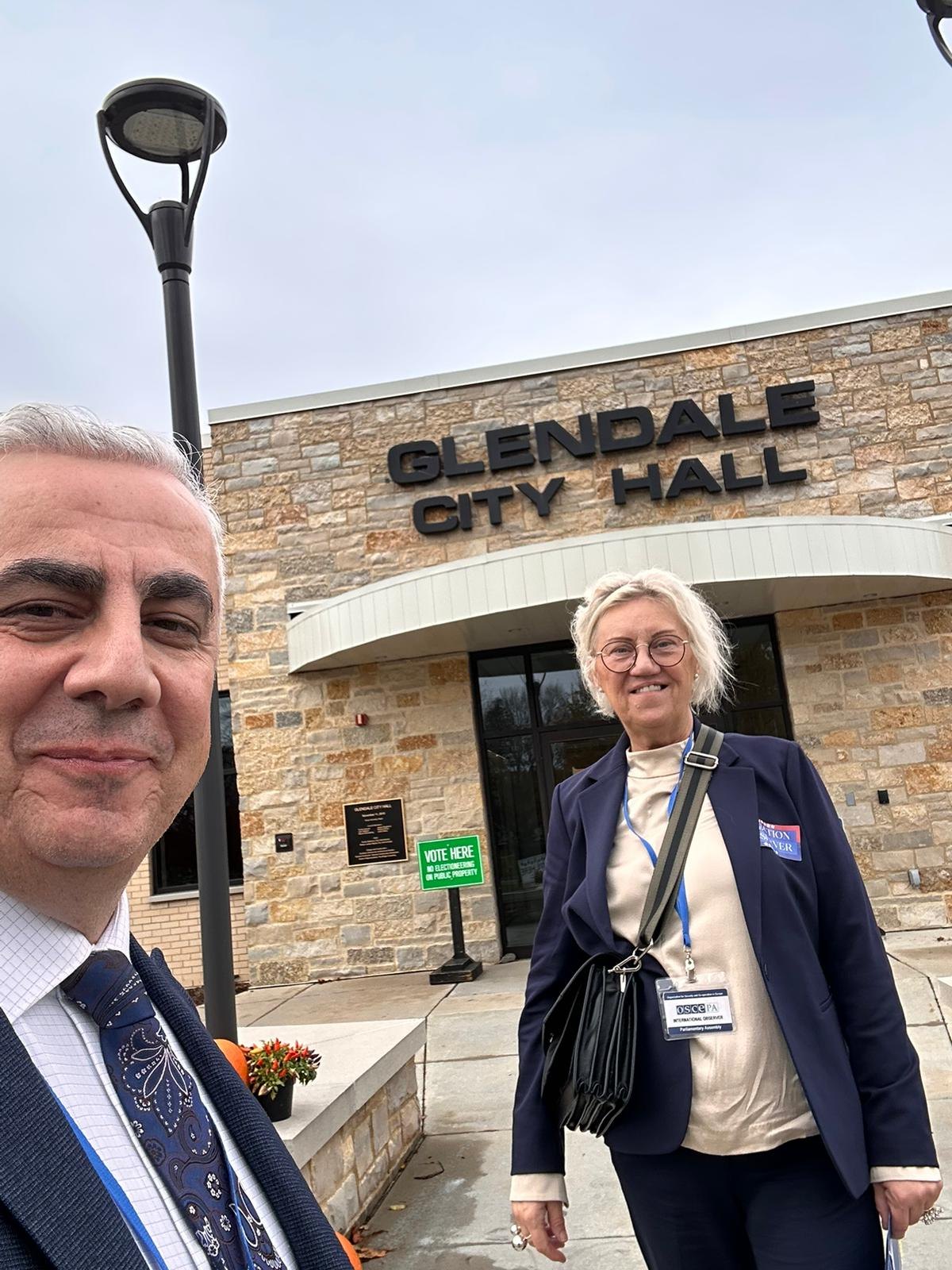
OSCE election observers outside Glendale City Hall in Wisconsin on Election Day, November 5, 2024. (OSCE Parliamentary Assembly, via Wikimedia Commons, CC BY-SA 2.0)
Read the OSCE's own statements side by side, and the comparison falls apart. ODIHR's August 6 release on Russia calls its refusal "a serious breach" and lists the reasons it matters there. Moscow now bars anyone labeled a "foreign agent" from running for office. It also pressured the citizen watchdog Golos until it dissolved. The U.S. release contains no charge of that kind. ODIHR Director Maria Telalian instead stressed that "election observation is not a judgment on a country or its institutions."
The Report That Says States Were Already Saying No
Here is what the outrage leaves out. ODIHR published a 50-page final report on the 2024 election in April 2025. Its section on election observation, on page 33, says states write the rules on who may watch, and many have chosen to keep foreign monitors out.
"Tennessee explicitly forbids international observers," the report says. Footnote 183 then names 18 states where "international observers were not allowed through regulation or by decision of the election officials": Alabama, Alaska, Arizona, Connecticut, Delaware, Florida, Illinois, Kentucky, Louisiana, Mississippi, Montana, New Jersey, North Carolina, Oklahoma, Tennessee, Texas, West Virginia and Wyoming. Only California, Missouri, Nebraska, New Mexico and D.C. explicitly welcome them.
The report's own body text puts the number of states with "legal prohibitions" at 17, one fewer than the footnote list. Either way, roughly a third of the country had already closed the door before anyone in this administration made a decision.
Official record
OSCE/ODIHR, United States of America, General Elections, 5 November 2024: ODIHR Limited Election Observation Mission Final Report (Warsaw, April 4, 2025), 50 pages, official PDF.
"Several state election officials either refused or ignored requests to meet with ODIHR LEOM observers, impeding international election observation. In several of these states, the primary reason for declining was the concerns that interacting with international observers may be perceived as exposure to potential foreign interference."
ODIHR final report, page 33
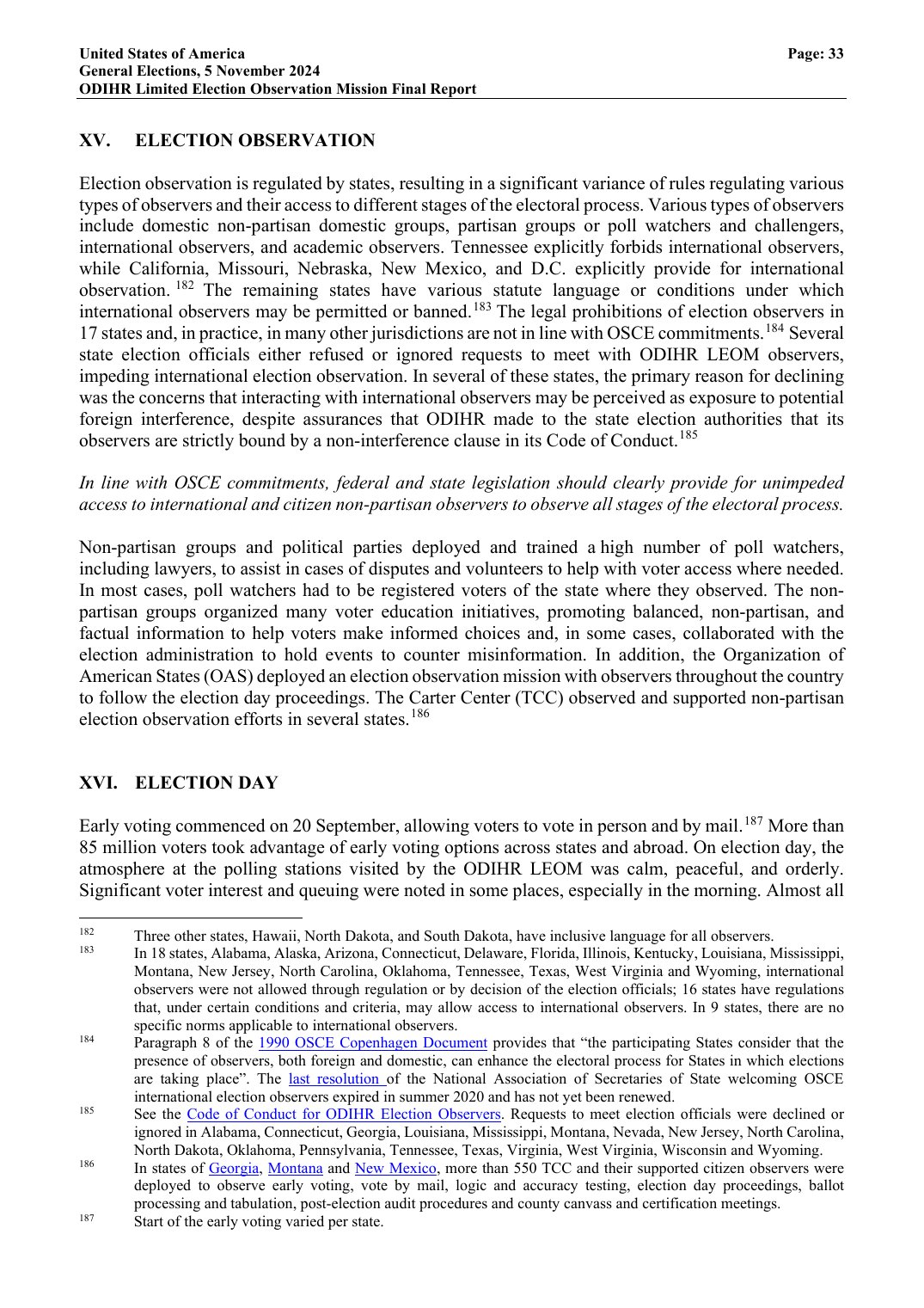
Read or download the full 50-page ODIHR report (PDF) · ODIHR's summary of its 2024 recommendations
Battleground Officials Turned Them Away Too
Footnote 185 is even more telling. It lists the states where "requests to meet election officials were declined or ignored." There are 18 of them, and the list reads like a midterm battleground map: Georgia, Pennsylvania, Wisconsin, Nevada, North Carolina, Texas and Virginia all appear, alongside Alabama, Connecticut, Louisiana, Mississippi, Montana, New Jersey, North Dakota, Oklahoma, Tennessee, West Virginia and Wyoming.
That list crosses party lines. Connecticut and New Jersey had Democratic governors at the time, and Pennsylvania's election chief answers to Democratic Gov. Josh Shapiro. The common thread, according to ODIHR's own text, was officials' worry about looking exposed to "foreign interference."
There is a long American history here. In 2012, then-Texas Attorney General Greg Abbott warned the OSCE that its monitors could face "criminal prosecution" if they came within 100 feet of a Texas polling place. The same footnote also notes that the National Association of Secretaries of State resolution welcoming OSCE observers "expired in summer 2020 and has not yet been renewed."

An OSCE observer delegation seated at a meeting in Wisconsin during the 2024 general election. (OSCE Parliamentary Assembly, via Wikimedia Commons, CC BY-SA 2.0)
What the Monitors Told America to Change
The report also shows why conservatives might not miss the mission. It ends with 31 recommendations, and ODIHR says most of its "priority" ones from past elections "remain unaddressed." First on that list is "reconsidering the system of the Electoral College with respect to vote equality."
On page 8, the report says plainly that "U.S. authorities should reassess the Electoral College system for electing the president and vice president." It also asks Washington to bring back federal pre-approval of state election law changes, the Voting Rights Act "preclearance" system that went dormant after the Supreme Court threw out its coverage formula in 2013. It wants "harmonizing federal standards for voter identification" too.
Its executive summary faults "harsh and intolerant language against women and immigrants by one candidate," and says "repeated unfounded claims about election fraud negatively impacted the public trust." The report never names that candidate. Its public summary goes on to recommend "actively discouraging inflammatory and divisive rhetoric in campaigns, as well as the spread of false information or unsubstantiated claims about election integrity."
Whose Numbers Did the Monitors Use?
Page 31 of the report counts lawsuits filed before the 2024 vote and finds Republicans and their allies filed at least 83, against 17 for Democrats. Footnote 172 says the figures came partly from "Democracy Docket, a Democrat-affiliated online source operated by lawyer Marc Elias," alongside the RNC's own Protect The Vote database.
From there the report concludes that "right-wing litigation groups" filed many suits "with the stated aim of ensuring election integrity, which in some cases may have led to disenfranchising eligible voters." On page 32 it adds that Republican efforts "targeting non-citizen voting" were "identified by ODIHR LEOM interlocutors as a potential voter intimidation tactic focused on immigrant voters."
To be fair, the same report praised the result. It found the 2024 election "well run," with polling "peaceful and orderly." That was a fair verdict. But a monitoring body that treats checks on noncitizen voting as possible intimidation was never going to grade the SAVE Act fight or this year's voter roll lawsuits neutrally.
Who Will Still Be Watching on November 3?
Plenty of people. The 2024 report notes that the Organization of American States sent its own mission. The Carter Center and allied citizen groups put more than 550 observers into Georgia, Montana and New Mexico. Party and nonpartisan poll watchers were present "in great numbers," in ODIHR's words.
The Justice Department is sending its own people as well. Assistant Attorney General Harmeet Dhillon, who runs the Civil Rights Division, has said "election monitoring is an ongoing priority for this office," and the department sent more than 75 monitors to five states during primary season, The Mirror reported. For comparison, the OSCE's entire 2024 effort put 250 observers from 45 countries in the field on Election Day. Before that, its long-term team numbered 64 observers for the whole country.
The Real Stakes
America's elections are run by states and counties, and they are watched by Americans. Skipping a European invitation does not change who counts the ballots or who stands in the room while they are counted. It changes who writes the report afterward.
The OSCE says it is ready to observe "future federal elections." If it wants a warmer welcome in 2028, it might start by reading page 33 of its own report. A third of the states had already decided they did not need Warsaw looking over their shoulder.