

Cook County asked the U.S. Supreme Court on Thursday to throw out the AR-15 ban case if its lead plaintiff, Cutberto Viramontes, is allowed to leave it. Some headlines read that as the county trying to dodge the December 2 argument. The county's own filing is more conditional, and its first footnote concedes that the Connecticut case consolidated with this one still lets the Court answer the AR-15 question.
What did Viramontes actually file?
Almost nothing. On Oct. 29 his lawyers at Cooper and Kirk filed a two-page motion under Supreme Court Rule 46.2 asking to dismiss him from the case. It gives no reason. It adds that the motion "does not apply to any other petitioner" and that the case "remains pending as to all other petitioners."
The Supreme Court docket lists the motion on Oct. 29 and Cook County's response on Nov. 5. As of early Friday it shows no order on either. The justices granted review on June 30 and set argument for Dec. 2.

The Richard J. Daley Center in Chicago, the address the Cook County State's Attorney lists on the filing. Photo by GregMcCollum via Wikimedia Commons, CC0. Cropped.
What does Cook County want?
State's Attorney Eileen O'Neill Burke's Suggestion of Mootness is three pages. It says that "if Petitioner Viramontes were permitted to withdraw from litigation, the Court should dismiss the case as moot or as improvidently granted." The request depends on the Court granting his motion first.
The county's argument is about standing. Viramontes wanted a Smith and Wesson AR-15-style rifle. The other individual petitioner, Christopher Khaya, wants an IMI Galil. The county says the petitioners themselves told the district court that rifle is "largely based on the AK-47 design," while the question the justices took covers "AR-15 platform and similar semiautomatic rifles." The petitioners' merits brief says the same thing, describing the Galil as "based on the AK-47 platform."
The two gun-rights groups in the suit, the Firearms Policy Coalition and the Second Amendment Foundation, are the third leg. The county says they named only two Cook County members, Viramontes and Khaya, so they cannot borrow standing from Khaya either.
Official record
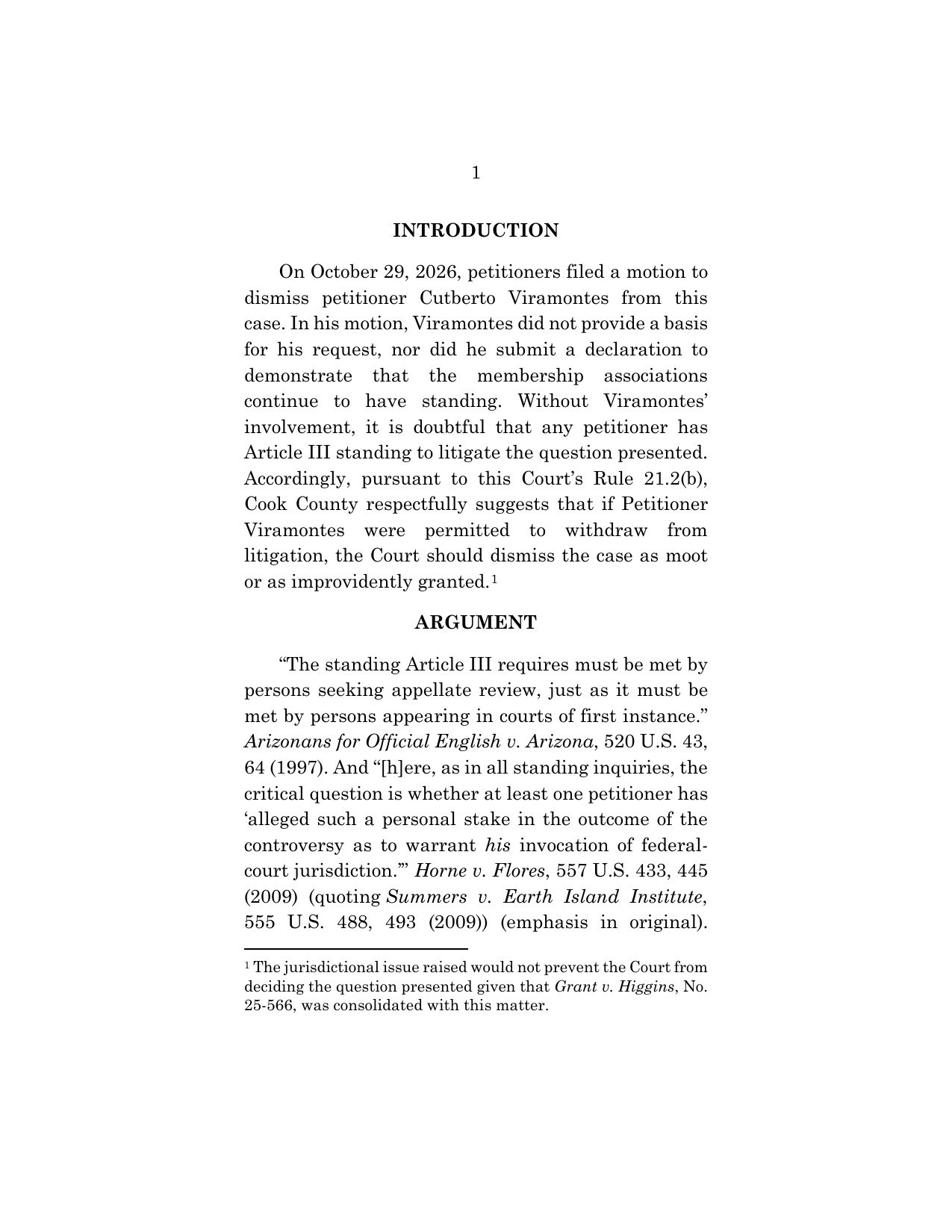
Viramontes v. Cook County, No. 25-238 (U.S.), Suggestion of Mootness filed Nov. 5, 2026. Footnote 1 appears on the first page of text.
"The jurisdictional issue raised would not prevent the Court from deciding the question presented given that Grant v. Higgins, No. 25-566, was consolidated with this matter." — Cook County State's Attorney, footnote 1
Read or download the full 3-page filing (PDF) · view the Supreme Court docket
Does the AR-15 question die if he leaves?
The county's footnote says no. On June 30 the Court granted the Connecticut petition, Grant v. Higgins, limited to the question in the Cook County case, consolidated the two and allotted one hour of argument for both. A standing problem in one does not erase the other.
The Second Amendment Foundation told CNN there is "every reason that this case should continue," for the remaining plaintiff and its members, and added, "This issue will be addressed by the Supreme Court." CNN reported that the Cooper and Kirk lawyers had not answered its questions about why Viramontes wants out.
Why is he leaving?
Nobody has said. The county writes that "the most natural inference" is that his "circumstances have changed in some significant fashion," and asks that if the petitioners disagree, the Court require Viramontes to file a declaration that he still wants an AR-15. That is the county's guess, not a fact in the record. The Daily Caller headlined its report "Illinois County Tries To Weasel Out Of Supreme Court Second Amendment Semi-Auto Showdown," though the article itself notes that Connecticut's case was consolidated.
CNN points to a precedent for unexplained exits. Last year a plaintiff in the Idaho transgender athlete case asked to withdraw, the Court deferred her request, and it ruled against her in June. What the justices do here is their call, and they have not made it.
What happens next?
Rule 46.2 lets an opposing party object within 15 days of service, but only to costs or to show the mover does not speak for all petitioners. Here the motion says it speaks only for Viramontes, and the county's filing is styled a suggestion of mootness instead. The rule text also says no mandate issues on a dismissal without a Court order.
For gun owners the practical point is plain. The county is asking to dump the case on standing grounds, and its own footnote admits Connecticut's side of the consolidated case remains. Watch the docket for an order on the motion before Dec. 2.
Header photo: the U.S. Supreme Court building. Photo by Jarek Tuszyński via Wikimedia Commons, CC BY-SA 3.0. Cropped.















