

Democrats won Congress in Tuesday's midterms and say they want to rein in ICE. The Secure America Act, signed June 10, already appropriated $69.5 billion for the Department of Homeland Security, and the text keeps every dollar of it available until Sept. 30, 2029.
What are Democrats promising on ICE?
NBC 7 San Diego reported Thursday that Rep. Scott Peters, D-Calif., sees a path for his Stop Excessive Force in Immigration Act now that his party is in the majority. Peters introduced it on Nov. 7, 2025 with Reps. Dan Goldman and Raja Krishnamoorthi. It requires body cameras and identifiable uniforms, and it strictly limits masks and crowd munitions such as tear gas.
NBC 7 says Peters would "dare" President Trump to veto it. It also says Peters noted that Congress has allocated more than $200 billion to DHS, funding the agency through the end of Trump's term, which he called "absurd," and that Democrats could redirect it.
DHS answered with a one-line post. Secretary Markwayne Mullin wrote "Deportations will continue." on X on Nov. 4, according to the Latin Times, which cites The Hill. NBC 7 says DHS pointed to the same post on Thursday.
What does the Secure America Act actually say?
It is Public Law 119-98. Each of its seven funding sections says the money is to "remain available until September 30, 2029." Adding the sections up gives $69.545 billion. The American Immigration Council totals it at $69.5 billion, and the Brennan Center rounds to $70 billion.
ICE gets $38.525 billion. Customs and Border Protection, which includes Border Patrol, gets $26.02 billion. The last $5 billion goes to the Homeland Security Secretary.
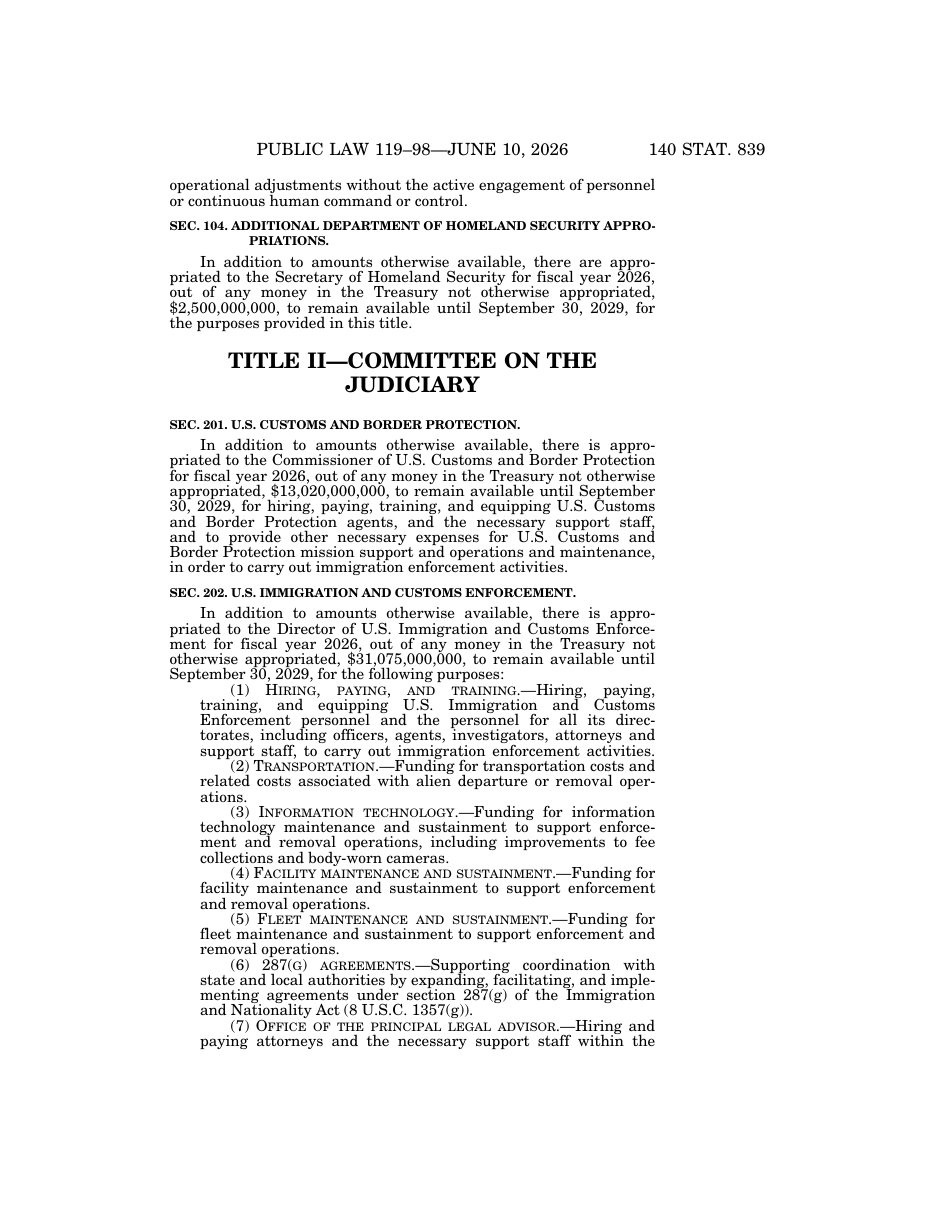
Official record
Public Law 119-98, the Secure America Act, 140 Stat. 837, approved June 10, 2026. Page shown: 140 Stat. 839, Sections 201 and 202.
"$31,075,000,000, to remain available until September 30, 2029" (Sec. 202, ICE)
How much of it is for immigration enforcement?
Less than the headline total. Sections 201 and 202 carry the immigration-enforcement purpose: $13.02 billion for CBP and $31.075 billion for ICE, or $44.095 billion. The rest funds other work. Section 102 sends $7.45 billion to Homeland Security Investigations for functions other than immigration and customs enforcement, and Section 101 sends $9.55 billion for Border Patrol personnel on functions other than immigration enforcement and customs.
Section 202 also sets aside at least $350 million for arrests in jurisdictions that are not "qualified cooperating" ones, meaning places without a 287(g) agreement or a filed certification of compliance with federal information-sharing law.
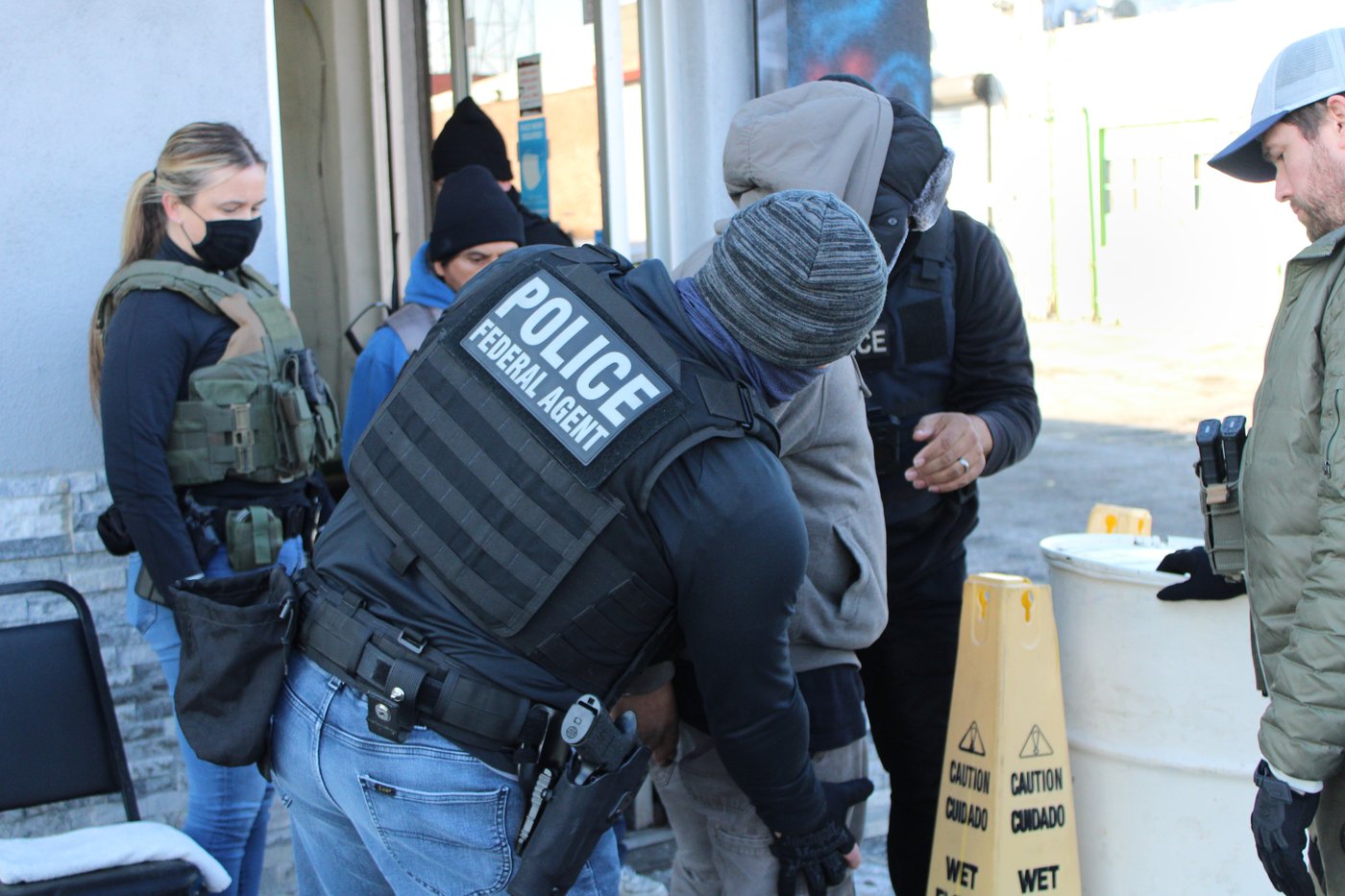
ICE officers during an enforcement operation. ICE's own caption describes a worksite operation at a Philadelphia car wash on Jan. 28 that led to seven arrests. File photo. Photo: U.S. Immigration and Customs Enforcement via Wikimedia Commons (public domain). Resized.
Is the "$200 billion" figure right?
It is in the right range, but it counts more than the Secure America Act. The Brennan Center's June 25 brief puts available ICE and CBP money at $183 billion: $118 billion unspent as of April, per USAspending data, plus $65 billion from the new law. It says the extra $28 billion the House Appropriations Committee approved for fiscal 2027 would push the total past $200 billion. That bill is not law.
How did the money get locked in?
Republicans used budget reconciliation. NPR, in a report carried by LAist, said the House passed it 214 to 212 on June 9, after a 115-day standoff in which Democrats withheld ICE and Border Patrol funding and asked for changes such as judicial warrants for home entry and a mask ban. Sen. Lisa Murkowski, R-Alaska, joined Democrats in a failed attempt to block it, saying it "weakens the normal budgeting process." House Budget Chair Jodey Arrington, R-Texas, called it regular funding, not a slush fund, covering last year's operating budget plus inflation over three years.
The Congressional Research Service notes that ICE and Border Patrol did not get money in the April DHS appropriations law and "continue to operate under funding provided in P.L. 119-98."
What can Democrats do, and when?
Not yet much. The new Congress convenes at noon on Jan. 3, and the stopgap spending law runs out Dec. 11, per CRS. Immigration attorney Vasanth Vaidyanathan writes that repealing the money would take a new law signed by Trump or a two-thirds vote in both chambers. The Latin Times says Trump has called himself "Mr. Veto" if Democrats took Congress.
Their nearer lever is the annual DHS bill. CRS says the House committee's version, H.R. 9310, passed 34-27 and includes at least $17.06 billion for ICE and Border Patrol activities that the reconciliation law had funded. The Senate committee has not marked up its version.
Trump's term ends at noon on Jan. 20, 2029. The money outlasts it by more than eight months. The American Immigration Council adds that the law sets no required spending pace and, in its reading, has no reporting provisions, so DHS decides how fast the money goes out. Mullin's post is a statement about cash already on hand, and only a new law, or a veto-proof vote, changes that.
Header photo: the U.S. Capitol's west front, viewed from the Newseum terrace, March 25, 2018. Photo by Beethoven via Wikimedia Commons, CC BY-SA 4.0. Cropped to 3:2 and resized.















