

The University of Michigan's final October consumer survey says sentiment "held steady" at 48.0, one-tenth of a point below September. The same release shows year-ahead inflation expectations at 4.7 percent and long-run expectations at 3.5 percent, and a report published the same day warns those expectations could become entrenched.
What did the final October numbers show?
The Surveys of Consumers release puts the sentiment index at 48.0, against 48.1 in September and 53.6 a year ago. That is 10.4 percent lower than October 2025. Director Joanne Hsu writes that it is also 15 percent below February, "just prior to the Iran conflict."
Underneath the flat headline, the pieces moved in opposite directions. The current conditions index fell to 46.7 from 50.9. The expectations index rose to 48.8 from 46.3. Hsu says the drop in current conditions "was driven entirely by buying conditions for durables, which plunged 18%" on higher interest rates and affordability worries.
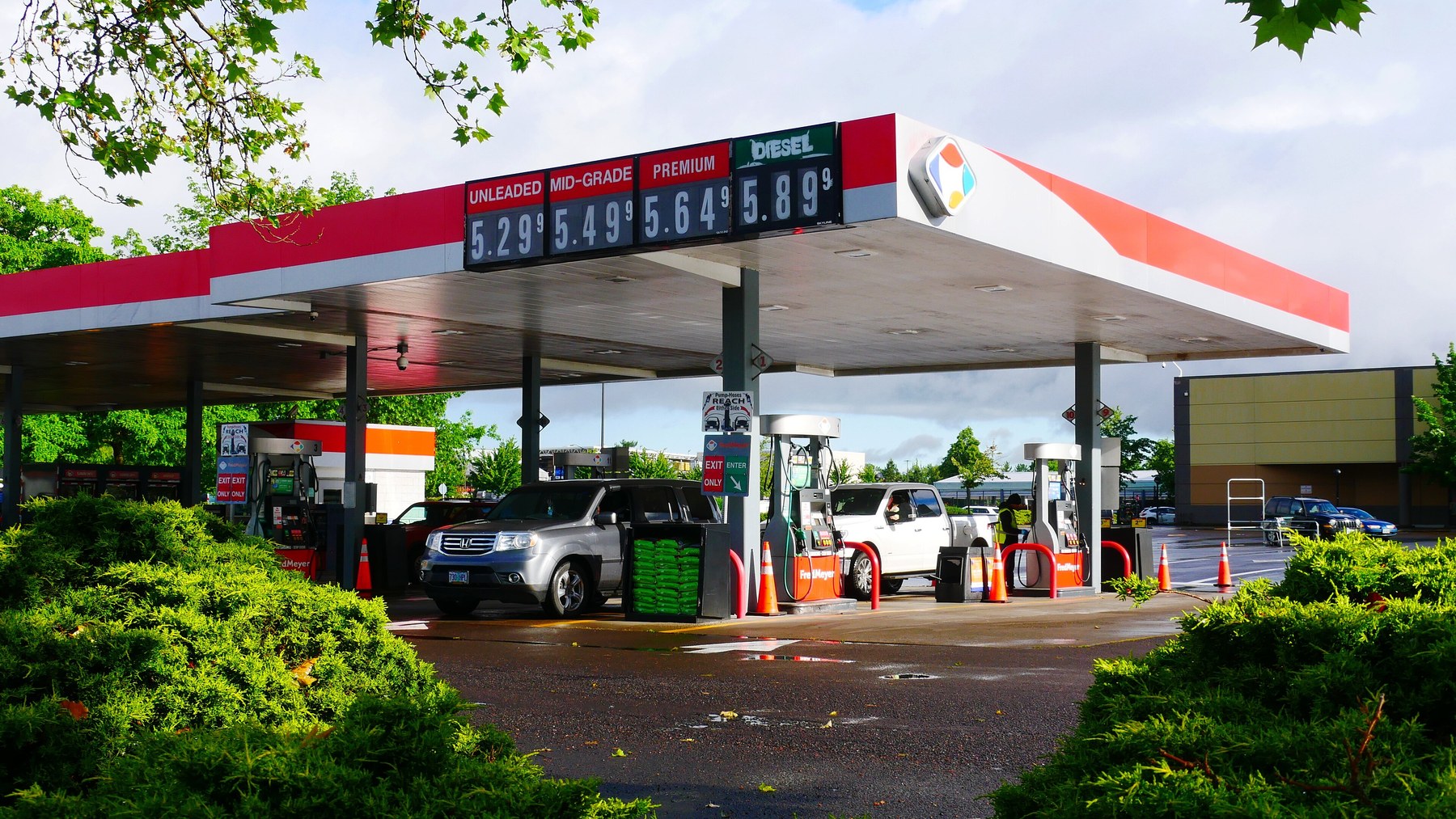
A gas station in Eugene, Oregon, photographed June 5, 2022. File photo; the prices shown are not current. Photo: Rick Obst via Wikimedia Commons, CC BY 2.0.
Why is gas the number to watch?
Michigan's Oct. 9 special report uses AAA figures. Gas averaged about $2.93 a gallon in the months before the Middle East conflict began on Feb. 28, 2026. It rose above $4.50 in May, eased in early summer, then approached $4.50 again in September.
The survey also tracks what consumers bring up unprompted. In 2025 the word was tariffs. The report says that in 2026 "the decline in tariff mentions has coincided with an increase in gasoline mentions." Only 31 percent of consumers said they will spend as usual on items with large price increases. Another 54 percent plan to cut back and 16 percent plan to stop buying those items altogether.
Where does the report say this goes next?
The year-ahead expectation of 4.7 percent compares with 3.4 percent in February. The long-run figure of 3.5 percent sits above the 2024 range of 2.8 to 3.2 percent. Both rose for the second month in a row to their highest since May.
Hsu's Oct. 23 special report says the readings suggest "consumers do not expect meaningful disinflation for the foreseeable future." She compares the pattern to the 1960s through the 1980s, when each supply shock left expectations starting from a higher base. She also says entrenchment "may not be inevitable."
Official record
University of Michigan Surveys of Consumers, Risks of Entrenchment: Long-Run Inflation Expectations in Recent and Longer Historical Context, Joanne Hsu, October 23, 2026.
"After five years of above-target inflation, both short- and long-term inflation expectations have ticked up in recent months, exposing risks that elevated inflation expectations could become entrenched." — Joanne Hsu, Director
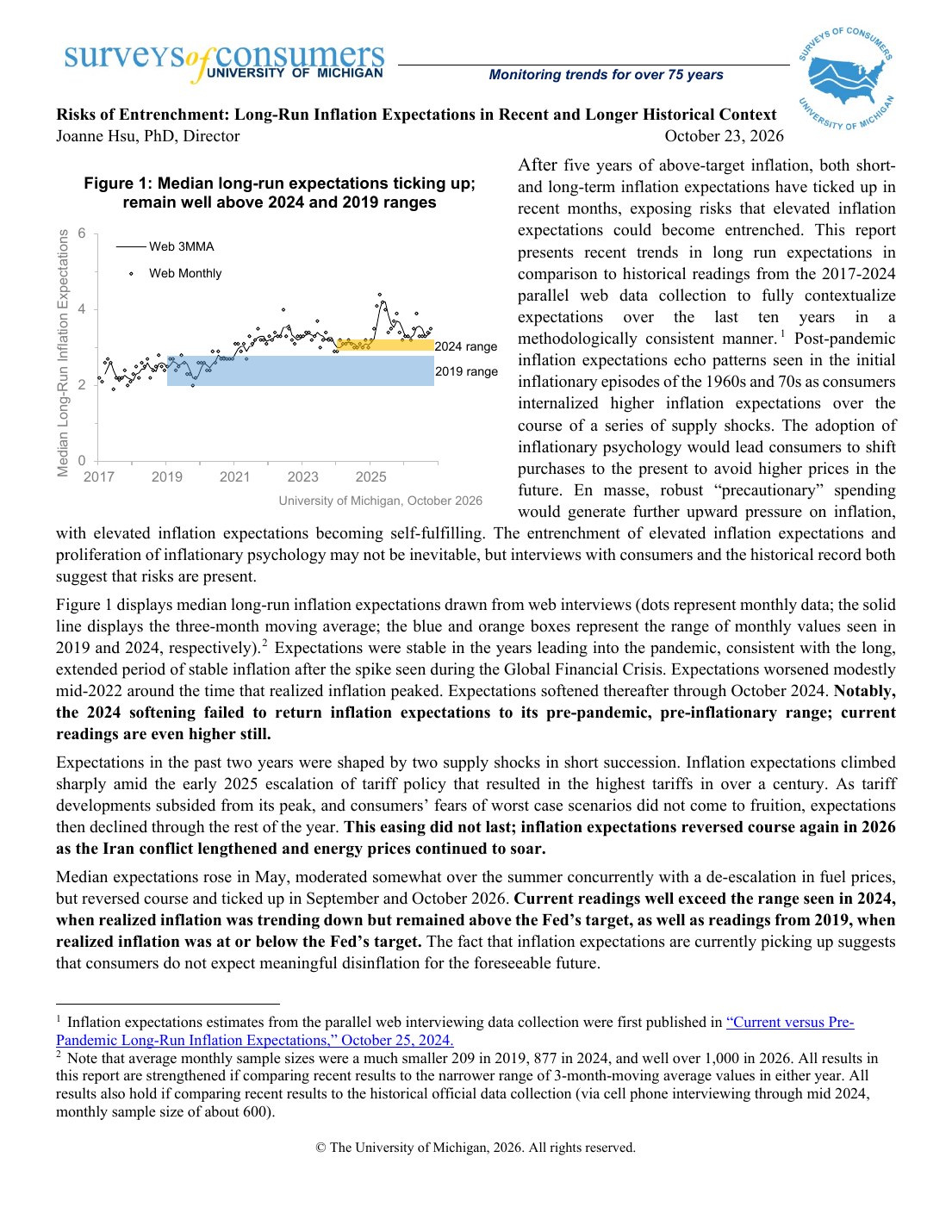
Static capture of page 1 · read the full 3-page report (PDF) · survey home page
Who is feeling it most?
The October release says gains among Republicans and Democrats were offset by drops among independents. The spending data in the Oct. 9 report shows the gap by party. Among Republicans, 48 percent expect to spend as usual despite price increases. For Democrats the figure is 27 percent, and for independents 28 percent.
Income matters more than party. In the lower third of households by income, 20 percent expect to spend as usual. In the upper third it is 42 percent. The report says the most common planned cutbacks are food and groceries, household items including durables, car buying, eating out and vacations.
The Marriner S. Eccles Federal Reserve Board Building in Washington, D.C. Photo: Federal Reserve via Wikimedia Commons, public domain.
Is the survey itself slanted?
It is a fair question, and Michigan has answered it in writing. Its July 10 report concedes that the share of self-identified Republicans in the sample has fallen since the 2025 transition, and says that is consistent with Gallup data showing a shift toward Democrats. It also says the May 2026 low of 44.8 sits below June 2022 even when compared with web interviews only, and that party-by-party trends match across interview methods.
Hsu adds that partisan differences in these answers "cannot be dismissed as mere political posturing," because research ties them to real spending. You can accept the survey's party mix as a limit and still note that Republicans in it report the same direction of pressure, only milder.
The next reading, preliminary November data, is due Nov. 6, three days after the midterms.
Header photo: Gas station price sign, Fort Pierre, South Dakota. Photo: Tony Webster via Wikimedia Commons, CC BY 2.0. Cropped. File photo; the prices shown are not current.















