

President Trump says Thailand "will eliminate all tariffs on U.S. exports" under a trade deal he sealed in Manila on Tuesday. The joint statement he and Thai Prime Minister Anutin Charnvirakul actually signed runs four short paragraphs and contains no tariff cuts, no purchase figures and no signing date. The numbers Trump cited trace back to a framework the two countries announced 13 months ago, when a final deal was promised "in the coming weeks."
What did Trump say in Manila?
Trump opened his Asia trip on Nov. 17 with a signing ceremony alongside Anutin ahead of the ASEAN summit in the Philippines. "Thailand will eliminate all tariffs on U.S. exports, which is something that we've been after for a long time," Trump said, according to UPI's report carried by Breitbart. He added that Thailand "will also be buying an estimated $2.6 billion in additional U.S. agricultural products," and said, "That makes our farmers very happy."
Trump also said Thailand would drop barriers on American vehicles, medical devices, pharmaceuticals, ethanol and poultry, as Fox News reported from Manila. Anutin was more measured. "I'm confident that the agreement will be ready for us to sign real soon," he said.
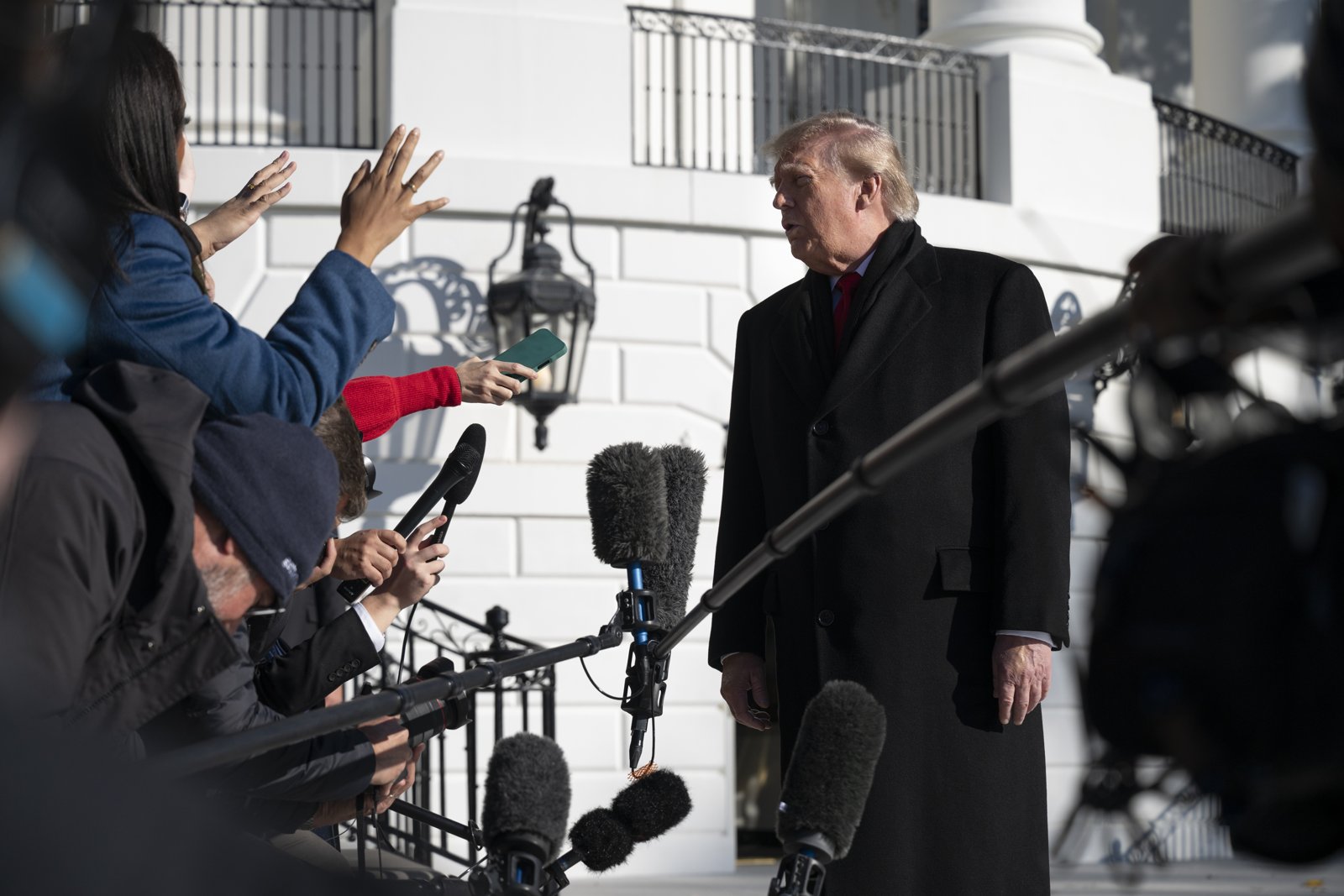
President Trump talks with reporters on the South Lawn before departing for the Philippines and China, Nov. 16, 2026. Official White House photo by Joyce Boghosian via whitehouse.gov (U.S. government work, public domain).
What does the signed statement actually say?
Very little. The text posted by the White House says the two leaders "confirmed that the United States of America ... and the Kingdom of Thailand ... have reached substantial conclusion in their negotiations" for an Agreement on Reciprocal Trade. It then names two older treaties, from 1966 and 2002, that the deal will build on.
The operative line is the last one: "The United States and Thailand will now begin their respective necessary internal processes to prepare the ART for signature and entry into force." That is the whole commitment. The words "tariff," "agriculture" and "$2.6 billion" do not appear anywhere in the document Trump signed.
Thailand's own Commerce Ministry said as much before the ceremony. "The full ART would not be signed at that meeting," the ministry said, according to The Nation Thailand. The draft still has to clear legal review on both sides, go to Thailand's Cabinet, and pass through parliamentary consideration and public consultation, which is when the ministry says the contents will be disclosed.
Where do Trump's numbers come from?
From October 2025. On Oct. 26, 2025, during Trump's last swing through Southeast Asia, the two governments issued a framework statement that did spell out terms. It said Thailand "will eliminate tariff barriers on approximately 99 percent of goods," not all of them. It listed agricultural purchases, mainly feed corn, soybean meal and distillers grains, "with an estimated value of $2.6 billion per year," plus $5.4 billion a year in energy and 80 American aircraft worth $18.8 billion.
Official record
"Joint Statement by President Trump and Prime Minister Anutin Charnvirakul of Thailand on a Framework for a United States-Thailand Agreement on Reciprocal Trade," October 26, 2025, Daily Compilation of Presidential Documents DCPD-202501056, published by the Government Publishing Office. Page 1 is shown below.
"Thailand will eliminate tariff barriers on approximately 99 percent of goods, covering a full range of U.S. industrial and food and agricultural products." Framework joint statement, Oct. 26, 2025, page 1
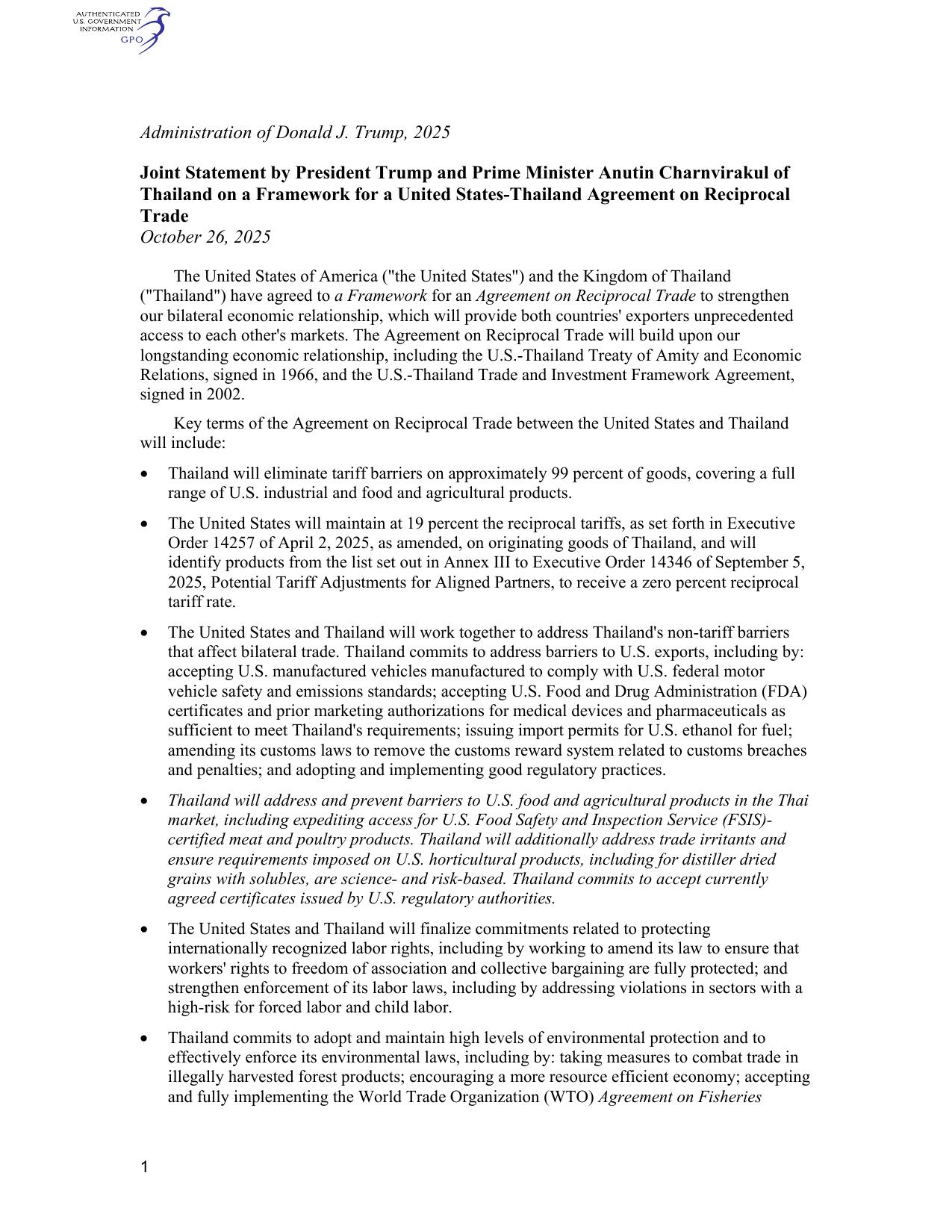
Read or download the full 2-page statement (PDF) or view it on GovInfo.
So the $2.6 billion Trump called "additional" on Tuesday is the same figure announced in 2025, and the "all tariffs" line rounds up the framework's 99 percent. That framework closed with a promise: "In the coming weeks, the United States and Thailand will negotiate and finalize the Agreement on Reciprocal Trade." Tuesday was 387 days later, and the deal is still unsigned.
What changed while the deal sat on the table?
The tariff that gave Washington its leverage did. The 2025 framework said the U.S. would "maintain at 19 percent" its reciprocal tariff on Thai goods under Executive Order 14257. In February, the Supreme Court ruled that Trump exceeded his emergency powers with those reciprocal tariffs. A temporary 10% global tariff under Section 122 followed, and on July 24 the administration replaced it with a 12.5% Section 301 tariff on Thai goods, citing what it called inadequate enforcement against forced labor, The Nation Thailand reported.
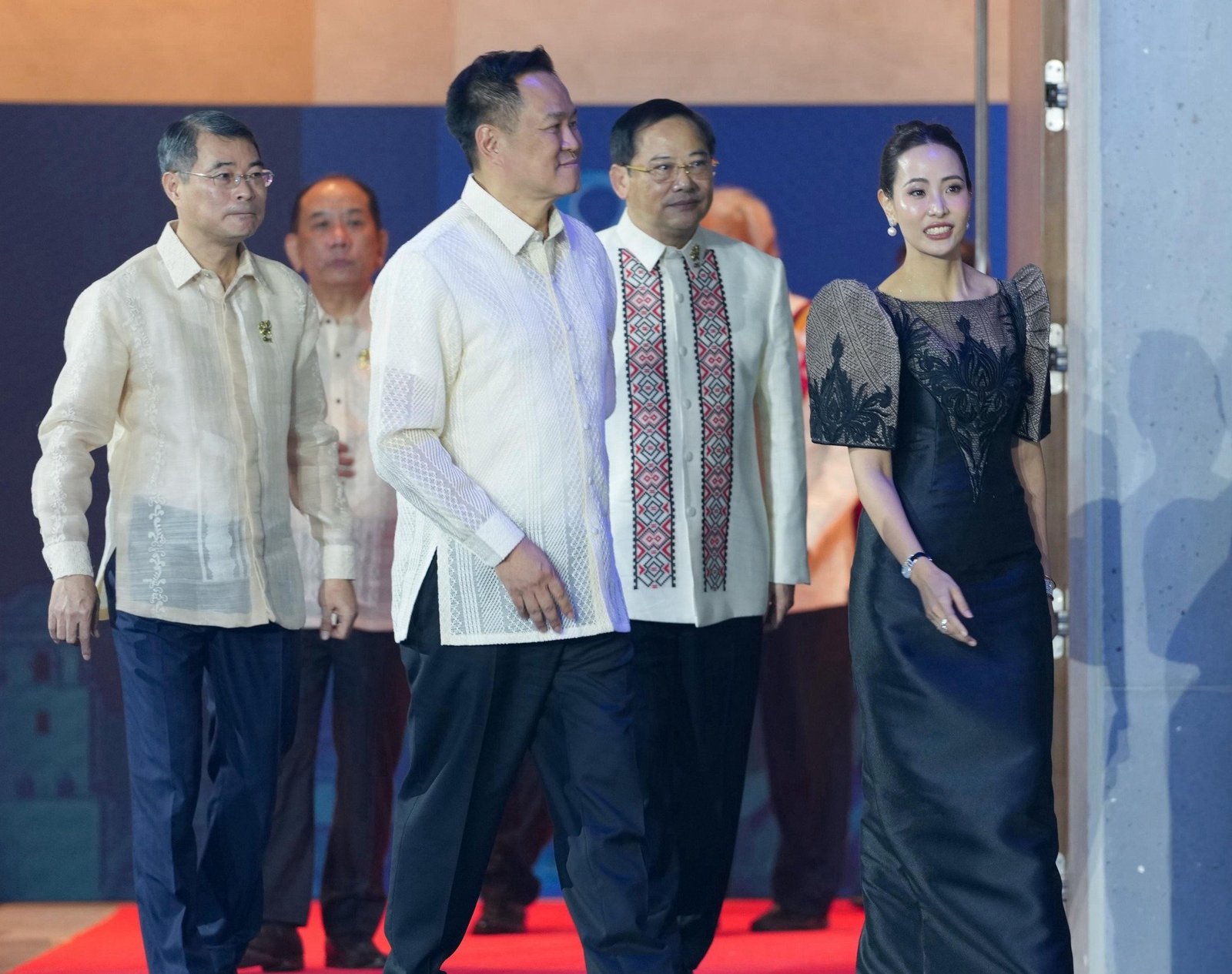
Thai Prime Minister Anutin Charnvirakul (center, white shirt) arrives at an ASEAN summit event in the Philippines, May 8, 2026. Presidential Communications Office of the Philippines via Wikimedia Commons (public domain).
The trade gap moved the wrong way too. According to the U.S. Trade Representative, American goods exports to Thailand rose 9.4% in 2025 to $19.6 billion, while imports from Thailand jumped 45% to $91.3 billion. The goods deficit hit $71.7 billion, up 59.1% in a single year. Thailand is not a minor partner. The U.S. buys 24% of everything Thailand ships abroad this year, The Star reported.
So is the Thailand deal real?
It is closer than it has ever been, and that counts for something. Thailand has every reason to finish: Bangkok openly hopes the deal earns it better treatment on the Section 301 duties, according to its Commerce Ministry. Trump holds the stronger hand, and American corn and soybean growers would gain a real buyer if the purchase commitments hold.
But Tuesday's paper is a promise to keep negotiating, not a tariff cut. American farmers and manufacturers have already heard "coming weeks" once from this exact pair of leaders. The win Trump described belongs to the final agreement, and the test is simple: when the signed text is published, does it say "all" or "approximately 99 percent," and does the $2.6 billion arrive every year as promised?
Top photo: President Donald Trump and Thai Prime Minister Anutin Charnvirakul hold signed documents at the Kuala Lumpur Accord ceremony in Malaysia, Oct. 26, 2025, the same day the two governments released their trade framework. Official White House photo via White House Flickr (U.S. government work, public domain).















