President Trump says the reported hack of the FBI's national crime database might finally expose the "Russia, Russia, Russia hoax." The FBI's own description of that database lists warrants, red flag orders and Secret Service threat records, with no file for the Russia investigation, and the Russia records Trump wants out are ones he can already order released.
What did Trump actually say about the FBI hack?
Trump called in to Fox News's "Saturday in America" on Nov. 21, the morning after CNN reported that the FBI is investigating a breach of its National Crime Information Center, or NCIC. "Well, we just heard about it, and I will say that it's not good. I don't like that," he said, according to ABC News.
Then he turned it around. Per The Hill, Trump said he likes to put a "positive spin" on things and that "maybe we'll learn things that we would have never learned otherwise." He named the targets: "You had the Russia, Russia, Russia hoax," and "maybe we'll learn about the voter fraud, all the voter fraud that took place." ABC reported he also pointed to the Zelenskyy phone call behind his first impeachment.
It is a very Trump answer, and plenty of his voters will cheer it. The FBI that ran Crossfire Hurricane earned that distrust. The problem is the database.
What is actually inside NCIC?
The FBI has published a detailed answer. Its Privacy Impact Assessment for NCIC, approved by the Justice Department on Nov. 7, 2022, calls the system "a computerized information system containing documented criminal justice information that is searched by name and other descriptive data." Police run it at traffic stops and on background checks, 24 hours a day.
The assessment walks through every file. Persons files cover wanted persons, missing persons, protection orders, sex offenders, gang members, people on supervised release and immigration violators. Property files cover stolen cars, plates, boats, securities and guns. Forbes, citing FBI figures from 2023, put the total at 22 files and more than 18 million active records.

The FBI's Criminal Justice Information Services Division in Clarksburg, West Virginia, the division that operates NCIC, seen in 2009. FBI photo via Wikimedia Commons (public domain).
None of those files is a counterintelligence case file. The closest thing to an investigative list is the "Case Subject List," which the FBI says holds people "under investigation for a potential nexus to terrorism" in the last five years. ABC put it flatly: the NCIC "would not have information" on the Russia or Ukraine investigations.
Official record
Federal Bureau of Investigation, Privacy Impact Assessment for the National Crime Information Center, approved Nov. 7, 2022 by the Justice Department's Chief Privacy and Civil Liberties Officer (Acting). Page 6, which describes the terrorist screening, protective interest and gun-denial files, is shown below.
"The Protective Interest File contains records of individuals whom an authorized agency reasonably believes, based on its law enforcement investigation, might pose a threat to the physical safety of protectees or their immediate families." FBI, NCIC Privacy Impact Assessment, page 6
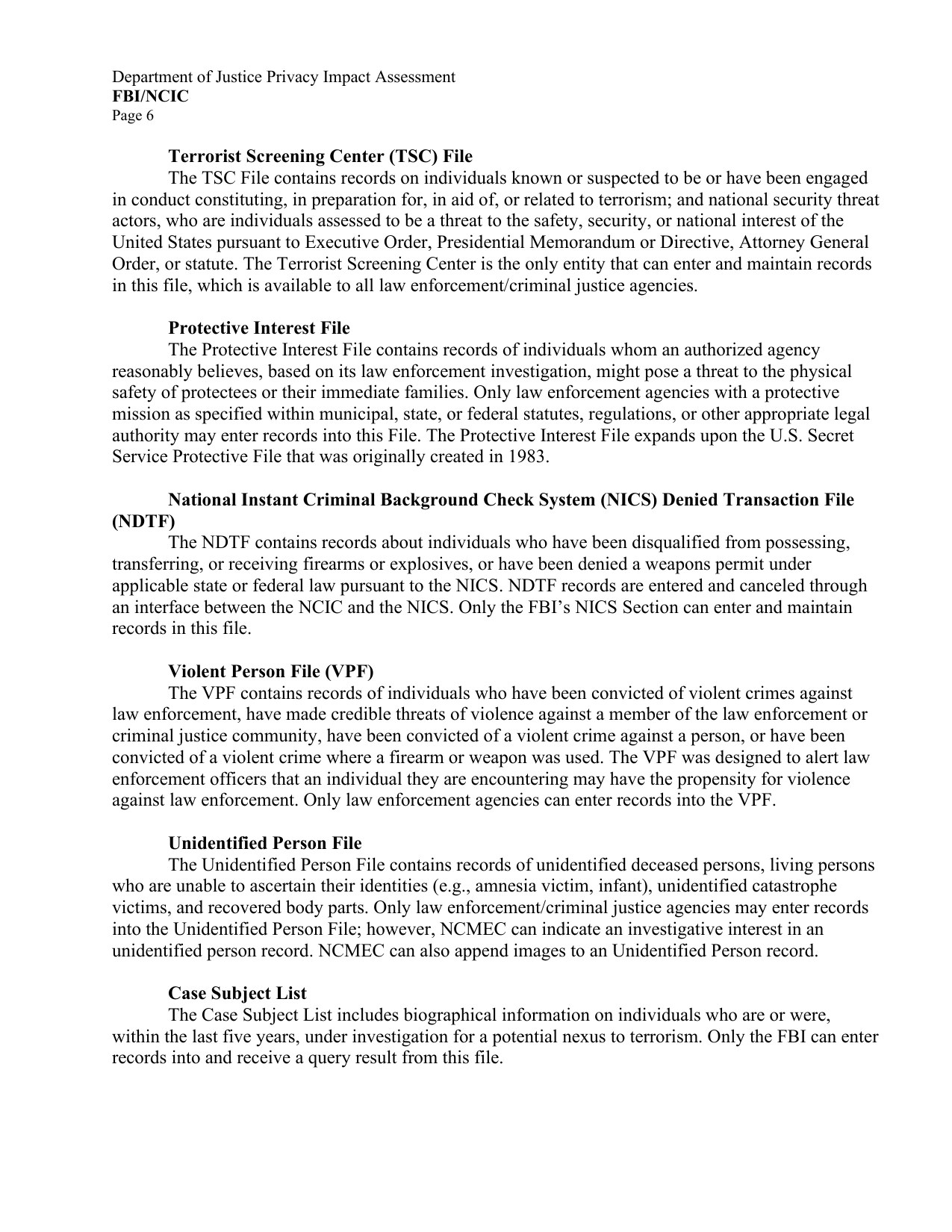
Read or download the full 33-page assessment (PDF) or view it on FBI.gov.
Why should gun owners worry more than Democrats?
Because the files a hacker would find are about ordinary Americans, and several of them are about guns. The assessment lists an Extreme Risk Protection Order file, the red flag orders that temporarily strip a person's right to buy or possess a firearm, including "the name of the individual petitioning." It lists a NICS Denied Transaction File of people turned down on a gun background check. Its Gun File holds serial numbers, makes and models of stolen, lost and recovered weapons.
Then there is the file that should bother the White House most. The Protective Interest File, built on a Secret Service file "originally created in 1983," lists people police believe "might pose a threat" to protectees. Next to it sits the Terrorist Screening Center file. If anyone walked out with those records, the people who learn the most will be the people being watched.
Retired FBI supervisory special agent Jason Pack told ABC that officers use NCIC to check "wanted persons, stolen vehicles, missing persons and other critical information." A former FBI official told CNN, as quoted by Forbes, that the bigger concern is "whether they could compromise the accuracy of the information that officers rely on." A tampered warrant record at a 2 a.m. traffic stop is nobody's positive spin.
Where are the Russia files, then?
In Washington, and Trump holds the key. On March 25, 2025, he signed a memorandum declaring the Crossfire Hurricane binder from his first term "no longer classified" and ordering the attorney general to release it "immediately." In July 2025 the Justice Department sent Sen. Chuck Grassley the declassified appendix to the Durham report.
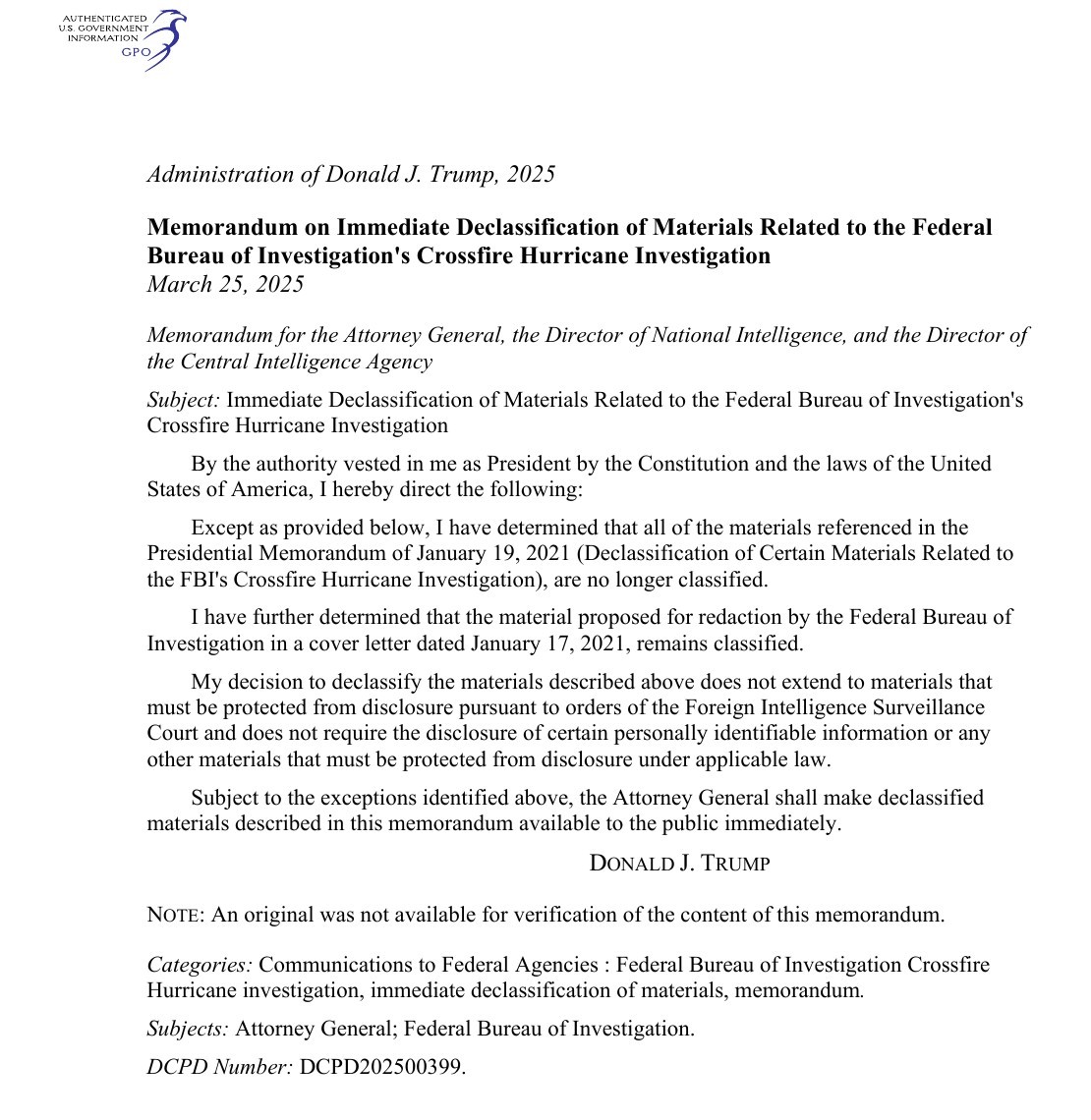
Trump's March 25, 2025 memorandum declassifying Crossfire Hurricane materials, as published in the Compilation of Presidential Documents. U.S. Government Publishing Office via govinfo.gov (public domain).
The job is not finished, and Trump's own allies say so. On Nov. 10, eleven days before the Fox call, Grassley and Sen. Ron Johnson wrote to Trump asking him to declassify everything left. Their letter says the inspector general has produced 58 redacted interview transcripts out of about 165, and that a roughly 400-page Inspection Division report reached their secure room classified and still redacted. "We urge your administration to produce the rest in short order and without unnecessary redactions," they wrote.
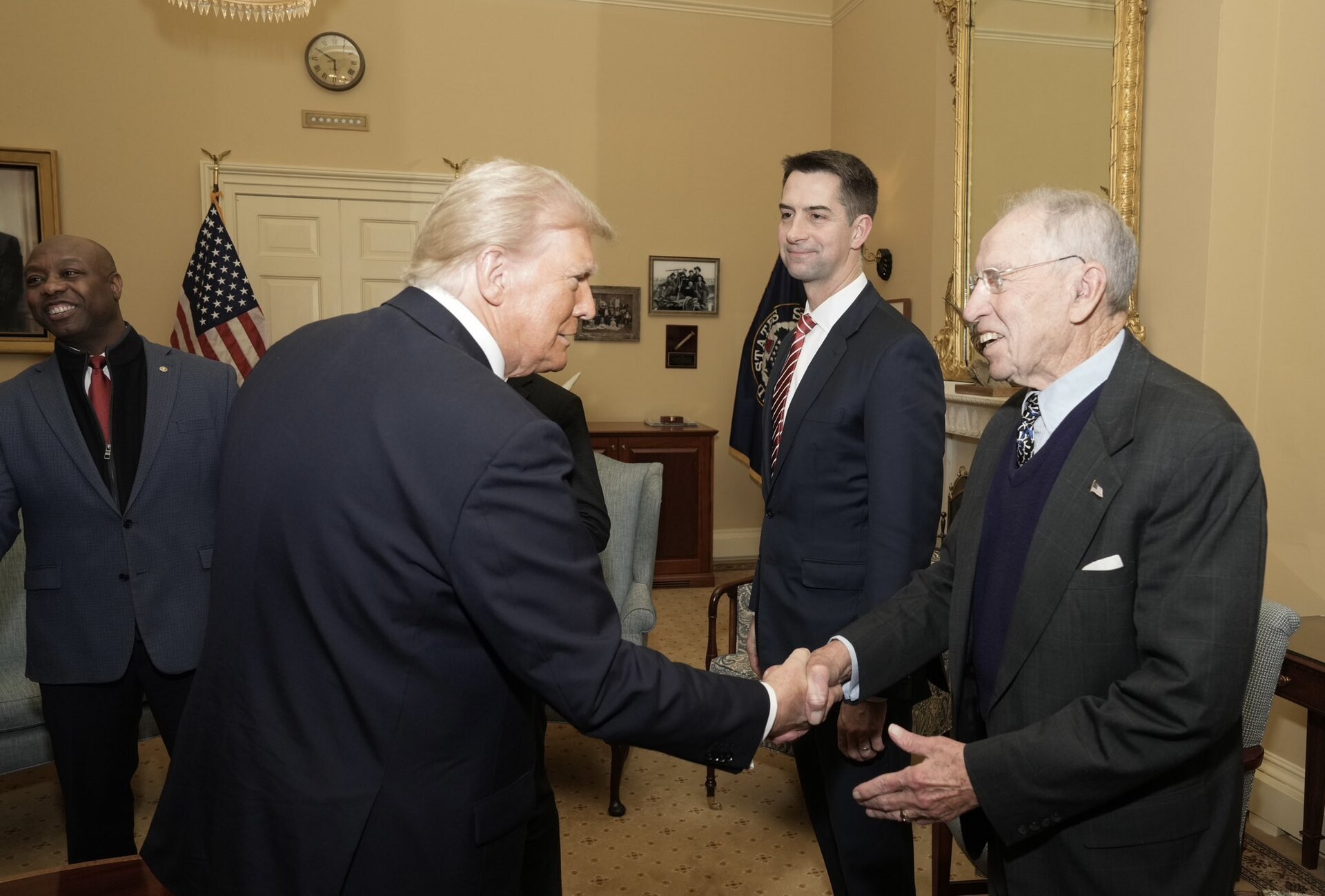
Trump greets Sen. Chuck Grassley at a January 2025 meeting with Senate Republican leadership, with Sens. Tom Cotton and Tim Scott looking on. Photo from the Office of Senator Chuck Grassley via Wikimedia Commons (public domain).
What is still unknown about the breach?
Almost everything. CNN's report rests on two people briefed on the investigation, and the FBI has not publicly confirmed it. BleepingComputer said it is unclear when the intrusion began, how it happened or whether anything was taken. This is the second reported FBI breach in about two months, after the ShinyHunters group claimed in September that it got into a platform tied to FBIJobs.gov. Nothing reported so far links the two.
Trump has a real grievance over how the FBI handled Russia, and he is right to want every page out. He does not need a hacker for that. He needs one more signature, and Grassley has already told him where to send it.
Top photo: President Trump on the phone in the Oval Office on Aug. 13, 2020. Official White House photo via Flickr (public domain).