A federal judge in Florida ruled Tuesday that President Trump's defamation claim against the BBC over its spliced Panorama clip of his Jan. 6 speech can go forward. Most headlines called it the "$10 billion" suit, but the 40-page order throws out half of it, and the most striking pages are about the BBC's own lawyers arguing against their chairman's apology.
What did Judge Kuntz actually rule?
The case is Trump v. British Broadcasting Corp., No. 1:25-cv-25894 in the Southern District of Florida. U.S. District Judge Jeffrey T. Kuntz signed the order on Nov. 10 in Fort Lauderdale. He denied the BBC's motion to dismiss Count I, the defamation claim, and ordered the network to file an answer by Dec. 1.
He granted the motion on Count II, a claim under Florida's Deceptive and Unfair Trade Practices Act. Citing an Eleventh Circuit ruling on newspapers, he held that even if the BBC has commercial purposes, "that does not convert the Documentary into commercial speech." Trump's complaint had asked for at least $5 billion on each count, Al Jazeera reported, under the headline "Judge rules Trump's $10bn BBC defamation suit can proceed." The Irish Times ran nearly the same line. What is still alive is one count, with a $5 billion ask.
Why does the judge say this case is different from CNN and the Wall Street Journal?
Kuntz opened by admitting the case "may seem familiar." Trump lost his defamation suit against CNN in 2023 because Judge Raag Singhal found the statements were opinion, and Judge Darrin Gayles dismissed his suit against the Wall Street Journal's owner on Oct. 31. Kuntz drew a sharp line: "Those cases involved a news entity reporting on a story. Here, the news entity created the story."
The order lays out the edit in full. The 12 seconds that aired in "Trump: A Second Chance" on Oct. 28, 2024, joined a line about walking "down to the Capitol" with a "fight like hell" line that came nearly 55 minutes later. Less than a minute after the first line, Trump told the crowd they would be marching to the Capitol "to peacefully and patriotically make your voices heard." That part did not make the cut. "This was not trimming around the edges," Kuntz wrote, "but creating something different than what was stated in the speech."
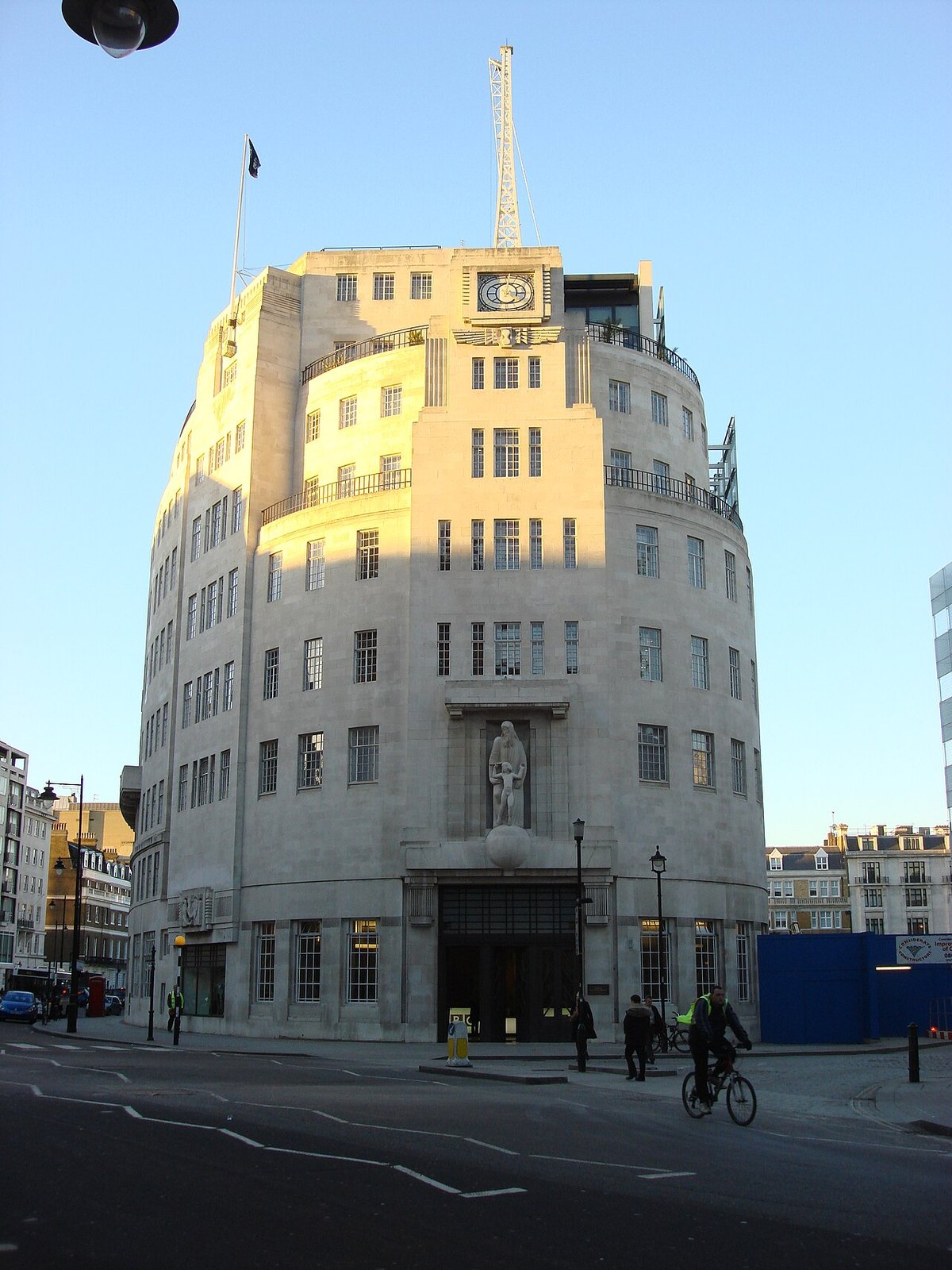
BBC Broadcasting House on Portland Place in London. The network's chairman apologized to Trump in November 2025 for the Panorama edit. Photo by Oxyman via Wikimedia Commons (CC BY 2.5).
Is the BBC now arguing against its own apology?
That is how the judge reads it. A year ago, BBC Chairman Samir Shah wrote to Trump that the edit "gave the mistaken impression that you had made a direct call for violent action. That was an editorial error and it should not have happened." The scandal had already cost the network its director general and its head of news, as this summary of the 2025 BBC controversy lays out.
In court, the BBC's motion pointed to statements by Jan. 6 defendants as evidence the speech could be read as a call to violence. In a footnote, Kuntz said he found it puzzling that the network was "implicitly alleging that the speech called for violence, in direct contradiction of the Chairman's own words." He also caught the BBC quoting a line from Shah's letter to Parliament while leaving off the front half of the sentence, which showed the words were something a BBC committee had "heard," not Shah's own view.
Official record
Trump v. British Broadcasting Corp., No. 1:25-cv-25894 (S.D. Fla. Nov. 10, 2026), ECF No. 209. Order granting in part and denying in part the BBC's motion to dismiss.
"Those cases involved a news entity reporting on a story. Here, the news entity created the story. BBC admitted as much by confirming it had edited a video to make it appear as though President Trump made a statement he never made." U.S. District Judge Jeffrey T. Kuntz
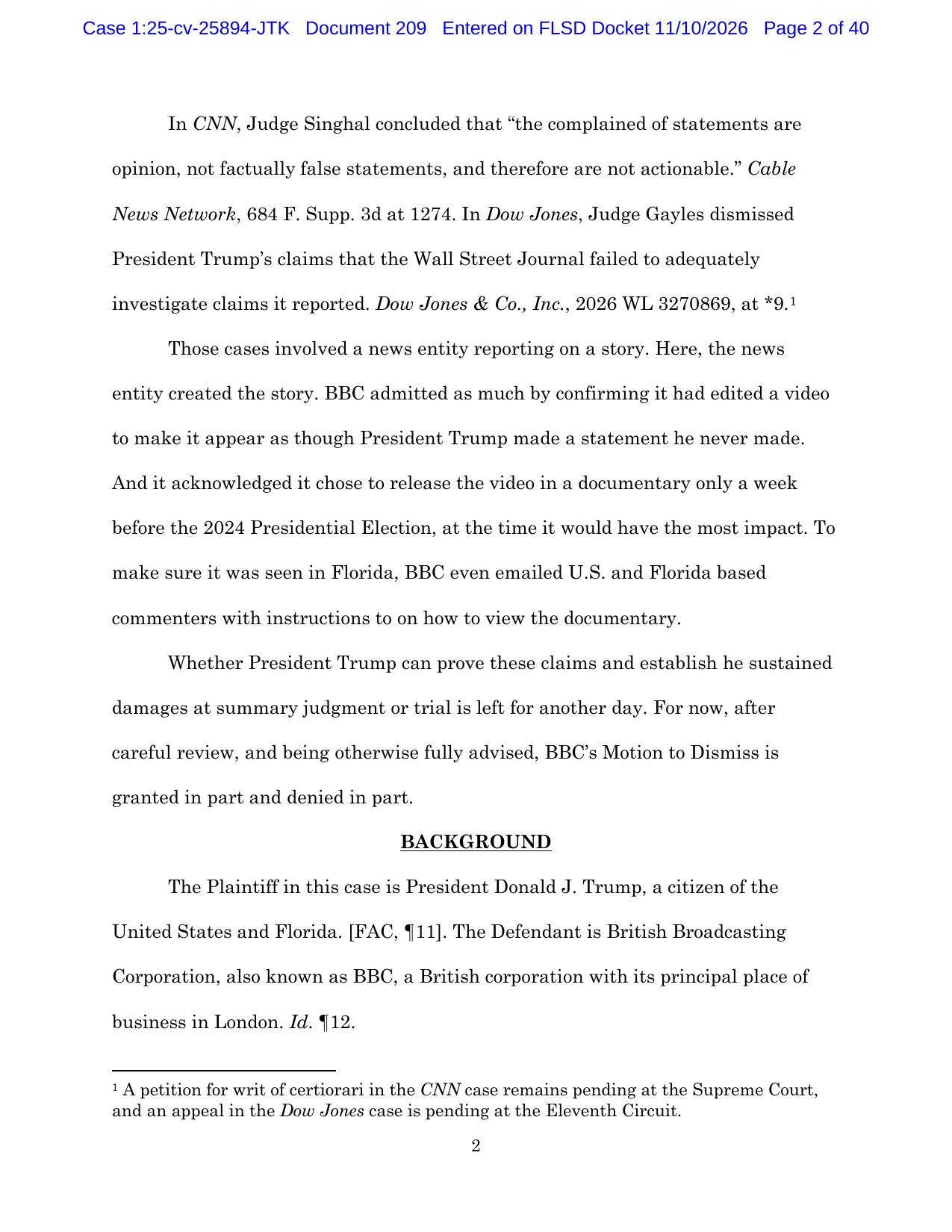
Read or download the full 40-page order (PDF) or view the docket on CourtListener.
What did the judge say about the apology coming a year late?
The BBC argued that its readiness to retract weighs against "actual malice," the standard a public figure has to meet under New York Times v. Sullivan. Kuntz noted that the rule comes from a 1977 case about a correction printed the next day. "It cannot be said that a retraction the next day is in the same ballpark as a retraction over a year later, and only after being threatened with legal action," he wrote. Given that the BBC heard the same complaint about a 2022 Newsnight edit, he said the 2025 apology "reads less like a readiness to retract, and more like a reluctance to retract."
He went further than he needed to. In a section on Sullivan itself, Kuntz wrote that the actual-malice rule is not grounded "in the original meaning of the Constitution, at least not in any meaningful sense," echoing Justice Clarence Thomas. Then he applied it anyway, because "Sullivan remains good law and inferior courts are bound by vertical precedent."
What did Trump not win?
Plenty, on paper. Kuntz rejected Trump's general jurisdiction theory, finding the BBC is not "at home" in Florida just because it has a subsidiary office there. He also agreed that Trump's complaint that the BBC never called him for comment does not show actual malice. Jurisdiction rests on narrower ground. The documentary was about a Florida resident and was partly filmed in Florida. The judge also pointed to a viewing link the BBC sent to Florida commentator Rick Wilson.
None of this means Trump has proven anything. "Whether President Trump can prove these claims and establish he sustained damages at summary judgment or trial is left for another day," the order says. The BBC told CBS News it was "surprised by this decision" and remains "confident in our position." Trump called it "A Huge Victory against Fake News BBC" on Truth Social.
What happens next?
The fight now moves to discovery, and that part is messy for both sides. A magistrate judge has ordered Trump to sit for a deposition by Dec. 11. The same day as the ruling, Trump's lawyers asked the court to pause that deadline and a BBC subpoena to the Mar-a-Lago Club for six years of membership-application and initiation-fee data, and said a motion to push back the trial date is coming.
For readers who have watched networks spin Jan. 6 for nearly six years, the order is worth reading for one reason. A federal judge set the full speech next to the 12 seconds that aired and wrote down in plain English that the quote did not exist. The BBC's chairman said the same thing a year ago. Its lawyers are the only ones still arguing otherwise.