Federal prosecutors in Manhattan say a Kata'ib Hizballah commander sitting in a New York jail used phone calls with his mother and sister to keep an Iranian-backed terror cell moving toward RAF Fairford, the British base that housed American bombers. The indictment unsealed Tuesday is real and it is detailed. But two of the three men charged were in Iran, British police say no bombs were found in the vans, and the counts that name specific targets never mention Fairford at all.
What did the Justice Department actually charge?
On Nov. 10 the Justice Department unsealed an eight-count superseding indictment in the Southern District of New York, case 26 Cr. 220. It names Mohammad Baqer Saad Dawood al-Saadi, 32, a citizen of Iraq and Iran; Mohsen Mohajeri, 48, an Iranian the indictment calls an IRGC operative; and Mohammed Ali al-Hassani, 35, an Iraqi. The charges include material support to two designated terror groups, Kata'ib Hizballah and Iran's Islamic Revolutionary Guard Corps, conspiracy to bomb a place of public use, and financing terrorism.
Attorney General Todd Blanche put it plainly: "Anyone who plans a terrorist plot on a military base housing American servicemembers will be prosecuted by the United States government." That is the right message. The question is what the paperwork behind it shows.
Who is al-Saadi, and why was he already in custody?
Al-Saadi is not new to prosecutors. The indictment says he was arrested abroad around May 1, 2026, brought to the United States, and first indicted on May 28 for helping plan about 18 attacks in Europe claimed by a front group called Harakat Ashab al-Yamin al-Islamiya, or HAYI. Seven of those hit the United Kingdom. The London attacks, prosecutors say, included arson against Hatzalah ambulances, synagogues and a Jewish charity, and a stabbing that seriously wounded two Jewish men, one of them a dual U.S.-U.K. citizen.
The same document says al-Saadi tried to bring the campaign here. He sent "targeting packages" for three Jewish institutions in the United States, including a synagogue in Manhattan, to a man who turned out to be an undercover officer, and paid him about $3,000 up front. In June he pleaded not guilty and called himself a "prisoner of war," according to Al Jazeera.
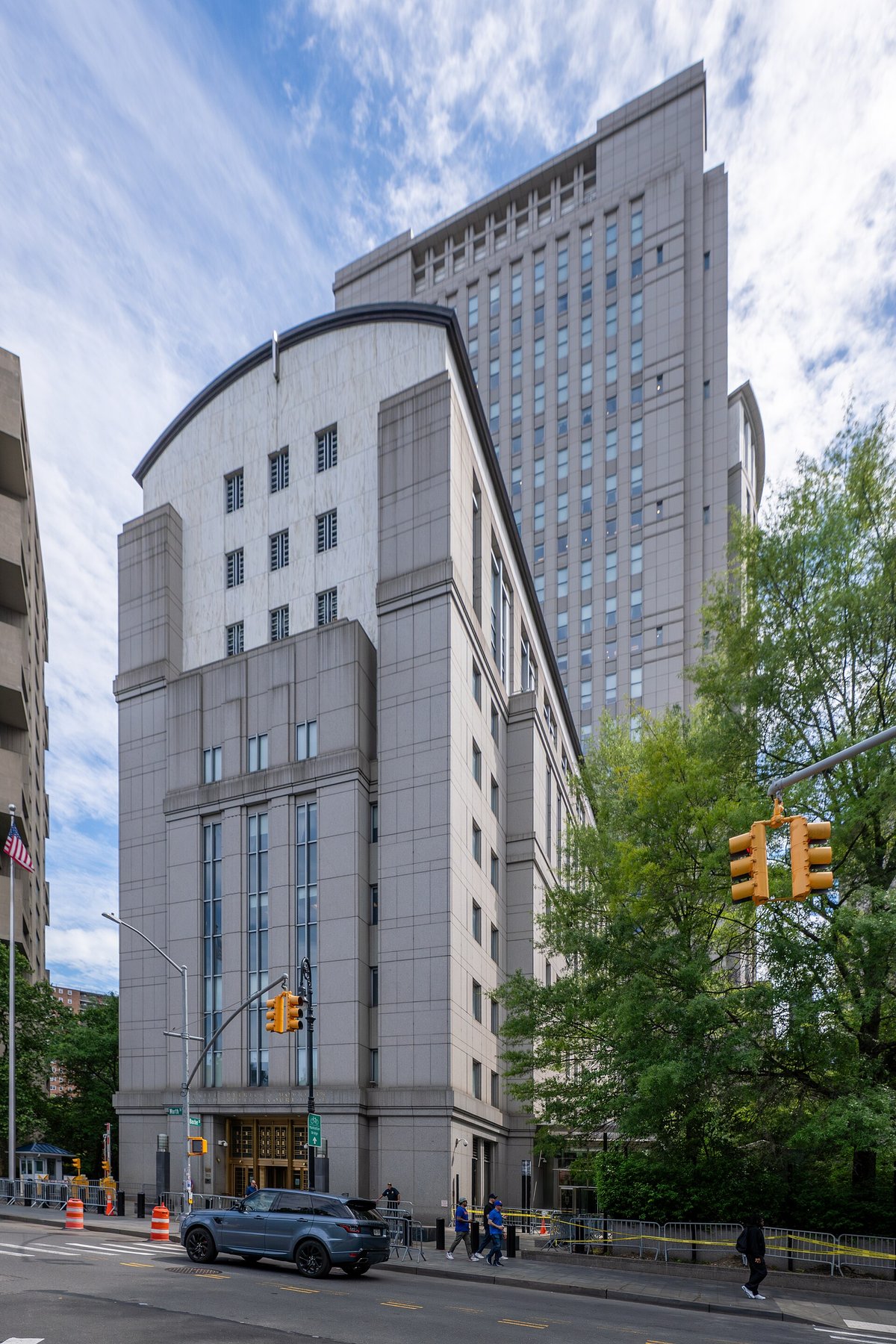
The Daniel Patrick Moynihan U.S. Courthouse in lower Manhattan, one of the Southern District of New York's federal courthouses. Photo by Ajay Suresh via Wikimedia Commons (CC BY 4.0).
How does a jailed man help steer a plot in England?
This is the part of the case that should bother every American. According to the indictment, al-Saadi has had phone and video calls from prison with relatives in Iraq, and used some of them to pass coded messages to his co-defendants. In June and July he spoke with his mother and sister about Mohajeri under aliases like "Abbas, Abu Daniel." On July 30 he asked his sister, "What are they doing about all our old work?" She told him "it isn't cancelled."
Then came Sept. 24. Prosecutors say al-Saadi asked how "Ali" was doing, was told Ali had been moved to the "International Section," and replied that the family should "give him money so we can do it." Two days later, the vans were rolling toward Fairford.
Official record
United States v. Al-Saadi, Mohajeri and Al-Hassani, S1 26 Cr. 220 (S.D.N.Y.), superseding indictment unsealed Nov. 10, 2026.
"AL-SAADI's family informed AL-SAADI that 'Ali' had been transferred to the 'International Section.' AL-SAADI then instructed his family to 'give him [i.e., AL-HASSANI] money so we can do it.' As described above, three days later, AL-HASSANI orchestrated the RAF Fairford Terrorist Plot." Superseding Indictment, paragraph 26
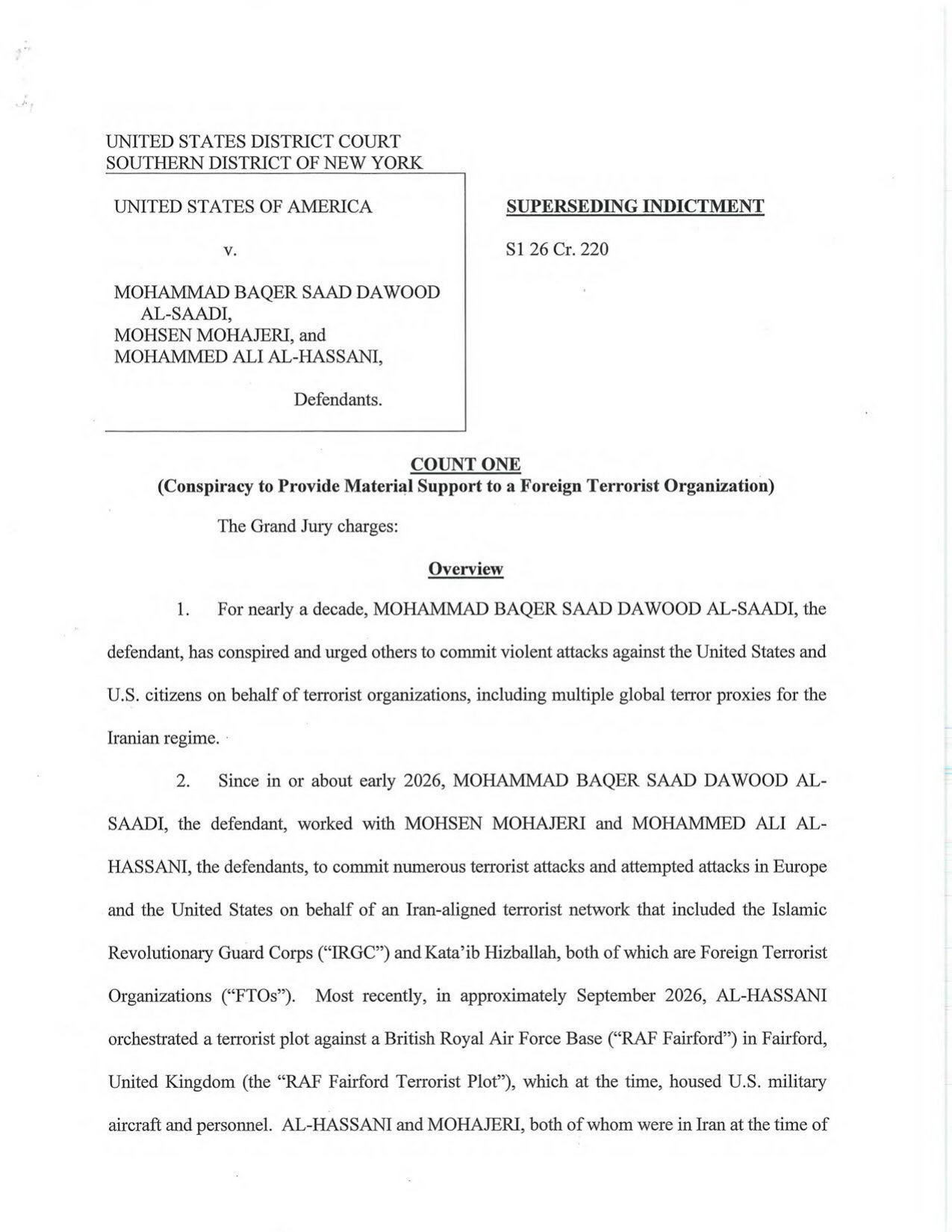
Read or download the full 27-page superseding indictment (PDF) or view it on the Justice Department's website.
The indictment quotes those calls word for word but does not say who was listening, or when. If investigators had the "give him money" call in real time, the public deserves to know why it took until November to say so.
What happened at RAF Fairford?
Prosecutors say al-Hassani, working from Iran, paid a man on Aug. 22 to film the base perimeter. In September his people bought vans and barrels of fuel, researched buying large amounts of potassium chloride, picked up metal objects "that could be used as explosive shrapnel," and put decals on the vans to look like a fuel delivery company and a swimming pool supply business. On Sept. 26, at least two of three vans hit a security roadblock and were turned away. British officers arrested the occupants early on Sept. 27.
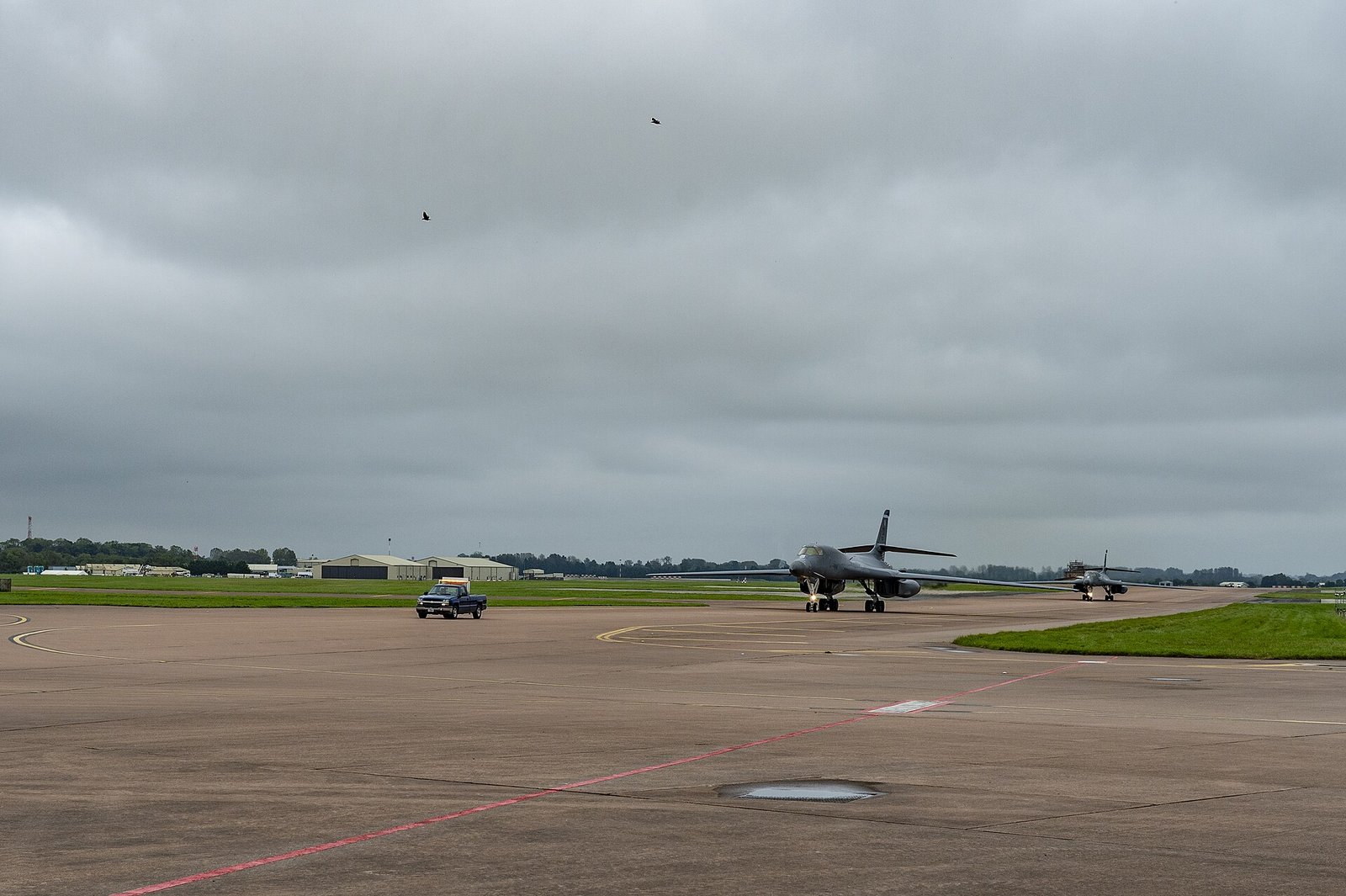
Two B-1B Lancers from the 9th Expeditionary Bomb Squadron taxi at RAF Fairford, England, in October 2023. Al Jazeera reports the U.S. pulled all of its B-1s from the base days after the September plot. U.S. Air Force photo by Senior Airman Ryan Hayman via Wikimedia Commons (public domain).
The British account is more cautious. Counter Terrorism Policing says "no improvised explosive devices were found" but a quantity of petrol was recovered, and the five men first arrested were bailed the next day. On Oct. 27 two 24-year-old British men from Westminster, Nouman Essghir and Mohmed Ahmad Abdulkarim, were charged under the National Security Act, the law covering help to a foreign intelligence service, not under terrorism law. Assistant Commissioner Laurence Taylor said police consider it "highly likely that there is Iranian state involvement."
Does the indictment charge the Fairford plot directly?
Not as a stand-alone count. Read the counts themselves and the specific targets are all from the spring. Count Six, conspiracy to bomb a place of public use, lists its overt acts as a March 15 explosives attack on the Bank of New York Mellon building in Amsterdam, a March 28 attempt on the Bank of America building in Paris, and an April attempt against Jewish institutions in the United States. Count Five covers February through May 2026. Count Seven covers April 2026 and U.S. Jewish sites.
Fairford enters through the opening paragraphs, which every count incorporates, and through the conspiracy, material support and financing counts that run "up to and including" the filing date. That is a legitimate way to charge it. It also means the headline plot is the least developed part of the document, and al-Saadi is the only defendant in an American courtroom.
Where are the other two men?
The indictment says Mohajeri and al-Hassani were "in Iran at the time" of the Fairford plot. The Justice Department release says nothing about arrests, and Al Jazeera reports Iran has strongly denied involvement. Charging them still matters. A sealed-then-public indictment makes every border crossing a gamble for both of them. It does not put them in handcuffs.
One more detail worth flagging. FBI Director Kash Patel's statement in the official release calls the base "RAF Fairfield," and it touts "over 1,300 terrorists disrupted and nearly 7,000 Foreign Terrorist Organization related arrests, up 1,057%" without saying where those numbers come from. The case is strong enough without loose numbers or a misspelled base.
What this case tells us about Iran
The indictment itself says the United States and Israel struck Iran on Feb. 28, 2026, and that Tehran answered by turning Kata'ib Hizballah and other proxies loose on U.S. and Israeli interests around the world. HAYI's spring campaign and the Fairford plot are what that looks like on the ground: hired locals, cheap vans, fuel barrels, and handlers who never leave Iran or Iraq.
A roadblock outside a Gloucestershire air base stopped this one. The harder fight is the one this indictment exposes without solving: an alleged terror commander in American custody who, by the government's own telling, still found a way to say "so we can do it."