

Treasury's new rule to block American money from Chinese tech swaps the term "artificial intelligence" for "super intelligence," a label the White House itself defines as artificial intelligence. The proposal, issued Thursday, would also ban U.S. investment in Chinese and Russian AI developers outright, with no technical thresholds and no dollar floor, even though the Associated Press says it "would only apply to investments that exceed $50,000."
What did Treasury actually propose?
On October 22, Treasury issued a proposed rule to carry out the Comprehensive Outbound Investment National Security Act, known as the COINS Act. Congress passed it in the fiscal 2026 defense bill, and it became law on December 18, 2025. The rule is not final. Public comments are open on regulations.gov until December 7, under docket TREAS-DO-2026-0595.
Treasury's fact sheet lists six sectors: semiconductors, "super intelligence" systems, quantum technology, supercomputing, hypersonic weapons and biotechnology. The countries of concern are China, including Hong Kong and Macau, plus Cuba, Iran, North Korea and Russia.
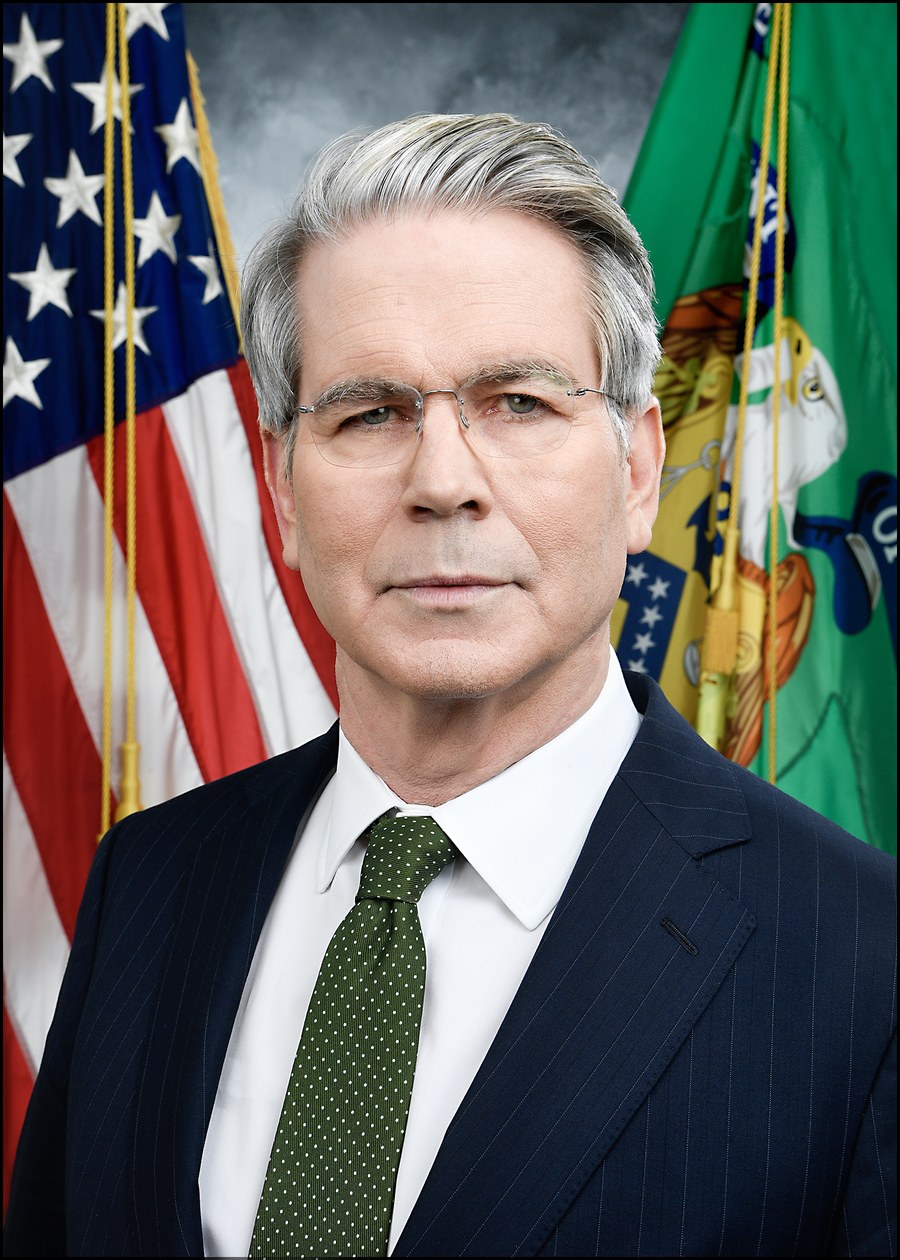
Treasury Secretary Scott Bessent. Official portrait: U.S. Department of the Treasury, public domain.
Is "super intelligence" a new technology or a new word?
It is a new word. Executive Order 14434, signed September 29, tells agencies to use "Super Intelligence" and "SI" in place of "Artificial Intelligence" and "AI." The order's own definition, in Section 3(a), says the terms "mean the technologies and systems encompassed by the term" artificial intelligence as defined in section 9401(3) of title 15 of the U.S. Code.
Treasury says the same thing in a footnote to its rule. The proposed definition of an "SI system" is a machine-based system that uses data inputs to make predictions, recommendations or decisions, which closely tracks the existing AI definition and adds systems that "generate content." It also sweeps in software, hardware and tools built on such a system, including "an SI agent harness" and "embodied" systems such as humanoid robots, autonomous vehicles and unmanned systems.
The Associated Press reported that Treasury used "Trump's favored term for AI." That is accurate. Nothing in either document says it describes a different technology.
Does the $50,000 floor cover everything?
No. The AP wrote that the rule "would only apply to investments that exceed $50,000." The proposed regulation text says something narrower. The de minimis exception covers "transactions that would otherwise be notifiable transactions" where the total over the preceding 12 months does not exceed $50,000. It does not mention prohibited transactions.
That matters because Treasury moves AI development out of the notice category and into the ban category. The fact sheet says the change "would eliminate the existing notification requirement" for these deals. Read as written, a U.S. fund putting $20,000 into a Chinese company that develops an SI system would not be exempt as a small deal. It would be barred, not merely reported.
Official record
U.S. Department of the Treasury, Office of Investment Security, Outbound Investment Security Program Regulations, proposed rule, 31 CFR Parts 850 and 851, Docket No. TREAS-DO-2026-0595, RIN 1505-AC94, issued October 22, 2026.
"The Treasury Department has not proposed any technical parameters within which the U.S. Government can permit a covered national security transaction into the SI systems or quantum information technologies sectors consistent with U.S. national security." — Treasury, proposed rule preamble
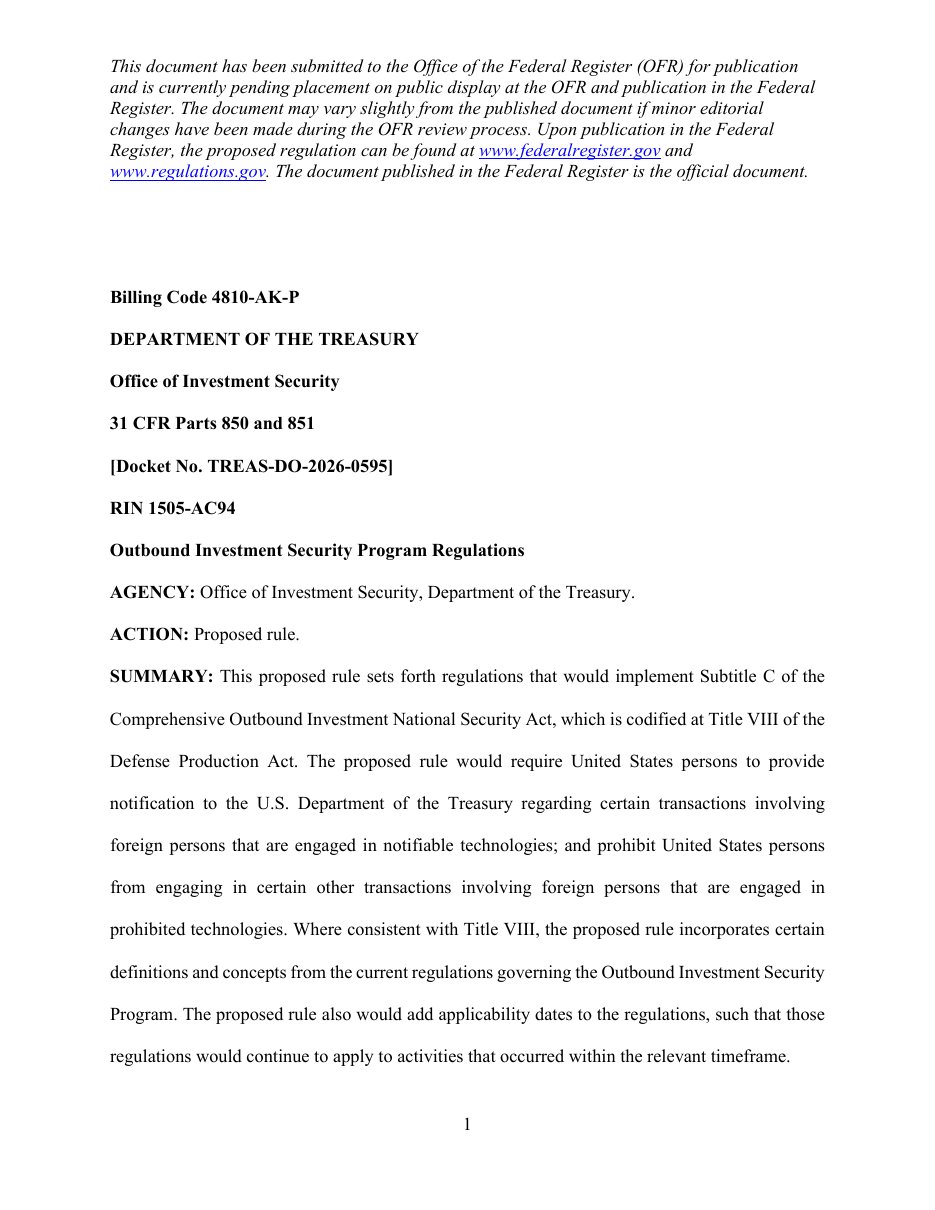
Read or download the full 163-page proposed rule (PDF) · view it on Treasury.gov. Federal government documents are in the public domain. Treasury notes the text is still pending publication in the Federal Register and may change slightly.
What would stay legal?
Plenty. The proposal excepts purchases of publicly traded stock and of index funds, mutual funds and ETFs. Limited partners in a foreign venture or private equity fund are excepted when their committed capital is $2 million or less, or when a binding contractual assurance is in place. Treasury's FAQ says the program "would not prohibit all investment activity in countries of concern."
Penalties for violations run up to the maximum civil amount under the International Emergency Economic Powers Act, and Treasury could order a divestment. A U.S. person is judged on what they knew, or "could have possessed" through "reasonable and diligent inquiry," per the fact sheet. No list of banned Chinese companies is planned.
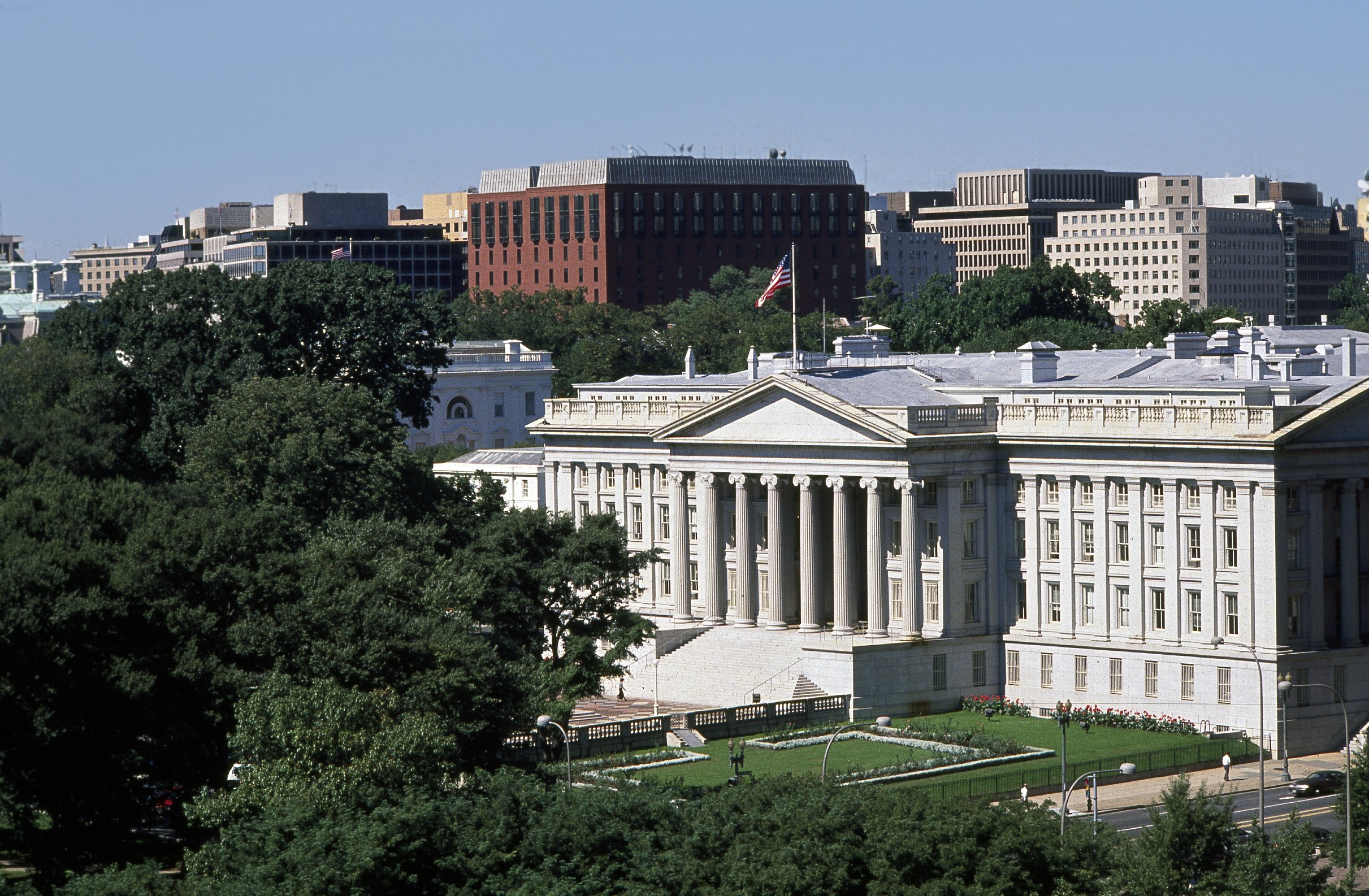
The U.S. Treasury Building in Washington, D.C., from above. Photo: Carol M. Highsmith, Library of Congress, no known restrictions on publication. File photo.
Why is Venezuela missing from the list?
The statute names "the Bolivarian Republic of Venezuela under the regime of Nicolás Maduro Moros." Treasury's FAQ says that regime "no longer exists." On March 5, 2026, it notes, the United States recognized Delcy Rodríguez as head of state, so Venezuela "does not meet the NPRM's definition of a country of concern." Investors are still told to check, because the rule can reach certain deals outside a country of concern.
Russia is on the list by statute, not by the administration's choice. The AP noted the proposal came days after Trump waived sanctions on Russia following a diesel deal with Vladimir Putin. Congress wrote Russia into the law either way.
What happens next?
Nothing takes effect yet. Treasury says the proposal "does not itself implement" the COINS Act, and the final rule will set the effective date. Until then, the 2025 rules at 31 CFR Part 850 stay in force. The comment window closes December 7, which gives investors and AI companies six weeks to argue over the definition of a word the government just chose to rename.
Header photo: the U.S. Treasury Building and the statue of Alexander Hamilton, Washington, D.C. Photo: Carol M. Highsmith, Library of Congress, no known restrictions on publication.















