Senate Majority Leader John Thune says he cannot find 50 Republican votes for the budget resolution that would unlock a third reconciliation bill. "I can't count to 50 right now on a budget resolution," he told reporters, according to The Hill. That resolution is the only vehicle carrying the $10 billion election-integrity fund House Republicans wrote for the SAVE America Act.
The House passed it on July 22. It has sat on the Senate calendar since July 23 without a vote. Four Republican senators have already killed the same idea three times, on the record, by name.
What the budget resolution actually says, and what it does not
The vehicle is H. Con. Res. 113, the fiscal 2027 budget resolution reported by Budget Chairman Jodey Arrington of Texas. The House adopted it 216 to 214 on roll call 281. Republicans went 216 to 2, the no votes being Thomas Massie of Kentucky and Warren Davidson of Ohio, with independent Kevin Kiley of California also voting no.
The famous $95 billion is in the operative text, just not in the words anyone is using. Section 201(b) hands four House committees a ten-year deficit ceiling: Armed Services $60 billion, Intelligence $13 billion, Agriculture $12 billion, House Administration $10 billion. The words Iran, election, citizenship, voter and SAVE appear nowhere in the 56-page engrossed text. Section 201(a) sets one hard date: those committees must report by September 11, 2026.
The widely repeated $73 billion "for the Iran war" is Armed Services plus Intelligence. Roll Call, Axios and NBC News tie those figures to the war and the voter-ID push, as House leaders do out loud. The document does not.
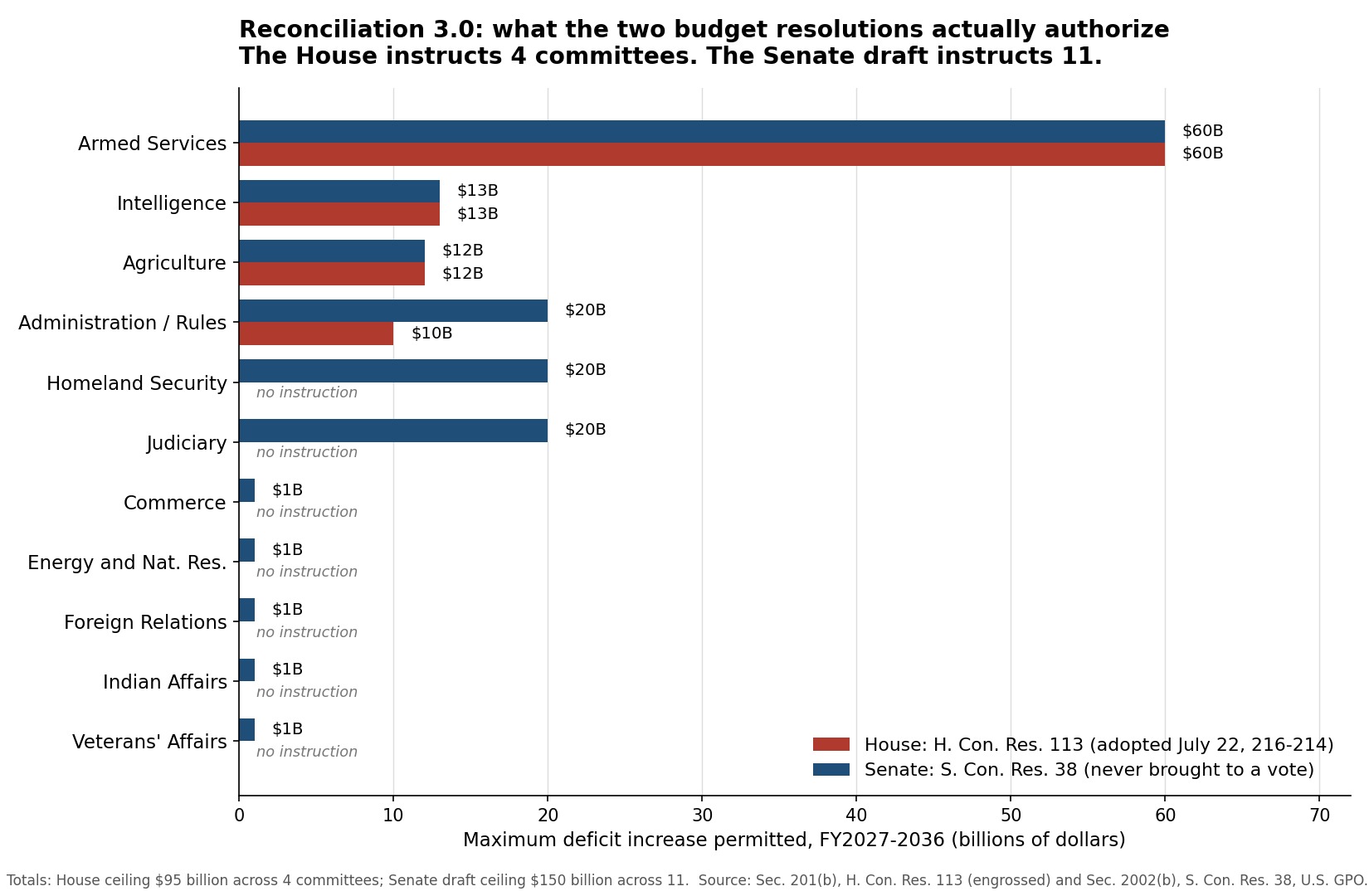
What each budget resolution authorizes, committee by committee. Chart built by PatriotAddict from Sec. 201(b) of H. Con. Res. 113 and Sec. 2002(b) of S. Con. Res. 38, U.S. Government Publishing Office.
The Senate wrote its own version, and it is bigger
Senate Budget Chairman Ron Johnson of Wisconsin unveiled his text on August 7 and it went onto the calendar as S. Con. Res. 38, Calendar No. 550. It keeps the House numbers for defense, intelligence and farm aid, then instructs eleven Senate committees instead of four, with ceilings adding up to $150 billion and no offsets required anywhere.
Johnson told Roll Call the $150 billion is inflated on purpose to give committees room, and that the real election-integrity total would be $20 billion rather than the $60 billion the text permits across Homeland Security, Judiciary and Rules and Administration. That is double what the House wrote. The eleven-committee spread exists "to avoid any jurisdictional challenges under the complicated rules of reconciliation," Roll Call reports, and Johnson skipped Finance to deny Democrats germane amendments on health programs.
Official record
S. Con. Res. 38, 119th Congress, 2d Session, placed on the Senate Legislative Calendar under General Orders, Calendar No. 550, August 7, 2026. The instruction that matters for the SAVE America Act is Section 2002(b)(10), on page 50 of 70.
"COMMITTEE ON RULES AND ADMINISTRATION.—The Committee on Rules and Administration of the Senate shall report changes in laws within its jurisdiction that increase the deficit by not more than $20,000,000,000 for the period of fiscal years 2027 through 2036." — S. Con. Res. 38, Sec. 2002(b)(10)
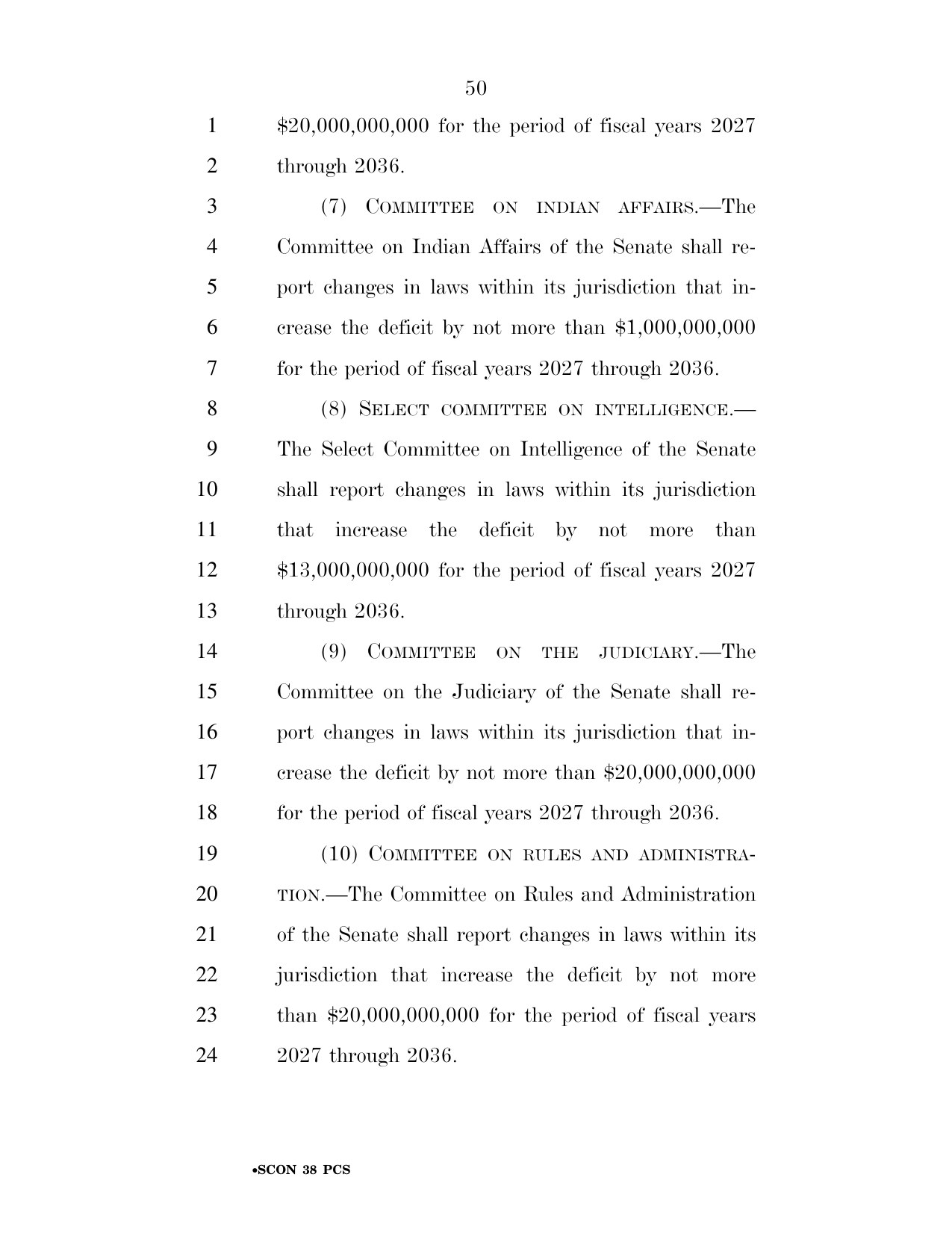
Read or download the full 70-page resolution (PDF) · view the same document on govinfo.gov
Why an election-law provision has a Byrd rule problem
Section 313 of the Congressional Budget Act bars provisions extraneous to the reconciliation instructions. The test that bites here is the fourth: a provision fails if its effect on outlays or revenues is "merely incidental" to its non-budgetary purpose. Telling a state how to run its elections is non-budgetary on its face. Handing a state money with conditions attached is not, which is why both resolutions route the SAVE America Act through a grant fund instead of a mandate.
James Wallner, a former Senate Republican staff director who writes at Legislative Procedure, spells out the jurisdictional catch. "Senate precedents bar committees from including terms and conditions under another committee's jurisdiction in their reconciliation title," he wrote, and Senate Rule XXV gives Rules and Administration jurisdiction over federal elections. That is why Johnson gave that committee $20 billion of instructions, and why the House resolution, which instructs no Senate committee at all, cannot finish the job alone.
Be precise about the parliamentarian. Elizabeth MacDonough has not ruled on the grant fund, because no committee has reported a line of reconciliation text and the deadline is September 11. What she did do, per Time, is advise that the SAVE America Act as written failed the Byrd rule inside the earlier reconciliation package, and Time hedges that with "reportedly." Trump has demanded Thune fire her. Waiving a Byrd rule point of order takes 60 votes, and ignoring her advice takes the nuclear option, which Thune and SAVE Act supporter James Lankford of Oklahoma both told Roll Call they will not use.

Sen. Ron Johnson, R-Wis., chairman of the Senate Budget Committee, who wrote S. Con. Res. 38 and then pulled the planned vote on it. Official Senate portrait, 2020, U.S. Senate Photographic Studio (public domain, via Wikimedia Commons).
Four Republicans, three roll calls, all on the record
Susan Collins of Maine, Mitch McConnell of Kentucky, Lisa Murkowski of Alaska and Thom Tillis of North Carolina have voted against putting the SAVE America Act into reconciliation every time it has come up. On April 23 at 12:31 a.m., a John Kennedy amendment writing reconciliation instructions for Rules and Administration failed 48 to 50 against a 60-vote threshold. On June 4 a Lindsey Graham amendment carrying the bill text failed 48 to 50. On June 5 a Mike Lee version failed 50 to 49.
McConnell chairs the Rules Committee, the panel that Fox News noted would have written the bill had Kennedy's amendment carried. He has not explained himself publicly and did not answer a Daily Signal questionnaire sent to every Republican Senate office. Collins told The Hill, "In general, my view is we should not be using reconciliation, we should work through the normal appropriations process." Murkowski said she is "not a big fan of reconciliation whether it's 1.0, 2.0 or 3.0," and Bill Cassidy of Louisiana told the Daily Signal she objects to the mail-ballot language because absentee voting is "very important in Alaska." The right flank objects in the other direction: Massie called the package "a slush fund for the Iran War" that would "add $130 billion to our debt," farm-state senators think $12 billion is too little, and defense hawks are looking at $60 billion when the administration asked for $350 billion.
Tillis has the argument conservatives should wrestle with, and it is operational rather than ideological. Thousands of state and local election offices cannot rewrite registration and ID procedures in 60 days. "There's no funding. There's no specific implementation instructions," he said in a floor speech carried by C-SPAN. He says the calendar killed the bill, not opposition to voter ID.
What happened the night the Senate left town
Trump spent weeks demanding the Senate cancel its August recess until the bill passed. Thune refused, and his public answer was a question: "Show me how this ends. What's the picture of victory at the end?" He also said flatly that "there aren't going to be 50 votes to get rid of the legislative filibuster."
On the night of August 7, Johnson, Lee and Rick Scott of Florida came out of Thune's office after a two-hour conference meeting and a call with Trump, and the procedural vote was dead. "Then we had a discussion with the president," Johnson told Roll Call. "He agrees. Don't take the vote tonight, and just work diligently through August and September to do an actually … better reconciliation bill."
Republicans took a vote on Jon Husted's standalone photo ID bill instead, S. 5271. Cloture failed 52 to 46 at 4:36 in the morning, every Republican present yes, every Democrat no. Chad Pergram reported for Fox News that the 60-vote threshold on that test vote was written into the unanimous consent agreement Thune negotiated in advance, so the result was settled before the roll was called. The Senate adjourned 21 minutes later, all 100 senators consenting.
The calendar is the whole answer now
Both resolutions order committees to report by September 11. Pergram reports the Senate is not back for debate and votes until the afternoon of Monday, September 15. Funding lapses September 30. Election Day is November 3.
Thune has said what he wants the House resolution for, and it has nothing to do with elections: "It's a possibility that, if necessary, we could pull that budget resolution passed by the House and use it to fund government." That use is now mostly moot, since both chambers passed stopgaps before recess and are only arguing over whether the next cliff falls on December 4 or December 11.
Here is the part that should sting. House Republicans engineered a Byrd-compliant workaround, wrote it into a resolution and passed it by two votes with their most exposed members on the board. The Senate answered with a bigger version nobody would vote on, a 4 a.m. show vote rigged to fail, and a five-week recess. Whatever the Rules Committee eventually writes, Tillis is right that no state is rewriting its registration rules before November 3. The question for Senate Republicans is not whether the parliamentarian would have let them pass proof of citizenship. It is why they never got close enough to find out.
Hero image: Senate Majority Leader John Thune, R-S.D., at the Republican Jewish Coalition Annual Leadership Summit in Las Vegas, October 28, 2023. Photo by Gage Skidmore, CC BY-SA 2.0, via Wikimedia Commons.