ABC's "The View" opened its 30th season on September 8 by telling viewers that "our lives literally depend on" voting Democrats into office this November, while co-host Sunny Hostin raised the 25th Amendment four separate times as a way to remove President Trump from the White House. The broadcast aired in the middle of a live Federal Communications Commission proceeding in which ABC itself is arguing the exact opposite: that "The View" is a "bona fide news interview program" and should be exempt from the federal law requiring equal airtime for opposing political candidates.
What Did Whoopi Goldberg and Sunny Hostin Actually Say on Night One?
The Season 30 premiere aired at 11 a.m. Eastern on September 8, with the full cast of Joy Behar, Alyssa Farah Griffin, Whoopi Goldberg, Sara Haines, Sunny Hostin and Ana Navarro returning to the table, according to TVInsider's own recap. A full transcript published by NewsBusters, timestamped against the broadcast itself, shows Hostin returning to one idea throughout the show's first Hot Topics segment: "When do we really start, in earnest, and mean it honestly, considering the 25th Amendment," she asked, later adding that if Republicans "lose the House and they lose the Senate," the cabinet might "look at each other and say, okay, we got to take control of this, 25th Amendment."
Hostin repeated the phrase "25th Amendment" as a punchline four more times before the segment ended, each one following a joke about the president. Goldberg closed the segment differently, dropping the joking tone entirely: "Find every way that you can to vote. Help everybody you can to get out this vote because our lives literally depend on this." When Hostin asked how many days remained until the election, Navarro answered on air: 56.
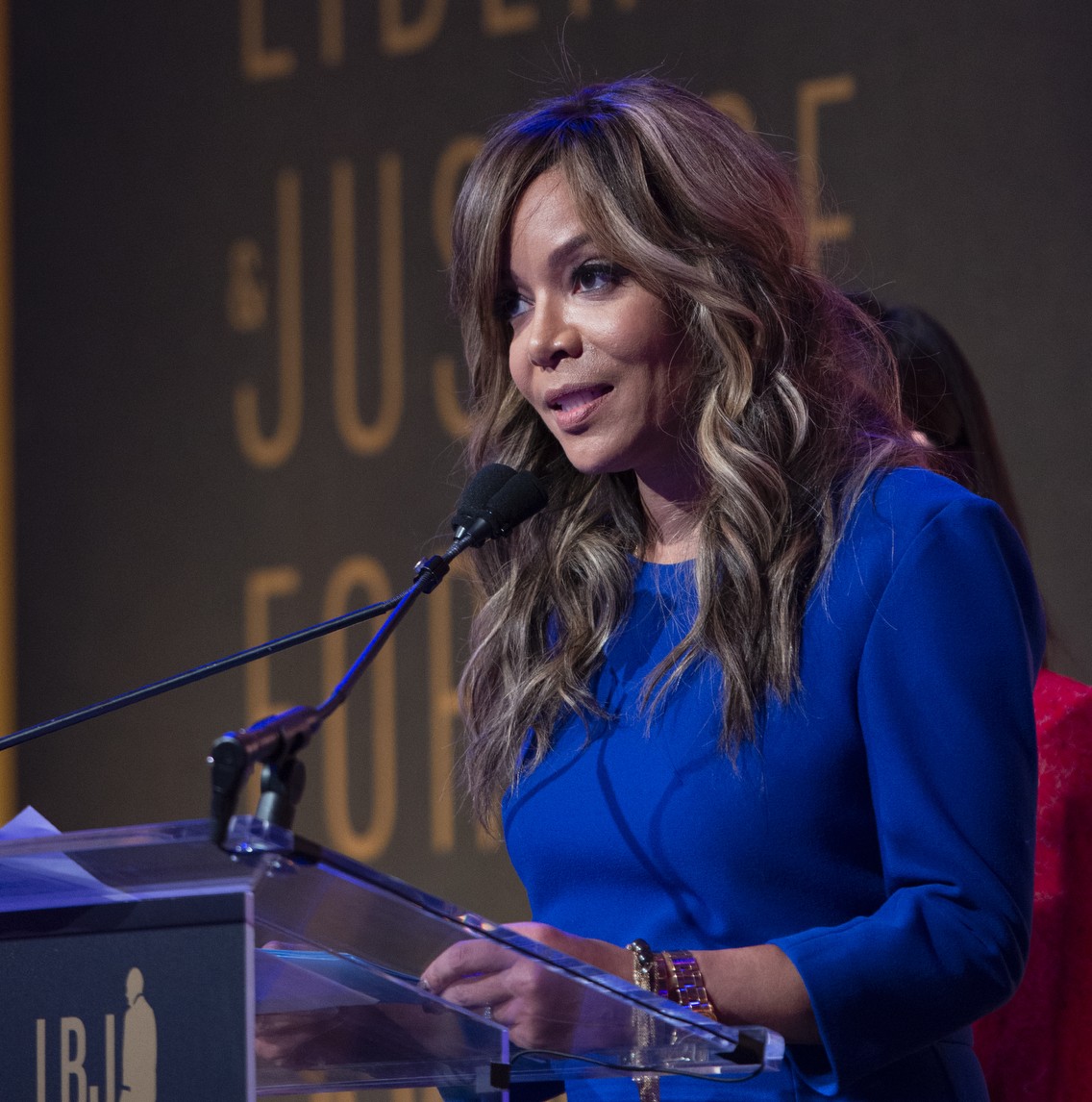
Sunny Hostin, seen here at a 2020 Library of Congress ceremony, repeated "25th Amendment" five times during the September 8 broadcast. Photo: LBJ Foundation/Jay Godwin, public domain.
Why Is a Daytime Talk Show Answering to a Federal Regulator at All?
Section 315 of the Communications Act of 1934 requires that if a broadcast station gives airtime to one legally qualified candidate for office, it has to give equal opportunity to that candidate's opponents, exactly the kind of rule that would make a running "vote Democrat" segment a problem for a licensed station. Congress carved out a narrow exception for programs that qualify as "bona fide news interview" shows, on the theory that real news coverage of candidates shouldn't trigger equal-time obligations. The text is public and searchable through Cornell Law School's US Code archive.
"The View" has held that exemption since 2002, but it came under direct scrutiny after Democratic Texas State Rep. James Talarico, then running for US Senate, appeared on the show on February 2, 2026, without Republican rivals getting comparable time. FCC Chairman Brendan Carr confirmed the agency was "pursuing Disney's program The View as an enforcement matter," as reported by The Hill and PBS NewsHour. Rather than fight the enforcement action directly, ABC and its Houston station KTRK-TV went on offense: on May 7, 2026, they filed a Petition for Declaratory Ruling asking the FCC to formally reaffirm that "The View" qualifies for the news exemption going forward.
The FCC's Media Bureau opened a public docket on that petition three weeks later. The proceeding is still open.
Does a Get-Out-the-Vote Segment Meet the Legal Test ABC Is Asking For?
The FCC's own public notice spells out exactly what separates a protected news program from a partisan one. A qualifying show has to be run so "that the content, format and participants not be intended for the political advantage of candidates," and a program otherwise eligible for the exemption loses it if it was "designed for the specific advantage of a candidate." That standard, cited directly from FCC precedent, is printed on page one of the notice below.
Official record
FCC Media Bureau Public Notice DA 26-517, "FCC's Media Bureau Seeks Comment on Petition by Disney's ABC Asking the FCC to Declare That The View Qualifies as a Bona Fide News Interview Program," MB Docket No. 26-124, released May 22, 2026.
"When considering the scope of an exemption related to a specific program, the FCC has long sought to ensure that the content, format and participants not be intended for the political advantage of candidates." — FCC Media Bureau, Public Notice DA 26-517
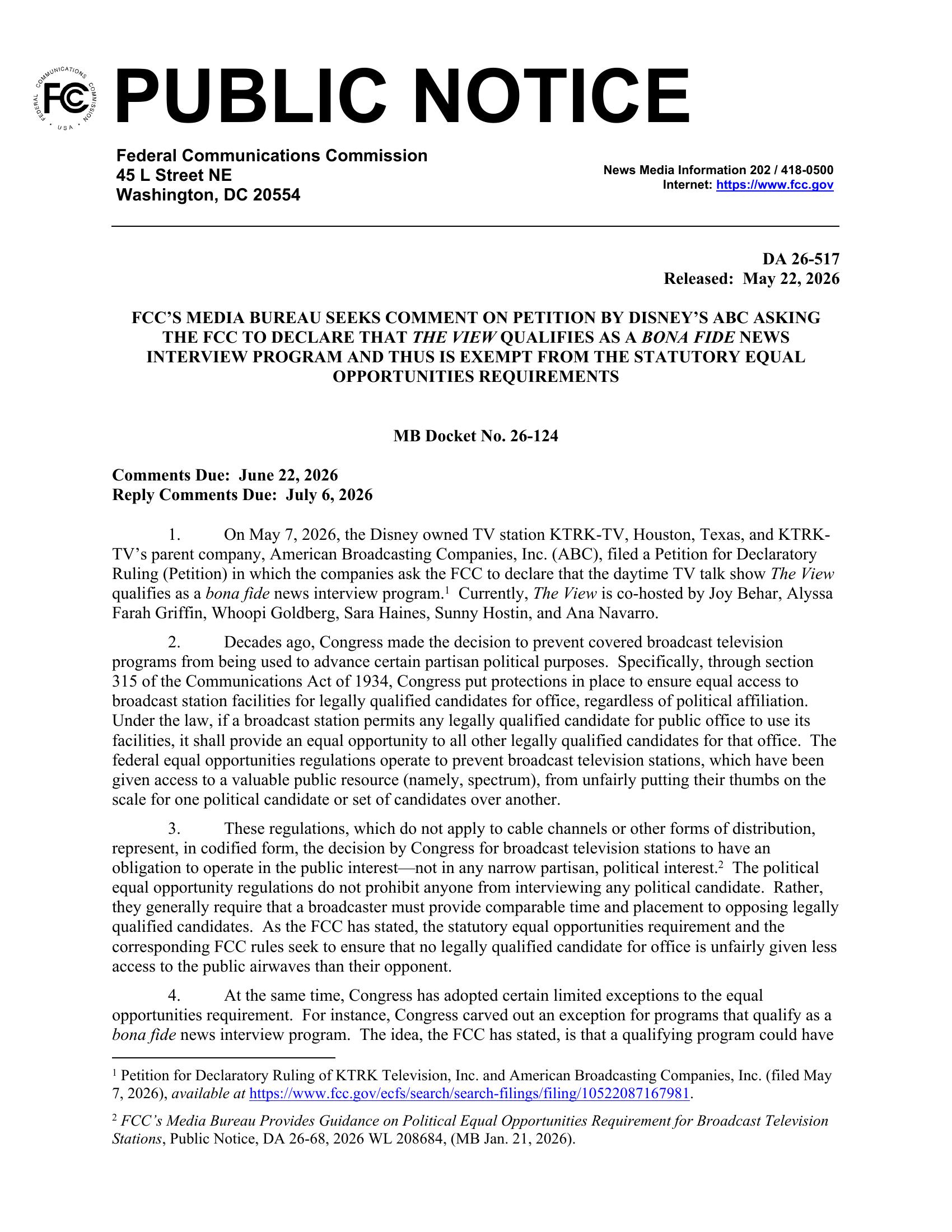
Read or download the full 3-page notice (PDF) · view the original filing on docs.fcc.gov
Nothing in that standard asks whether a host is likeable or whether the audience enjoys the show. It asks whether the content was built to help one side of a partisan race. A season premiere that instructs viewers to vote out a sitting president and speculates, on air, about which chamber losses would finally convince a cabinet to invoke the 25th Amendment is not a hard case to analyze against that language. ABC's own petition is what put that test in front of regulators in the first place, and its own flagship show answered the question three months later on live television.
What Has the Media Research Center Already Told the FCC?
ABC did not have the field to itself. On June 22, 2026, the last day of the public comment period, the Media Research Center filed what it called 2,473 separate pieces of evidence documenting years of one-sided booking and commentary on the show. MRC President David Bozell told the commission plainly that "The View" operates "for political purposes and is therefore not entitled to an exemption to the law," and accused ABC of misrepresenting its own program to federal regulators.
ABC's public response arrived the same morning the comment window closed, an on-air segment urging fans to submit comments defending the show, without mentioning that the FCC inquiry existed because of ABC's own petition. Chairman Carr had previously posted the underlying question directly to the public on his own account: "Disney wants the FCC to classify The View as a bona fide news program under federal law. Doing so would exempt The View from the political equal time requirements that Congress passed decades ago. What do you think?"
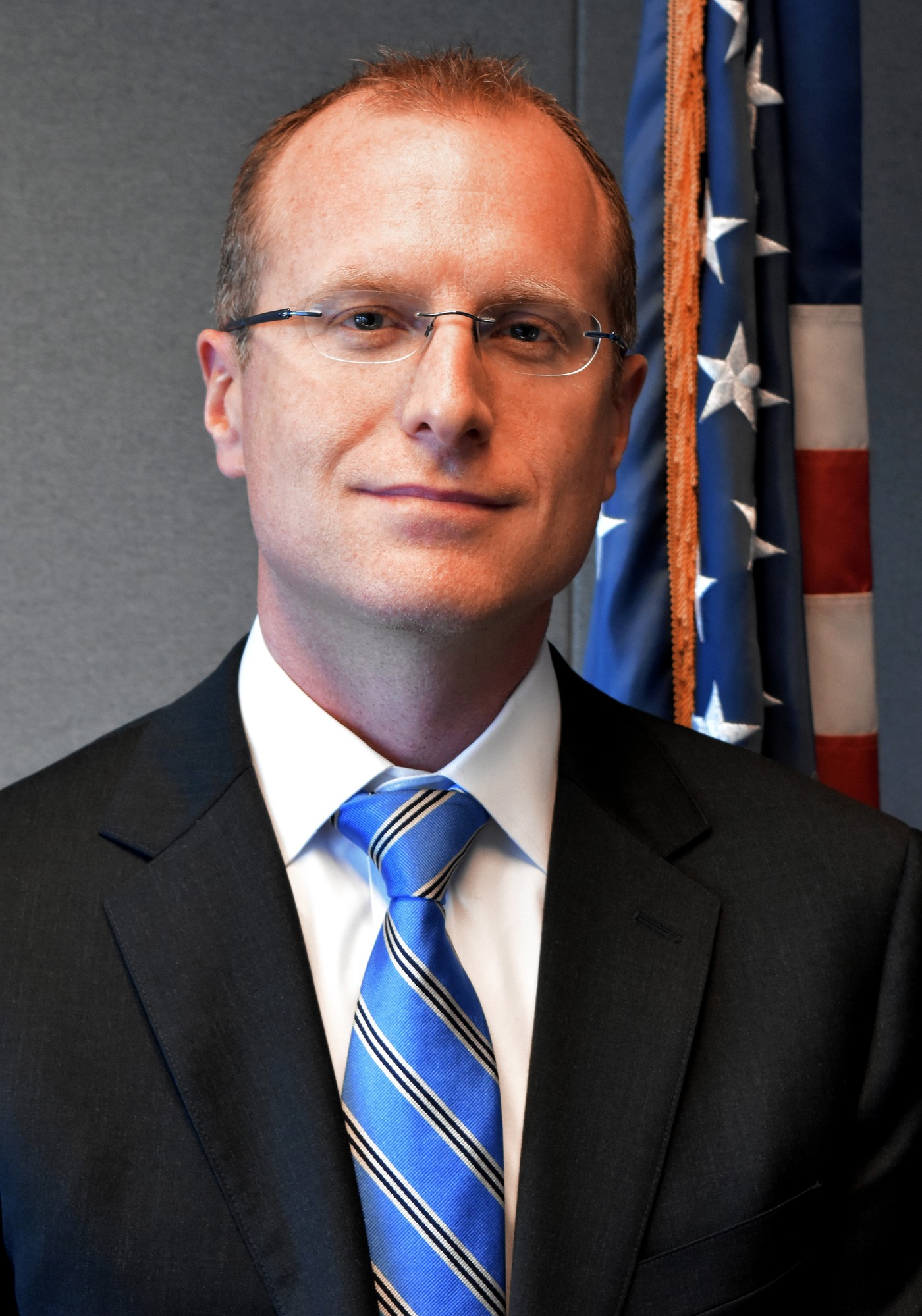
FCC Chairman Brendan Carr has said the agency is treating the equal-time question as a live enforcement matter, not a formality. Official FCC photo, public domain.
Why Didn't Anyone Covering the Premiere Mention Any of This?
Entertainment coverage of the same broadcast ran heavy on nostalgia and light on the regulatory fight playing out over the same content. TVInsider's premiere writeup focused on Joy Behar passing a hosting-tenure milestone. A separate piece on the premiere, syndicated through Yahoo News Canada, led with a personal update Goldberg shared backstage. Neither mentioned that the same episode's Hot Topics segment was arguably the clearest real-world test yet of the exact legal standard sitting in front of the FCC in MB Docket No. 26-124.
That is not a small omission. The petition asking regulators to call this show exempt "news" was filed by the same network airing the segment, and the segment itself supplies the evidence either side would want to use. Coverage built around season milestones and green-room anecdotes left that connection for conservative media and MRC's own monitoring operation to draw, even though it required nothing more than reading the FCC's own public docket alongside the day's transcript.
What Happens Next, and What's Actually at Stake?
Reply comments in MB Docket No. 26-124 closed July 6, 2026, and the Media Bureau has not issued a ruling as of this writing. The docket remains open and searchable on the FCC's own site. Whichever way it goes, the decision will set a real precedent, not a symbolic one.
If the FCC denies ABC's petition, stations that aired the September 8 broadcast could face equal-opportunities exposure the next time a Republican opponent asks for comparable time. If the FCC grants it, a network will have secured formal cover to keep running exactly this kind of programming, an open call to vote out a sitting president, branded as protected news interview content immune from the rules Congress wrote to stop broadcasters from doing precisely that. With 56 days left before Americans vote, as Ana Navarro herself counted down on the air, that is not a rhetorical stakes line. It is the number the FCC's own pending decision will be measured against.