U.S. forces killed four more suspected drug traffickers in a Caribbean strike Saturday, the latest hit in a military campaign against cartels that just passed its first anniversary without ever getting a vote from Congress. The legal theory behind every strike, built within two weeks of the first one, is still classified.
What happened in the Caribbean this weekend
On Saturday, Joint Task Force Western Hemisphere, operating under U.S. Southern Command, hit a go-fast vessel "operating along established narco-trafficking routes in the Caribbean," SOUTHCOM said in a statement posted to social media. "Confirmed intelligence revealed the vessel's active involvement in narco-trafficking," the command added. The strike killed four people, and video posted alongside the statement showed a small boat followed by a large explosion, according to Euronews' report on the strike.
No names, no nationality, no evidence beyond the government's own word were made public. That has been true of nearly every strike in this campaign since the first one, which happened one year and 17 days earlier.
A campaign that just turned one
Operation Southern Spear began September 2, 2025, when U.S. forces struck a boat "at a location beyond the territorial seas of any nation" that Trump's own letter to Congress said was "assessed to be affiliated with a designated terrorist organization." A year later, on September 2, 2026, Pentagon officials briefed reporters on what SOUTHCOM called a largely successful mission: a 65 percent reduction in illicit maritime activity in the Western Caribbean, 60 percent in the Eastern Caribbean, and nearly 50 percent in parts of the Eastern Pacific, according to the War Department's own one-year briefing.
The Pentagon's most recent quarterly report to Congress on the operation, covering April through June of this year, put a harder number on it: 19 vessels struck, roughly 56 people killed or presumed dead. The quarter before that, January through March, saw 12 vessels hit and 40 killed. That is 96 dead in six months by the government's own count, before Saturday's four are added on top.
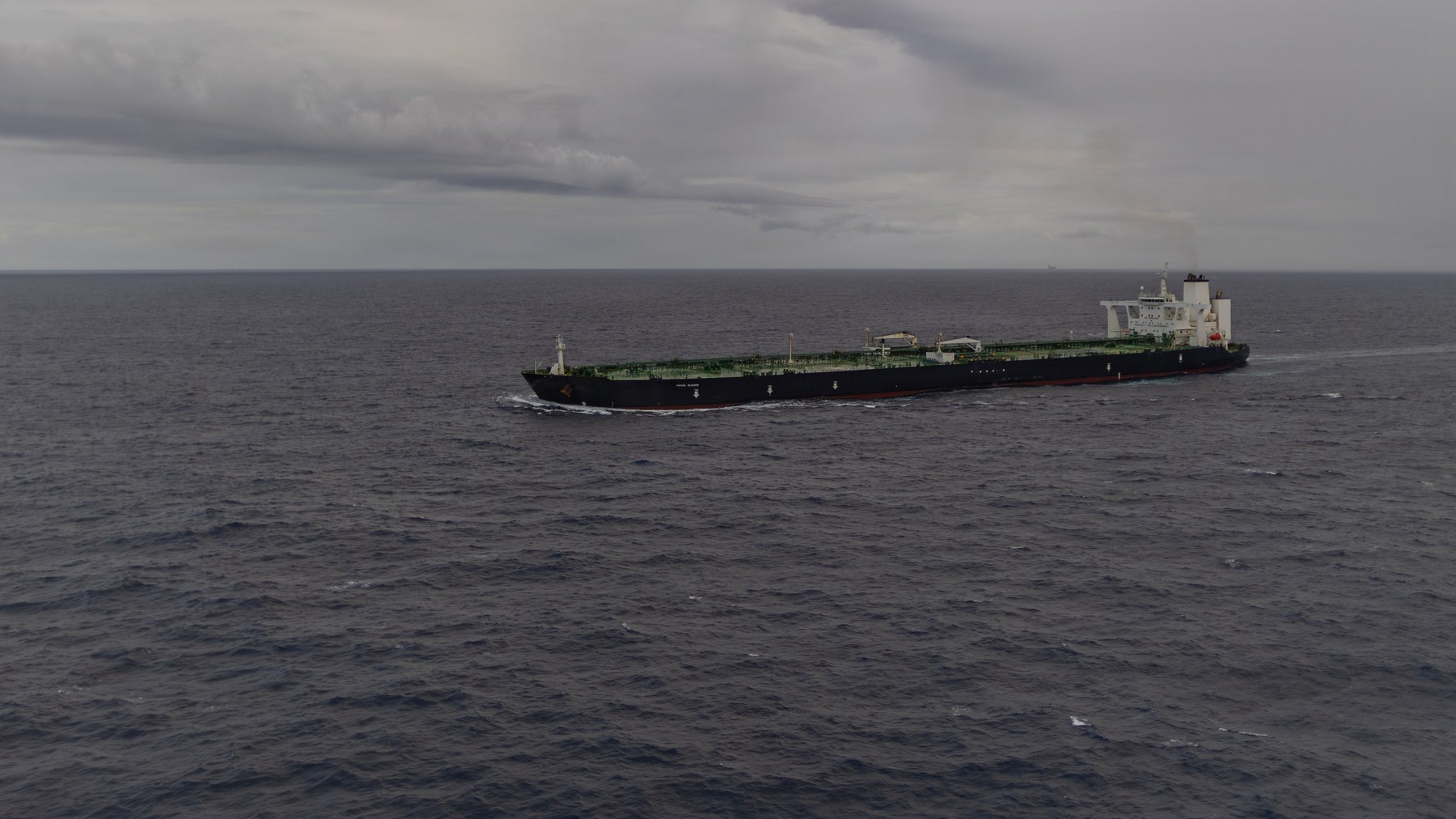
The stateless tanker M/T Sophia transits the Atlantic during a U.S. Southern Command right-of-visit boarding, Jan. 7, 2026. Boardings like this one and lethal strikes like Saturday's are both part of the counternarcotics campaign officials credit with this year's drop in Caribbean smuggling traffic. (U.S. Navy photo, public domain)
The war Congress never declared
None of this runs on anything Congress passed. Thirteen days after the first strike, the administration sent lawmakers a formal notice, required under Section 1230 of the 2024 defense authorization law, that changed the legal picture entirely. "The President determined that the United States is in a non-international armed conflict with these designated terrorist organizations," the notice reads. "The President directed the Department of War to conduct operations against them pursuant to the law of armed conflict." The same notice described the dead from the September 15, 2025 strike as "approximately 3 unlawful combatants."
Official record
President Trump's original War Powers letter to Speaker Mike Johnson, House Document 119-92, dated September 4, 2025, and the separate notice filed under Section 1230 of the FY2024 National Defense Authorization Act roughly two weeks later.
"At my direction, on September 2, 2025, United States forces struck a vessel at a location beyond the territorial seas of any nation that was assessed to be affiliated with a designated terrorist organization and to be engaged in illicit drug trafficking activities." — House Document 119-92
"The President determined that the United States is in a non-international armed conflict with these designated terrorist organizations... This strike resulted in the destruction of the vessel, the illicit narcotics, and the death of approximately 3 unlawful combatants." — Section 1230 notice to Congress
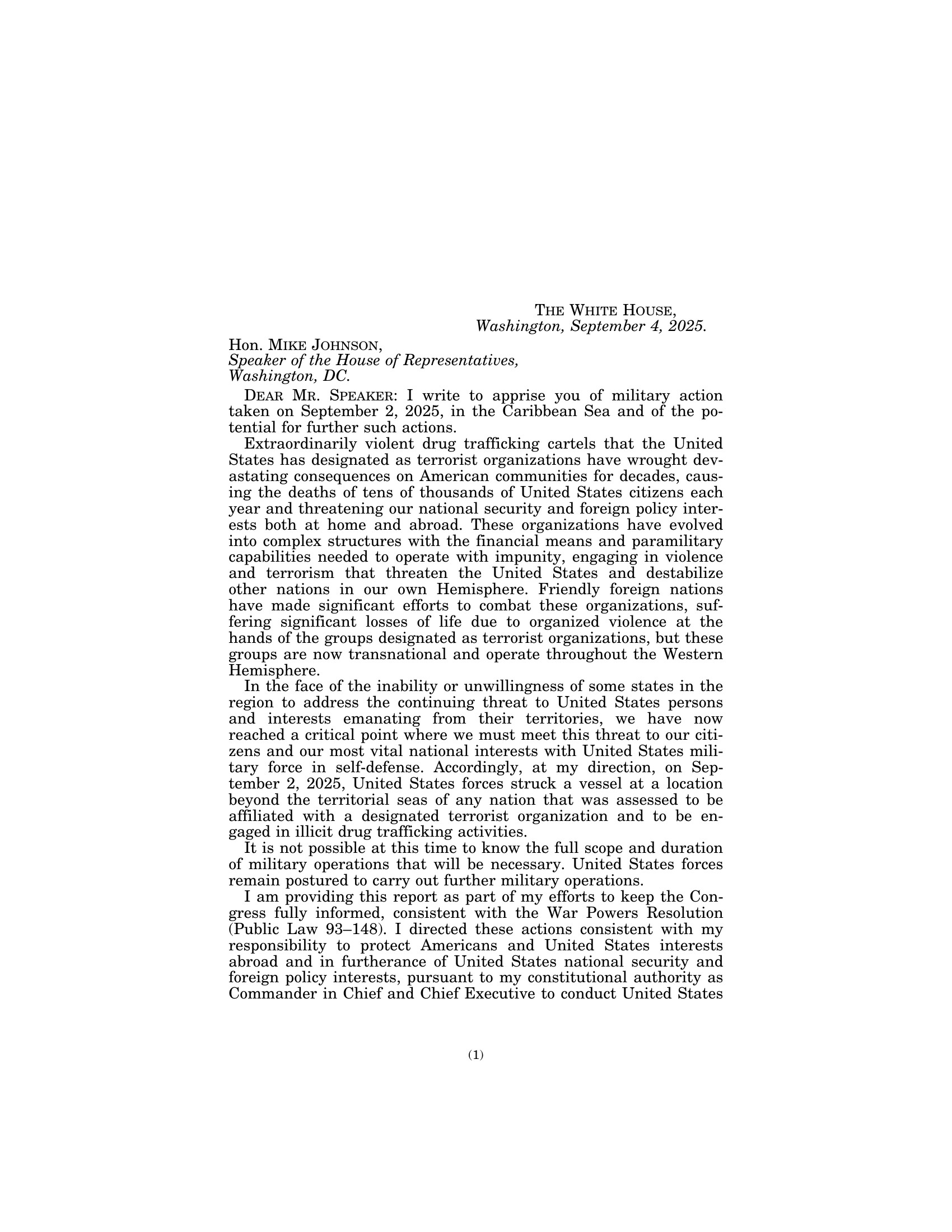
Read the full House Document 119-92 (PDF) · read the Section 1230 notice in full
How "self-defense" became "armed conflict" in two weeks
Read side by side instead of through secondhand paraphrase, the two documents do not describe the same legal theory. Trump's original September 4 letter uses only the vocabulary of an aggressive but ordinary self-defense action. Forces struck a vessel "assessed to be affiliated with a designated terrorist organization," acting "in self-defense." Nothing in that letter mentions an armed conflict, the law of war, or combatant status of any kind.
The Section 1230 notice, covering a strike that happened less than two weeks later, is a different document making a different claim. It invokes "the law of armed conflict" by name, states a formal presidential determination of "non-international armed conflict," and labels the dead "unlawful combatants," a term borrowed from the post-9/11 terrorism fights that carries real legal weight: no criminal charge, no trial, no judicial review, just a strike. Most of this year's anniversary coverage treats "unlawful combatants" as the administration's position from day one. The government's own paper trail shows it was built, and hardened considerably, inside the campaign's first two weeks.
From sinking boats to striking land
The campaign has also grown well past speedboats at sea. A House Document filed in March 2026 informed Congress that "at the invitation and with the consent of the Government of the Republic of Ecuador, United States Armed Forces partnered with Ecuadorian Armed Forces to strike," on March 6, the facilities of narco-terrorists on land, not a vessel in open water, according to House Document 119-141.
It is the same legal and diplomatic formula, a foreign government's consent plus the cartel terrorist designation, that turned one vessel strike into a yearlong campaign, now extended onto land alongside a partner nation's own military. Most one-year retrospectives calling this "the boat strikes" do not mention that expansion at all.
Congress has tried to stop it, and lost
The clearest attempt came October 8, 2025, when a joint resolution from Sens. Adam Schiff of California and Tim Kaine of Virginia, forcing a vote under the War Powers Act, failed on the Senate floor 48 to 51. Only two Republicans, Rand Paul of Kentucky and Lisa Murkowski of Alaska, voted with nearly every Democrat to advance it, while Democratic Sen. John Fetterman of Pennsylvania crossed over to vote with Republicans against it, according to CBS News' account of the vote.
Paul, a Republican, made the due-process argument more bluntly than any Democrat on the floor that day. "Is it too much to ask to know the names of those we kill before we kill them? To know what evidence exists of their guilt?" he said, adding that "the blow-them-to-smithereens crowd also conveniently ignores the fact that death is generally not the penalty for drug smuggling." Secretary of State Marco Rubio, at the Capitol the same day, told reporters plainly: "These are targeted strikes against imminent threats against the United States."
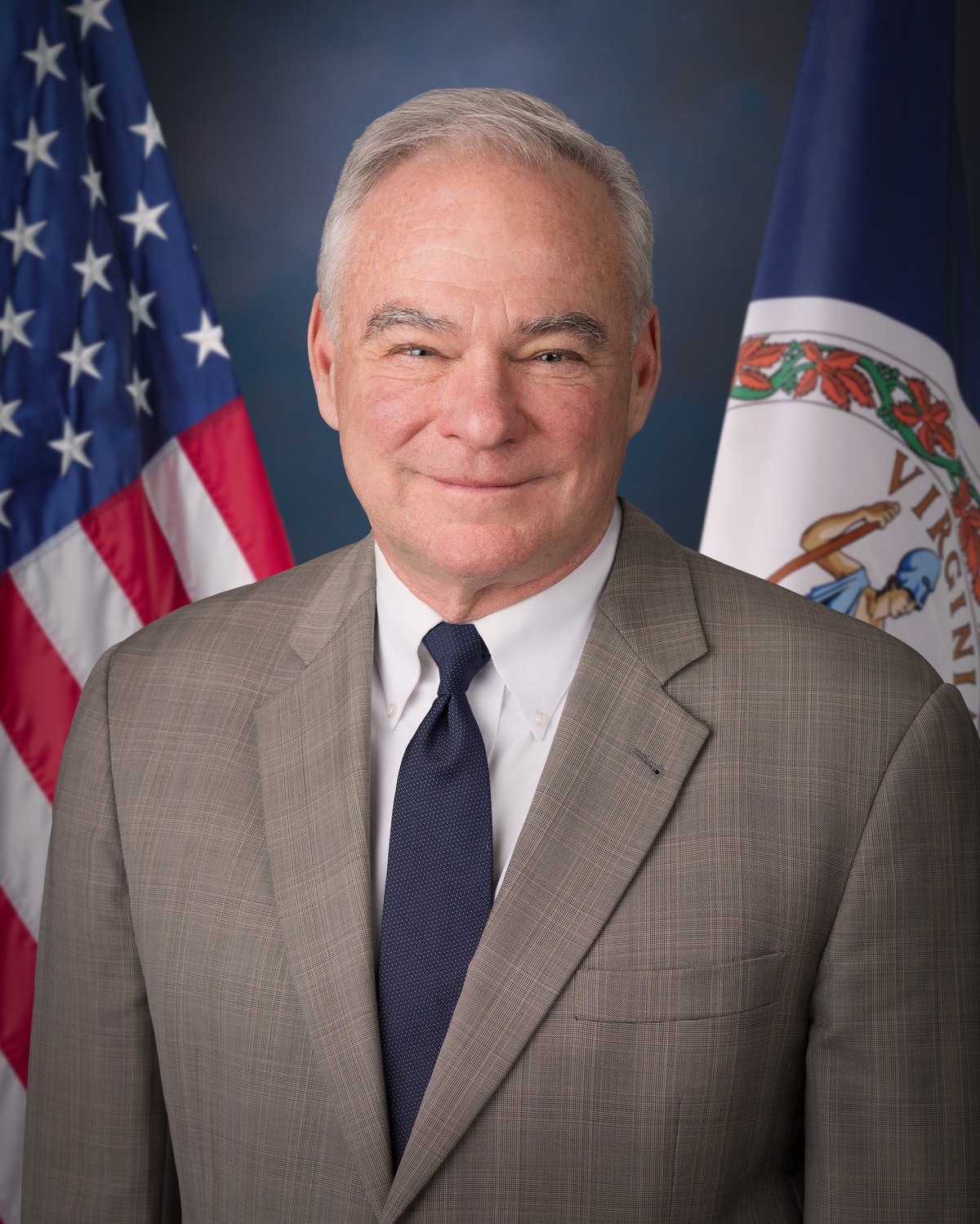
Sen. Tim Kaine, D-Va., co-sponsored the October 2025 War Powers resolution to end the Caribbean strikes. It failed 48-51, with Republicans Rand Paul and Lisa Murkowski the only members of their party to vote for it. (Official portrait, 119th Congress, public domain)
The latest attempt came on the campaign's own anniversary. On September 2, 2026, House Foreign Affairs ranking member Gregory Meeks, Armed Services ranking member Adam Smith, Intelligence ranking member Jim Himes, and Homeland Security ranking member Bennie Thompson introduced a new War Powers Resolution, arguing the administration had used "the U.S. military and taxpayer dollars to execute at least 227 individuals without due process or a credible national-security justification," per their own joint statement. Meeks called it a campaign with "little to show...except a mounting body count, a massive price tag, and a stain on the American conscience." As of this writing there is no scheduled floor vote.
What Washington still will not show the public
The document that actually justifies all of this, a classified Justice Department Office of Legal Counsel opinion, has never been released to the public. The American Civil Liberties Union, the Center for Constitutional Rights, and the New York Civil Liberties Union sued for it under the Freedom of Information Act in December, and as of this writing the administration is still fighting to keep it sealed. Congress got a limited look in mid-November, and one senator came away telling the Washington Post the opinion "would not constrain any use of force anywhere in the world."
The administration has never published a running public death count of its own. The Pentagon's quarterly reports account for 96 killed across the two most recent quarters alone, a partial number that does not cover the campaign's first six months. The ACLU's own September 2 anniversary statement independently arrived at the same figure House Democrats used that day, "at least 68 strikes" and "at least 227 civilians" killed, and named two of them: Chad Joseph and Rishi Samaroo, Trinidadian fishermen the group says were headed home from farm work in Venezuela when an October 14, 2025 strike killed them. Their families are suing the government in a separate case. None of that has been proven in court, and the administration has not conceded a single one of these strikes hit the wrong target, but it is a specific enough claim that "at least 227" stops being an abstraction.
What is not in dispute is that the Pentagon's own numbers show a real drop in Caribbean and Pacific smuggling traffic this year, and that the campaign has never once been put to Congress for an up-or-down vote it might actually lose. One of those facts should please most of this site's readers. The other ought to worry them regardless of who they voted for, because a legal theory built in less than two weeks to justify killing suspected traffickers without a trial does not stay pointed at cartels by default. It stays pointed wherever the next president decides to aim it.