A federal judge has accused Philadelphia District Attorney Larry Krasner and his own top deputy of threatening the prosecutors who work for them, then referred both men to the U.S. Attorney's Office for possible criminal investigation. In a 40-page memorandum issued September 15, U.S. District Judge Paul S. Diamond found what he called a "prima facie showing" that Krasner and Matthew Stiegler, chief of the office's Conviction Integrity Unit, may have committed perjury, false statements, obstruction of justice and conspiracy.
Diamond removed both men from the case entirely. Whether the U.S. Attorney's Office in Philadelphia acts on the referral is now up to federal prosecutors, in an administration Krasner has picked fights with before, including his public vow to arrest ICE agents working at Philadelphia's own airport.
What Judge Diamond actually found
The case is Johnson v. Nickelson, Civ. No. 15-4965, a federal habeas corpus petition pending in the Eastern District of Pennsylvania. Diamond, a George W. Bush appointee, spent months holding evidentiary hearings with live testimony before reaching his conclusion. Notably, Krasner was not the only party asking Diamond to act. Pennsylvania's Republican Attorney General, Dave Sunday, had his office intervene and separately urge the judge to disqualify Krasner and the entire District Attorney's Office over the same conflict.
"The credible evidence is tantamount to a prima facie showing of conduct that may constitute false statements, false declarations made under oath, perjury, obstruction of justice, and conspiracy," Diamond wrote, citing the specific federal statutes: 18 U.S.C. §§ 1001, 1621, 1623, 1503 and 371. He disqualified Krasner from the case, disqualified Stiegler, and declined a broader request to disqualify the entire District Attorney's Office. "I have thus reluctantly concluded that Philadelphia's highest law enforcement official and one of his top assistants may have violated the law," the judge wrote, according to WHYY's report on the memorandum.
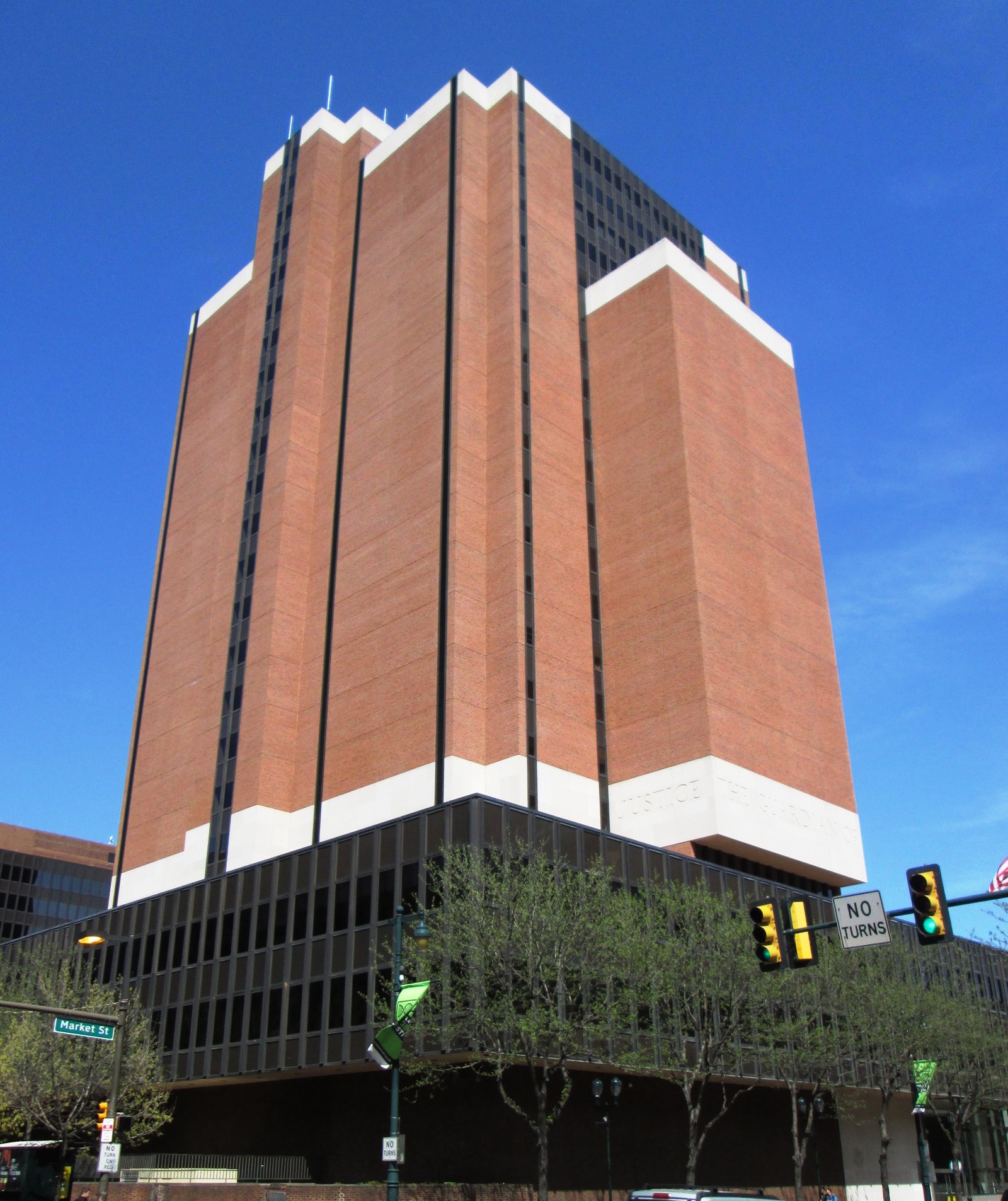
The James A. Byrne United States Courthouse in Philadelphia, where Judge Paul S. Diamond sits on the U.S. District Court for the Eastern District of Pennsylvania. (Photo by Beyond My Ken, CC BY-SA 4.0 via Wikimedia Commons.)
The 2007 killing at the center of the case
The underlying case has nothing to do with politics on its face. Dennis Johnson was convicted in 2009 of second-degree murder, robbery and a firearms offense for the killing of Kenyatta Smith, who was shot during a robbery outside the Lehigh Variety convenience store in North Philadelphia. He was sentenced to life in prison.
Johnson filed a federal habeas petition in 2016. The District Attorney's Office initially opposed it, then reversed course after Krasner took office in 2018. In May 2022, Johnson's attorneys submitted new evidence: one eyewitness recanted his identification, a second witness said he never actually named Johnson as the shooter, and two people came forward claiming a third man had confessed. That November, an assistant district attorney with no prior experience as a criminal litigator filed the office's response agreeing Johnson was entitled to relief.
How the concession fell apart inside the DA's office
Diamond scheduled an evidentiary hearing this year and invited the Pennsylvania Attorney General's Office to participate, since the District Attorney's Office was effectively supporting the defendant's position. While preparing for that hearing, four supervisors in the office's Law Division, Katherine Ernst, Steven Wildberger, David Napiorski and Peter Andrews, reviewed the trial record themselves and found what they considered material errors in the 2022 concession. In June, they moved to withdraw it, testifying that Stiegler had dictated the substance of the earlier filing under guidance from the Innocence Project without independently investigating the case.
"There would be consequences"
According to Diamond's findings, when the four supervisors brought Krasner a draft letter proposing to refer the case to the state Attorney General's Office over the conflict, Krasner was "apoplectic," "furious" and "very angry with us." He told the group there would be "consequences" if any of them told the judge about the conflict without his approval, using the word three times. Two of the supervisors testified they understood that to mean losing their jobs.
Official record
Memorandum, Johnson v. Nickelson, Civ. No. 15-4965 (E.D. Pa. Sept. 15, 2026), Document 173.
"District Attorney Krasner correctly assumed that Ms. Ernst was one of those people and he said that there would be consequences for Ms. Ernst if she alerted the Court to the conflict issue." — Judge Paul S. Diamond, quoting hearing testimony, Memorandum at 26
Read the full 40-page memorandum on DocumentCloud, or view the official case record on govinfo.gov.
Krasner's alarm reportedly ran deeper than a policy disagreement. One supervisor, Ernst, later told a colleague, "The DA has threatened to fire anyone who tells the Judge about this." Another supervisor pushed back on the word "fired" but not the substance, saying Krasner "didn't say fired, he said there would be consequences."
The judge draws a distinction
Most of the coverage of the referral has treated Krasner and Stiegler as a package deal. Reading the memorandum itself turns up a sharper split. Diamond writes that Stiegler's conduct "may well amount to perjury," but then adds a line that secondary reporting has largely skipped past: "Mr. Krasner's actions are more troubling."
The judge found that Krasner did not simply go along with a plan Stiegler proposed. He personally directed the Law Division supervisors, who serve at his pleasure, to implement it and to present what Diamond calls a false narrative to the court. Krasner also directed that the office stay on the case "to protect the office," which one supervisor testified he understood to mean protecting Krasner himself, and ordered the supervisors to conduct no independent investigation of their own. Wildberger testified that Krasner "didn't want people poking around in what occurred." Diamond concluded that threat could itself amount to obstruction of justice under 18 U.S.C. § 1503, separate from anything Stiegler did.
Krasner says he will appeal, no charges yet
Krasner has not been charged with a crime, and Diamond has no authority to bring one himself. That decision belongs to the U.S. Attorney's Office for the Eastern District of Pennsylvania, which declined to comment when CBS News Philadelphia and the Associated Press asked. In a statement, Krasner disputed the ruling outright. "I respectfully and vigorously disagree with the court's findings of fact and conclusions of law," he said. "I look forward to appealing to the higher court as soon as the law allows." Stiegler did not respond to reporters' requests for comment.
A familiar fight for a prosecutor Trump calls "the worst"
Krasner built his career on the opposite reputation this memorandum describes. Since taking office in 2018, he has expanded the Conviction Integrity Unit into one of the most active in the country, and voters rewarded him for it, reelecting him to a third term in November 2025 with 76 percent of the vote. His original 2017 campaign was boosted by nearly $1.7 million in spending from a Soros-backed PAC, Philadelphia Justice and Public Safety, according to WHYY's own reporting at the time, more than five times what Krasner's own campaign spent.
President Trump has called Krasner the "worst district attorney" in the country, and Pennsylvania's 2026 Republican gubernatorial nominee, Stacy Garrity, has made his record a centerpiece of her campaign. The friction goes beyond campaign rhetoric. Just months before this referral, Krasner stood at Philadelphia International Airport and warned ICE agents deployed there during a TSA staffing shortage that he would put them "in handcuffs" if their conduct at the airport resembled what he called the "criminal homicide of unarmed, innocent people" in Minneapolis, adding that the president "cannot pardon you."
That same instinct, that Krasner alone gets to decide who answers for what happens on his watch, is what a federal judge now says may have crossed into obstruction and perjury inside his own office. The disqualification stands regardless of what the Justice Department decides to do next. A sitting district attorney referred by a sitting federal judge for potential prosecution is rare enough that it would be news anywhere. In a city where Krasner just won reelection by 50 points, it lands as something closer to a reckoning.