Pete Hegseth's Pentagon says Canada's defense shortfalls "speak for themselves." They do, in Ottawa's own words: Canada's 2025-26 results report, signed by its defense minister, says only 41.9% of its key air fleets were serviceable, a figure that fell two years in a row, with a target date of 2032.
What did the Pentagon actually say about Canada?
On Nov. 23 the Pentagon put out a short document titled "Fact Sheet: Canadian Defense Shortfalls." According to the Associated Press, it says "Canada's defense shortfalls speak for themselves" and "Canada must get serious and focused," and it calls Hegseth "laser focused" on modernizing Canada's military.
Allied governments do not usually talk to each other this way in print. The fact sheet, as quoted by Canadian security analyst Wesley Wark, says Canada "has yet to make the hard decisions and tradeoffs needed," that Canada has no airborne early warning and control aircraft, the flying radar planes often called AWACS, and that Ottawa puts "parochial economic and commercial interests over military optimization." Wark, a former Canadian government adviser, called the document "insulting and infuriating."
AP reported the fact sheet's readiness numbers for 2025-26: 41.9% of the air force fleet and 53.9% of the naval fleet serviceable, and army readiness at 48%.
Where do those numbers come from?
Canada. The same figures sit in the 2025-26 Departmental Results Report from Canada's Department of National Defence, the annual scorecard every federal department files with Parliament. The minister's message is signed by Defence Minister David McGuinty, and the page was last updated Nov. 6.
The report's Table 2.2 lists the share of "aerospace key fleets that are serviceable to meet training, readiness, and operational requirements" at 41.9% for 2025-26. It was 48.9% in 2023-24 and 42.3% in 2024-25, so the air force got worse two years in a row. The target is 70%, and the report gives the military until March 2032 to reach it.
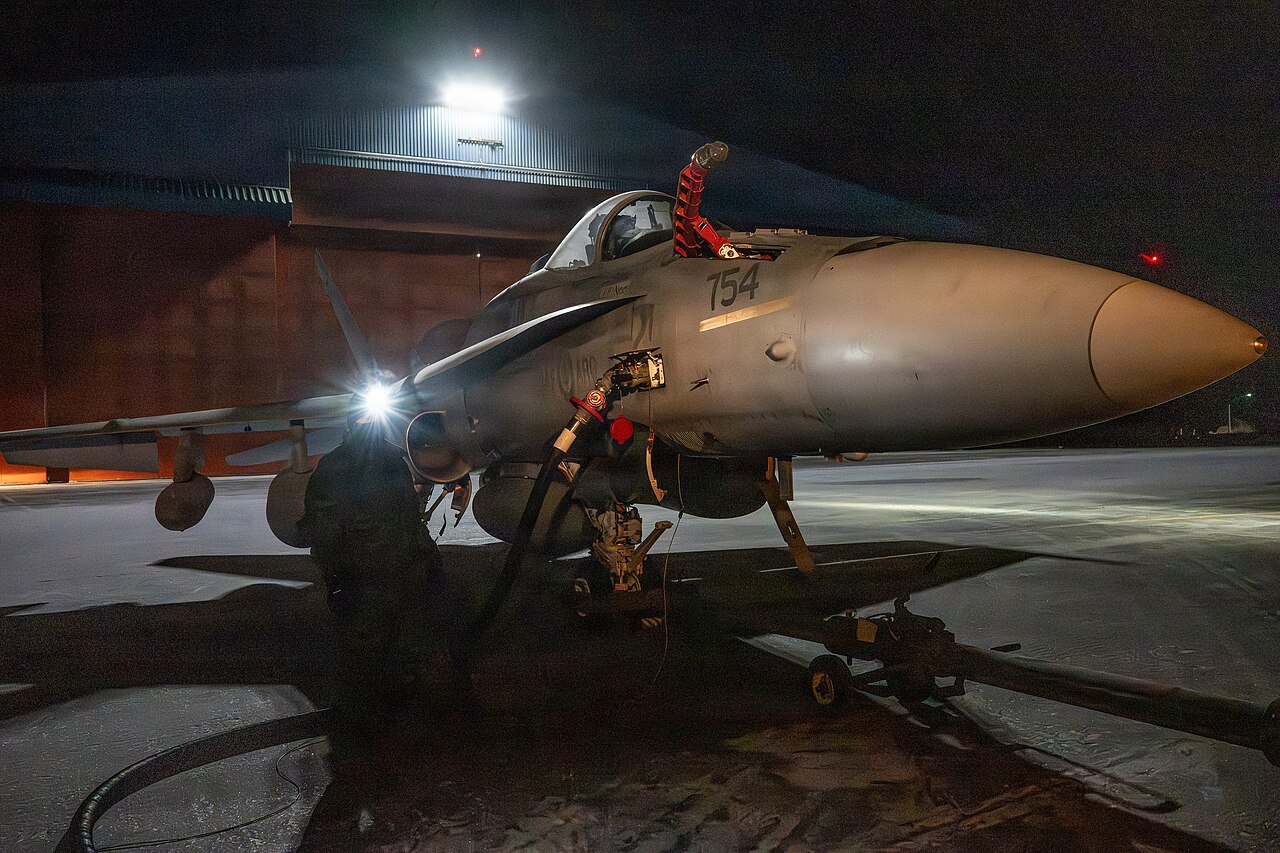
A member of NORAD's binational Air Task Force prepares a Royal Canadian Air Force CF-188 Hornet at Pituffik Space Base, Greenland, in January 2026 during Operation Noble Defender. U.S. government photo by Belynda Casse via Wikimedia Commons (public domain).
Maritime key fleets came in at 53.91% against a 60% target, after hitting 59.6% the year before. A footnote says "submarine availability declined due to maintenance and crew requirements." Prime Minister Mark Carney has acknowledged that only one of Canada's four submarines was seaworthy.
Official record
Department of National Defence and the Canadian Armed Forces, 2025-26 Departmental Results Report, Core Responsibility 2: Ready Forces, Tables 2.1 and 2.2. Published on Canada.ca.
"Persistent personnel and equipment shortfalls continued to affect overall force readiness." Canada's Department of National Defence, 2025-26 Departmental Results Report
Key results for 2025-26, as listed in the report: 61% of force elements ready for operations (target 90%); 33% of planned readiness achieved for the "core concurrent mission set" (target 90%); 41.9% of aerospace key fleets serviceable (target 70%); 53.91% of maritime key fleets serviceable (target 60%); 48% of land key fleets serviceable (target 70%). Every target date is March 2032.
The Pentagon's own fact sheet (PDF) is posted at Defense.gov.
Is the "48% army readiness" figure right?
It is a real number with a different label. In Canada's report, 48% is the share of "land key fleets" serviceable, meaning the army's vehicles and equipment, down from 51% the year before. AP's summary of the fact sheet calls it army readiness. We could not confirm the fact sheet's exact wording, because the Defense.gov file would not load for us.
Canada's own readiness numbers are arguably worse. The report says only 61% of force elements were ready for operations, and just 33% of the readiness Canada planned for its "core concurrent mission set," the set of missions it says it must be able to handle at the same time. Both targets are 90%.
What else is the Pentagon pushing back on?
Money and fighter jets. Canada signed on to NATO's pledge of 5% of GDP by 2035. AP's account of the fact sheet says Ottawa counts 4.1% in combined defense and security spending by 2027-28 but only 2.6% for core defense, and has pushed its biggest increases past the 2029 election. The Canadian Press reported that this month's federal budget stops its defense projections at 2030. In February, Canada's Parliamentary Budget Officer wrote that "the Government has not published supporting projection details" and put the cost of the NATO goal at about $159.1 billion Canadian in core defense spending in 2035-36.
Then there is the F-35. Canada decided in 2023 to buy 88, and Carney put the deal under review after taking office. As of Oct. 29, Ottawa had committed to at least 16 and received 2, the Canadian Press reported, while the rest "remains under review." Sweden's Saab Gripen is the alternative. AP reported that the fact sheet warns a mixed fleet could worsen pilot and crew shortages and create uncertainty for NORAD, the joint U.S.-Canada command that guards North American airspace.
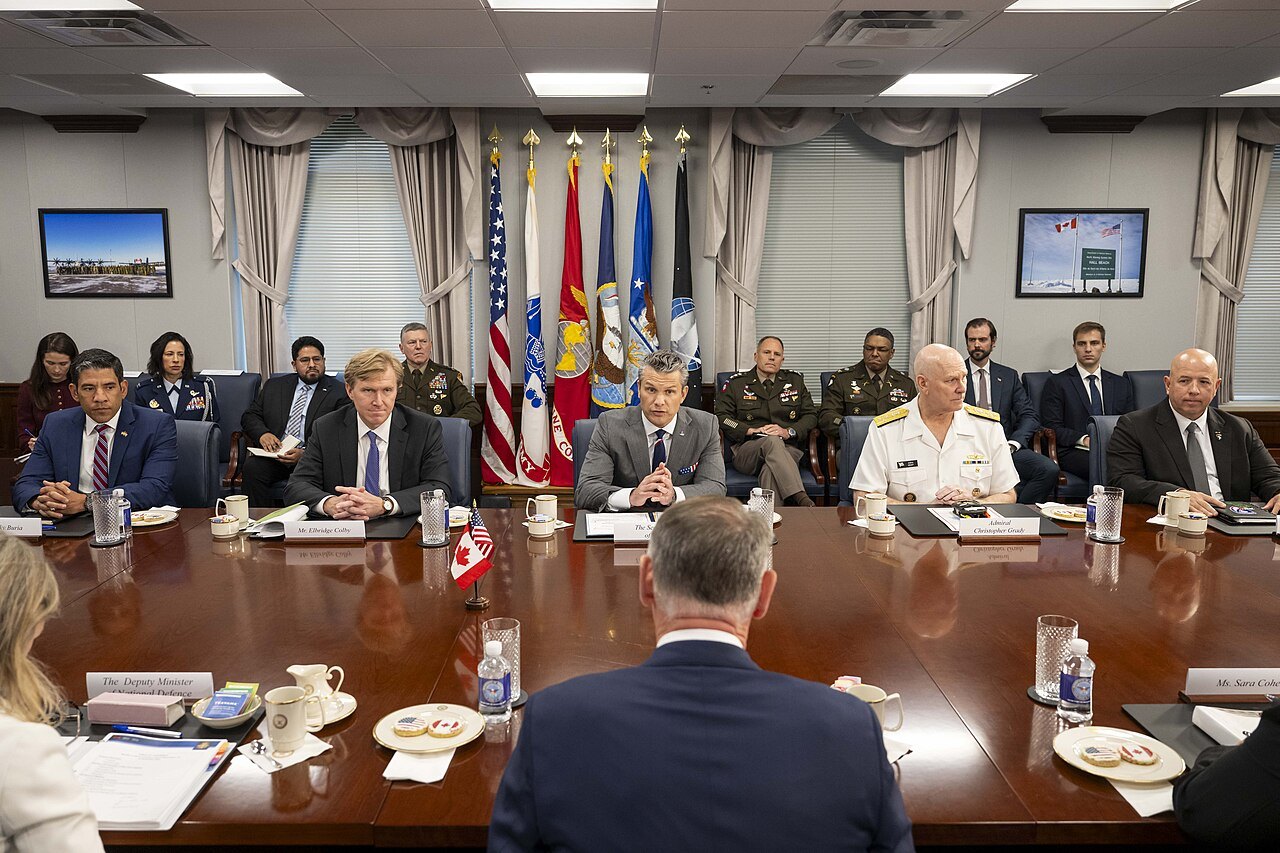
Hegseth hosts Canadian Defence Minister David McGuinty, back to camera, at the Pentagon on Sept. 22, 2025. Pentagon policy chief Elbridge Colby is seated to Hegseth's right. U.S. Department of Defense photo via Wikimedia Commons (public domain).
What does Ottawa say back?
Not much on the record. AP said National Defence and Carney's office did not comment on the fact sheet. The document follows a classified Hegseth memo, first reported by The Washington Post, that changes how U.S. officers deal with Canada. At the Halifax International Security Forum on Nov. 21, Sen. Mike Rounds (R-S.D.) told Breaking Defense it "does limit general flag officer meetings to those that advance DoD objectives," and that officers "must request permission for Canadian think tank events or social engagements." Pentagon spokesman Sean Parnell said it does not touch NORAD, NATO cooperation or intelligence sharing.
McGuinty said "there's some sort of document we haven't seen." In the same appearance he said, "We'd like to procure less from the United States when it comes to military hardware." That echoes Carney's line from June, quoted by AP: "We should no longer send three-quarters of our defense capital spending to America."
Who has the better of this argument?
On the numbers, Washington. Canada's government wrote them down itself, and its own minister signed the report. The memo is a different matter, since nobody outside the Pentagon has published its text and Canada says it has not seen it.
Canada shares a continent and a missile-warning system with the United States. When less than half of its air fleet can do its job and its leaders say they want to buy fewer American jets, more of the load over the Arctic falls on American crews and American taxpayers. Ottawa's report gives itself until 2032 to fix the problem.
Top photo: Defense Secretary Pete Hegseth, right, and Canadian Defence Minister David McGuinty at a Pentagon welcome ceremony on Sept. 22, 2025. U.S. Department of Defense photo via Wikimedia Commons (public domain).