

Retail sales rose just 0.2% in October, and the headlines blamed cautious shoppers. The Census Bureau's own tables point somewhere else: the pump. Gas station sales ran 30.3% above last October and made up a third of the entire year-over-year gain in retail spending, while prices rose twice as fast as sales did last month.
What did Tuesday's report actually say?
The Census Bureau's advance retail report for October, released Nov. 17, puts total retail and food services sales at $748.2 billion, up 0.2% from September and up 6.8% from October 2025. Census flags the monthly number with an asterisk: the 90% confidence interval includes zero, so the bureau cannot say for sure that sales grew at all.
That 0.2% landed in the same month consumer prices rose 0.4%, according to the Bureau of Labor Statistics' October CPI release. Spending that grows half as fast as prices means Americans took home less stuff in October than in September, not more.
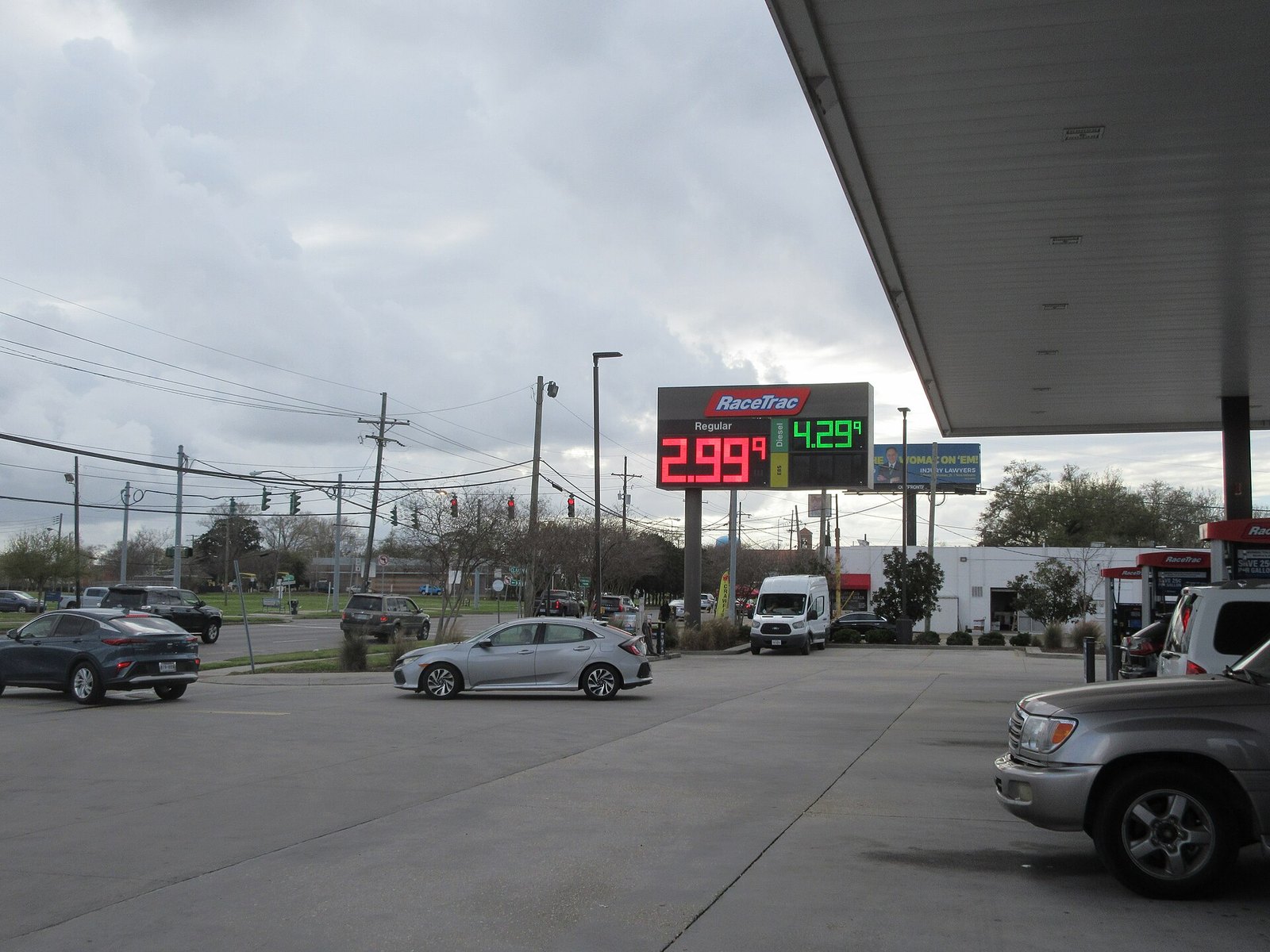
A RaceTrac station in Jefferson Parish, Louisiana, on March 5, 2026, as pump prices started to climb: regular at $2.99, diesel at $4.29. EIA's national average for regular hit $4.31 in October. Photo by Infrogmation via Wikimedia Commons (CC BY-SA 4.0).
Did gas station sales really spike 30.3% in September?
No. The Associated Press story on the report, carried by PBS and outlets nationwide, says: "Sales at gas stations rose 1.5% last month after spiking 30.3% in September." That would be a stunning one-month jump. It never happened.
Census Table 2 shows gas station sales rose 6.0% from August to September. The 30.3% figure sits in the next column over: it is the change from October 2025 to October 2026. The wire service took a twelve-month number and reported it as a one-month number, and that version is now running on PBS and local news sites around the country.
Official record
U.S. Census Bureau, "Advance Monthly Sales for Retail and Food Services, October 2026," Release CB26-181, Nov. 17, 2026. Table 2 (page 5) is shown below. The Gasoline stations row reads 1.5 (October from September), 30.3 (October from October 2025) and 6.0 (September from August).
"Advance estimates of U.S. retail and food services sales for October 2026 ... were $748.2 billion, up 0.2 percent (±0.4 percent)* from the previous month, and up 6.8 percent (±0.5 percent) from October 2025." U.S. Census Bureau, CB26-181, page 1
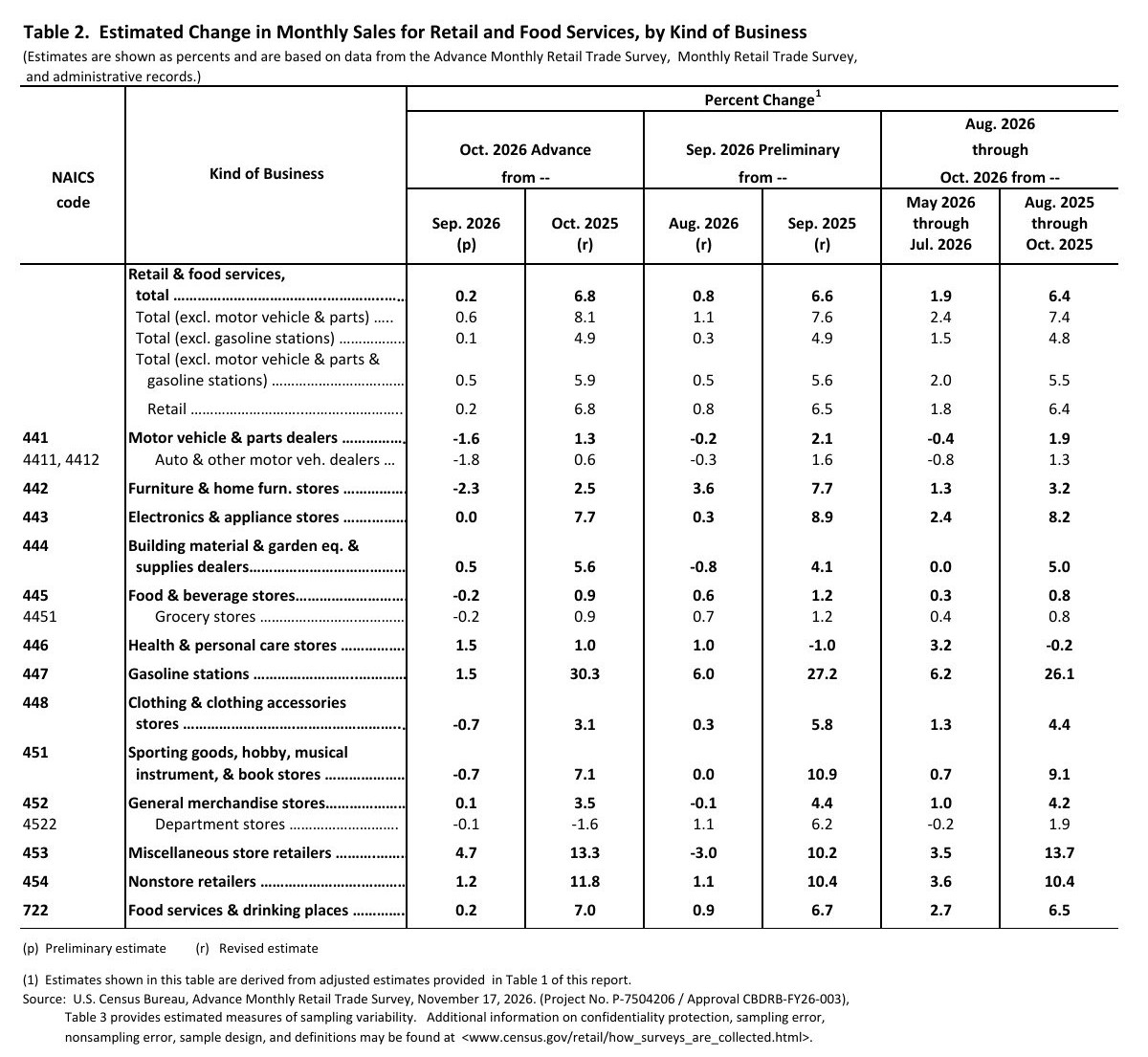
Read or download the full 6-page report (PDF) or view it on the Census Bureau's retail page.
How much of the spending growth was just gas?
About a third. Census Table 1 puts seasonally adjusted sales at $748.2 billion this October against $700.4 billion a year earlier, a gain of $47.8 billion. Gas stations went from $52.6 billion to $68.6 billion, a $16.0 billion jump. Gas stations ring up about 9% of retail sales, yet they produced 33% of the year's growth.
Take the pumps out and the picture cools fast. Sales excluding gas stations were up 4.9% from a year ago and rose just 0.1% from September. Car dealers fell 1.6% on the month, furniture stores dropped 2.3% and clothing stores slipped 0.7%.
Families are also getting less fuel for the money. The Energy Information Administration's monthly price series puts regular gasoline at $4.31 a gallon in October, up 41% from $3.06 a year earlier. Gas station receipts rose only 30%. Gas stations also sell diesel, snacks and coffee, so this is a rough comparison, but it suggests drivers bought something like 7% less fuel than they did a year ago and still paid far more for it.
Are shoppers cutting back at the grocery store too?
The numbers say yes. Grocery store sales were up just 0.9% from last October. BLS cannot publish a twelve-month food price change for October, because it never collected October 2025 prices during last year's government shutdown, but its September release had food-at-home prices up 1.8% over the year. Grocery store sales rose only 1.2% over that same stretch. When the grocery bill climbs slower than grocery prices, carts are getting lighter.
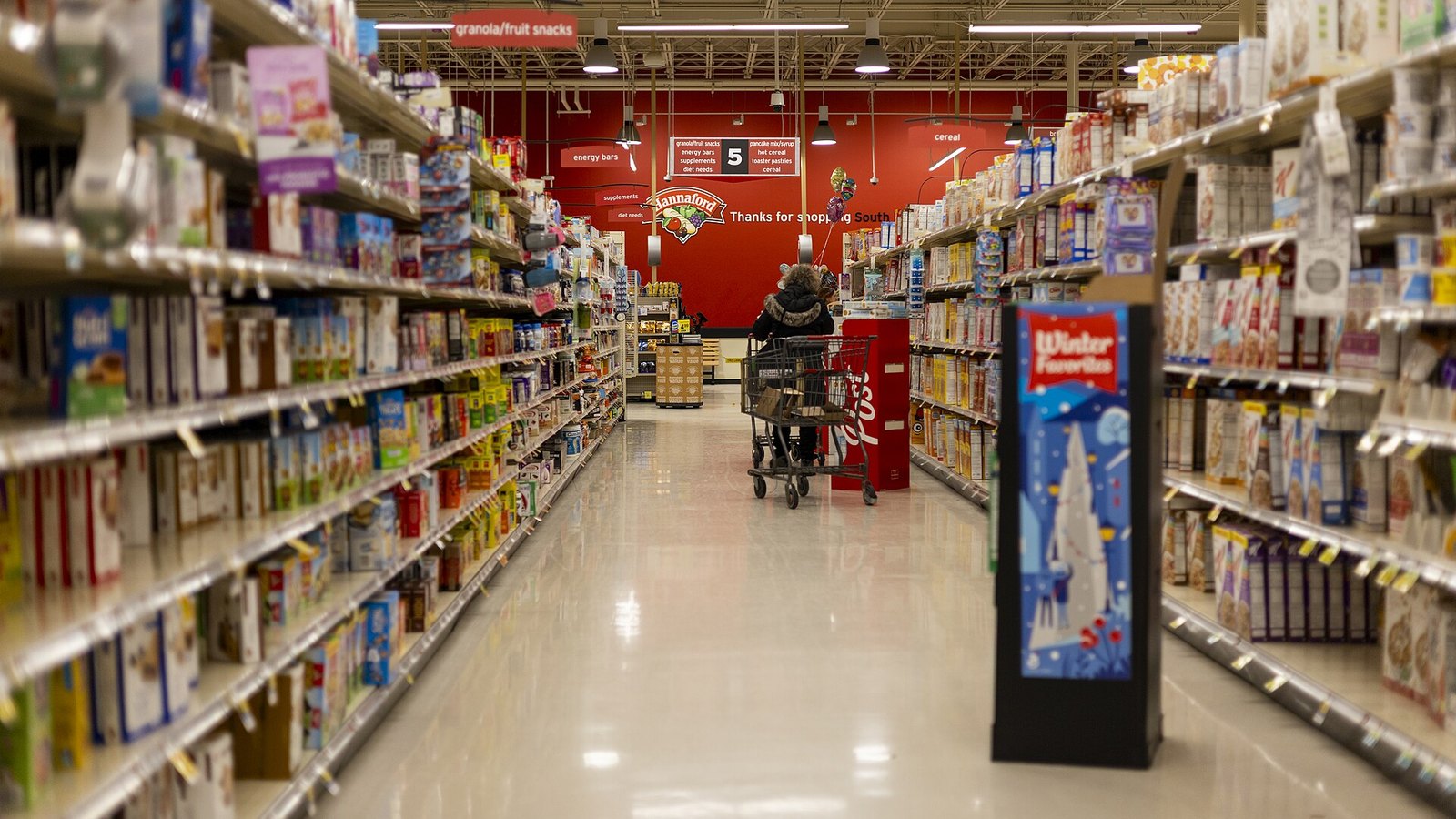
A shopper in the cereal aisle of a Hannaford supermarket in Vermont. Census data show grocery store sales up 0.9% from a year ago in October. Photo by Tessa Bury via Wikimedia Commons (CC BY 4.0).
Is there any relief coming before Christmas?
At the pump, yes, and it is moving quickly. EIA's weekly survey released Nov. 17 has regular gasoline at $3.805, down 19 cents in one week and down from $4.153 on Nov. 2. That is still 74 cents, or about 24%, above a year ago, so the AP's "nearly 20% more" undersells it. Diesel, which moves every truckload of holiday freight, averaged $5.937, more than $2 a gallon above last year.
Heather Long, chief economist at Navy Federal Credit Union, told the AP that "the cautious consumer is back." The tables describe a squeezed one. Americans kept spending on online orders, which rose 1.2% in October, and on restaurants, but a fuel bill 41% higher than last year ate the room for cars, couches and coats. If pump prices keep falling at November's pace, that money goes back into family budgets right as the holiday season opens. That is the number to watch when Census reports November sales on Dec. 16.
Top photo: A Phillips 66 sign at Miller's Travel Centers in Farr West, Utah, showing regular gas at $4.19 and diesel at $5.19, Oct. 19, 2022. Photo by Tony Webster via Wikimedia Commons (CC BY 2.0).















