

Mississippi's Senate race is still uncalled, and Democrat Scott Colom led Republican Sen. Cindy Hyde-Smith by 1,138 votes in late Wednesday counts, with mail and affidavit ballots still to come. Some of the mail ballots will be counted because the Supreme Court ruled 5-4 in June, in a case the Republican National Committee brought and lost, that Mississippi's five-day grace period is legal. Here is what the ruling says, what the numbers are, and what happens next.
How close is the Mississippi race, and whose numbers are right?
It depends on the hour. Overnight, Colom led by 43 votes, according to the Mississippi Free Press and WLBT, which reported Hyde-Smith's campaign saying the margin was "measured in just dozens of votes." By Wednesday evening, ABC News had Colom at 464,926 votes to Hyde-Smith's 463,788, a gap of 1,138, with about 96 percent counted and independent Ty Pinkins at 19,934.
Those are unofficial tallies that moved as counties uploaded results, and I could not pull the Secretary of State's own results page. The AP had not called the race in the reports I read, and I could not confirm anything from Thursday. Treat every figure here as a snapshot.
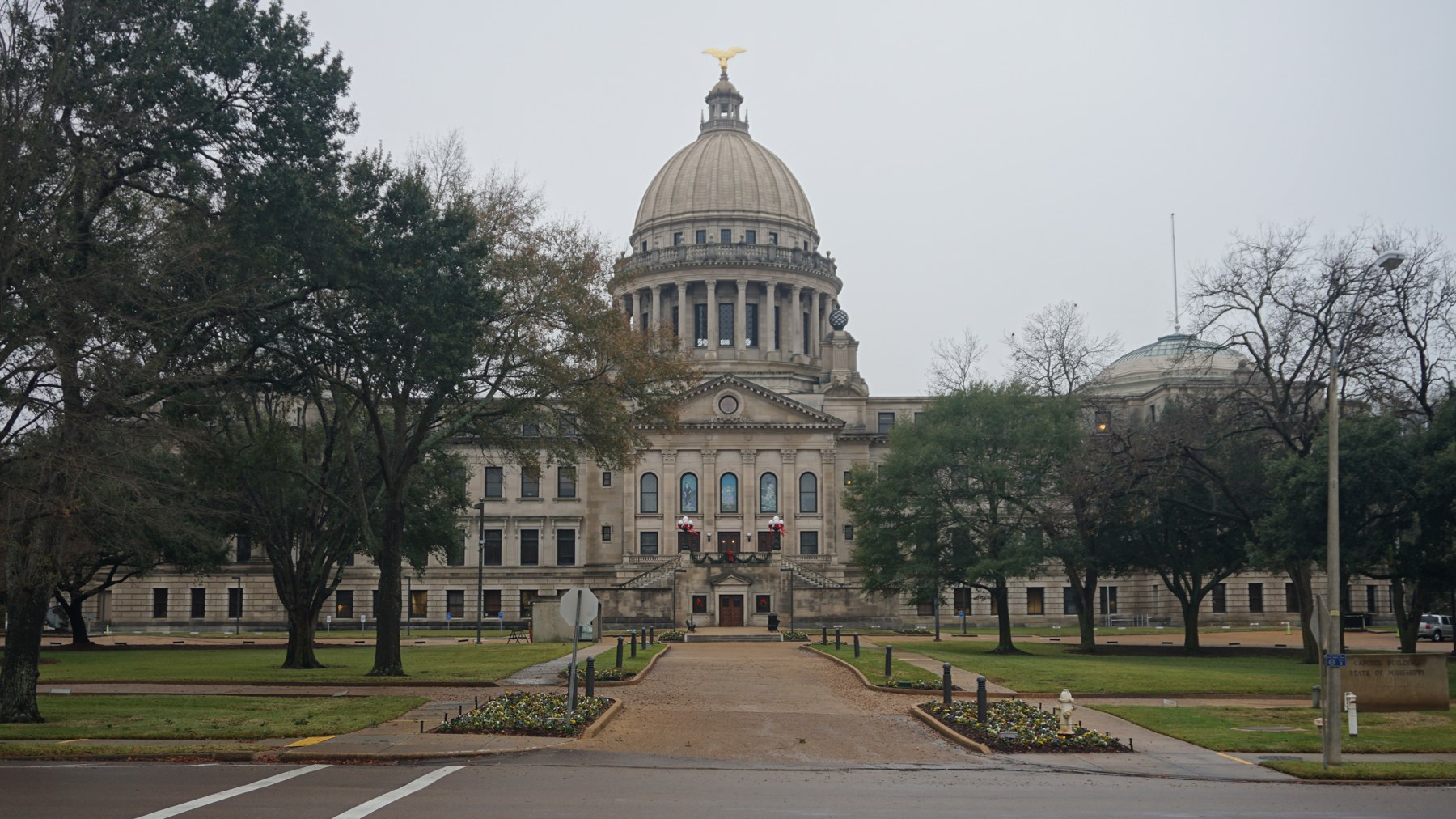
The Mississippi State Capitol in Jackson. Photo by Michael Barera via Wikimedia Commons, CC BY-SA 4.0. Resized.
Which ballots are still out?
ABC reports Secretary of State Michael Watson's Wednesday afternoon update put the outstanding mail ballots at about 3,600, with "an unknown number" of affidavit ballots to process inside the 10-day window. Colom's campaign manager told reporters there could be around 15,000 affidavit ballots, a figure the Secretary of State's office told ABC it could not confirm.
Affidavit ballots are the ones cast when a voter's eligibility or photo ID could not be settled at the polls. Per the Mississippi Secretary of State, a voter without acceptable ID can still have the ballot counted by showing it to the circuit clerk within five business days of the election. Action News 5 sets that date at Nov. 10, and counties have until Nov. 13 to certify.
One piece of arithmetic is mine, not a reporter's. If all 3,600 mail ballots were split between the two major candidates, Hyde-Smith would need about two of every three to erase a 1,138-vote gap. Not every outstanding ballot is a late arrival, and nobody has published how they lean, so that is a yardstick and not a forecast.
What did the Supreme Court actually decide about late ballots?
The Mississippi law is at the center of Watson v. Republican National Committee, No. 24-1260. The RNC, the Mississippi Republican Party and several individuals argued that the federal Election Day statutes bar counting absentee ballots that arrive after Election Day. The Fifth Circuit agreed. The Supreme Court reversed on June 29, 2026.
Justice Barrett wrote the opinion, joined by Chief Justice Roberts and Justices Sotomayor, Kagan and Jackson. Justice Alito dissented, joined by Justices Thomas and Gorsuch, and Justice Kavanaugh joined most of that dissent. The Trump administration's Solicitor General had argued the plaintiffs' side, according to CBS News' March preview of the case.
Official record
Watson, Mississippi Secretary of State v. Republican National Committee et al., No. 24-1260, decided June 29, 2026. Read from the Supreme Court's slip opinion.
"The federal election-day statutes do not prevent Mississippi from counting absentee ballots postmarked by election day but received up to five days thereafter; nothing in the federal election-day statutes requires ballots to be received by election day." — Syllabus, Watson v. RNC (the syllabus is the Reporter of Decisions' summary, not part of the Court's opinion)
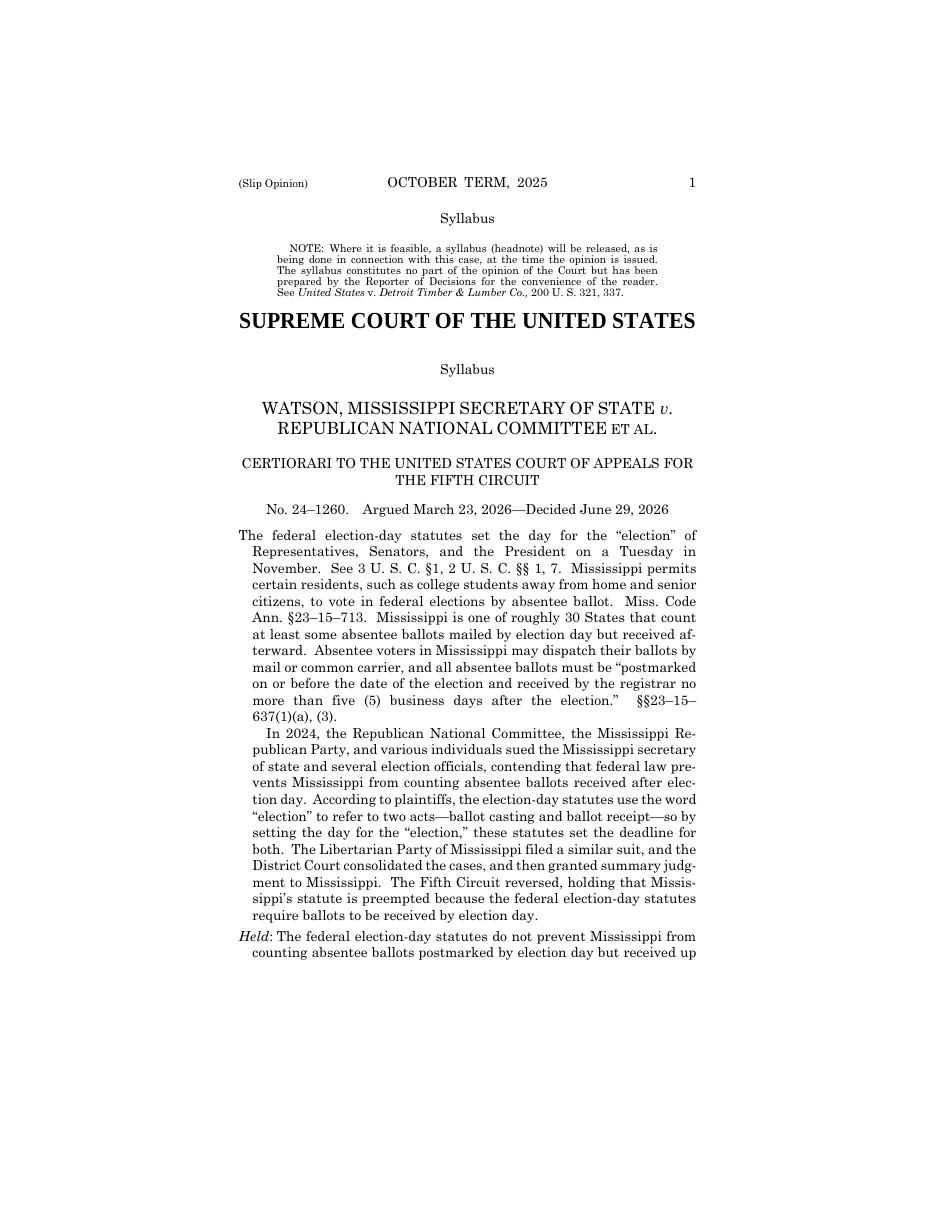
Read or download the full 48-page opinion (PDF) · view it at supremecourt.gov
Why does the ruling matter to Hyde-Smith's seat?
It settles that the late-arriving mail ballots are lawful. The syllabus quotes the statute, which requires absentee ballots to be "postmarked on or before the date of the election and received by the registrar no more than five (5) business days after the election," Miss. Code Ann. 23-15-637. That is the rule behind the Nov. 10 receipt deadline.
The syllabus calls the question before the Court "narrow," and the opinion itself says the issue is not whether an Election Day receipt deadline "is a good or bad idea" but whether it is in the United States Code. Anyone who wants that deadline would have to get it from Congress or a state legislature. Mississippi's current law stands.

The U.S. Supreme Court building, where the Watson decision was issued June 29. Photo by Sunira Moses via Wikimedia Commons, CC BY-SA 3.0. Resized.
Can Hyde-Smith demand a recount?
Not in the usual way. ABC and Action News 5 both report Mississippi has no automatic recount and no process for a candidate to request one. Citing the National Conference of State Legislatures, one report says Mississippi is among three states where a recount happens only by court order. Action News 5 says a judge would have to order it based on findings of fraud or irregularities. There is also no runoff, so a plurality wins.
That means the canvass is the main event. Hyde-Smith's campaign says it is "closely monitoring the remaining count," according to WLBT. IBTimes reports both parties have sent legal observers to county courthouses and that the Mississippi Democratic Party has filed challenges over opening delays and ballot shortages in DeSoto County. I did not see those filings.
What is at stake in a state Trump won big?
Trump carried Mississippi by roughly 20 points in 2024, and Time notes no Democrat has won a Senate seat there since 1982. Time also reports Trump held a rally for Hyde-Smith the week before the vote. Colom told supporters, "I am confident we will ultimately flip this seat." Hyde-Smith said, "I will continue to be your U.S. Senator."
The RNC wanted an Election Day receipt deadline and lost that argument in June. For now the remaining mail and affidavit ballots, counted under rules the Court left alone, decide who holds the seat.
Header photo: Sen. Cindy Hyde-Smith, official U.S. Senate portrait via Wikimedia Commons, public domain. Cropped.















