DHS put out a press release Wednesday saying ICE kept making arrests on Election Day, and that five of the men it picked up have convictions for crimes including attempted murder and child molestation. As DHS describes them, those five records are serious. What the release leaves out is how many people ICE arrested in total that day, so it cannot tell you how typical the five are.
What does the DHS release actually say?
The release is dated Nov. 4, the day after the midterms. It quotes DHS Secretary Markwayne Mullin saying ICE officers are "targeting and arresting criminal illegal aliens to make America safe again" 365 days a year, and that the sentence runs on to include Thanksgiving, Christmas and, in his words, "yes, Election Day." He adds: "The Trump Administration will never apologize for putting the safety of the American people first."
The release then introduces a list with the words "just some of the illegal aliens ICE arrested on Election Day." Five arrests follow, one each in Salt Lake City, Miami, New Orleans, Newark and St. Paul. Nothing else is in it.
Official record
DHS press release, Nov. 4, 2026, on the Election Day ICE arrests.
"Just yesterday, ICE arrested more heinous illegal alien criminals with convictions including attempted murder, aggravated assault with a weapon, and child molestation." (Secretary Mullin, in the release)
What are the five convictions?
Per DHS, four of the five men are from Mexico and one is from Guatemala. The convictions DHS lists are these:
- Salt Lake City: burglary and aggravated assault with a weapon.
- Miami: attempted murder and aggravated battery, in Naples, Florida.
- New Orleans: aggravated assault with a weapon, in Nashville, Tennessee.
- Newark: aggravated assault with a deadly weapon causing bodily injury.
- St. Paul: child molestation.
The release names each man and shows a photo of him. I am leaving the names out here because the convictions are DHS's description, and I did not pull the court records for all five. If those records match, these are exactly the arrests a voter who wants enforcement expects to see.
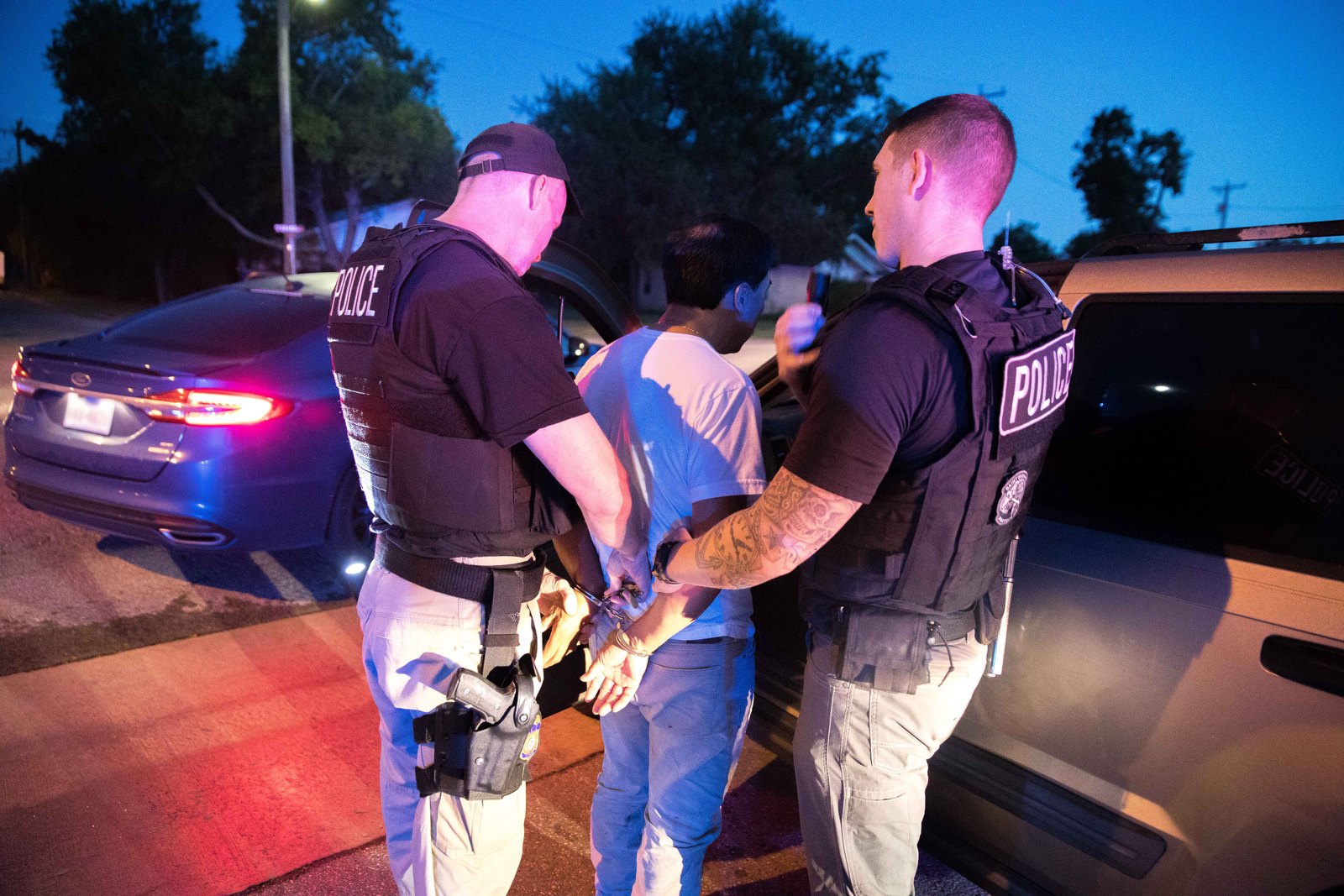
ICE Enforcement and Removal Operations officers arrest a fugitive during Operation Cross Check. File photo, not from Election Day. Photo: U.S. Immigration and Customs Enforcement via Wikimedia Commons (public domain). Resized.
What does the release leave out?
It gives no total for Election Day arrests. It does not say how many of that day's arrests involved a conviction, when each conviction happened, or how each man was found. DHS calls the five "just some," which makes them a selection, and press offices pick their strongest examples. That is normal, and it is also the reason five names cannot stand in for a day's work.
For scale, CNN reported on Sept. 30 that ICE took "around 51,000 people into custody" in August, a monthly high under this administration. CNN did not attribute that number to a named dataset. Spread over 31 days it is about 1,600 a day, so five names is a very small slice of any one day, if Election Day ran near that pace. The release does not say whether it did.
How many ICE detainees have convictions?
Two public counts exist, and they measure different things. ABC News reported on July 21, from ICE's own postings, that 65,765 people were in ICE detention and 60 percent had a criminal record. The tracking group TRAC counted 46,436 of 65,765 detainees, or 70.6 percent, with no criminal conviction as of July 11.
A "record" can include pending charges. A conviction cannot. Subtracting TRAC's figure leaves roughly 29 percent with a conviction, though that subtraction is my arithmetic and TRAC does not print it. Those are July numbers, not Election Day numbers, and neither count covers everyone arrested.
Did Mullin say anything beyond the release?
The Rio Times reports that on Wednesday Mullin wrote "Deportations will continue," citing his post on X. The Hill ran a story under the headline "Markwayne Mullin defends ICE operations following election results." I could not open The Hill's page, only see its headline, so that quote rests on the Rio Times alone. The release itself does not contain those words.
What would settle it?
DHS has the number that would make its case better than five photos can: the total arrested on Election Day, and how many of those had convictions. If the share is high, publishing it answers critics who point to the July detention counts. If the department keeps releasing only the worst five, the argument stays on a handful of men while critics keep pointing to the July detention counts.
Header photo: an ICE Enforcement and Removal Operations officer scans fingerprints of a handcuffed man during a fugitive operation in Collier and Lee Counties, Florida. File photo, not from Election Day. Photo: U.S. Immigration and Customs Enforcement via Wikimedia Commons (public domain). Cropped to 3:2 and resized.