Rep. Thomas Massie stood on the House floor for more than an hour on Sept. 15 and read all 34 pages of a resolution to impeach Defense Secretary Pete Hegseth. Two days later, House Republican leadership sent the entire chamber home early, a move that quietly guarantees no vote happens until after the midterms.
What Massie Actually Put in the Congressional Record
Massie, R-Ky., filed eight articles of impeachment against Hegseth, whom the administration now calls Secretary of War. Three articles accuse Hegseth of running the Iran war in violation of the War Powers Resolution of 1973. A fourth ties dismantled civilian-protection safeguards at the Pentagon to a strike that hit a school in Iran's Hormozgan province. A fifth calls the Caribbean drug-boat strikes "extrajudicial killings." A sixth accuses Hegseth of retaliating against Sen. Mark Kelly, D-Ariz., for telling troops they can refuse illegal orders. The last two cover the operation that captured former Venezuelan leader Nicolas Maduro and the ongoing campaign in Yemen. Fox News and Townhall both confirm Massie read the full document aloud rather than simply filing it.
The resolution itself is a public document, filed with the House and referred to the Judiciary Committee. Reading it directly, rather than relying on summaries, turns up language none of the wire coverage quoted at length.

Rep. Thomas Massie, R-Ky., whose privileged resolution forced House leadership's hand. (Wikimedia Commons, GFDL)
Massie's Own Document Uses Trump's Words Against the Administration
Article VII, titled "Kidnapping of a Sovereign Foreign Leader," does something the secondary coverage skipped past: it quotes President Trump directly. According to the resolution, immediately after the operation that captured Maduro, Trump said of Venezuela, "We're going to run the country until such time as we can do a safe, proper, and judicious transition," and added that "we're going to have our very large United States oil companies, the biggest anywhere in the world, go in and start making money."
Massie's resolution uses that quote to argue the operation was never really about narcotics enforcement, the stated legal justification, but about Venezuelan oil. Whether that argument holds up is a separate question. What matters here is that a sitting Republican built part of his case against a Trump cabinet official by citing Trump's own remarks back at him, a detail that got buried under the more attention-grabbing word "kidnapping" in most headlines.
How Republican Leadership Made the Vote Vanish
Massie's move worked because impeachment resolutions offered as questions of privilege carry force under House rules. Once a member calls one up, the House has to act within two legislative days, either voting on the resolution itself or voting to dispose of it some other way, such as tabling or referring it to committee. That rule is what let Massie force the issue over leadership's objections in the first place.
It's also the rule that made an early recess so useful. House Speaker Mike Johnson announced Republicans would leave Washington a day earlier than planned, cutting short an already light September work period. CNBC reported the chamber is "not due back in Washington until after the Nov. 3 election," with lawmakers heading home to campaign for the midterms. No legislative days means no clock running against the two-day requirement. The resolution doesn't disappear, but the House simply isn't in session to be forced to act on it.

Speaker Mike Johnson, whose decision to send the House home early stopped the privileged clock on Massie's resolution. (Wikimedia Commons, public domain)
Johnson Said the Quiet Part on the Record
Johnson wasn't shy about what would eventually happen to the resolution. He told reporters it "will immediately be tabled, of course. But we probably won't do that today. We will do it when we come back," according to reporting picked up by CNN. He also dismissed the whole effort outright, calling it "a publicity stunt by someone who wants attention" and arguing the House "should not be playing games with national security" in the middle of active conflicts abroad.
That's a more direct answer than most of Congress gives on a hard vote. Johnson isn't claiming the articles have merit that needs studying. He's saying the outcome is already decided and the only question is when the House gets around to formalizing it, on the other side of the election.
Official record
H. Res. impeaching Peter Brian Hegseth, Secretary of Defense, for high crimes and misdemeanors, introduced by Mr. Massie and referred to the House Committee on the Judiciary, 119th Congress, 2d Session.
"Resolved, That Peter Brian Hegseth, Secretary of Defense, also referred to as Secretary of War by the Administration, is impeached for high crimes and misdemeanors and that the following articles of impeachment be exhibited to the United States Senate." — from the resolution's text
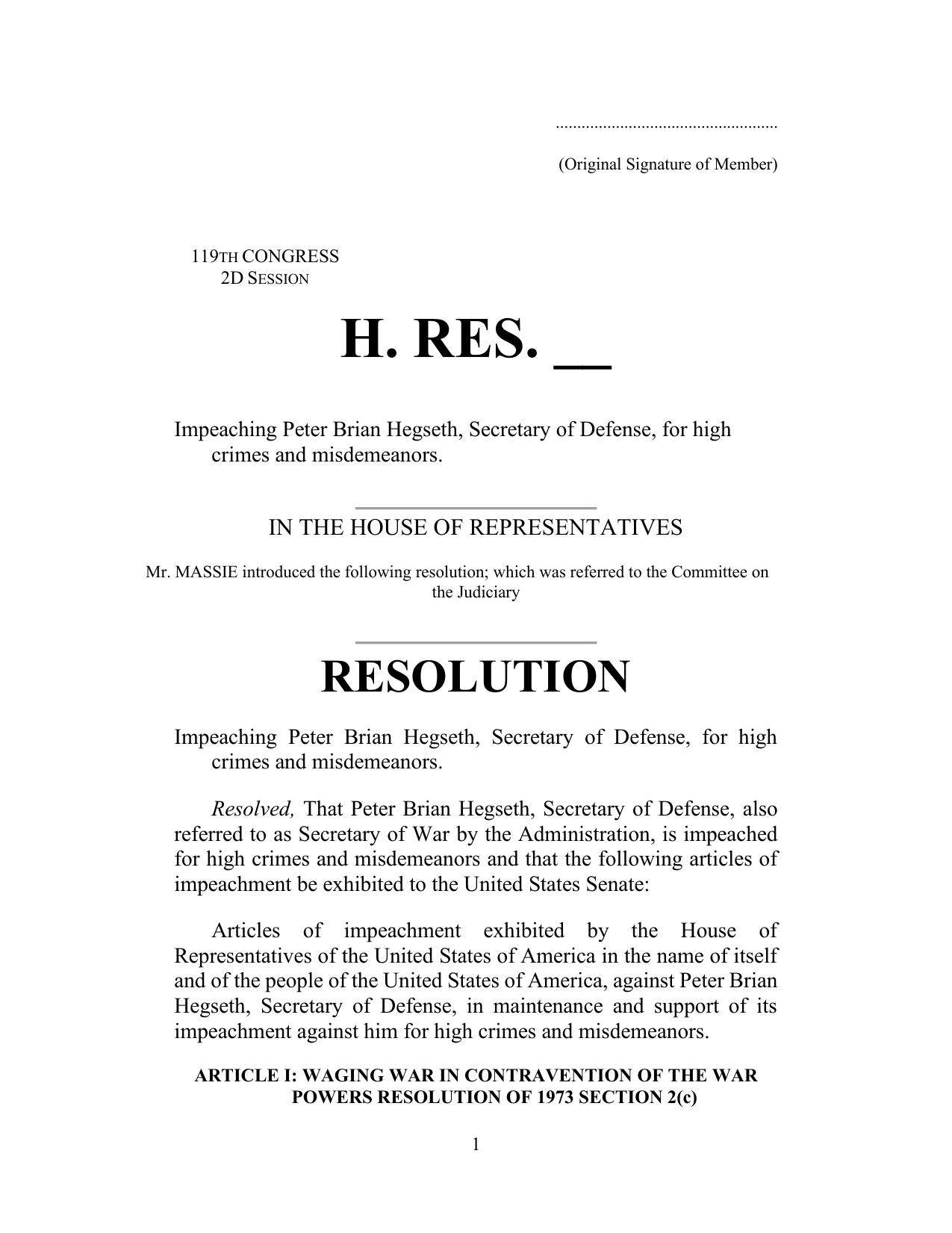
Read or download the full 34-page resolution (PDF), filed by Rep. Massie's own office
The Pentagon and the Justice Department Aren't Backing Down
The administration didn't treat this as something worth quiet legal review. Pentagon press secretary Kingsley Wilson told reporters Hegseth "has been a transformative leader for the Department of War," pointing to recruitment numbers and saying "the entire Department is unified behind the Secretary's vision," according to Just the News. Attorney General Todd Blanche went further at a Rose Garden press event, saying Hegseth "is doing a phenomenal job" and that the Justice Department "plays a role" in ensuring military actions comply with the law.
On the specific legal question at the heart of Articles I through III, the administration's actual defense is narrower than "trust us." Per Just the News, the Trump administration's position is that a "nominal ceasefire" in the Iran conflict reset the War Powers Resolution's 60-day withdrawal clock, the same clock Massie's resolution says had already expired. That's a real legal dispute over how a ceasefire interacts with a statutory deadline, not just a talking point, and it's the argument most coverage skipped in favor of the punchier Pentagon quotes.
Why Massie Can Afford to Lose This One
There's a reason Massie could gamble on a resolution leadership was always going to kill: he has nothing left to lose in the House. Trump-backed Navy SEAL veteran Ed Gallrein beat Massie in Kentucky's 4th District Republican primary back in May, in what became the most expensive House primary on record, with more than $32 million spent. Massie isn't returning to Congress in January. Reading eight articles of impeachment into the record costs him nothing politically, since the voters who might have punished him already did.
That context matters for how much weight to put on the theatrics. A member with a future in the conference thinks twice about torching relationships with leadership and the Pentagon over a doomed vote. A lame duck with an ax to grind doesn't have that constraint, which is a big part of why this played out as a one-man floor speech rather than a real legislative threat.
One Scheduling Decision, Two Massie Fights Stalled
The early recess didn't just shelve the impeachment resolution. Massie has also been working to collect signatures on a discharge petition to force a floor vote on releasing the remaining Epstein files, a separate fight that needs 218 signatures on the House floor to succeed. Writing on X after the recess was announced, Massie said the early departure "will also make it harder for us to reach 218 signatures on the Epstein Discharge Petition before the election," adding that the petition stood at "190+ signatures last night," a count reported by CNBC.
Whether or not leadership scheduled the recess specifically to stop the Hegseth vote, as Johnson's office insists it didn't, the practical effect is that one calendar decision slowed down two separate pressure campaigns Massie was running against his own party at the same time. For a Republican conference trying to hold a fragile majority through a midterm year, that's a tidy outcome regardless of the stated reason behind it.
Nothing here changes the underlying legal fight over Iran, Venezuela, or the War Powers Resolution, and Congress will eventually have to take up the resolution when it returns after Nov. 3. But for now, a Republican member spent 67 minutes putting a Trump cabinet secretary's conduct into the official record, and the party's answer was to leave town before anyone had to vote on it.